


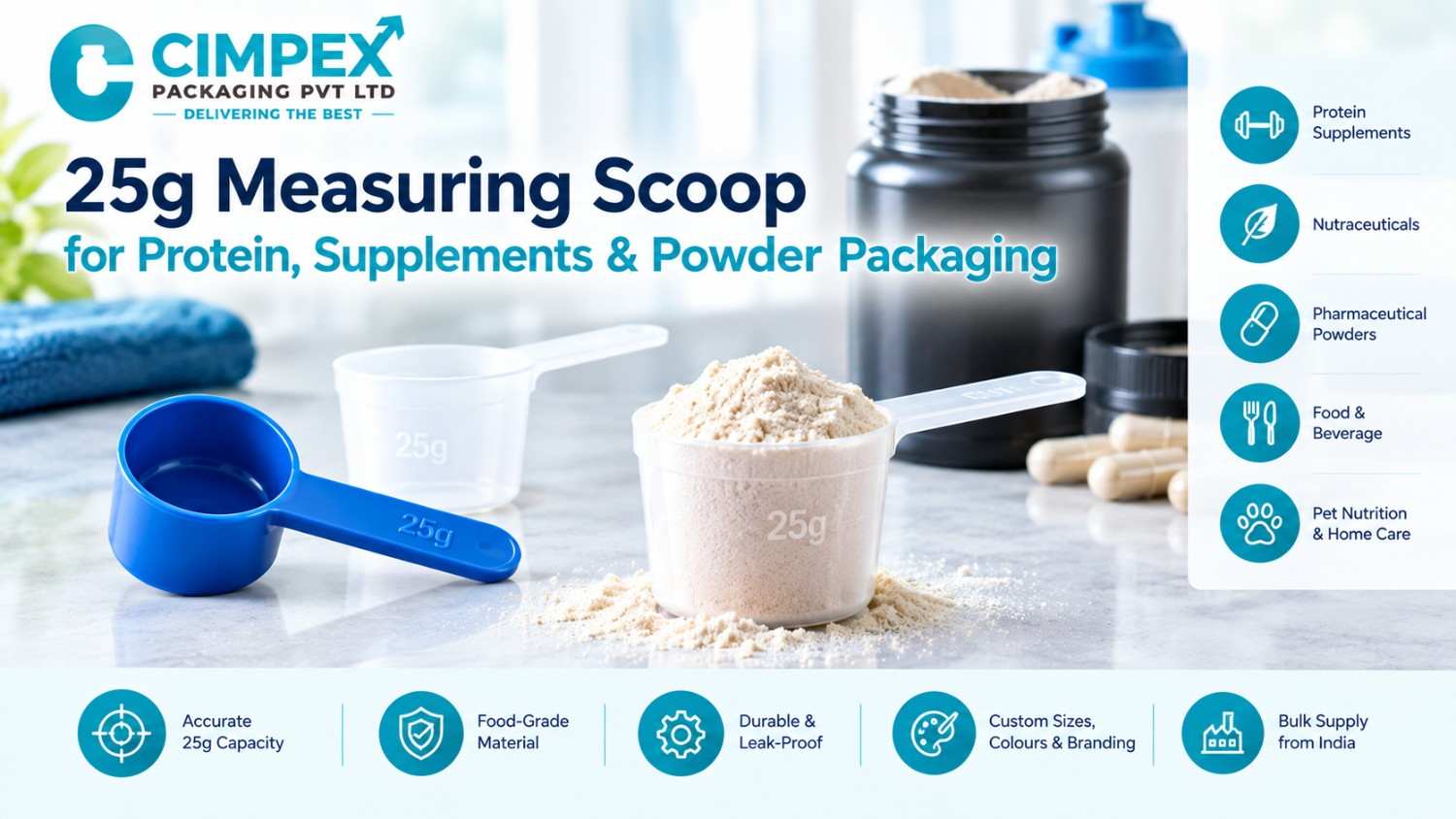
What Is a 25g Measuring Scoop and Why Does It Matter?
A 25g measuring scoop is designed so that one level fill equals the recommended serving of a powder. Customers rarely weigh their protein or supplement at home; they rely on the scoop. If it under-delivers or over-delivers, the label claim, the nutrition panel and the customer’s experience all drift away from what the brand intended. For this reason, the scoop is best treated as a functional part of the product rather than a free extra. It must stay dimensionally consistent from the first unit to the ten-thousandth, feel comfortable in the hand, clean easily and remain safe for contact with food or supplements. It is also the one packaging component the customer touches every day, so it quietly shapes how the brand is judged.Understanding 25 Gram Scoop Size
The most common confusion about 25 gram scoop size is that “25g” describes weight, while the scoop itself has a fixed volume. How much space 25 grams occupies depends on the bulk density of the powder, which differs between whey concentrate, isolate, mass gainer, creatine and plant-based blends.Weight Versus Volume
Volume equals weight divided by bulk density. As a purely illustrative example, a powder with a bulk density of 0.5 g/ml needs about 50 ml to hold 25 g, while a lighter powder at 0.4 g/ml needs roughly 62.5 ml. One scoop cannot be exact for both, so the mould should be sized around your actual powder instead of assuming any generic 25g measuring scoop will fit.How to Validate a 25g Measuring Scoop Sample Before Bulk Production
Fill the sample with your real powder, level it with a straight edge and weigh the contents. Repeat the test at least ten times, ideally with different people, to see natural variation. Then test more than one powder batch, because bulk density can shift between production lots. Finally, check that the scoop sits properly inside the tub and does not trap powder against the wall. Once a sample is approved, moulding tolerance decides whether the same result repeats across the full order.Materials and Manufacturing Standards
A scoop touches food-grade products, so the material matters as much as the shape. Cimpex Packaging lists its scoops as food-grade polypropylene (PP) or HDPE, made by injection moulding with smooth, burr-free edges. Polypropylene is valued for rigidity and low weight, while HDPE feels slightly softer and more flexible. Either material can suit a 25g measuring scoop, depending on the powder and the brand’s preference. Manufacturing quality is just as important. High-cavity moulds support uniform wall thickness and repeatable capacity, whereas thin or uneven walls can flex against dense powder and change the fill. Stated checks such as weight checks, visual inspection and dimensional verification are a useful sign that the process is controlled.Design Details That Affect Everyday Use
Small design choices influence how a 25g measuring scoop performs in a real kitchen or gym bag. A long handle keeps fingers away from the powder and reaches the bottom of a deep tub. A rounded bowl base levels cleanly against the edge of the tub, whereas a sharp internal corner can trap powder and skew the dose. Colour also helps: brands often match the scoop to the tub or use a contrasting shade so it is easy to find in a full container. Embossing the gram capacity on the handle is a low-cost way to reassure customers about serving size. Cimpex Packaging lists custom capacity, handle length, colour and branding options for its scoops.Where a 25g Measuring Scoop Is Used
This size suits any dry powder sold by serving. Common applications include:- Sports nutrition: whey protein, mass gainers, creatine and pre-workout powders, where serving accuracy is part of the brand promise.
- Nutraceuticals: collagen, greens, fibre and herbal powders that pair naturally with HDPE powder jars and matching closures.
- Pharmaceutical powders: ORS and antacid powders, where a food-safe material and a consistent dose both matter.
- Food and beverage: instant drink mixes, milk powder and premixes packed in tubs.
- Pet nutrition and home care: supplement powders for animals and detergent powders that need a defined dose.
Choosing a 25g Measuring Scoop Supplier in India
Sourcing a scoop looks simple, yet small errors surface later as complaints about under-filled servings. A structured evaluation protects the brand.Top 25g Measuring Scoop Suppliers in India: What to Evaluate
When shortlisting top 25g measuring scoop suppliers in India, compare more than the quoted rate:- Whether the supplier owns its moulds and moulding lines or only trades the product.
- Whether it will make a sample around your powder’s density, not a stock size.
- Which resin grade is used, and whether it is suitable for food or pharma contact.
- How it tests batches, and whether it shares inspection records on request.
- Whether the stated lead time covers sampling, tooling and dispatch.
25g Measuring Scoop Manufacturer in Baddi, Himachal Pradesh
Baddi in Solan district is an established industrial hub for pharmaceutical, nutraceutical and FMCG production, so buyers there and nearby benefit from short transit for packaging. Cimpex Packaging operates from Village Thana, Baddi, and positions itself as a 25g measuring scoop manufacturer in Baddi that dispatches across India. Proximity to your filling site can shorten sampling cycles and make repeat orders simpler to plan. For brands filling in the hill state, a dependable 25g measuring scoop supplier in Himachal Pradesh also reduces freight time when scoops and tubs need to arrive together.Scoop Factory in India: Process and Quality Checks
A genuine scoop factory in India should be able to explain its process clearly. Cimpex Packaging’s manufacturing process page describes a workflow that begins with raw material inspection, moves through injection moulding and in-house testing, and ends with batch-coded packing and despatch. Ask any factory how it verifies scoop weight and dimensions, because those checks protect dosing accuracy at scale.Minimum Order Quantity, Lead Time and Pricing
Commercial terms decide whether a supplier fits your launch plan, so clarify them early.Minimum Order Quantity and Lead Time
The minimum order quantity for a 25g measuring scoop depends on whether the design is standard or custom. Cimpex Packaging’s product page lists a starting MOQ of 10,000 units for standard 25g and 30g sizes and 25,000 units for custom sizes or colours. It also lists 7 to 15 working days for stock sizes and roughly 3 to 5 weeks for custom tooling. Confirm current figures at the quotation stage.Dealers Versus Direct Manufacturers
Many buyers first meet scoop dealers in India, which can suit small trial orders. Direct manufacturers usually suit larger, repeat or customised requirements, and the difference shows up most clearly in support and traceability:| Factor | Dealer | Direct Manufacturer |
| Customisation | Usually limited to stock sizes | Custom capacity, colour and branding possible |
| Technical support | Depends on the dealer’s knowledge | Direct access to process and tooling teams |
| Quality traceability | Often indirect | Batch-level records can be requested |
| Best suited for | Small or trial quantities | Bulk, repeat and branded programmes |
Price per Piece: What Drives the Cost
Buyers asking for a 25g measuring scoop price per piece often want a single figure, but the rate moves with several variables:- Resin grade and weight of plastic used per scoop.
- Order quantity, since higher volumes spread tooling and setup cost.
- Custom colour, embossing or logo requirements.
- One-time mould development for non-standard sizes.
- Packing format and delivery location.
Advantages and Limitations of Plastic Measuring Scoops
Plastic scoops are light, inexpensive at volume, unbreakable in normal use and easy to mould in brand colours. Their limitation is that accuracy depends on the powder: a scoop calibrated for one formulation may deliver a different weight with another. Static cling and moisture can also affect how powder levels, so re-test whenever the formula changes.Common Mistakes to Avoid
The most frequent mistake is ordering a stock 25g measuring scoop without weighing real powder. Others include approving a sample from one batch only, ignoring heaped versus levelled filling instructions on the label, and comparing quotes without confirming resin grade. A short sampling round is far cheaper than a returned batch.Conclusion
A dependable scoop protects serving accuracy, brand credibility and customer trust. The essentials are straightforward: understand that a 25g measuring scoop is a weight target achieved through volume, validate samples with your own powder, insist on food-grade resin and controlled moulding, and compare suppliers on process and terms rather than price alone. For brands filling in northern India, a nearby manufacturer can also simplify sampling, freight and follow-up. If you are planning a supplement or protein launch, confirm your powder’s density, serving size and expected volume, then request samples before finalising the mould. Explore the Cimpex Packaging product range or contact the team at sales@cimpexpackaging.com for guidance based on your product and order quantity.Frequently Asked Questions
A 25 gram scoop size is defined by weight, not by a universal volume. The volume depends on the bulk density of your powder, so the same scoop can hold different weights of different formulations. Always weigh a levelled sample of your own product before approving the mould.
Look for suppliers that own their moulding lines, use food-grade resin, share inspection practices and are willing to sample against your powder. Ask about tolerance checks and batch records rather than relying on price alone.
Cimpex Packaging manufactures scoops at its Baddi facility and supplies buyers across Himachal Pradesh and the rest of India. Standard sizes are 25g and 30g, with customisation available on request.
Cimpex Packaging’s product page lists 10,000 units for standard sizes and 25,000 units for custom variants. MOQs differ by supplier and design, so confirm the current figure when requesting a quote.
Every product goes through a strict multi-stage quality assurance process, including leak testing, strength evaluation, and dimensional accuracy checks. We use high-grade raw materials and advanced manufacturing techniques to ensure each product meets industry standards and performs reliably in real-world conditions.
For trial quantities, yes. Dealers stock common sizes and can ship quickly. For custom capacity, colour or branding, and for repeat bulk supply, working directly with a manufacturer is usually more efficient.
There is no single price, because it depends on resin, quantity, colour, customisation and delivery location. Share your specification and expected volume with the manufacturer to receive an accurate written quotation.
Yes, when they are made from food-grade polypropylene or HDPE and produced under hygienic conditions. Ask the supplier to confirm the resin grade and material compliance before approving production.