


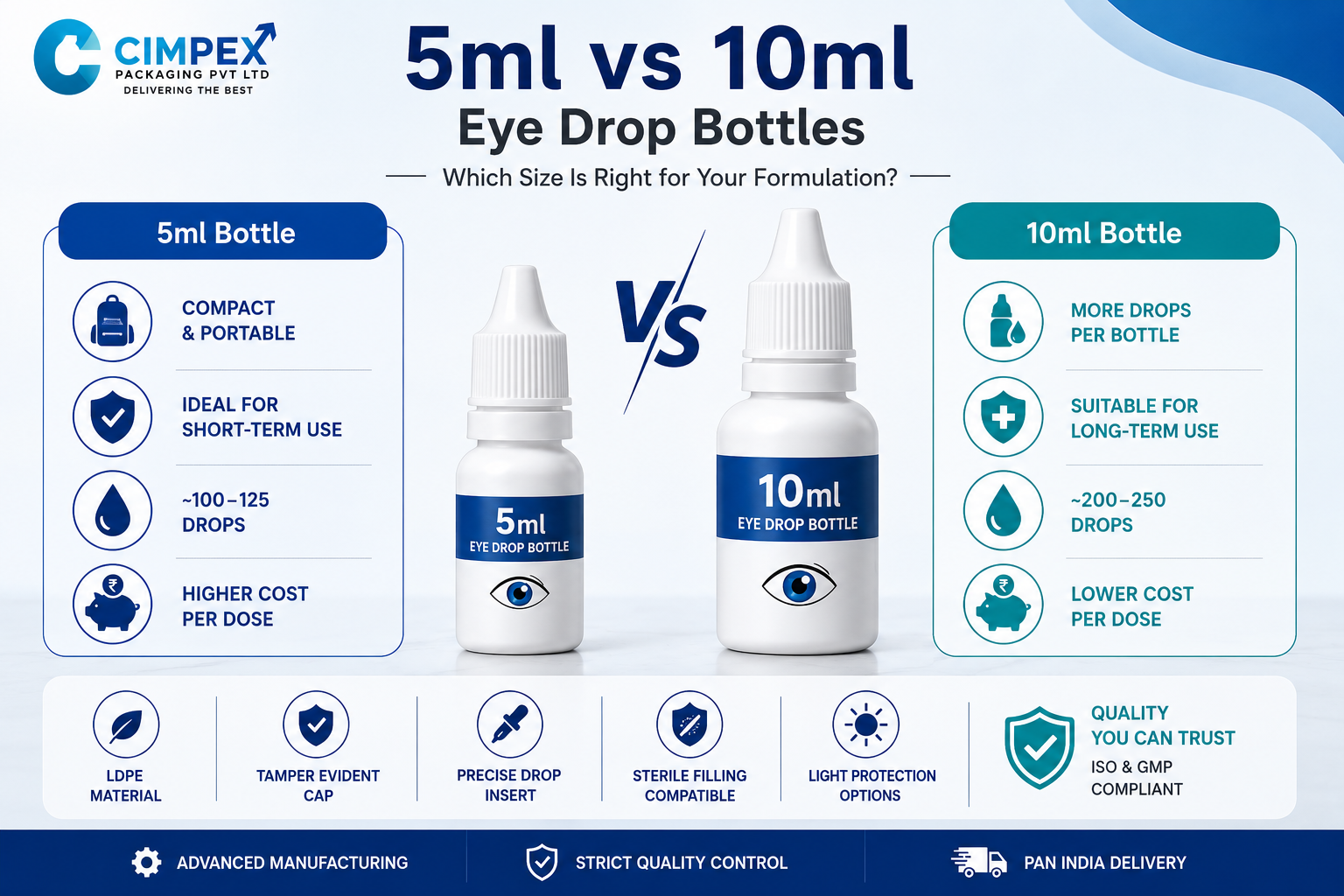
Eye drops look simple until you specify the pack. Fill volume, dose count, preservative system and patient routine all meet inside one small LDPE bottle, and that container doubles as the dosing device.
The choice between 5ml vs 10ml eye drop bottles shapes dosage accuracy, in-use shelf life, patient convenience, freight cost and cost per dose. Get it right and the product moves smoothly from filling line to pharmacy shelf.
Get it wrong and you face wastage, returns or a pack patients abandon mid-therapy. Ophthalmic packaging punishes guesswork, because every millilitre carries a clinical and a commercial consequence, and the in-use period is fixed long before the patient opens the carton.
This guide compares 5ml vs 10ml eye drop bottles from a formulation and manufacturing standpoint rather than a marketing one. You will find dose counts, cost logic, regulatory considerations and a detailed comparison table. To review current specifications first, see our eye drop bottles range.
Teams that settle 5ml vs 10ml eye drop bottles early avoid expensive mould changes, artwork revisions and stability reworks later in the project.
Why Eye Drop Bottle Size Matters
Capacity is not a cosmetic decision. Each of these five factors changes when you move between 5ml vs 10ml eye drop bottles, and each one is measurable before tooling starts.
- Patient compliance: a pack that runs out mid-course breaks therapy, while an oversized one invites use beyond expiry
- Dosage accuracy: nozzle bore, wall stiffness and squeeze force set drop volume, so every capacity needs a validated insert
- Shelf life after opening: preserved drops are commonly discarded 28 days after first use, capping the volume a patient can consume
- Portability: smaller ophthalmic containers travel in a pocket, so ophthalmic bottle sizes track the patient, not the product
- Manufacturing efficiency: cavitation, cycle time, filling speed and cartonisation shift with capacity, and so does cost per dose
An experienced eye drop bottle manufacturer weighs all five together rather than optimising any single one. That balance is the real argument behind 5ml vs 10ml eye drop bottles.
Understanding 5ml Eye Drop Bottles
Features
The smaller option in any 5ml vs 10ml eye drop bottles comparison carries these characteristics.
- Compact LDPE body, 13 mm to 15 mm neck with integral dropper insert
- Tamper evident cap as standard, with child-resistant options available
- Supplied for aseptic filling or terminal sterilisation as a sterile eye drop bottle
- Natural, white, amber or opaque for light-sensitive actives
Advantages
The 5ml eye drop bottle is travel-friendly and easy for elderly patients to grip. Because the fill is consumed faster, less product remains when the in-use period expires, which is the strongest clinical argument in the 5ml vs 10ml eye drop bottles debate.
That shorter in-use window also lowers contamination risk, which matters for preservative-free and specialty formulations where microbial control drives the design of the 5ml eye drop bottle.
Best Applications
Choosing between 5ml vs 10ml eye drop bottles is simplest in these cases.
- Short antibiotic and anti-inflammatory courses of one to three weeks, where a 5ml eye drop bottle finishes with the prescription
- Post-operative cataract and LASIK regimens
- Physician sample packs, where a 5ml eye drop bottle carries the trial quantity
- Premium eye care packaging, where a smaller pack supports a higher price
Ideal Formulations
A 5ml eye drop bottle suits preservative-free drops, high-value actives and specialty ophthalmic medications, where minimising residual volume matters more than cost per dose.
When comparing 5ml vs 10ml eye drop bottles for such products, the smaller pack usually wins on safety even though it costs more per millilitre delivered.
Understanding 10ml Eye Drop Bottles
Features
The larger option in the 5ml vs 10ml eye drop bottles comparison brings a different set of strengths.
- Taller LDPE body with the same standard neck, so caps and inserts often carry over
- Roughly twice the doses of a 5ml eye drop bottle from one closure and label
- Compatible with preserved multi-dose eye drop systems
- Stable base geometry for bedside and trolley storage
Advantages
The 10ml eye drop bottle lowers cost per dose because cap, label, carton and filling time are spread across more drops. For chronic therapy that saving compounds with every refill, which is why tender buyers rarely hesitate.
Fewer dispensing events also mean fewer pharmacy visits, which supports adherence in long-term multi-dose eye drop therapy.
Best Applications
- Glaucoma, dry eye and allergic conjunctivitis maintenance therapy, where capacity is decided by treatment length alone
- Hospital, clinic and institutional supply
- Government tenders and public health multi-dose eye drop programmes
- Retail pharmacy lines where cost per dose drives the purchase
Ideal Formulations
Preserved multi-dose eye drop formulations with a validated antimicrobial system suit the 10ml eye drop bottle, since the fill must stay safe across a longer in-use period.
Weighing 5ml vs 10ml eye drop bottles here is straightforward. If therapy runs beyond a month, the larger multi-dose eye drop pack is the rational choice.
5ml vs 10ml Eye Drop Bottles Comparison
The table sets out 5ml vs 10ml eye drop bottles across the nine parameters formulation and procurement teams argue over most.
| Parameter | 5ml Eye Drop Bottle | 10ml Eye Drop Bottle |
| Capacity | 5ml fill, compact body | 10ml fill, taller body |
| Number of doses | About 100 to 125 drops | About 200 to 250 drops |
| Portability | Pocket, purse, travel kit | Bedside, clinic, trolley |
| In-use shelf life | Usually finished within the in-use period | Risk of unused residue at discard |
| Manufacturing cost | Lower resin cost per bottle | Lower cost per dose delivered |
| Storage and freight | More units per carton | Fewer units, less packaging per dose |
| Target users | Travellers, short-course patients | Chronic patients, hospitals |
| Suitable formulations | Preservative-free, specialty drops | Preserved multi-dose eye drop formulas |
| Best applications | Antibiotics, post-op, sample packs | Glaucoma, dry eye, long-term therapy |
Read it beside your dosing schedule. Comparing 5ml vs 10ml eye drop bottles without prescription frequency to hand produces a pack that looks efficient on paper and fails in the pharmacy. Most disputes dissolve once the dose maths appears.
How to Choose the Right Ophthalmic Bottle Size
Work through these nine checkpoints before locking the mould. They resolve most 5ml vs 10ml eye drop bottles debates within a single meeting.
- Treatment duration: match total drops required to fill volume, plus a margin for wasted drops
- Prescription frequency: four-times-daily dosing in both eyes empties a 5ml eye drop bottle quickly
- Product viscosity: gels need wider bores and firmer squeeze, changing drop weight across ophthalmic bottle sizes
- Preservative system: preservative-free products push you toward smaller packs or unit-dose formats, which usually settles 5ml vs 10ml eye drop bottles immediately
- Regulatory requirements: in-use stability data must support the registered pack, and CDSCO and pharmacopoeial expectations cover container and closure
- Patient convenience: grip and cap torque influence the choice as much as volume does
- Distribution channels: hospital tenders favour larger fills, while retail and travel retail favour smaller ophthalmic bottle sizes
- Export packaging: shipping density, carton count and labelling rules can decide 5ml vs 10ml eye drop bottles on cost alone
- Branding: label area, shelf presence and perceived value differ between these ophthalmic bottle sizes
Our manufacturing process page shows how 5ml vs 10ml eye drop bottles translate into tooling and validation.
Customization Options for Eye Drop Bottles
Both formats support the same customisation set, so capacity rarely limits branding. The options below apply across ophthalmic bottle sizes.
- Bottle colours: natural, white, amber and opaque for light-sensitive actives
- LDPE grades selected for clarity, squeeze feel and drop control
- Tamper evident cap: break-ring closures for pharmaceutical compliance
- Child-resistant closures where accidental ingestion is a risk
- Sterile packaging: double-bagged bulk supply for cleanroom and multi-dose eye drop filling
- Printed labels and screen printing on either capacity, without tooling changes
- Custom moulds: bespoke shapes, shoulders and nozzle profiles
- OEM and private labelling for pharmaceutical brands
Matching nasal drop bottles and nasal vials use the same platform, and caps and closures are supplied to suit.
Conclusion
There is no universal winner in 5ml vs 10ml eye drop bottles. Short courses, preservative-free actives and premium eye care packaging point to the smaller fill; chronic therapy, hospital supply and cost pressure point to the larger.
Resolve 5ml vs 10ml eye drop bottles using treatment duration, dosing frequency and in-use stability, then let branding and distribution refine it. Reviewed that way, 5ml vs 10ml eye drop bottles becomes a calculation rather than a preference.
Ready to specify your pack? Contact Cimpex Packaging today for premium eye drop bottle manufacturing, custom moulds and tailored ophthalmic packaging. Send your formulation and dosing schedule, and we will recommend a capacity, ship samples and quote in writing.
Frequently Asked Questions
1. Which is better, a 5ml or a 10ml pack?
Neither wins outright. Judging 5ml vs 10ml eye drop bottles depends on therapy length: short courses suit the 5ml eye drop bottle, while chronic treatment suits the 10ml eye drop bottle.
2. How many drops does a 5ml eye drop bottle deliver?
A 5ml eye drop bottle yields roughly 100 to 125 drops at 40 to 50 microlitres each, which covers two to four weeks of twice-daily dosing in one eye.
3. How long can a multi-dose eye drop be used after opening?
Most preserved multi-dose eye drop packs are discarded 28 days after opening in many markets. Always follow the in-use period stated in your approved labelling.
4. Are LDPE eye drop bottles suitable for sterile products?
Yes. LDPE eye drop bottles are supplied for aseptic filling or terminal sterilisation, giving a sterile eye drop bottle with a controlled dropper and tamper evident cap.
5. Which ophthalmic bottle sizes are most common in India?
5ml and 10ml dominate. Beyond 5ml vs 10ml eye drop bottles, other ophthalmic bottle sizes such as 3ml, 8ml and 15ml serve specialty, unit-dose and hospital packs.
6. Does bottle size change drop volume?
Yes. Nozzle bore and wall stiffness set drop size, so each capacity needs a separately validated dropper insert before dosing claims are approved.
7. Is a 10ml eye drop bottle cheaper per dose?
Usually. Across 5ml vs 10ml eye drop bottles, the larger pack spreads cap, label and filling cost over twice the doses, so cost per dose falls even though unit price rises.
8. Can Cimpex customise both capacities?
Yes. We develop custom moulds, colours, inserts and child-resistant closures across 5ml vs 10ml eye drop bottles, plus nasal drop bottle and sterile ophthalmic container formats.