


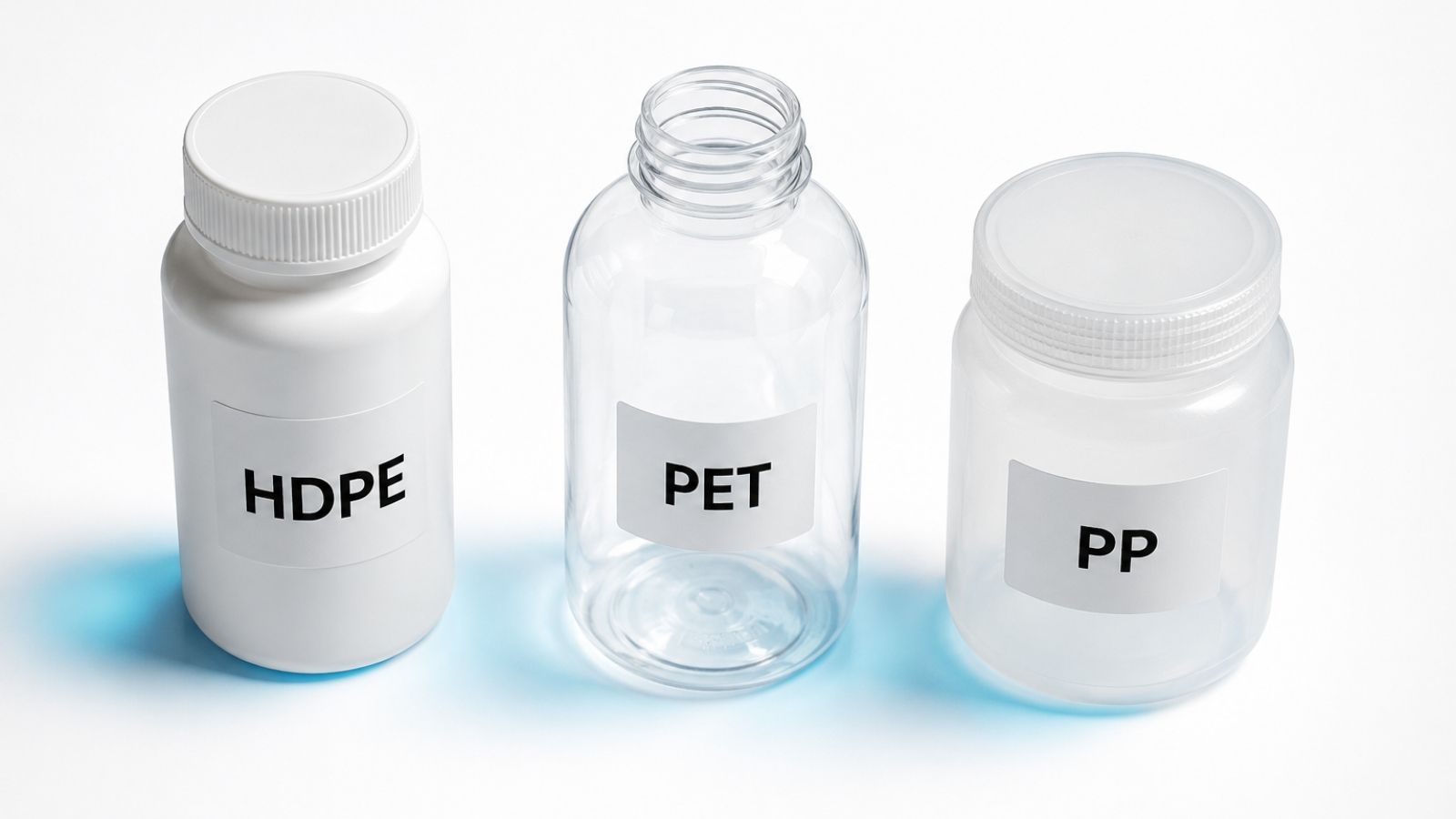
Every product that reaches a customer has traveled inside some form of packaging — and in the pharmaceutical, FMCG, cosmetic, and healthcare industries, that packaging is doing far more work than most buyers realize. Partnering with a reliable HDPE Bottle Manufacturer is one of the most consequential supply chain decisions a product company can make, yet many buyers still choose packaging on price alone without fully understanding what the material itself is doing for — or against — their product.
In India, demand for high-quality plastic packaging has grown considerably. Pharmaceutical companies are scaling production, FMCG brands are expanding distribution networks, and cosmetic manufacturers are competing on packaging presentation as much as formulation. Regulatory requirements for packaging safety, tamper-proofing, and material compliance have also become more stringent.
This guide covers the three most widely used plastic materials — HDPE, PET, and PP — and explains clearly what each does best, where each falls short, and how to make the right call for your specific product and market.
What Is HDPE and Why Is It So Widely Used?
High-Density Polyethylene — HDPE — offers an exceptional combination of chemical resistance, impact strength, moisture barrier properties, and cost efficiency that few other materials can match. HDPE bottles are opaque or translucent, rigid without being brittle, and highly resistant to cracking during transport, storage, and handling.
Key Properties of HDPE
|
🧪
Chemical Resistance
Resists acids, bases, and solvents — ideal for chemical and pharma applications.
|
💧
Moisture Barrier
Very low moisture vapor transmission — critical for tablet and powder medicines.
|
🛡️
Impact Strength
Resists cracking under drop impact better than PET at equivalent wall thickness.
|
|
🌡️
Temperature Tolerance
Performs reliably across wide temperature ranges including tropical and cold chain environments.
|
✅
FDA / Pharma Grade
Virgin HDPE meets food-grade and pharmaceutical-grade standards for direct contact use.
|
♻️
Recyclability
One of the most widely recycled plastics globally with established reprocessing infrastructure.
|
Common Applications of HDPE Bottles
- ▸Pharmaceutical packaging — Tablet containers, capsule bottles, vitamin supplement jars, and syrup bottles
- ▸Chemical packaging — Industrial cleaning agents, disinfectants, and laboratory reagents
- ▸Agricultural packaging — Fertilizers, pesticides, and herbicides in chemically resistant containers
- ▸Food packaging — Edible oils, dairy products, condiments, and dry food storage
- ▸Personal care — Shampoos, conditioners, lotions, and household cleaning products
What Is PET and Where Does It Excel?
Polyethylene Terephthalate — PET — is best known from beverage bottles. Its clarity, lightweight construction, and aesthetic versatility have made it a dominant material in consumer-facing packaging where product visibility and retail presentation matter most.
Key Properties of PET
- ▸Optical clarity — Glass-like transparency that allows full product visibility, valued in cosmetic and beverage packaging
- ▸Lightweight — Excellent strength-to-weight ratio, reducing shipping costs at scale
- ▸Gas barrier — Good resistance to oxygen and carbon dioxide permeation for carbonated beverages
- ▸Surface quality — Smooth surface accepts printing, labeling, and decoration very well
- ▸Recyclability — PET (resin code 1) is among the most commonly recycled plastics globally
Limitations of PET
PET has lower chemical resistance than HDPE, making it unsuitable for many cleaning agents or agricultural chemicals. It also has limited heat resistance — PET bottles deform at relatively modest temperatures, ruling out hot-fill applications. For pharmaceutical tablet packaging where moisture exclusion is paramount, HDPE remains the stronger choice.
What Is PP and When Should You Choose It?
Polypropylene — PP — is harder and stiffer than both HDPE and PET, with a higher melting point that makes it uniquely suitable for heat sterilization and hot-fill packaging. This heat tolerance is PP’s most significant advantage and the primary reason it is the standard for autoclavable containers.
Key Properties of PP
|
🔥
Heat Resistance
Retains structural integrity up to ~130°C — suitable for steam sterilization and hot-fill.
|
🧪
Chemical Resistance
Resists a wide range of chemicals across pharmaceutical and industrial applications.
|
📦
Rigidity & Strength
Stiffer than HDPE — ideal for wide-mouth jars that must hold shape under load.
|
|
⚖️
Light Weight
Low density contributes to cost efficiency in high-volume bulk packaging supply.
|
🔄
Hinge Durability
Excellent fatigue resistance makes PP ideal for flip-top caps and integrated closures.
|
✅
Food & Pharma Grade
Meets FDA and EU food contact standards — approved for pharmaceutical primary packaging.
|
Common Applications of PP
- ▸Pharmaceutical jars — Wide-mouth PP jars for creams, ointments, and topical preparations
- ▸Food packaging — Yogurt containers, condiment jars, margarine tubs, and microwave-safe food containers
- ▸Cosmetic packaging — Cream jars, lotion containers, and sample packaging for cosmetic brands
- ▸Medical and laboratory containers — Sterilizable PP containers for clinical and research environments
HDPE vs PET vs PP: Direct Comparison
The table below summarizes the most practically relevant performance differences across the three materials.
| Property | HDPE | PET | PP |
|---|---|---|---|
| Clarity | Opaque / Translucent | Clear / Transparent | Translucent / Opaque |
| Chemical Resistance | Excellent | Moderate | Good |
| Moisture Barrier | Excellent | Good | Good |
| Heat Resistance | Moderate (~70°C) | Low (~60°C) | High (~130°C) |
| Impact Resistance | Excellent | Good | Good |
| Food / Pharma Grade | Yes | Yes | Yes |
| Recyclability | High | High | Moderate |
| Typical Cost | Low–Moderate | Moderate | Moderate |
| Best For | Pharma, Chemical, FMCG | Beverage, Cosmetic, Retail | Pharma Jars, Hot-fill, Cosmetic |
No single material wins across every category. The right choice depends on what the product requires, what regulations demand, and what the end buyer expects.
Pharmaceutical Packaging: Why Material Selection Is a Regulatory Issue
In pharmaceutical packaging, material selection is not simply a procurement decision — it is a regulatory and product safety obligation. Experienced Pharmaceutical Packaging Manufacturers understand that the container is part of the drug delivery system, not just a vessel.
What Pharma Packaging Must Do
- ✓Protect active ingredients from moisture, oxygen, light, and contamination throughout shelf life
- ✓Maintain chemical inertness — the material must not leach, react with, or absorb the drug formulation
- ✓Support compliance with pharmacopoeial standards (USP, IP, BP) for acceptable materials
- ✓Enable tamper-evident and child-resistant closures where legally required
- ✓Withstand distribution stress including temperature variation, vibration, and humidity exposure
- ✓Pass extractables and leachables testing for direct-contact pharmaceutical applications
Child-Resistant and Tamper-Evident Closures
Pharmaceutical packaging regulations in most markets require child-resistant closures for certain product categories. Well-engineered child-resistant caps — manufactured to ASTM D3475 or equivalent standards — are typically available in PP or HDPE. Tamper-evident features such as induction seals, shrink bands, and breakaway caps add further consumer protection and regulatory compliance.
Wholesale Plastic Bottles India: What Buyers Should Know
India has become a significant global supplier of plastic packaging for pharmaceutical, FMCG, and industrial applications. Buyers sourcing Wholesale Plastic Bottles India should understand what separates a reliable, export-quality supplier from one competing only on price.
Key Factors for Wholesale Buyers
- ▸Material certification — Confirm the supplier uses virgin-grade resin and can provide material safety data sheets
- ▸Manufacturing technology — Injection blow molding and extrusion blow molding produce more consistent wall thickness
- ▸Quality control systems — Leak testing, dimensional inspection, and wall thickness measurement should be standard
- ▸Compliance documentation — Confirm the supplier can provide EU, US FDA, or applicable compliance documentation
- ▸Customization capabilities — Color, label panel design, bottle shape, neck finish, and closure compatibility
Manufacturing Technology: How Quality Bottles Are Made
Understanding the basic manufacturing processes behind plastic bottles helps buyers evaluate supplier capabilities and ask better questions during sourcing.
|
🏭
Extrusion Blow Molding
Most common process for HDPE and PP bottles. Cost-efficient at high volumes across a wide range of bottle sizes and shapes.
|
⚙️
Injection Blow Molding
Superior dimensional consistency, thread accuracy, and surface finish. PET bottles use a stretch blow variant for enhanced mechanical properties.
|
|
🔩
Injection Molding (Caps)
Produces closures with precision needed for consistent thread engagement, child-resistant mechanisms, and induction seal compatibility.
|
🔍
Quality Inspection
Leak testing, wall thickness gauging, and dimensional verification should be standard at every production stage.
|
Sustainable Packaging Trends in Plastic Manufacturing
Sustainability has moved from a marketing preference to a supply chain priority for most major brands. Current trends shaping the plastic packaging industry include:
📉 Lightweighting
🔄 Mono-Material Packaging
🔁 Refillable Formats
🌱 Bio-Based Plastics
For buyers with public sustainability commitments, these considerations are worth discussing explicitly with packaging suppliers. PCR content can be incorporated into HDPE and PET bottles, though pharmaceutical applications may have restrictions on recycled material use.
Industries Served: HDPE, PET, and PP Applications
| Industry | Recommended Material | Key Applications |
|---|---|---|
| Pharmaceutical | HDPE / PP | Tablet containers, syrup bottles, eye drops, capsule jars, ointment containers |
| Nutraceutical | HDPE / PET | Vitamin containers, supplement jars, wellness product packaging |
| FMCG | HDPE / PET | Personal care, hygiene, household product packaging, condiments |
| Cosmetic | PET / PP | Serum bottles, cream jars, lotion containers, sample packaging |
| Chemical / Industrial | HDPE | Cleaning agents, disinfectants, agricultural chemicals, industrial reagents |
| Food & Beverage | PET / HDPE / PP | Beverages, edible oils, dairy products, condiments, hot-fill food products |
How to Choose: HDPE, PET, or PP?
There is no universal right answer — the better question is which material is right for your specific product, regulatory environment, and market.
|
Choose HDPE If…
|
Choose PET If…
|
Choose PP If…
|
Why Leading Businesses Choose Cimpex Packaging
As a trusted packaging manufacturer in India, Cimpex Packaging brings together manufacturing capability, material expertise, and supply chain reliability for pharmaceutical companies, FMCG brands, cosmetic manufacturers, and industrial buyers. Working with a qualified Pharma Bottle Manufacturer that understands compliance, customization, and bulk delivery timelines makes a meaningful difference to supply chain performance.
PP Bottles & Jars
Tablet Containers
Eye Drop Bottles
Nasal Spray Bottles
Lotion Bottles
Sanitizer Bottles
Caps & Closures
Dispenser Pumps
Nutraceutical Containers
- ✓Pharmaceutical-grade raw materials and documented quality systems
- ✓Advanced blow molding and injection molding manufacturing facilities
- ✓Custom bottle sizes, colors, shapes, and closure configurations
- ✓Bulk production capabilities for high-volume pharmaceutical and FMCG requirements
- ✓Timely delivery with efficient production systems and transparent lead times
- ✓Export-ready documentation for international compliance requirements
Conclusion
Choosing between HDPE, PET, and PP is not a question with a single right answer — it depends entirely on what your product demands, what your regulatory environment requires, and what your end customer expects. HDPE remains the strongest all-around choice for pharmaceutical solid dose packaging, chemical packaging, and FMCG applications where moisture resistance and durability are priorities. PET serves consumer-facing applications where clarity and shelf presence matter. PP fills a specific and important role in heat-resistant, sterilizable, and rigid-format packaging.
Working with a reliable HDPE Bottle Manufacturer — one that understands the technical, regulatory, and commercial dimensions of packaging — is what separates a supply chain that works reliably from one that creates recurring problems. For buyers exploring Wholesale Plastic Bottles India options, the most important question is not just what the bottles cost, but what the supplier’s quality systems, material documentation, and compliance capabilities actually look like.
For pharmaceutical companies evaluating a Pharmaceutical Packaging Manufacturer, or those looking for a trusted Pharma Bottle Manufacturer that can deliver at scale across regulated and export markets, Cimpex Packaging offers the combination of manufacturing capability, material expertise, and industry experience that serious buyers need.
Frequently Asked Questions