


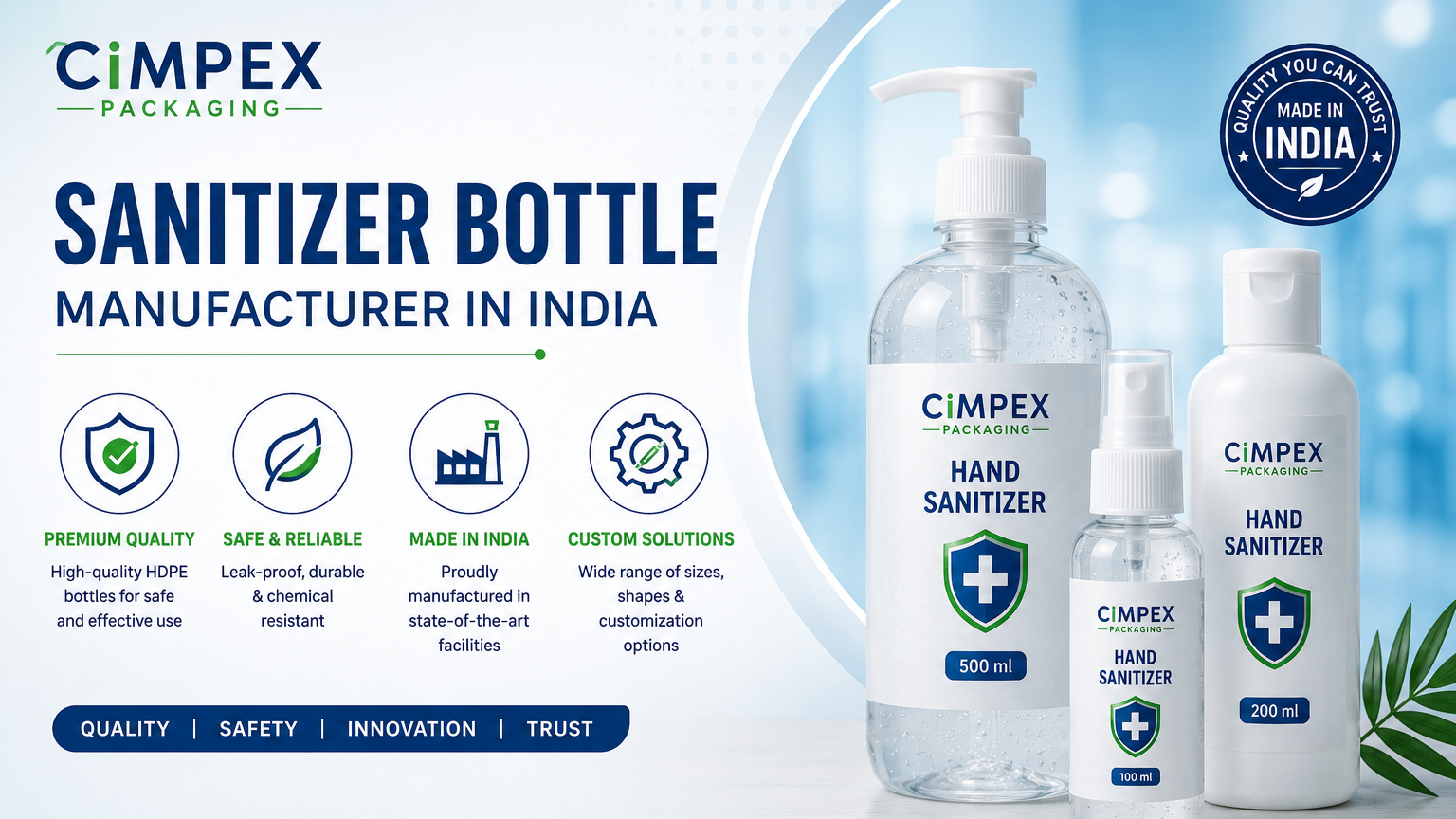
Finding a dependable sanitizer bottle manufacturer in India has become a priority for brands that need consistent quality, food-grade safety, and reliable supply at scale. Over the last few years, demand for hand sanitizers has shifted from a seasonal spike to a steady part of everyday hygiene, and packaging is what carries that product safely from the production line to the end user. The bottle is not just a container; it protects the formulation, communicates the brand, and has to survive transport, storage, and daily handling without leaking or failing.
India has grown into one of the largest hubs for plastic packaging, supplying both the domestic market and a long list of export destinations. The growth has been driven by a maturing pharmaceutical sector, a fast-moving FMCG market, and the rise of nutraceutical and personal-care brands that all rely on rigid plastic bottles. For buyers, this means more choice, more competitive pricing, and access to manufacturers who understand compliance for regulated industries. Companies like Cimpex Packaging have built their business around that exact need, helping brands source durable plastic packaging that holds up under real-world conditions.
This guide walks through the bottle types, the materials, the manufacturing process, the safety standards, and the customisation options that matter when you are choosing a packaging partner. Whether you are sourcing a single 500ml sanitizer bottle design or placing repeat orders for hand sanitizer bottle wholesale supply, the goal here is to give you the practical detail you actually need before signing off on a purchase order.
Overview of the Product Category
Sanitizer bottles fall under the broader category of rigid plastic packaging, but they have their own specific demands. The contents are usually alcohol-based, which means the bottle and closure have to resist the formulation without warping, clouding, or losing structural integrity over time. A bottle that works perfectly for shampoo may behave very differently when it holds 70% ethanol.
Within this category, a few formats dominate the market:
- Pump and dispenser bottles — the most common retail and institutional format. A sanitizer bottle with pump is preferred in hospitals, offices, and reception areas because it allows controlled, hands-free-friendly dosing.
- Flip-top and disc-top bottles — popular for personal and travel-size sanitizers where portability matters.
- Spray bottles — used for surface sanitizers and liquid formulations that need a fine mist.
- Bulk refill cans and jars — five-litre and larger formats supplied to institutions that decant into smaller dispensers.
Sizes typically range from small 50ml travel bottles up to the widely ordered 500ml sanitizer bottle and larger refill packs. The 500ml size sits in a sweet spot for both households and workplaces, which is why it remains one of the most requested formats from any packaging supplier. Cimpex Packaging works across this full range, so brands can keep a consistent look from the smallest pocket bottle to the largest refill container.
Importance of Quality Packaging
It is easy to treat packaging as the last line item in a budget, but in regulated and consumer-facing industries it does a lot of heavy lifting. Poor packaging shows up as leaks during shipping, caps that crack in cold storage, labels that peel off, or bottles that fail a drop test on the warehouse floor. Each of those failures costs money and damages trust with the customer.
Good packaging quietly does its job. Here is what it protects:
- Product integrity — the right resin keeps the formulation stable and prevents the bottle from reacting with the contents.
- Shelf life — barrier properties and moisture resistance keep the product effective until the end of its dated life.
- Brand reputation — a clean, well-finished bottle signals a serious brand, while a flimsy one undermines confidence at the point of sale.
- Compliance — for pharma and healthcare buyers, the packaging itself is part of what regulators review.
This is why experienced buyers look beyond price alone. A slightly cheaper bottle that fails one in fifty leak tests will erase any saving the moment a shipment is returned. Choosing a manufacturer with proper plastic packaging solutions and tested quality controls is almost always the lower-risk decision over the long run.
Industries Using These Packaging Products
Although this article focuses on sanitizer bottles, the same manufacturing capability and material expertise serve a wide spread of industries. A capable bottle manufacturer rarely works in only one vertical, and the cross-industry experience usually translates into better compliance knowledge.
Pharmaceutical Packaging
Pharma is one of the most demanding sectors because every container has to meet strict regulatory and documentation requirements. Bottles for syrups, tablets, and liquid medication need tamper evidence, child-resistant closures, and full traceability. A specialised pharma bottle manufacturer understands the difference between a generic bottle and one that will pass a regulatory audit.
FMCG Packaging
Fast-moving consumer goods rely on packaging that looks good on a crowded shelf and survives high-volume distribution. Transparency, branding space, and consistent fill volumes all matter here, which is why PET bottles are so common in this segment.
Nutraceutical Packaging
Supplements, protein powders, and health products need packaging that protects against moisture and light. Pharma-grade HDPE bottles and tamper-evident caps are the standard, often paired with a desiccant or induction seal for sensitive contents.
Food Packaging
Food-grade containers must be made from approved, non-reactive materials. Polypropylene is a frequent choice here because it tolerates heat and is suitable for hot-fill and microwave-safe applications.
Cosmetic Packaging
Cosmetics put a premium on appearance and feel. Brands often want frosted finishes, custom colours, and pump or dropper closures. Purpose-built cosmetic packaging containers let beauty brands match their bottle to their identity.
Healthcare Packaging
Hospitals and clinics need durable, hygienic packaging for sanitizers, disinfectants, and medical solutions. Larger pump bottles and refill cans dominate this space because they balance dosing control with bulk economy.
Industrial Packaging
Industrial buyers often need chemical-resistant bottles and drums that can hold solvents, lubricants, and cleaning agents. Wall thickness, resin choice, and closure sealing become critical when the contents are aggressive.
Packaging Materials Used
The material is the single biggest decision in bottle design. Three resins cover the vast majority of sanitizer and general bottle applications: HDPE, PET, and PP. Each has a clear role, and a good manufacturer will recommend the right one based on the formulation rather than defaulting to whatever is cheapest.
HDPE (High-Density Polyethylene)
HDPE is the workhorse of pharmaceutical and chemical packaging. It is tough, opaque by nature, and offers excellent moisture resistance and chemical compatibility. That makes it a natural fit for alcohol-based sanitizers and medication. If you need rigid, dependable bottles that resist stress cracking, an experienced HDPE bottle manufacturer is the right place to start.
PET (Polyethylene Terephthalate)
PET is prized for its glass-like clarity, light weight, and recyclability. It lets the product show through, which is why it is the default for many FMCG and consumer sanitizer lines. A well-made PET sanitizer bottle India buyers can rely on combines clarity with enough wall strength to handle filling and transport. PET is also fully recyclable, which supports brands moving toward greener packaging.
PP (Polypropylene)
PP brings heat resistance and a slightly flexible toughness. It is the go-to for closures, flip-tops, and containers that may face higher temperatures or hot-fill processes. PP caps are frequently paired with HDPE or PET bottles to create a complete, well-matched pack.
| Material | Key Properties | Best Suited For |
|---|---|---|
| HDPE | Durable, opaque, strong chemical & moisture resistance | Pharma bottles, sanitizers, nutraceuticals |
| PET | Transparent, lightweight, fully recyclable | FMCG packaging, retail sanitizer bottles |
| PP | Heat resistant, flexible, food safe | Caps, closures, food containers |
Manufacturing Process
Understanding how bottles are made helps buyers ask better questions and spot a serious manufacturer from a reseller. Most sanitizer bottles are produced through one of two moulding methods, supported by a chain of quality checks.
Injection Moulding
Injection moulding is used mainly for caps, closures, and preforms. Molten resin is injected into a precision steel mould under high pressure, producing parts with tight tolerances. This is why threads on a well-made cap line up cleanly every time.
Blow Moulding
The bottle body is usually formed by blow moulding. In extrusion blow moulding, a heated tube of plastic is inflated against the mould walls to take its shape; in stretch blow moulding, a PET preform is heated and stretched into a clear, strong bottle. The method chosen affects wall thickness, clarity, and strength.
Quality Control, Material Testing and Leak Testing
The difference between a reliable supplier and a risky one shows up in testing:
- Material testing — incoming resin is checked for grade, melt flow, and food or pharma compliance before it enters production.
- Dimensional checks — bottle weight, neck finish, and wall thickness are verified against the approved sample.
- Leak testing — bottles are pressure or vacuum tested to confirm they will not leak in transit.
- Drop and load testing — packs are stress-tested to mimic stacking and handling during shipping.
- Visual inspection — every batch is screened for flash, contamination, and colour consistency.
A manufacturer that documents these steps gives you a paper trail you can show to auditors and customers. That documentation is part of what separates a true manufacturer of pharmaceutical packaging products from a basic trader.
Quick answer: Sanitizer bottles are made mainly by blow moulding the bottle body and injection moulding the caps. The resin is tested on arrival, the bottles are checked for dimensions and leaks, and each batch is visually inspected before packing — so the final pack is safe to fill, store, and ship.
Packaging Safety Standards
Safety standards are where many cheap suppliers fall short, and where regulated buyers cannot afford to compromise. The exact requirements depend on the product and the destination market, but the common pillars are consistent.
- Food-grade standards — resins and colourants must be approved for contact with consumable or skin-contact products, with supporting certificates.
- Pharma compliance — bottles used for medication need to meet pharmacopoeia and regulatory expectations, including batch traceability.
- Export requirements — different countries enforce different rules; reliable export packaging anticipates these instead of reacting to a rejected shipment.
- Tamper-evident packaging — induction seals, shrink bands, and breakaway caps show the consumer the product has not been opened.
- Child-resistant closures — essential for sanitizers and medication where accidental ingestion is a real risk.
For brands that produce tablets or capsules alongside liquid lines, pairing your bottle order with a trusted tablet container manufacturer keeps your packaging consistent and your compliance documentation under one roof.
Customization Options
Off-the-shelf bottles are fine for some buyers, but most growing brands want packaging that reflects their identity. Customisation is where a flexible manufacturer earns repeat business.
- Size customisation — from compact travel bottles to the popular 500ml format and bulk refill sizes.
- Colour customisation — clear, white, frosted, or brand-matched colours using approved masterbatch.
- Branding — screen printing, hot stamping, and embossing for a premium finish.
- Label compatibility — smooth or contoured panels designed to hold labels flat without wrinkling.
- Cap options — pumps, flip-tops, disc-tops, sprayers, and child-resistant closures matched to the neck finish.
For brands wanting added protection for sensitive formulations, a multilayer bottle manufacturer can build barrier layers directly into the bottle wall, extending shelf life without changing the look. Cimpex Packaging treats customisation as a standard service rather than a premium add-on, which helps smaller brands compete on shelf appeal.
Benefits of Buying from an Indian Manufacturer
Sourcing from India is not only about price, although cost is a genuine advantage. The wider package of benefits is what keeps international and domestic buyers coming back.
- Cost efficiency — competitive resin sourcing and lower production overheads translate into better unit pricing without cutting corners on quality.
- Bulk supply capability — established factories can fulfil large, repeat orders, which is essential for hand sanitizer bottle wholesale buyers and distributors.
- Export support — experienced manufacturers handle documentation, compliant packaging, and logistics for overseas shipments.
- Faster production — in-house moulding and tooling shorten lead times compared with multi-vendor supply chains.
- Flexibility — Indian suppliers tend to accommodate custom sizes and finishes more readily than large overseas plants tied to fixed catalogues.
For packaging distributors and export businesses, that combination of price, volume, and adaptability is hard to match elsewhere, and it is the main reason India remains a first stop for bottle sourcing.
Sustainable Packaging Trends
Sustainability has moved from a marketing line to a buyer requirement. Brands face pressure from regulators and customers alike to reduce plastic waste, and packaging manufacturers are adapting.
- Recyclable plastics — PET and HDPE are both widely recyclable, and using mono-material packs makes recycling easier at end of life.
- Reduced material usage — light-weighting bottle designs cuts plastic consumption per unit while keeping the bottle strong enough for its job.
- Recycled content — incorporating post-consumer recycled resin where regulations allow lowers the footprint of each bottle.
- Eco-conscious closures — simpler, recyclable cap designs reduce the mix of materials in a single pack.
The encouraging part is that durable plastic and sustainability are no longer at odds. Smarter design lets a bottle be lighter, recyclable, and still pass every leak and drop test. Manufacturers that invest early in these trends help their clients stay ahead of changing rules instead of scrambling to catch up.
Need Reliable Bulk Sanitizer Bottles?
Cimpex Packaging supplies food-grade, export-ready bottles in custom sizes, materials, and finishes — built for pharma, FMCG, cosmetic, and healthcare brands.
Conclusion
Choosing the right sanitizer bottle manufacturer in India comes down to matching the bottle to the product, backing it with proper testing, and working with a partner who can scale with your orders. From a compact travel pack to the popular 500ml sanitizer bottle, and from a single sanitizer bottle with pump to large-volume hand sanitizer bottle wholesale supply, the fundamentals stay the same: the right material, a clean manufacturing process, and verified safety standards. A well-made PET sanitizer bottle India buyers can trust is the result of all three working together.
Cimpex Packaging brings these elements under one roof — quality-focused production, custom packaging expertise, and dependable bulk supply for brands and distributors. If you are planning your next packaging run or exploring a new product line, reach out to discuss your requirements and request a quote for bulk packaging solutions. Getting the bottle right at the start saves cost, protects your product, and keeps your customers confident in your brand.
Frequently Asked Questions
A reliable manufacturer offers food-grade materials, tested quality control, and consistent bulk supply. Cimpex Packaging produces sanitizer bottles in HDPE, PET, and PP across multiple sizes, with leak testing and custom branding available for pharma, FMCG, cosmetic, and healthcare brands.
Sizes typically range from 50ml travel bottles to the widely ordered 500ml sanitizer bottle, plus larger one-litre and five-litre refill packs. Wholesale buyers can order a single size or a full range to keep their branding consistent across products.
HDPE is ideal for alcohol-based sanitizers because of its strong chemical and moisture resistance. PET is preferred when clarity and recyclability matter for retail. PP is mainly used for caps and heat-resistant closures. The right choice depends on the formulation and the look you want.
Yes. Pharma-grade HDPE bottles with tamper-evident and child-resistant closures meet the requirements for medication and healthcare products. A proper manufacturer also maintains batch documentation and material certificates needed for regulatory audits.
Yes. A sanitizer bottle with pump is one of the most requested formats for offices, hospitals, and retail. Pumps, flip-tops, disc-tops, and sprayers can all be matched to the bottle neck finish to suit your application.
A PET sanitizer bottle in India is valued for its glass-like clarity, light weight, and full recyclability. It lets the product show through on the shelf, which makes it a favourite for retail and FMCG sanitizer lines while still offering good strength for filling and transport.
Yes. Customisation includes size and colour options, screen printing, hot stamping, embossing, and label-friendly panels. Cap and closure styles can also be matched to your design, giving your product a distinct, professional appearance.
Bottles are produced from approved food-grade resins and can be supplied with the documentation needed for export markets. Tamper-evident sealing and compliant packaging help shipments clear different regulatory requirements smoothly.
Minimum order quantities depend on the bottle size, material, and customisation involved. For an accurate figure and pricing tailored to your requirement, it is best to share your specifications and request a quote directly from Cimpex Packaging.
Each batch goes through material testing, dimensional checks, leak testing, and visual inspection. Drop and load tests confirm the packs can handle stacking and transport, so the bottles arrive ready to fill and ship without surprises.