


Introduction
Pick up almost any bottle in a pharmacy, a chemical storeroom, or a cosmetics aisle, and there’s a good chance it’s HDPE. The material shows up everywhere because it survives what other plastics can’t: harsh chemicals, repeated handling, and months of storage without degrading. Understanding how HDPE bottles are manufactured explains why this material dominates pharmaceutical, chemical, cosmetic, agrochemical, food, and personal care packaging.
The process behind that dominance is blow moulding, a manufacturing method that turns raw resin pellets into a finished, leak-proof container in seconds. It’s not a niche technique; it’s the backbone of modern rigid plastic packaging, refined over decades into a highly repeatable, quality-controlled process.
Our own HDPE bottle range at Cimpex Packaging is built on exactly this process, tested and refined across thousands of production runs.
This guide walks through how HDPE bottles are manufactured from raw material to finished product, covering the resin itself, the step-by-step blow moulding process, the different moulding technologies available, and what separates a dependable HDPE bottle manufacturer from one that just claims to be one.
Why HDPE Bottles Are the Preferred Packaging Choice
- High durability
- Excellent chemical resistance
- Lightweight construction
- Moisture resistance
- Cost-effectiveness
- Recyclability
- Long service life
High durability means HDPE bottles survive drops, stacking pressure, and rough handling without cracking. Excellent chemical resistance protects the bottle from degrading when it holds solvents, acids, or aggressive cleaning agents, which is why chemical and agrochemical brands rely on it almost exclusively. Lightweight construction keeps freight costs down across bulk and export shipments.
Moisture resistance protects sensitive formulations, particularly in pharmaceutical packaging where humidity can compromise a tablet’s shelf life. Cost-effectiveness comes from efficient processing and low resin cost compared to glass or specialty plastics. Recyclability, carrying resin code 2, supports growing sustainability commitments, and long service life rounds it out: HDPE containers hold up through repeated refills in industrial settings.
How HDPE Bottles Are Manufactured: Complete Blow-Moulding Guide
Blow moulding earns its place as the dominant HDPE manufacturing method because it produces consistent, hollow containers at high speed with minimal material waste. Understanding how HDPE bottles are manufactured through this process matters whether you’re specifying packaging for a new product or auditing an existing supplier, since the process directly determines wall thickness consistency, leak resistance, and how well the finished bottle performs under real-world handling.
Understanding HDPE as a Packaging Material
What is HDPE?
HDPE, or high-density polyethylene, is a thermoplastic polymer produced from ethylene monomers under low-pressure polymerization. Its molecular chains carry minimal branching, letting them pack tightly together, which gives the material its density and rigidity. That density brings strong chemical resistance against acids, alkalis, and solvents, along with a low moisture-vapor transmission rate, making it suitable for industrial, pharmaceutical, and household chemical packaging alike.
Why Manufacturers Prefer HDPE
The strength-to-weight ratio is hard to beat: HDPE delivers structural strength without adding shipping weight. Excellent barrier properties protect contents from oxygen and moisture over long shelf lives. Durability keeps rejection rates low at high volume, cost efficiency comes from both material price and processing speed, and sustainability credentials keep improving as recycled-content HDPE becomes more widely accepted.
Raw Materials Used in HDPE Bottle Manufacturing
Virgin HDPE Resin
Virgin resin, made entirely from new petrochemical feedstock, offers the most consistent melt flow and fewest impurities, which matters most for pharmaceutical and food-contact applications where purity is non-negotiable. It costs more than recycled alternatives but delivers more predictable processing.
Recycled HDPE
Recycled HDPE, often labeled PCR (post-consumer recycled), supports sustainability goals and costs less, but needs careful sourcing since inconsistent feedstock can affect melt flow and bottle strength. It suits industrial and household packaging better than pharmaceutical applications with strict purity requirements.
Performance Additives
UV stabilizers protect bottles stored in direct sunlight from becoming brittle. Colour masterbatch delivers consistent branding and sometimes blocks light for photosensitive contents. Anti-static agents reduce dust attraction during handling. Processing aids improve melt flow and reduce friction inside the extruder, maintaining consistent cycle times.
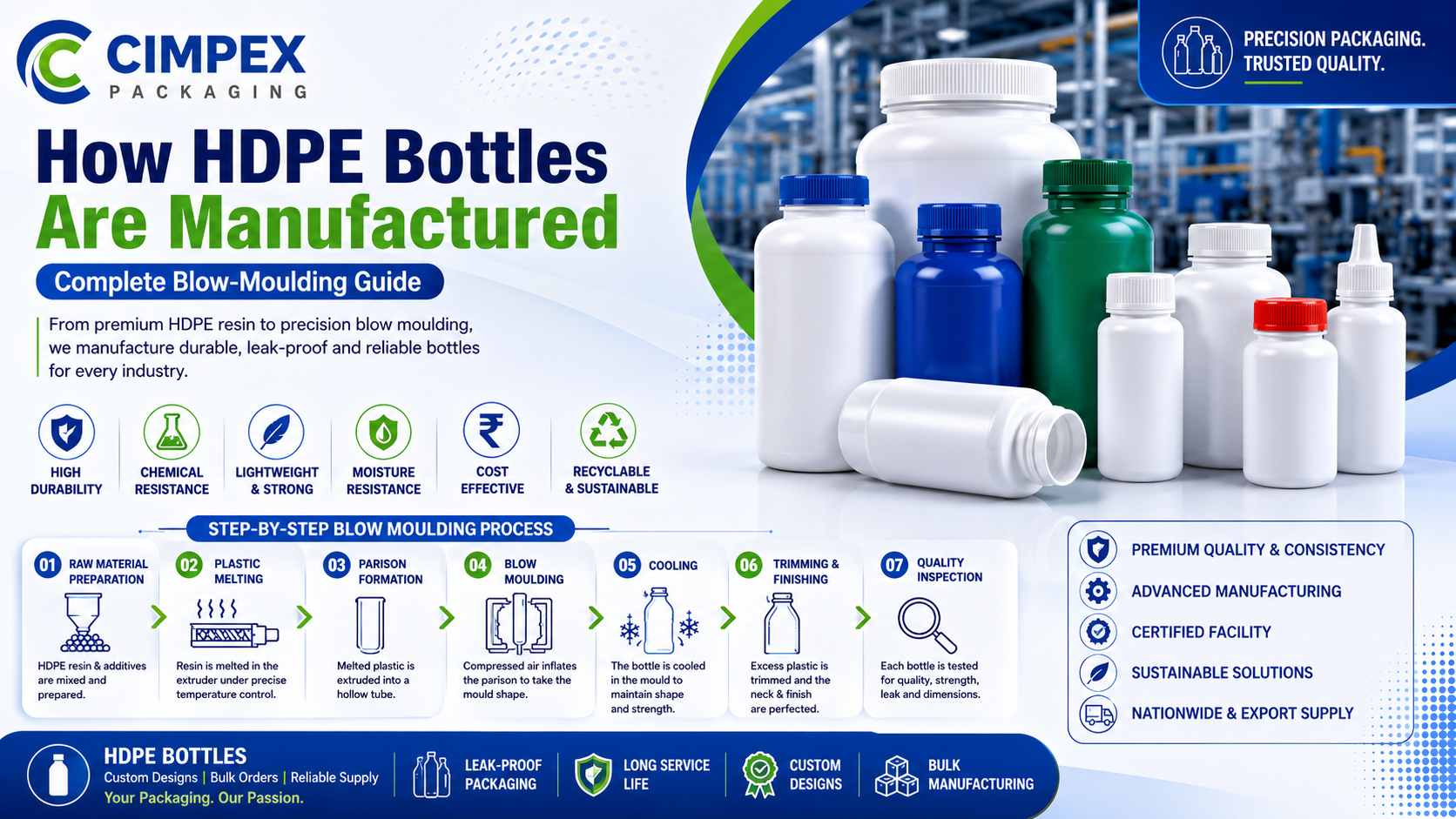
Step-by-Step Blow Moulding Process
Step 1 – Raw Material Preparation
Resin pellets get inspected for contamination, dried if moisture is too high, blended with required additives, and fed into the hopper at a controlled rate.
Step 2 – Plastic Melting
Inside the extruder, resin passes through multiple heating zones while a rotating screw pushes and mixes it forward. Precise temperature control keeps the melt consistent, since cold spots or overheating both create weak points.
Step 3 – Parison Formation
The molten plastic exits as a hollow tube called a parison. Its thickness, controlled by the die gap, directly determines wall thickness and how material distributes across narrow necks or wider bases.
Step 4 – Blow Moulding
Mould halves close around the parison, and compressed air presses the hot plastic outward until it fills the cavity, forming the bottle’s final shape. Cycle time and pressure control affect throughput without compromising branding detail.
Step 5 – Cooling
Cooling channels inside the mould draw heat out quickly and evenly, controlling shrinkage and locking in the dimensional stability that keeps every bottle in a batch consistent.
Step 6 – Trimming & Finishing
Excess flash gets trimmed from the neck and base, neck finishing ensures threads accept caps cleanly, and a surface check catches blemishes before inspection.
Step 7 – Quality Inspection
Bottles undergo leak testing, wall thickness testing, drop testing, weight testing, visual inspection, and dimensional inspection before release. Each test catches a different failure mode, which is why skipping any one raises the risk of a defective batch reaching a customer.
Different Types of Blow Moulding
Extrusion Blow Moulding
This is the standard method for HDPE bottles, using a continuously extruded parison captured between mould halves and inflated. It suits high-volume production across sizes, from small pharmaceutical bottles to large industrial containers, at relatively low tooling cost.
Injection Blow Moulding
Here, a preform gets injection moulded around a core rod before transferring to a blow mould for final shaping, part of our broader manufacturing process. This delivers tighter neck tolerances and better wall consistency, making it preferred for smaller bottles needing precise dosing or dropper mechanisms.
Stretch Blow Moulding
Less common for HDPE than for PET, this method stretches the preform before inflation, improving clarity and barrier strength. It occasionally suits specialty HDPE containers where added rigidity matters more than cost.
Applications of HDPE Bottles Across Industries
- HDPE bottles for pharmaceutical industry use need tamper-evident, chemically stable construction to protect medications from moisture.
- Agrochemical brands rely on HDPE containers that resist pesticide and fertilizer formulations across harsh storage conditions.
- Chemical companies need corrosion-resistant containers for solvents and industrial concentrates.
- Cosmetics brands choose customizable HDPE bottles for lotions, shampoos, and creams that need shelf appeal.
- Personal care products benefit from HDPE’s lightweight, squeeze-friendly construction for daily-use items.
- Food and beverage packaging uses food-grade HDPE for milk, oils, and condiments.
- Household product makers rely on HDPE for detergents and cleaning sprays needing leak-proof sealing.
- Industrial chemical buyers need heavy-duty HDPE drums and containers for bulk storage and transport.
Advantages of Blow-Moulded HDPE Bottles
- Durability
- Leak-proof construction
- Chemical resistance
- Cost efficiency
- Lightweight design
- Easy transportation
- Sustainability
- Customization options
Durability and leak-proof construction go hand in hand, since a properly moulded HDPE bottle resists physical damage and seal failure alike. Chemical resistance protects contents and prevents the container from degrading. Cost efficiency stays strong even at scale, thanks to fast cycle times and low material cost.
Lightweight design and easy transportation reduce freight expenses across bulk and export orders. Sustainability keeps improving as recycled resin content becomes standard, and customization options, from colour and embossing to fully custom mould development, let brands differentiate their packaging instead of settling for generic stock shapes.
How to Choose a Reliable HDPE Bottle Manufacturer
- Manufacturing experience across your specific industry reveals whether a supplier has already solved problems generic manufacturers haven’t.
- Production capacity should match your order volume without stretching a supplier’s existing commitments too thin.
- Modern machinery produces tighter tolerances and more consistent output than older equipment.
- Certifications like ISO 9001 signal documented, audited quality systems rather than informal practices.
- Quality assurance processes should include batch-level testing, not just occasional spot checks.
- In-house testing facilities mean faster turnaround when a design needs compatibility or leak validation.
- Custom mould development lets you build genuinely differentiated packaging rather than generic shapes.
- Export capability matters if you’re shipping internationally, since documentation shifts by market.
- On-time delivery performance protects your production and launch schedules from unplanned delays.
- Technical support during material selection saves real time for buyers new to HDPE bottle manufacturing.
Common Manufacturing Challenges and Their Solutions
- Uneven wall thickness usually traces back to poor parison programming, fixed by recalibrating the die gap.
- Flash defects often mean clamping pressure needs adjustment or trim tooling has worn down.
- Sink marks typically point to insufficient cooling time or uneven mould temperature, corrected through cycle adjustments.
- Bottle deformation after ejection signals the same cooling issue, solved by extending cooling time.
- Air leakage during moulding usually points to worn blow pin seals or misaligned parting lines.
- Poor dimensional accuracy often stems from inconsistent melt temperature, corrected through tighter control.
- Surface imperfections can result from contaminated or damp resin, solved by proper drying and inspection upfront.
Choosing the Right Manufacturing Partner for Long-Term Success
Understanding how HDPE bottles are manufactured, from resin selection through blow moulding, cooling, and final inspection, gives you a real basis for evaluating suppliers rather than comparing quotes blindly. Every stage shapes the finished bottle’s strength, consistency, and shelf performance.
Whether you’re sourcing HDPE bottles wholesale for a new product launch, comparing an HDPE bottles bulk supplier India option against overseas alternatives, or switching suppliers after quality issues, the manufacturing knowledge in this guide should help you spot a genuinely capable HDPE bottle manufacturer before committing to an order.
Ready to work with an HDPE plastic bottles supplier that treats every stage of blow moulding with the same seriousness you do? Contact Cimpex Packaging for custom HDPE bottles, bulk manufacturing, and reliable packaging solutions across pharmaceutical, chemical, cosmetic, and industrial applications.
Frequently Asked Questions
What is the blow molding process for HDPE bottles?
The blow molding process shapes heated HDPE resin inside a mould using compressed air, forming a hollow bottle to precise wall-thickness specifications.
Why is HDPE preferred for plastic bottle manufacturing?
HDPE resists chemicals and moisture, stays lightweight yet durable, and processes efficiently, making it the standard choice across most bottle manufacturing.
What industries use HDPE bottles?
Pharmaceutical, chemical, agrochemical, cosmetic, food, and household product industries all rely on HDPE bottles for durable, chemical-resistant packaging.
Are HDPE bottles recyclable?
Yes, HDPE carries resin code 2 and is widely recyclable, with many manufacturers now incorporating recycled content into new bottles.
How are HDPE bottles tested for quality?
Bottles undergo leak testing, wall thickness testing, drop testing, weight testing, and visual and dimensional inspection before release.
What are the advantages of blow-moulded HDPE bottles?
Blow-moulded HDPE bottles offer durability, chemical resistance, leak-proof sealing, cost efficiency, and flexible customization options for brands.
How do I choose an HDPE plastic bottles supplier?
Evaluate manufacturing experience, certifications, quality testing capability, and production capacity before choosing an HDPE plastic bottles supplier.
Where can I buy HDPE bottles wholesale in India?
Established manufacturers like Cimpex Packaging offer HDPE bottles wholesale with bulk pricing, though minimum order quantities vary by customization.