


Introduction
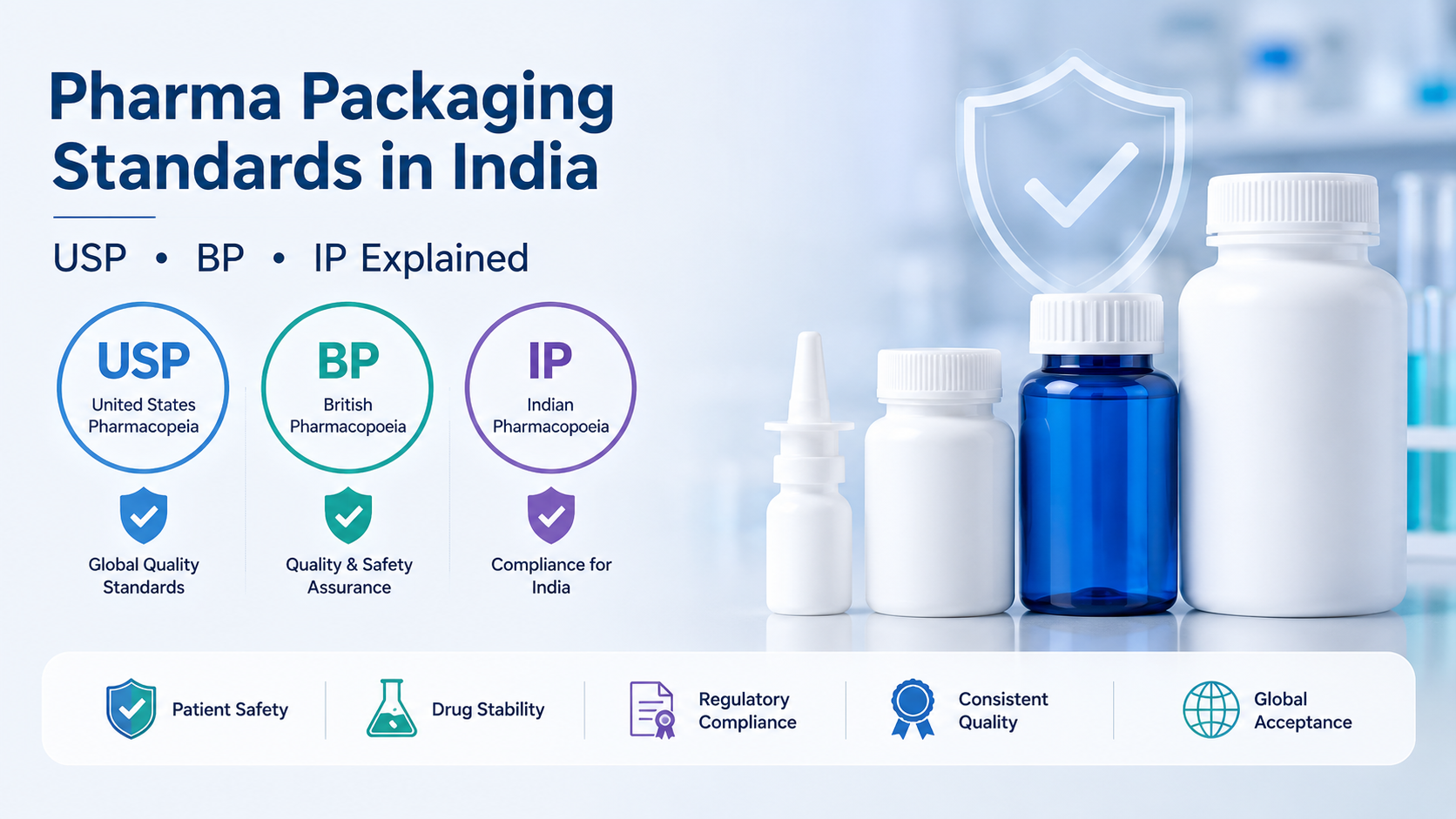
A tablet’s shelf life on paper and its shelf life in the real world are two different numbers, and packaging is usually what closes that gap. Moisture, oxygen, and material leaching can quietly undermine an otherwise well-formulated drug before its printed expiry date. That’s exactly why pharma packaging standards in India exist, built around three interlinked pharmacopeial systems: USP, BP, and IP.
For pharmaceutical manufacturers and procurement teams, understanding pharma packaging standards in India isn’t optional if you’re selling domestically or exporting. Each standard governs how packaging materials get tested, which containers qualify for which drug types, and how compliance gets documented for regulators and auditors alike.
Our own pharma bottle range at Cimpex Packaging is built around exactly this compliance framework, since packaging that fails one of these standards can mean a blocked shipment or a failed audit.
This guide breaks down pharma packaging standards in India: USP, BP, IP explained clearly, covering what each standard requires, how they compare, which materials meet global standards, the tests packaging must pass, and how to choose a genuinely GMP-compliant manufacturer.
Why Pharmaceutical Packaging Standards Matter
- Patient safety
- Drug stability
- Regulatory compliance
- Product quality
- Export readiness
- Brand reputation
- Risk reduction
Patient safety depends on packaging that doesn’t leach chemicals into a drug or let contaminants in, since a compromised container can turn a safe medication into a health risk. Drug stability relies on packaging blocking moisture and oxygen, since an antibiotic in the wrong container can lose potency before its printed expiry. Regulatory compliance isn’t optional in India, where CDSCO and state drug controllers inspect packaging during every GMP audit.
Product quality reflects directly on packaging performance, since even a perfectly formulated drug fails if its container degrades. Export readiness means your packaging needs to satisfy the destination market’s pharmacopeial requirements, not just domestic ones. Brand reputation, once damaged by a packaging failure, takes years to rebuild, and risk reduction across the supply chain starts with choosing compliant packaging from day one.
Pharma Packaging Standards in India: USP, BP, IP Explained
Pharmaceutical manufacturers serving India’s domestic market and export customers rarely get to choose just one standard. Pharma packaging standards in India typically mean satisfying IP for domestic legal compliance while also meeting USP or BP requirements for any export market, since a shipment that passes one pharmacopeial standard but not another gets rejected at the destination port regardless of how well it performed at home.
Understanding Pharmaceutical Packaging Standards
What Are Pharmaceutical Packaging Standards?
Pharmaceutical packaging standards are documented, pharmacopeia-published specifications defining which materials, container designs, and closures are acceptable for a given drug. Their purpose is preventing interaction between the container and its contents. Regulators use them as the legal benchmark during inspections, covering everything from raw material sourcing to finished container testing.
Why Packaging Compliance Is Critical
Patient health depends directly on packaging that doesn’t compromise a drug’s safety profile. Product shelf life ties to how well the material blocks moisture and light. Manufacturing consistency means every batch performs identically, verified through documented process controls, and global market acceptance depends on demonstrating compliance with whichever pharmacopeial standard a target market requires.
USP Standards Explained
What is USP?
USP, the United States Pharmacopeia, is a private nonprofit whose specifications become legally binding once referenced by the FDA, making USP compliance essential for pharmaceutical packaging India exports to the American market.
USP Requirements for Packaging Materials
USP General Chapter <661> and its sub-chapters define how plastic materials and finished packaging systems get evaluated, covering physicochemical properties and extractables testing before a material qualifies for drug contact.
USP Container Testing
Chapter <671> governs container performance testing, including moisture-vapor permeation for solid oral dosage forms, confirming the finished container protects its contents under real storage conditions.
USP Material Compatibility
Compatibility testing confirms the resin doesn’t react with or absorb the drug formulation over its full shelf life, regardless of which specific product the packaging holds.
USP-VI Certification
USP Class VI, often called USP-VI, is the most stringent tier of USP’s biological reactivity testing for plastics, covering systemic toxicity, intracutaneous reactivity, and implantation tests. A USP-VI bottle manufacturer demonstrates its resin has passed this in-vivo testing, which many pharmaceutical and medical device buyers treat as a baseline requirement.
BP Standards Explained
What is British Pharmacopoeia?
BP is published under the authority of the UK’s Medicines and Healthcare products Regulatory Agency and governs packaging for drugs sold in UK-linked markets.
Packaging Material Requirements
BP classifies containers by function, well-closed, airtight, single-dose, and multi-dose, treating the closure as part of the container rather than a separate component.
Quality Testing
BP testing covers material compatibility, light protection, and moisture resistance, using methods that closely parallel physicochemical testing under other pharmacopeial systems.
Compliance Expectations
Manufacturers supplying Commonwealth or UK-linked buyers typically need BP-aligned documentation alongside whatever domestic standard, usually IP, already applies to their facility.
Indian Pharmacopoeia (IP) Standards Explained
Role of Indian Pharmacopoeia
IP is published by the Indian Pharmacopoeia Commission under the Ministry of Health and Family Welfare, and it’s the legally enforceable packaging standard for anything manufactured, sold, or distributed in India under the Drugs and Cosmetics Act, 1940.
Packaging Material Specifications
IP standards cover plastic, glass, and rubber closures, with testing procedures for physicochemical properties that closely parallel BP’s historical structure.
Quality Control Procedures
IP compliance gets verified through routine domestic GMP inspections rather than third-party lab certification alone, tying packaging compliance directly to a facility’s quality system.
Regulatory Requirements
CDSCO and state drug controllers enforce IP packaging standards during inspections under the revised Schedule M, which aligned India’s GMP framework more closely with WHO-GMP expectations.
USP vs BP vs IP: Complete Comparison
Regulatory Authority
USP is maintained by a private nonprofit recognized by the FDA; BP by the UK’s MHRA; IP by India’s Pharmacopoeia Commission under CDSCO.
Testing Procedures
USP relies on numbered general chapters with specific test methods; BP and IP use closely related physicochemical approaches with historical overlap.
Packaging Material Requirements
USP focuses heavily on plastics and extractables; BP and IP both emphasize container classification and closure integrity alongside compatibility.
Documentation
USP documentation typically satisfies FDA auditors; BP satisfies MHRA-linked buyers; IP satisfies CDSCO and state drug controller inspections.
Global Acceptance
USP dominates for US-bound exports, BP for Commonwealth markets, and IP is mandatory domestically regardless of where a manufacturer also exports.
Applications
Large exporters typically maintain dual or triple compliance; smaller domestic manufacturers often meet IP alone until they pursue export markets.
Pharmaceutical Packaging Materials That Meet Global Standards
HDPE Bottles
HDPE dominates solid oral dosage packaging thanks to moisture resistance and chemical inertness. Pharma HDPE bottle supplier operations typically qualify their resin against USP <661>, BP, and IP simultaneously, since tablet containers often ship to multiple markets.
LDPE Bottles
LDPE’s flexibility makes it the standard choice for squeeze-dispensed nasal sprays and eye drops, where controlled compression delivers a dose that rigid HDPE can’t replicate.
PET Bottles
PET offers clarity useful for liquid formulations, though its weaker moisture barrier makes it less suitable for moisture-sensitive tablets than HDPE.
Polypropylene Containers
PP tolerates higher temperatures than HDPE, suiting products requiring autoclave sterilization or hot-fill processing, and it’s widely used for closures.
Glass Containers
Glass remains the gold standard for injectables since it’s essentially inert. Type I borosilicate glass is required for most sterile products under USP and IP alike.
Quality Tests Required for Pharmaceutical Packaging
Leak Testing
Confirms the container-closure system stays sealed under pressure, critical for liquid and sterile pharmaceutical products.
Migration Testing
Detects whether chemicals from the packaging leach into the drug product, a mandatory check under USP, BP, and IP alike.
Chemical Compatibility Testing
Checks whether the packaging material reacts with or absorbs the drug formulation across its full shelf life.
Sterility Testing
Confirms packaging for injectables and other sterile products maintains an aseptic barrier throughout storage.
Container Closure Integrity Testing
Verifies the sealed container prevents microbial ingress and product leakage, a critical test validated as part of our manufacturing process for sterile pharmaceutical packaging.
Visual Inspection
Catches surface defects, discoloration, and dimensional inconsistencies that automated testing alone might miss.
Dimensional Accuracy Testing
Confirms neck finish and wall thickness stay within tolerance, since even small deviations can cause capping or sealing failures.
How to Choose a GMP-Compliant Pharmaceutical Packaging Manufacturer
Finding a genuinely GMP compliant bottle manufacturer takes more than checking a box on a vendor questionnaire.
- GMP certification should be demonstrated through documentation, not just claimed during a sales call.
- ISO certifications, particularly ISO 15378 for primary pharmaceutical packaging, signal an audited quality system.
- USP/BP/IP compliance needs actual test reports and certificates, not verbal assurance.
- In-house testing facilities mean faster turnaround when a batch needs compatibility testing.
- Manufacturing capacity should genuinely match your order volume without stretching commitments thin.
- Technical expertise during material selection saves significant time for complex formulations.
- Product traceability, tracking batches back to source resin lots, matters during any investigation.
- Export capability means the manufacturer already understands documentation for compliant shipments.
- Custom packaging solutions let you match container design to your formulation and dispensing needs.
Common Compliance Mistakes and How to Avoid Them
- Using non-certified materials risks discovering incompatibility only after a formulation has scaled to production.
- Poor documentation, missing batch records or incomplete certificates, is the top reason inspections flag a facility.
- Inadequate testing means skipping migration or compatibility checks to save time, a shortcut that surfaces later.
- Weak supplier qualification happens when manufacturers prioritize price over verified compliance history.
- Ignoring pharmacopeial updates can leave a facility non-compliant without anyone noticing until an audit.
- Poor validation practices mean a packaging change goes into production without being re-tested first.
Building Safer Pharmaceutical Packaging Through Regulatory Compliance
Understanding pharma packaging standards in India isn’t a compliance checkbox, it’s what determines whether a drug performs the way it was formulated to. USP, BP, and IP each answer a different question, but together they cover material safety, container performance, and regulatory enforceability across every market a manufacturer might serve.
Whether you manufacture domestically or export globally, treating pharma packaging standards in India: USP, BP, IP explained as a working reference pays off during every audit, export review, and product launch that follows.
Ready to work with a packaging partner that treats USP, BP, and IP compliance as a baseline, not an afterthought? Contact Cimpex Packaging for GMP-compliant HDPE bottles, USP-VI certified packaging options, and customized pharma bottle manufacturing built around your regulatory requirements.
Frequently Asked Questions
What are pharma packaging standards?
They’re pharmacopeial specifications, mainly USP, BP, and IP, defining which packaging materials and container designs are safe and compliant for specific drugs.
What is USP in pharmaceutical packaging?
USP is the United States Pharmacopeia, a legally referenced standard defining plastic, container, and testing requirements for drugs sold in or exported to the US.
What is BP in pharmaceutical packaging?
BP is the British Pharmacopoeia, published under UK MHRA authority, defining container classification and closure requirements for UK-linked markets.
What is Indian Pharmacopoeia (IP)?
IP is India’s legally enforceable drug standard, published by the Indian Pharmacopoeia Commission, covering packaging materials under the Drugs and Cosmetics Act.
Why is USP-VI certification important?
USP-VI certification confirms a plastic material passed rigorous biological reactivity testing, a common baseline requirement for pharmaceutical and medical-grade packaging.
How do pharmaceutical bottles meet GMP standards?
Bottles meet GMP standards through documented material sourcing, in-process quality checks, and finished-product testing under a facility’s certified quality management system.
How do I choose a Pharma HDPE bottle supplier?
Verify GMP and ISO certifications, USP/BP/IP compliance documentation, in-house testing capability, and production capacity before choosing a Pharma HDPE bottle supplier.
Why are USP, BP, and IP important for pharmaceutical exports?
Export shipments must satisfy the destination market’s pharmacopeial standard, so manufacturers targeting multiple markets often need USP, BP, and IP compliance simultaneously.