


When a pharma brand’s amber HDPE bottle lets in enough oxygen to degrade an active ingredient before the expiry date, the problem usually isn’t the cap or the resin grade — it’s the wall of the bottle itself. That’s the gap a multilayer bottle manufacturer is built to close. By co-extruding several plastic layers, each with a specific barrier or structural job, into a single container wall, a manufacturer can hold back oxygen, moisture and UV light far more effectively than a standard mono-layer bottle. At Cimpex Packaging, our multilayer bottles are engineered for exactly this kind of protection, and in 2026, as pharma, nutraceutical and agrochemical brands push for longer shelf life without heavier secondary packaging, barrier performance has stopped being a nice-to-have and become a baseline requirement. Procurement teams sourcing 50ml pump bottles as easily as 500ml jerry-can-style containers are now asking upfront about oxygen transmission rates, not just wall thickness or unit price, and that shift alone has reshaped how packaging-development briefs get written.
What Is a Multilayer Bottle, and Why Does the Wall Structure Matter?
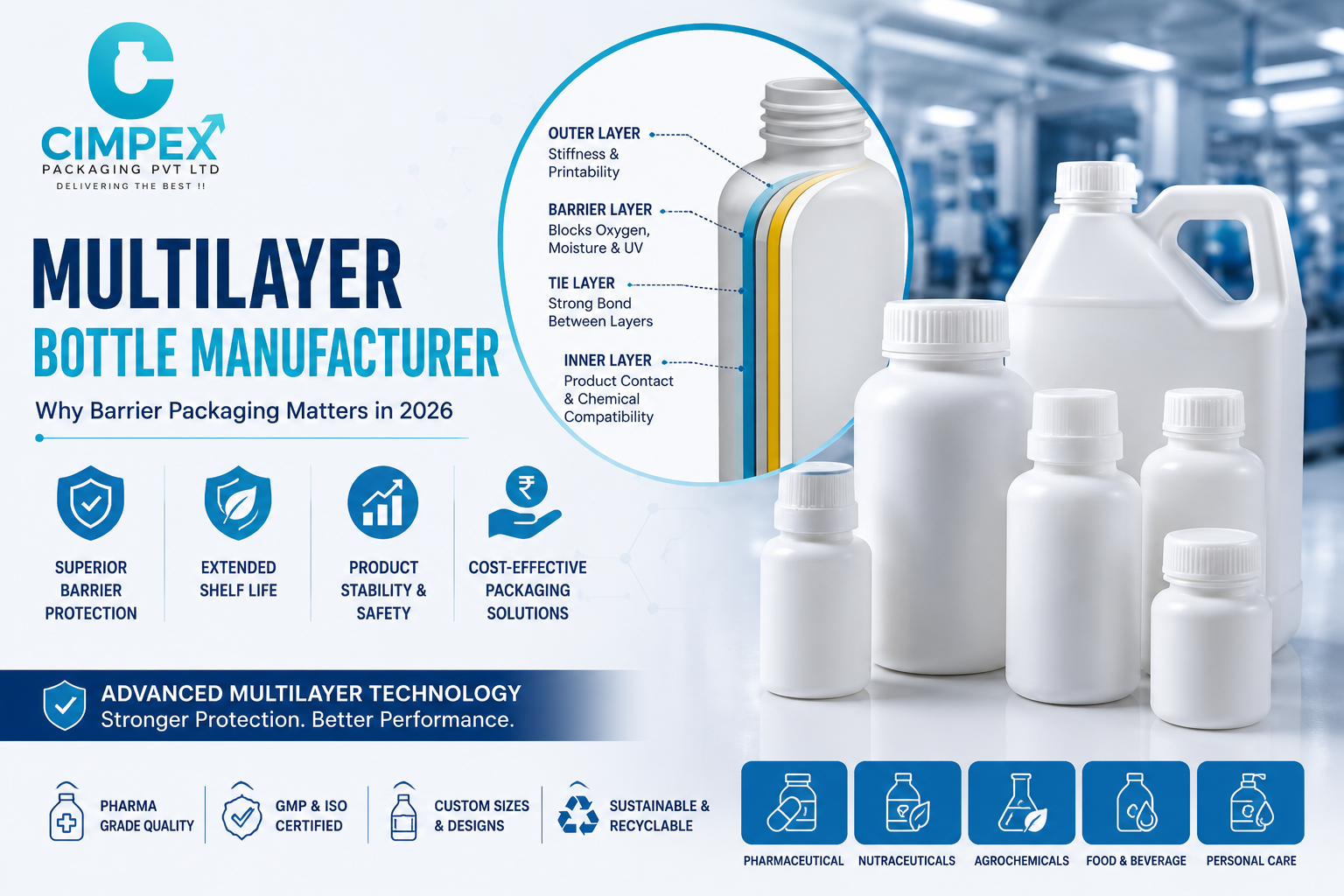
A multilayer bottle is exactly what it sounds like: a container wall made of three, five or seven distinct plastic layers, extruded together in a single pass rather than bonded afterward. Each layer plays a different role — an outer layer for stiffness and print quality, a barrier layer (often EVOH or a specialty nylon) that blocks oxygen transmission, a tie layer that bonds otherwise incompatible plastics, and an inner layer chosen for product compatibility, such as USP Class VI-compliant HDPE for oral pharma liquids. A multilayer bottle manufacturer has to control extrusion temperature, layer ratio and cooling rate simultaneously, because a barrier layer that’s too thin loses its oxygen-blocking value, while one that’s too thick can make the bottle brittle or push cost past what the category can bear. This is precision work, and it’s exactly why not every bottle manufacturer offers true co-extruded barrier construction. Getting the ratio wrong by even a few percentage points can shift oxygen transmission rate enough to fail a stability test that a formulation team has already budgeted six months for, which is why layer-ratio control sits closer to a chemistry problem than a moulding one.
Why Barrier Packaging Matters in 2026
Three things have converged to make barrier packaging a 2026 priority rather than a future consideration. First, formulation science has moved toward more oxygen-sensitive actives — probiotics, certain vitamins, and biologics-adjacent nutraceuticals — that visibly degrade within months in a permeable container. Second, regulatory expectations are tightening: CIB-registered agrochemical categories and GMP-audited pharma manufacturing now demand stronger stability-testing data, and a bottle that fails accelerated aging delays a product launch by weeks, sometimes months, while a new wall structure gets re-qualified. Third, brand owners are under real cost pressure to cut secondary packaging — foil pouches, extra cartons, desiccant sachets — and a well-built multilayer bottle manufacturer can often replace that secondary layer with the primary container itself, which lowers landed cost even though the bottle carries a modest premium over mono-layer.
For a packaging-development team evaluating suppliers, that arithmetic usually settles the debate: paying slightly more per unit to a multilayer bottle manufacturer is frequently cheaper than paying for foil lamination, extra warehousing for shorter-dated stock, or the cost of a recall triggered by oxidized product.
How Does a Multilayer Bottle Manufacturer Build an Effective Barrier?
Getting barrier performance right isn’t a single decision — it’s a stack of smaller ones made at the resin, tooling and process level, and it’s where a serious multilayer bottle manufacturer separates itself from a generic blow-moulder. Ask any experienced multilayer bottle manufacturer and they’ll tell you the barrier layer gets most of the attention, but wall-thickness distribution around the shoulder and base of the bottle matters almost as much — a thin spot at the base undermines an otherwise excellent barrier core.
Layer Architecture and Materials
Most co-extruded barrier bottles use a 3-layer or 5-layer structure. A typical configuration pairs virgin HDPE or PP on the outside with an EVOH or nylon barrier core, tied together with a maleic-anhydride-grafted adhesive resin. A skilled multilayer bottle manufacturer will also design in a scrap or regrind layer sandwiched between two virgin layers, which recovers production waste without touching the product-contact surface — useful for keeping unit costs competitive on high-volume runs.
What Goes Into the Barrier Layer Choice
- EVOH: excellent oxygen barrier, ideal for oxidation-sensitive actives and flavored liquids
- Nylon (PA): good barrier plus toughness, common in agrochemical bottles
- Tie-layer resin: bonds the barrier core to HDPE or PP without delamination
- Virgin inner layer: the product-contact surface, matched to fill chemistry
- Neck finish compatibility: standard finishes like 24/410, 28/410 and 38mm for pump and cap fit
What Does Barrier Construction Add to Unit Cost and Lead Time?
Brand teams new to barrier packaging usually ask about cost before anything else, and it’s a fair question. A multilayer wall typically adds a modest per-unit premium over a mono-layer bottle in the same resin family, driven mostly by the barrier resin itself — EVOH runs considerably more than commodity HDPE — plus slightly slower cycle times on co-extrusion tooling compared with single-layer blow moulding. Minimum order quantities tend to sit close to standard mono-layer runs once a mould exists, though a brand-new multilayer mould naturally carries a longer lead time than reusing an existing cavity. For most oxidation-sensitive fills, that premium is still smaller than the combined cost of foil-laminated pouches, individually wrapped desiccants, or the inventory write-off from stock that ages out before it sells.
Where Multilayer Bottles Are Used Across Industries
Not every fill needs a barrier bottle, but a growing list does. A multilayer bottle manufacturer working across pharma, nutraceutical, cosmetic, FMCG and agrochemical categories typically sees demand concentrated in:
- Oral liquids and syrups sensitive to oxidation
- Probiotic and enzyme-based nutraceutical formulations
- Fragranced or actives-loaded cosmetic lotions and serums
- Agrochemical concentrates requiring CIB-compliant containment
- Chemical and industrial fills where solvent permeation is a concern
In each of these categories, the choice usually comes down to weighing barrier performance against cost and recyclability, which is why packaging-development teams increasingly compare our HDPE & PP bottles against multilayer options rather than assuming barrier is always the right call. A good multilayer bottle manufacturer will tell you honestly when a mono-layer bottle is enough — for example, a short-dated FMCG liquid with a nine-month shelf life rarely needs the same barrier core as a nutraceutical capsule blister-alternative liquid meant to sit on a pharmacy shelf for two years.
Multilayer HDPE Bottle vs. Standard HDPE vs. PET — Choosing the Right Material
Material choice still matters even once you’ve decided barrier protection is worth the cost. A multilayer HDPE bottle keeps HDPE’s chemical resistance and impact strength on the outside while adding an internal barrier core — a good fit for agrochemical and industrial fills that need both toughness and low permeability. PET, by contrast, offers natural clarity and a reasonable inherent oxygen barrier on its own, so a mono-layer PET bottle can sometimes match a lower-tier multilayer HDPE bottle for cost-sensitive cosmetic or FMCG lines. For teams weighing these trade-offs line by line, our detailed HDPE vs PET vs PP guide breaks down chemical resistance, clarity, weight and cost across all three resins, and it’s worth reading before finalizing a spec with any multilayer bottle manufacturer. PP, meanwhile, tends to enter the conversation when a fill needs higher heat resistance — think hot-fill agrochemical concentrates or certain cosmetic actives processed above 70°C — and a multilayer PP structure can combine that heat tolerance with the same barrier core options used in HDPE builds.
What Should You Look for in a Multilayer Bottle Supplier India Sourcing Decision?
Choosing between manufacturers isn’t only about who quotes the lowest price per unit. A reliable multilayer bottle supplier India-based procurement teams can depend on for repeat orders should be able to demonstrate several things at once, and a genuine multilayer bottle manufacturer will have documented answers ready rather than vague assurances:
- ISO 9001:2015-certified manufacturing with documented process controls
- In-house co-extrusion tooling rather than outsourced blow-moulding
- Oxygen transmission rate (OTR) data for each barrier configuration offered
- Consistent neck-finish tolerances (24/410, 28/410, 38mm and similar) for cap and pump compatibility
- Capacity to trial small batches before committing to full production runs
- Clear lead times and the ability to scale from pilot to bulk without re-tooling delays
A multilayer bottle manufacturer that can walk through OTR numbers and layer ratios in a technical conversation — not just a sales call — is usually the one that will hold spec consistently across your first hundred thousand units and your millionth. It’s also worth asking how the supplier handles regrind: a manufacturer that reuses production scrap responsibly inside a middle layer, without letting it touch the product-contact surface, is generally running a tighter, more cost-disciplined operation than one that either wastes scrap entirely or cuts corners on where it goes back in.
The Barrier Advantage
Barrier packaging in 2026 isn’t about chasing a trend — it’s about matching container performance to what’s actually inside the bottle. Whether you’re stabilizing a probiotic formulation, protecting an agrochemical concentrate, or simply trying to extend shelf life without adding a foil pouch, working with an experienced multilayer bottle manufacturer gives you a direct route to that protection, built into the primary pack rather than bolted on afterward. The right multilayer bottle manufacturer treats the barrier layer as part of the formulation-protection strategy from day one, not as an afterthought bolted onto an existing mould.
Cimpex Packaging manufactures co-extruded, multilayer and standard HDPE/PP/LDPE bottles, jars, caps and pumps from our ISO 9001:2015-certified facility in Baddi, Himachal Pradesh, serving pharma, nutraceutical, cosmetic, FMCG, agrochemical and chemical brands across India. As a multilayer bottle manufacturer built around in-house co-extrusion, we can walk you through layer configurations and OTR data for your specific fill. You can browse our product range to see current bottle and closure formats, or reach out directly to discuss multilayer needs with our packaging-development team.
FAQs
- What makes a multilayer bottle different from a standard HDPE bottle?
A multilayer bottle has several co-extruded layers, including a barrier core like EVOH, giving it far lower oxygen and moisture transmission than a single-material bottle.
- Which industries need barrier bottles most?
Pharma, nutraceutical, agrochemical and select cosmetic brands with oxidation-sensitive formulations rely most heavily on barrier packaging.
- How do I choose the right multilayer bottle manufacturer?
Look for in-house co-extrusion tooling, published OTR data, ISO 9001:2015 certification and willingness to run small trial batches before full production.
- Is a multilayer HDPE bottle recyclable?
Multilayer bottles are recyclable but require compatible waste streams; check with your recycler on multi-resin container handling in your region.
- Does a multilayer bottle cost more than a mono-layer bottle?
Yes, typically a modest premium, but it often offsets the cost of foil pouches, desiccants or shorter shelf life on sensitive formulations.
- What neck sizes are available on multilayer bottles?
Common finishes include 24/410, 28/410 and 38mm, matched to standard pump, cap and dispensing closure options.
- Can a multilayer bottle manufacturer produce custom capacities?
Yes — most multilayer bottle manufacturers, including Cimpex, offer custom mould development once minimum order volumes are confirmed.