


Some products fail in the pack long before they fail on the shelf. Solvents escape through the wall, oxygen creeps in, aromas fade, and a formulation that passed every stability test arrives weakened.
Multilayer bottles exist to close that gap. Instead of one plastic doing every job, several materials are combined into a single wall, each handling what it does best. The result is barrier packaging that behaves like one bottle but performs like four.
Demand for high barrier packaging keeps rising because shelf lives are longer, formulations more aggressive and export routes slower. A mono-layer HDPE pack cannot hold certain products for eighteen months, however thick the wall. Adding a dedicated barrier layer solves what extra material cannot.
This guide explains what multilayer bottles are, how the layers are built, what the EVOH barrier actually does and where these containers earn their cost. To see current specifications first, view our multilayer bottles range.
Written from the shop floor rather than a brochure, it should help technical buyers specify multilayer bottles and their coextrusion requirements with confidence.
What Are Multilayer Bottles?
Definition
Multilayer bottles are containers whose wall is built from two or more polymer layers bonded together during moulding. The layers are not laminated afterwards, and they cannot be peeled apart in normal use.
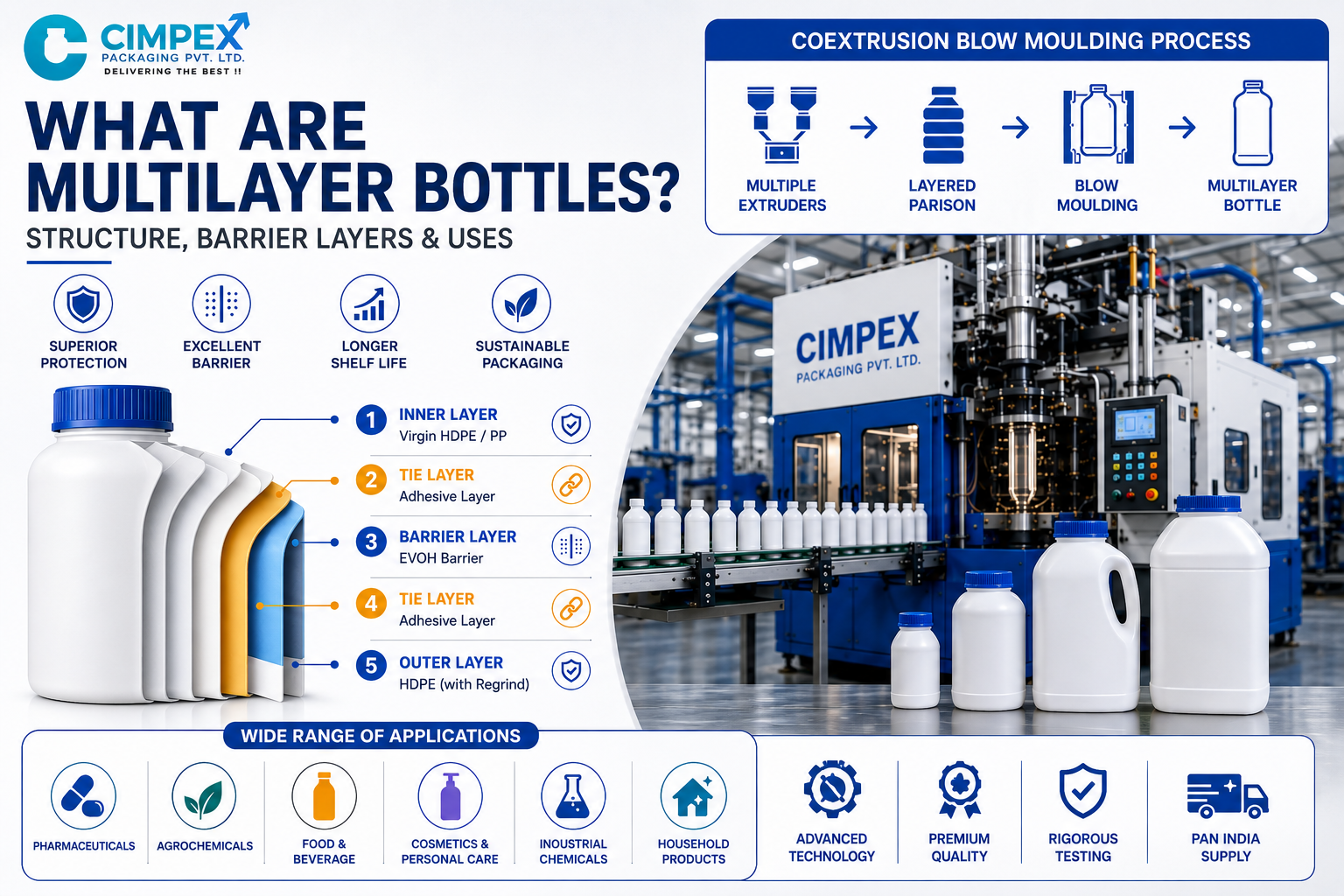
A common design places a thin EVOH barrier between two polyolefin skins, held by adhesive tie layers. Total wall thickness stays close to a standard bottle, so the multilayer bottle structure runs on existing filling lines.
How Multilayer Bottles Are Manufactured
Production uses coextrusion blow moulding. Several extruders feed one die head, which forms a layered parison. That parison is clamped in the mould and inflated, so the container emerges fully bonded in a single cycle.
No secondary operation is needed. In coextrusion, layer sequence, thickness and distribution are set by the die geometry and the extruder speeds.
Why Multiple Layers Are Used
No single commodity polymer offers strength, chemical resistance, oxygen barrier and low cost together. HDPE is tough and cheap but breathes. EVOH stops oxygen but is expensive and moisture-sensitive.
Layering resolves the conflict. Multilayer bottles place each material exactly where it is needed, which is why the EVOH barrier layer is often only three to five percent of wall thickness.
Understanding Multilayer Bottle Structure
A typical multilayer bottle structure runs five layers, sometimes six. Reading from the product outwards:
Inner Layer
Material: virgin HDPE or PP, selected for compatibility with the fill. Purpose: safe direct contact. Benefit: no interaction with the product and a clean surface for filling lines.
Adhesive (Tie Layer)
Material: maleic anhydride grafted polyethylene. Purpose: EVOH will not bond to polyolefins on its own, so the tie layer glues them chemically. Benefit: no delamination when the bottle is squeezed, dropped or thermally cycled.
EVOH Barrier Layer
Material: ethylene vinyl alcohol copolymer. Purpose: block oxygen ingress and solvent or aroma loss. Benefit: the shelf life gain that justifies the whole multilayer bottle structure. This is the barrier layer everything else protects.
Because EVOH loses barrier performance when it absorbs moisture, it is always buried between hydrophobic layers.
Outer Protective Layer
Material: HDPE, frequently carrying reprocessed regrind. Purpose: mechanical strength, UV protection and print surface. Benefit: impact resistance plus a route to use production scrap responsibly.
| Layer | Typical Material | Purpose | Benefit |
| 1. Inner layer | Virgin HDPE or PP | Direct product contact | Chemical compatibility and clean fill |
| 2. Tie layer | Grafted adhesive resin | Bonds EVOH to polyolefin | Prevents delamination in service |
| 3. Barrier layer | EVOH copolymer | Blocks oxygen and aroma transfer | Longer shelf life, stable actives |
| 4. Tie layer | Grafted adhesive resin | Bonds barrier to outer skin | Structural integrity under stress |
| 5. Outer layer | HDPE, often with regrind | Mechanical strength and finish | Impact resistance, printable surface |
What Is an EVOH Barrier and Why Is It Important?
The EVOH barrier is the working core of most multilayer bottles, and the reason a multilayer bottle structure costs more than a mono-layer pack. Its contribution shows up in five measurable ways.
- Oxygen barrier: EVOH reduces oxygen transmission by orders of magnitude compared with plain HDPE, which protects oxidation-sensitive actives
- Aroma retention: flavour and fragrance compounds stay inside instead of migrating through the wall
- Chemical resistance: hydrocarbon solvents and aromatic agrochemicals lose far less volume during storage
- Shelf-life improvement: many products gain twelve to twenty-four months of usable life from the same formulation
- Product stability: assay values, colour and viscosity hold closer to release specification through the shelf period
For oxygen barrier bottles the maths is simple. If the EVOH barrier prevents one batch rejection a year, it has paid for itself.
How Coextrusion Technology Works
Blow Moulding Process
Coextrusion blow moulding starts with separate extruders, one per material. Each melts and meters its polymer, then feeds a shared die head under controlled pressure.
The die combines the streams into a single tube. Standard blow moulding follows: clamp, inflate, cool, trim.
Layer Formation
Layer order and thickness are governed by the die geometry and relative extruder output. Increasing one screw speed thickens that layer without disturbing the sequence.
Because coextrusion happens in the melt, the barrier layer bonds molecularly rather than mechanically, which is what makes the wall behave as a single material.
Manufacturing Advantages
- One cycle produces the finished container, with no lamination or coating step
- Expensive EVOH barrier resin is used sparingly, only where it works
- Regrind can be routed into the outer layer without touching the product contact surface
- Coextrusion allows layer structures to be tuned per product rather than per factory
Applications of Multilayer Bottles
These six sectors account for most demand for multilayer bottles in India.
Pharmaceuticals
Oxidation-sensitive syrups, oral liquids and nutraceuticals benefit directly. The EVOH barrier holds assay values steady across long distribution chains, supporting the registered stability data.
Agrochemicals
Emulsifiable concentrates and aromatic solvent formulations permeate ordinary HDPE. A barrier structure retains active content, prevents panelling and reduce the odour complaints that follow solvent loss.
Food & Beverage
Edible oils, sauces, syrups and health drinks stay fresher for longer. Oxygen barrier technology delays rancidity and protects colour in food packaging bottles.
Cosmetics & Personal Care
Fragrance retention is the main driver. A perfumed lotion loses character quickly in a permeable pack, so cosmetic packaging increasingly specifies an EVOH barrier layer.
Industrial Chemicals
Solvents, thinners and cleaning chemicals need chemical resistant bottles that hold volume and resist stress cracking in storage.
Household Products
Fragranced cleaners, insecticides and air care products rely on multilayer bottles to keep scent strength intact until the consumer opens the cap.
Advantages of Multilayer Bottles
The commercial case rests on nine practical gains.
- Superior oxygen barrier: the barrier layer cuts transmission sharply, protecting vitamins and reactive actives
- Longer shelf life: exporters gain the months that slow logistics consume
- Better chemical resistance: aromatic and chlorinated solvents stay contained instead of permeating
- Product freshness: aroma, colour and viscosity remain close to the release specification
- Reduced contamination: an unbroken virgin inner skin keeps regrind away from the fill
- Lightweight packaging: barrier performance replaces the extra wall thickness some products need
- Cost efficiency: a thin EVOH barrier layer often removes the need for fluorination, foil seals or overpacking
- Sustainable packaging: scrap returns to the outer layer, and lighter bottles cut freight emissions
- Excellent durability: bonded layers resist impact, stacking load and temperature swings
Set against these, the honest trade-offs are higher tooling cost and a recycling stream that prefers mono-material packs.
How to Choose the Right Multilayer Bottle Manufacturer
Barrier packaging is unforgiving of shortcuts. Check these nine points before appointing a supplier for multilayer bottles.
- Manufacturing expertise: genuine coextrusion experience, not mono-layer moulding with a barrier claim
- Quality certifications: ISO 9001 systems and documented food or pharma grade material handling
- Barrier technology: ability to design the multilayer bottle structure around your specific permeant
- Custom mould development: in-house tooling shortens development and protects your design
- Production capacity: enough coextrusion lines to hold schedule during peak season
- Material quality: traceable virgin resin and controlled regrind policy
- Leak testing: one hundred percent online leak detection, not sample-based checking
- Regulatory compliance: BIS and relevant food-contact requirements evidenced on paper
- Bulk supply capability: dependable monthly volume against firm delivery dates
Our manufacturing process page sets out how these controls run in practice.
Conclusion
Multilayer bottles are not premium packaging for its own sake. They solve a specific engineering problem: holding a difficult product for a long time without changing the bottle a filling line already runs.
Once you understand the multilayer bottle structure, the choice becomes technical rather than commercial. Match the EVOH barrier to the permeant, size the tie layers correctly, and the pack does the rest.
Ready to specify a structure? Contact Cimpex Packaging today for customised multilayer bottles and advanced barrier packaging. Send your product, fill volume and shelf-life target, and our engineers will propose a layer design, produce samples and quote in writing.
Frequently Asked Questions
1. What are multilayer bottles made of?
Multilayer bottles combine HDPE or PP skins, adhesive tie layers and an EVOH barrier layer, all coextruded into a single wall that behaves as one container.
2. Why is EVOH used as the barrier layer?
EVOH offers an outstanding oxygen barrier but absorbs moisture, so multilayer bottles bury the EVOH barrier between polyolefin layers that keep it dry and effective.
3. How many layers does a multilayer bottle structure have?
Three, five and six-layer designs are common. A typical multilayer bottle structure runs HDPE, tie, EVOH, tie, HDPE, with the barrier layer only a few percent of wall thickness.
4. What is coextrusion?
Coextrusion feeds several extruders into one die head to form a layered parison. Blow moulding then shapes it, so the layers leave the machine fully bonded.
5. Which industries use multilayer bottles?
Agrochemical, pharmaceutical, food, cosmetic and industrial chemical brands specify multilayer bottles wherever oxygen ingress, solvent loss or aroma migration shortens shelf life.
6. Are multilayer bottles recyclable?
They enter polyolefin streams where EVOH content stays low, though separation is harder than for mono-material packs. Layer design decides how recyclable the bottle really is.
7. Do multilayer bottles cost more?
Unit cost is higher, but the barrier layer often removes fluorination, foil seals or overpacking, so total packaging cost per protected litre frequently falls.
8. Can Cimpex develop custom multilayer bottles?
Yes. We design layer structures, moulds and colours for multilayer bottles across pharmaceutical, agrochemical, food and cosmetic applications, with coextrusion in-house.