


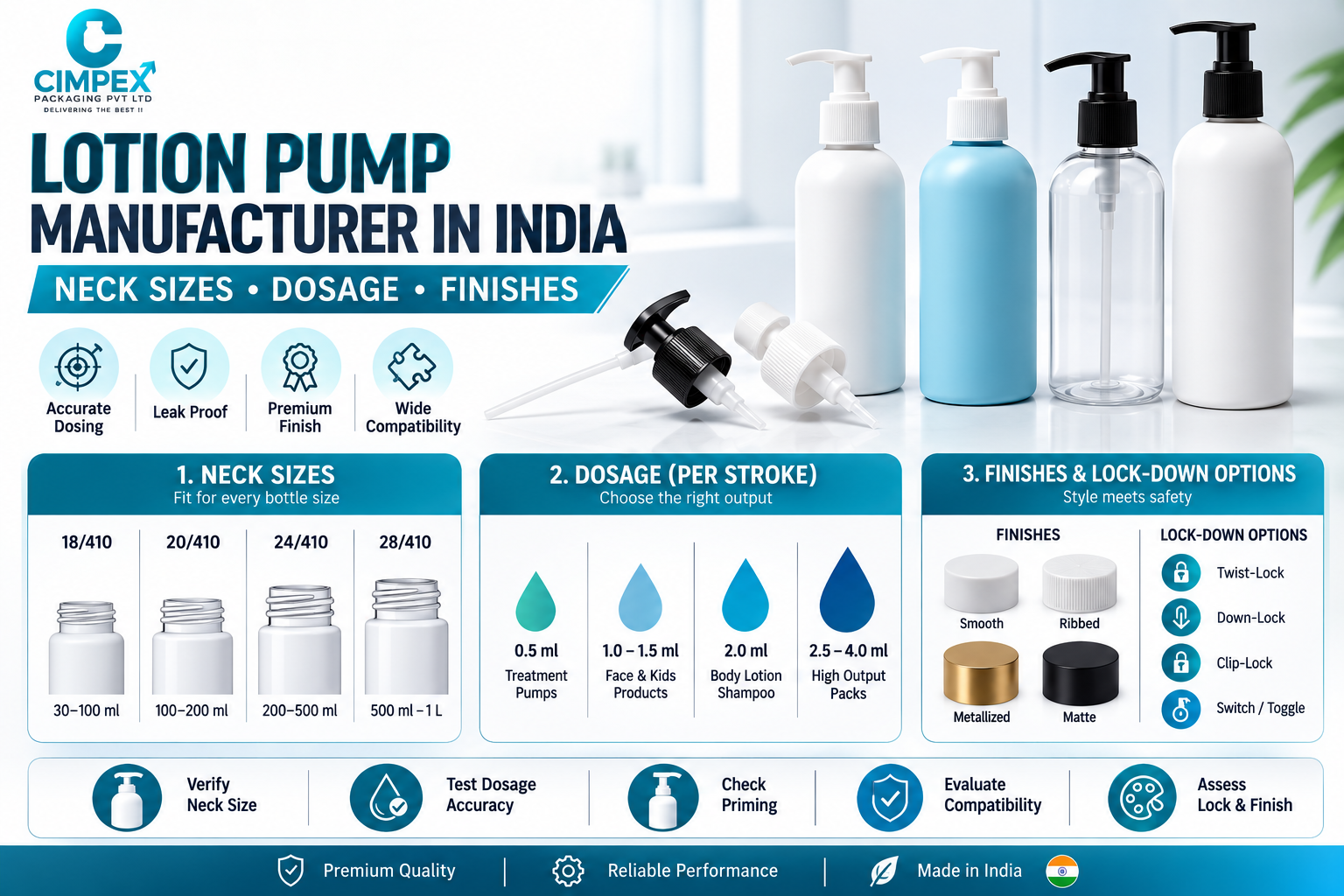
Choosing a lotion pump manufacturer in India looks simple until the first sampling round. A pump that matches the bottle on paper leaks at the shoulder, doses 1.9 ml when R&D asked for 1.2, or ships with a glossy silver collar that fights the label design. Most of these failures trace back to three specifications that get skimmed in the RFQ: neck size, output per stroke, and finish. This guide walks procurement, packaging-development and brand teams through all three plus lock-down styles, dip-tube sizing and bottle compatibility so the next batch of lotion pumps you approve fits, doses and presents exactly as intended. The same logic applies whether you are ordering 10,000 units for a pilot or negotiating annual volumes with a lotion pump manufacturer in India across a dozen SKUs.
Why Neck Size Is the First Question a Lotion Pump Manufacturer in India Will Ask
Neck size is the interface between pump and bottle. Get it wrong and nothing else matters: the closure cross-threads, wobbles or weeps at the gasket. Indian converters follow the same SPI/GPI neck-finish system used worldwide, so a drawing from a plastic pump manufacturer in Baddi reads the same as one from Guangzhou. Any lotion pump manufacturer in India worth shortlisting will ask for your bottle’s neck-finish drawing before quoting treat that question as a good sign, not a delay.
What Does 24/410 Actually Mean?
The first number is the outer thread diameter of the bottle neck in millimetres. The second describes the thread profile a 410 finish carries one full thread turn at a defined neck height, which suits pumps and dispensing closures. A lotion pump 24/410 therefore fits any bottle blown with a 24 mm, 410-series neck, whether that bottle is HDPE, PET or glass. Sister profiles exist: 400 is shorter, 415 taller, and they are not interchangeable. Seat a 24/410 pump on a 24/400 neck and the housing bottoms out or the gasket never compresses evenly. Confirm both numbers, never just the diameter.
The Four Neck Sizes That Cover Most Briefs
- 18/410 the smallest mainstream pump neck. Pairs with 30–100 ml bottles for serums, facial treatments and premium travel formats where a small, discreet collar matters.
- 20/410 the 100–200 ml zone: face lotions, hair serums, hand sanitizers. Most sanitizer pump India programmes launched since 2020 standardised here or on 24 mm.
- 24/410 the workhorse. Runs 200–500 ml bottles for body lotion, shampoo, conditioner and liquid handwash, and is typically the fastest size to source in bulk because every serious dispenser pump bulk supplier tools for it first.
- 28/410 for 500 ml to 1 litre packs: family-size lotions, liquid soaps, industrial hand cleaners and agrochemical adjuvant dosing, where a wider neck speeds filling lines.
If the range will grow, confirm early that your lotion pump manufacturer in India stocks all four necks consolidating later is painful.
Dosage: Matching Output per Stroke to the Product
Output per stroke is fixed by the piston and chamber, not something the user can modulate. Specify it against real usage: a mismatch either irritates the customer or empties the bottle in three weeks. A capable lotion pump manufacturer in India will offer several output bands within the same neck size.
Standard Dosage Bands from 0.5 ml to 4 ml
- 5 ml treatment pumps for actives, pharma topicals and nutraceutical syrups where dosing discipline matters more than speed.
- 0–1.5 ml facial moisturisers, sanitizing gels, kids’ formats; two strokes still feel generous.
- 2 ml the default for body lotion and shampoo on 24/410 necks, and the band most buyers mean when they say “standard lotion pump.”
- 5–4 ml high-output heads for 28/410 salon packs, litre-size handwash and B2B refill formats.
Whichever band fits, ask the lotion pump manufacturer in India to state its tolerance on nominal output around ±10% is a reasonable benchmark and to test it with your formulation, not with water.
Viscosity, Dip Tubes and Priming
Viscosity decides whether the stated dose actually arrives. Thick creams above roughly 10,000 cP starve a standard chamber, so pumps for rich body butters need wider dip tubes, stronger springs or a shift to an airless format. Two checks catch most problems early: strokes-to-prime (a good pump primes in three to five actuations) and dose consistency across the first and last quarter of the bottle. Both belong in your sampling protocol, and any experienced lotion pump manufacturer in India can run them for you before dispatch.
Finishes, Collars and Lock-Down Options
The pump is often the only component the customer touches every day, so its finish carries disproportionate brand weight and its lock-down mechanism decides whether the product survives e-commerce transit.
Surface and Collar Finishes
Smooth PP collars in custom-matched colours are the volume standard. Ribbed collars aid grip on utility packs and improve torque control on capping lines. Metallized silver or gold collars lift shelf presence for premium personal care, while matte and soft-touch treatments are increasingly specified for derma-cosmetic lines. Whatever the look, ask how the finish is achieved in-mould colouring resists scuffing far better than post-applied coatings on a bottle that lives in a wet shower. An established lotion pump manufacturer in India will also hold colour masters so repeat orders match the first.
Which Lock-Down Style Should You Specify?
- Twist-lock (left-right) the market default; the actuator rotates a quarter-turn to lock. Familiar to users and reliable on automated lines.
- Down-lock the head screws down flush for a lower transit profile; popular for export cartons where every millimetre of headspace costs freight.
- Clip-lock a removable clip under the actuator; cheap and visibly tamper-evident, but the clip becomes loose plastic waste.
- Switch or toggle locks found on premium formats; they add cost and parts, so justify them with real positioning need.
For online-first brands, pair any lock-down with an induction or plug seal on the bottle. The pump lock stops actuation; it does not make the pack leak-proof upside down in a courier bag.
Bottle Compatibility: Making Pump and Container Work as One
A pump specified in isolation is a coin toss. The safest route is sourcing pump and bottle from one manufacturer so neck finish, dip-tube length and gasket compression are engineered together one reason brands increasingly buy lotion bottles and closures as a validated pair from a single lotion pump manufacturer in India, rather than mating components from two vendors and hoping.
Dip-Tube Length and Cut
The dip tube should reach the bottle’s lowest point with a 45-degree cut sitting just off the base too short strands product; too long kinks the tube and blocks flow. Boston rounds, flat oval tottles and offset-base custom bottles all need different lengths, so share the bottle drawing (or the bottle itself) at RFQ stage and ask for tubes trimmed to it a detail engineered properly only when pump and container come from the same plant.
Materials and Regulatory Fit
A typical lotion pump combines a PP body, closure and actuator, an LDPE dip tube, a stainless spring and an HDPE or PP gasket. For pharma and nutraceutical fills, ask for product-contact materials that comply with USP Class VI or equivalent food-grade norms, supported by batch traceability from a GMP-aligned, ISO 9001:2015-certified plant. Agrochemical brands dosing CIB-registered formulations should also verify chemical resistance against the actual solvent system an accelerated compatibility study beats any datasheet. A serious lotion pump manufacturer in India will run that study with you rather than wave a generic certificate.
How to Evaluate a Lotion Pump Manufacturer in India
Once samples pass, the commercial questions decide whether a lotion pump manufacturer in India can hold price, quality and lead time in year two. Work through this checklist before awarding annual volumes:
- Neck-size range can one partner cover 18/410 through 28/410 so you consolidate vendors as the range grows?
- Dosage options multiple output bands per neck size, with stated tolerances.
- In-house testing output-per-stroke, leak, torque and life-cycle actuation data on request.
- Bottle capability a manufacturer that also moulds HDPE, PP and LDPE containers can guarantee the pair, not just the pump.
- Certifications ISO 9001:2015 at minimum; GMP alignment for pharma work.
- Scalability honest lead times at 50,000 and at 5 lakh units, not just an attractive pilot MOQ.
- Customisation colour matching, collar finishes and logo engraving handled in-house.
For a deeper look at how these criteria play out across cosmetic, pharma and personal-care programmes, this guide to choosing a top lotion pump manufacturer in India goes segment by segment. And if your range extends beyond lotions into sprayers, foamers or treatment formats, evaluate the supplier’s full dispenser pumps catalogue at the same time consolidating closures with one dispenser pump bulk supplier almost always beats fragmenting the spend.
Specifying Your Pump
Write the specification the way a moulder reads it: neck size and finish (say, 24/410), nominal output per stroke with tolerance, lock-down style, collar finish and colour, dip-tube length against a named bottle, and the fill formulation for compatibility testing. That single paragraph prevents most sampling iterations. Then test with real product, on real filling equipment, at real line speeds. If you are shortlisting a lotion pump manufacturer in India, the fastest way to pressure-test everything here is to request pump samples against your own bottle and formulation a week of bench testing tells you more than any brochure will.
Frequently Asked Questions
Which lotion pump neck size is most common in India?
24/410 dominates for almost every lotion pump manufacturer in India because it fits the 200–500 ml bottles most brands sell. 28/410 leads in litre packs; 20/410 and 18/410 serve facial and pharma formats.
How much does a standard lotion pump dispense per stroke?
Around 2 ml per stroke on a typical 24/410 pump. Options run from 0.5 ml treatment pumps to 4 ml high-output heads. Always confirm nominal output and tolerance in writing before tooling approval.
Can the same pump dispense both sanitizer and lotion?
Often, yes most sanitizer gels run happily through a standard 1–2 ml pump. Verify chemical compatibility of the gasket and spring with high-alcohol formulas, and confirm dose consistency with your exact viscosity.
What is a realistic MOQ when buying pumps in bulk?
Stock colours in standard sizes like 24/410 often start at 5,000–10,000 pieces from a lotion pump manufacturer in India. Custom colours, metallized collars or logo engraving push MOQs to 25,000 pieces or more.
How do I identify my bottle’s neck finish?
Measure the outer thread diameter with vernier callipers (18, 20, 24 or 28 mm), then match thread turns and neck height to the SPI chart or send the bottle to your pump supplier and ask for a fitment report.
Do lotion pumps work with thick creams?
Up to a point. Very viscous creams and butters starve standard chambers, causing partial doses. Wider dip tubes and stronger springs help; beyond that, switch to an airless pump or a wide-mouth jar format.
Which lock-down style is best for e-commerce shipping?
Down-lock or twist-lock heads paired with an induction-sealed bottle. The lock prevents actuation in transit, while the seal stops leakage courier handling requires both, not either one alone.