


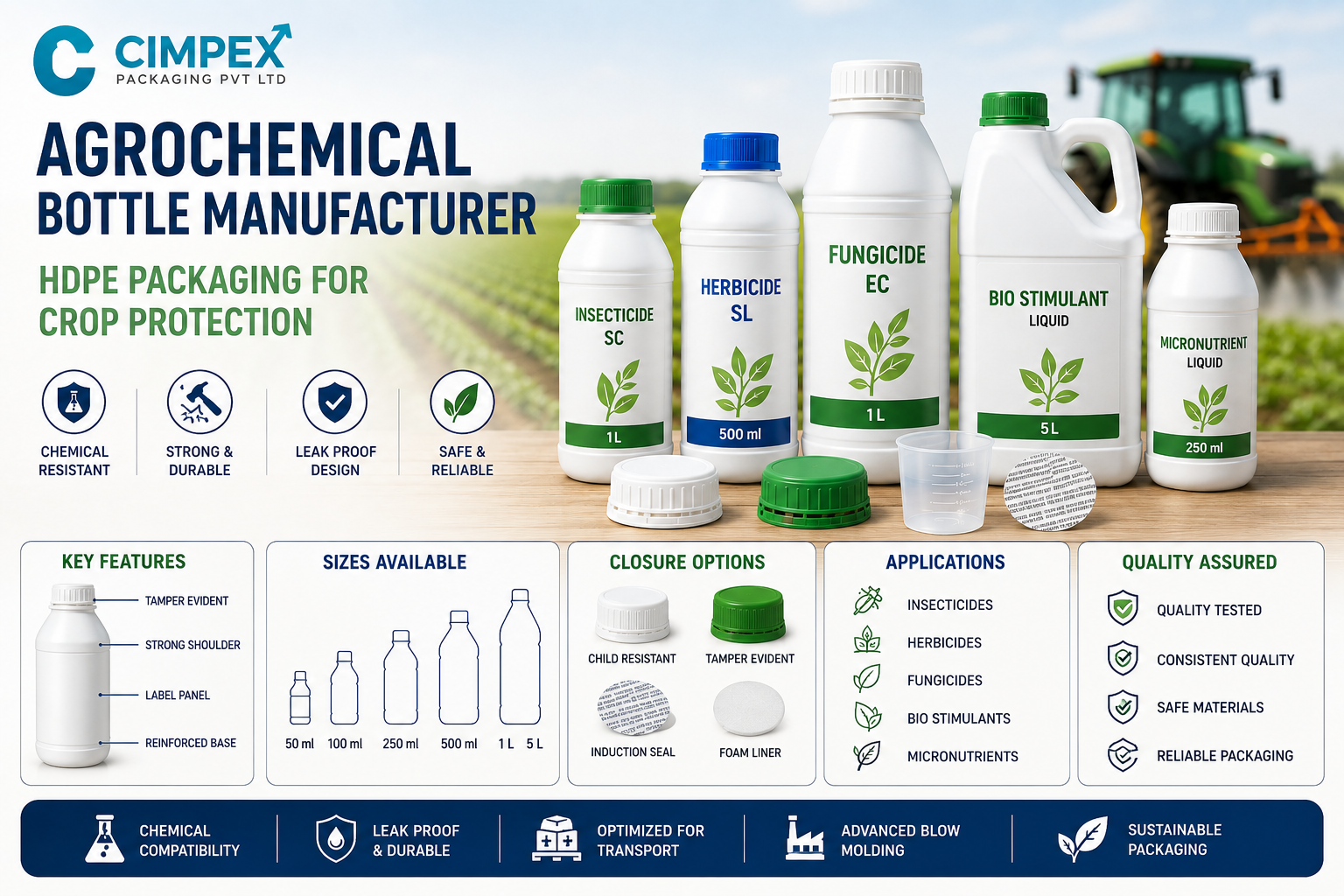
Picking an agrochemical bottle manufacturer is not a commodity decision. A crop protection pack has to hold an aggressive EC formulation for two years, survive a tractor trolley on a village road, vent without glugging when a farmer pours into a knapsack sprayer, and still carry a legible batch code at the dealer counter. Cimpex Packaging moulds HDPE, PP and multilayer agrochemical bottles from Baddi for pesticide, herbicide, fungicide and micronutrient brands, and most failures we are asked to fix trace back to a spec sheet that treated the bottle as a container, not a chemical containment system. This guide covers what to specify, test and demand from an agrochemical bottle manufacturer supporting a registered product.
Why HDPE Remains the Default for Crop Protection Packaging
Every agrochemical bottle manufacturer should start from the formulation. Suspension concentrates (SC) and soluble liquids (SL) are water-based and undemanding. Emulsifiable concentrates (EC) are the problem: aromatic solvents such as xylene, plus emulsifiers and cyclohexanone, migrate into an unprotected polyolefin wall.
High-density polyethylene earns its place for four reasons:
- Chemical resistance across acids, alkalis, salts and most water-based formulations.
- Environmental stress crack resistance (ESCR) critical where surfactants and wetting agents are present.
- Impact strength at low temperature, which matters for warehouses in the north during winter dispatch.
- Cost and processability in extrusion blow moulding, including handled and stackable shapes.
PP suits higher heat resistance or stiffness; LDPE serves mainly liners, gaskets and squeeze packs. Our comparison of HDPE, PET and PP in choosing the right plastic sets out the trade-offs in more detail than a datasheet usually does.
Fluorination and multilayer barriers
For EC and solvent-heavy formulations, plain monolayer HDPE is not enough you will see weight loss, panelling and label lift within months. Two routes solve it:
- In-mould or post-mould fluorination, which converts the inner surface to create a barrier against non-polar solvents.
- Co-extruded multilayer construction, typically HDPE with an EVOH or barrier layer sandwiched between tie layers.
A capable agrochemical bottle manufacturer will recommend one over the other based on your formulation, shelf-life claim and volume, not on which line is free. We mould both monolayer and multilayer bottles; for high-solvent products the multilayer route usually wins on long-term weight-loss numbers.
What Should You Ask an Agrochemical Bottle Manufacturer Before Tooling?
Tooling is the point of no return. Ask these questions before the mould is cut, not after the first commercial batch.
1. Which resin grade, and why?
Blow moulding grade HDPE with a controlled melt flow index and high ESCR rating is the baseline. Ask for the resin grade name, the supplier, and the ESCR data. A vendor that cannot name the grade is buying on price each month, which makes your compatibility study valid only for the batch you tested.
2. What is the wall distribution?
Agro bottles fail at three places: the handle junction on 5L jerry cans, the shoulder radius, and the base standing ring. On a 1L round bottle we typically target 0.9–1.2 mm in the sidewall with heavier sections at the shoulder and base. Ask your agrochemical bottle manufacturer for a section-weight map, not a single average wall figure.
3. Which neck finish and closure system?
Common agro finishes in India include 28mm, 38mm and 45mm for liquids, with 24/410 or 28/410 used for smaller bio-stimulant and micronutrient SKUs where a dispensing or trigger closure is involved. Specify:
- Cap type: continuous thread, child-resistant (CRC), or tamper-evident band with frangible bridges.
- Wad or liner: EPE, foam or induction seal with a heat-seal layer matched to HDPE.
- Application torque range, validated on your own capping head rather than a lab vice.
4. How does the bottle vent?
Glugging is not a cosmetic complaint. A bottle that gulps splashes concentrate onto the operator’s hands and wastes product. Options include an integrated venting channel in the neck, a wider bore relative to fill volume, or a shaped shoulder. Raise it early your agrochemical bottle manufacturer has to design vent geometry into the mould.
Measuring, Dosing and Field Usability
Dose accuracy drives repeat purchase. Farmers who overdose lose margin and damage crops; those who underdose blame the product.
Practical features worth costing in:
- Moulded graduations on a translucent panel, readable in field light and not dependent on a printed label surviving a season.
- Integral measuring chambers for 100ml, 250ml and 500ml SKUs.
- A dosing cap with clear cc markings, moulded in PP for stiffness.
- A defined flat label panel, because wrap-around labels on a drafted surface will lift at the leading edge.
A good agrochemical bottle manufacturer should show you real mouldings, not renders, before you commit. Our standard HDPE & PP bottles range covers most common capacities from 50ml through 5L, which shortens qualification when a stock mould already fits the fill volume.
Transport Durability: The Part Buyers Underestimate
A pesticide bottle manufacturer in India is packing for a supply chain that includes non-palletised trucking, manual loading and rural storage sheds. Design accordingly.
- Drop performance: ask your agrochemical bottle manufacturer to test filled, conditioned bottles on base rim, shoulder and closure never empty samples.
- Top load must account for stacked cartons in a warehouse without racking.
- Panelling and vacuum collapse occur when hot-filled or when solvent loss reduces internal pressure; ribbed or panelled bottle geometry resists it.
- Leak testing on 100% of filled units where the formulation is classed as hazardous.
- Carton fit bottles that rattle inside a carton abrade labels and transfer scuffs.
If you export, dangerous goods packaging carries UN performance testing and marking requirements. Confirm early whether your SKU needs certified packaging that decision changes resin, wall weight and closure spec.
CIB Compliance, Documentation and Traceability
Registration under the Insecticides Act means your pack is part of the approved product, not an accessory to it. A CIB compliant bottle programme depends on documentation as much as moulding.
Expect your agrochemical bottle manufacturer to provide:
- Resin food or industrial grade documentation and batch-level COAs.
- Dimensional drawings with tolerances for bottle and closure.
- Compatibility and storage stability support samples for your accelerated study at 54°C and real-time trials.
- Lot traceability from resin batch to dispatch, retained samples, and change control notification.
- Consistent moulding conditions under a documented quality system; Cimpex operates an ISO 9001:2015-certified system at Baddi.
Any agrochemical bottle manufacturer can send bottles. Fewer can send the paperwork that keeps a registration audit uneventful.
How to Shortlist a Pesticide Bottle Manufacturer in India
Use this filter when shortlisting an agrochemical bottle manufacturer:
- Do they mould bottles and closures, or only bottles?
- Can they offer both fluorinated monolayer and co-extruded multilayer options?
- What in-house testing exists drop, top load, leak, ESCR, weight loss, torque retention?
- Will they hold samples and support your 54°C accelerated study?
- Who owns the mould, and what does a cavity modification cost?
- What is the repeat lead time once tooling is amortised?
- Can they supply matching caps, measuring cups and induction liners as one kit?
A vendor answering six of seven is usually workable; one that deflects on ESCR data or tool ownership rarely improves after the PO.
Costing Without Cutting the Wrong Corners
Landed cost is driven by resin price, bottle weight, barrier method and decoration. Three practical levers:
- Lightweighting works only when supported by drop and top-load data on the reduced wall.
- Barrier choice is a shelf-life decision first and a cost decision second; a failed EC batch costs more than a multilayer premium.
- Capacity rationalisation consolidating 900ml and 1L into one mould across brands lowers cost per piece.
For growing brands, the right agrochemical bottle manufacturer is the one whose tool capacity and quality system scale from 10,000 to 100,000 pieces a month without a re-tool.
Final Thoughts
Crop protection packaging fails quietly a little weight loss, a slightly lifted label, a hairline crack at the handle and then loudly, in a dealer’s godown. Specify the resin grade, the barrier route, the vent, the closure and the test protocol at the same time, and most of those failures never happen. As an agrochemical bottle manufacturer supplying pharma, nutraceutical, cosmetic, FMCG and chemical sectors from Baddi, Cimpex Packaging builds HDPE, PP and LDPE bottles, jars, caps and pumps to that standard. Discuss agro needs with our team and bring your formulation type, fill volume, shelf-life claim and closure preference to the first call.
Frequently Asked Questions
Is HDPE suitable for EC pesticide formulations?
Not on its own. Emulsifiable concentrates with aromatic solvents need a barrier either fluorination or a co-extruded multilayer wall. Plain monolayer HDPE will show weight loss and panelling over shelf life.
What is a CIB compliant bottle?
It refers to packaging that supports a product registered under the Insecticides Act correct material compatibility, storage stability data, declared pack sizes and traceable manufacturing documentation for the registered SKU.
What bottle sizes are standard for crop protection products?
Common Indian retail packs run 50ml, 100ml, 250ml, 500ml, 1L and 5L. Larger volumes generally move to jerry cans with integrated handles and 45mm or wider necks.
Fluorination or multilayer which should I choose?
Fluorination suits moderate solvent exposure and lower volumes. Co-extruded multilayer with a barrier layer performs better for long shelf life and high-solvent EC formulations, and is usually more economical at scale.
Do agrochemical bottles need child-resistant caps?
It depends on toxicity classification and market. Many household and higher-toxicity products use CRC closures; agricultural trade packs often use tamper-evident bands with induction seals instead.
How long does new bottle tooling take?
Plan several weeks from frozen drawing to first-article samples, then add time for drop, top-load and compatibility trials. Building that into the launch calendar avoids compromises at registration stage.
Can one supplier provide bottles, caps and measuring cups?
Yes. Sourcing from one agrochemical bottle manufacturer removes fitment risk between neck and closure, shortens approvals and gives you a single accountable party when a leak or torque issue hits the filling line.