


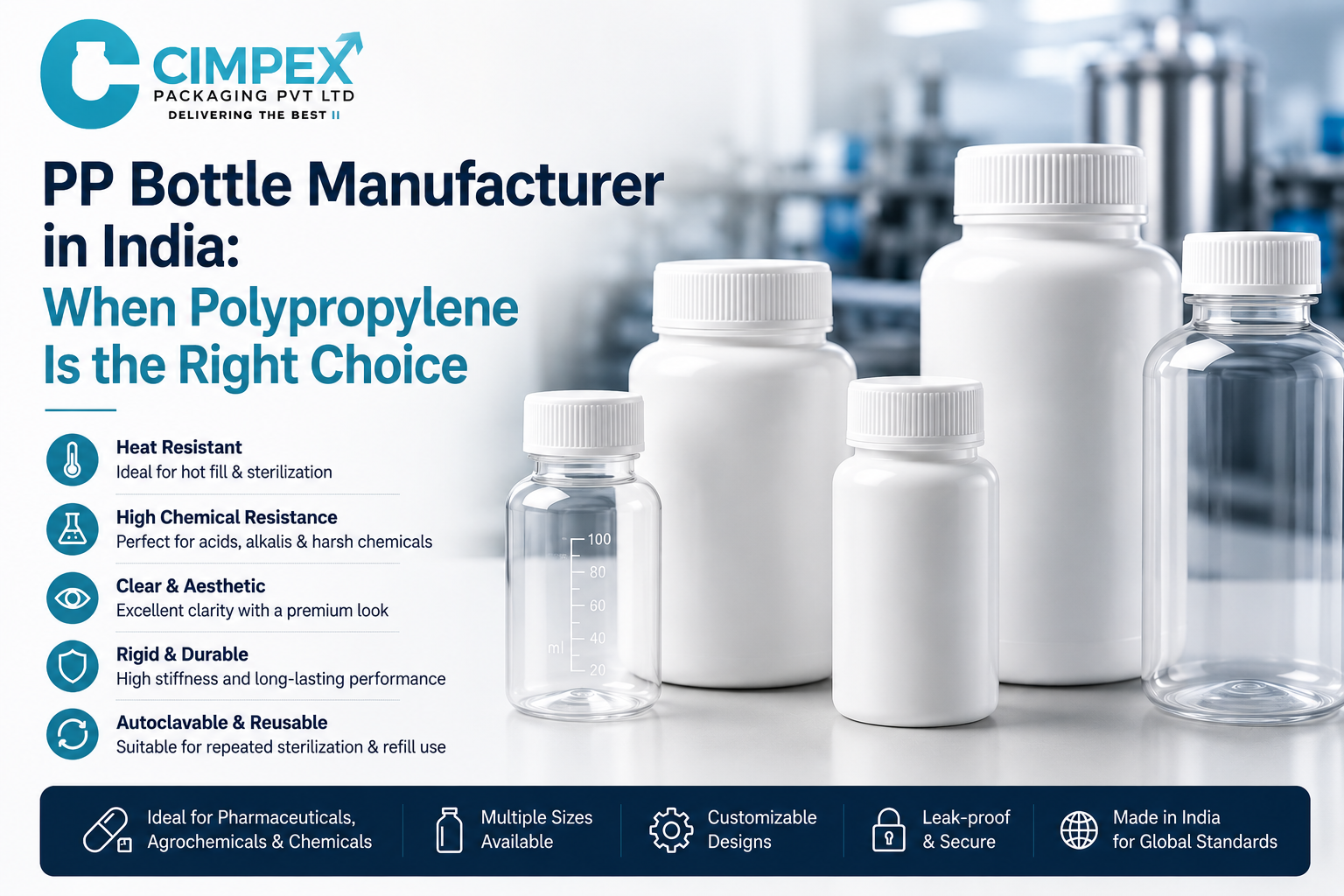
Most packaging briefs reaching our Baddi plant arrive with “HDPE” already typed into the material field. It is a sensible default. But roughly one brief in five describes something polypropylene would carry better a hot-filled syrup, an autoclaved diagnostic container, an essential oil blend that quietly stress-cracks its bottle over eight months on a distributor’s shelf. Choosing a PP bottle manufacturer is therefore less a sourcing decision than a formulation-compatibility one. This guide covers where PP outperforms HDPE and PET, where it does not, and what to ask before signing off a mould. If you are still weighing materials, start with our overview of HDPE & PP bottles.
What Actually Separates PP From HDPE and PET
The short version, from a PP bottle manufacturer that runs both resins daily: polypropylene trades a little impact toughness for a lot of heat tolerance and stiffness.
- PP melts around 160–165°C and holds shape in continuous service near 100°C. HDPE softens from roughly 75–80°C. Standard PET distorts by 60–70°C unless heat-set.
- PP has a higher flexural modulus, so a PP bottle feels rigid at a lower wall thickness than the HDPE equivalent useful when fighting for panel strength on a slim 100 ml pack.
- Clarified random copolymer PP gives contact clarity HDPE cannot reach. Not PET-grade glass clarity, but enough to show fill level and colour.
- Chemical behaviour. PP resists acids, alkalis and many polar solvents well at elevated temperature. HDPE is generally better against chlorinated solvents.
- Moisture barrier. Here HDPE wins. PP has a modestly higher water-vapour transmission rate, which matters for hygroscopic powders and effervescent tablets.
A competent PP bottle manufacturer raises that last point unprompted rather than letting you discover it during accelerated stability. For a full side-by-side across all three resins, our HDPE vs PET vs PP guide goes deeper into barrier and cost trade-offs.
The three PP grades you will actually be quoted
Homopolymer PP stiffest and most heat-tolerant. The default for autoclavable bottle applications and steam-sterilised labware.
Random copolymer (PP-R) the clarity PP bottle grade. Better impact strength, slightly lower heat deflection.
Block/impact copolymer toughest, opaque, and the grade for cold-chain handling or long winter transit.
Grade selection is where an experienced PP plastic containers supplier earns their margin. Ask which grade, which MFI, and why.
When PP Beats HDPE and PET
Hot fill, steam and terminal sterilisation
If your process fills above 85°C, HDPE is already marginal expect panel distortion and ovality after cooling. PP handles hot fill comfortably and, in homopolymer grades, survives repeated 121°C autoclave cycles at 15 psi. That makes an autoclavable bottle in PP the standard choice for diagnostic reagents, media, veterinary sterile packs and reusable labware. Wall distribution matters: an uneven neck is the first thing to slump in a steriliser, which is why a serious PP bottle manufacturer moulds bottle and closure as a matched set rather than pairing a PP bottle with any cap in stock.
Clarity without moving to PET
Nutraceutical and cosmetic brands often want visible product but need chemical resistance PET cannot deliver. A clarified random copolymer clarity PP bottle sits neatly in that gap good see-through for gummies, capsules or clear serums, with far better tolerance for alkaline and alcohol-based formulations. Expect slight haze against PET; a PP bottle manufacturer promising identical optics is overselling. A candid polypropylene bottle India supplier will mould a sample under your own label before you commit tooling.
Aggressive chemistries
Agrochemical, disinfectant and industrial chemical brands come to us specifically for PP. It holds up against concentrated acids, caustics, hypochlorite and most surfactant systems, hot or cold. For CIB-registered agrochemical formulations, PP also survives elevated-temperature storage protocols better than HDPE. Compatibility remains formulation-specific no PP bottle manufacturer should sign off on a resin without your material safety data sheet and, ideally, a filled sample.
Reuse and refill
PP tolerates dishwashing and repeated sterilisation, so it suits refill and returnable formats a rising ask under extended producer responsibility rules. HDPE survives a cycle or two; PP handles many. Flag refill intent to your PP bottle manufacturer early: it changes wall thickness and thread design.
Where PP Is the Wrong Call
Being useful means saying no. A PP bottle manufacturer that never does is selling, not advising. We steer customers away from PP when:
- The pack sees sub-zero handling. Homopolymer PP turns brittle below about 0°C. Drop-test failures in a north Indian warehouse in January are a real thing. Specify impact copolymer, or use HDPE.
- You need a squeezable bottle. LDPE dropper and squeeze bottles flex where PP cracks.
- Moisture barrier is the primary requirement. For hygroscopic granules or effervescent tablets, HDPE with an induction seal and desiccant closure is the stronger system.
- Oxygen barrier drives shelf life. Neither PP nor HDPE is a barrier resin that is a PET or multilayer conversation.
- Unit cost is the only metric. PP resin and slower cycle times add a few paise per bottle over HDPE. Worth it for performance you need; wasteful for performance you do not.
How Do You Qualify a PP Bottle Manufacturer?
Most buyers evaluate on price per thousand and lead time. Both matter, but neither causes a recall. Work through this before placing a first order with any PP bottle manufacturer:
- Ask for resin grade and source in writing. Not “PP” the grade name and MFI. Reputable suppliers name it.
- Confirm compliance for your route. For pharmaceutical primary packaging, ask about USP Class VI biological reactivity data on the specific grade.
- Check the quality system. ISO 9001:2015 is the baseline; GMP-aligned moulding halls, controlled air handling and documented line clearance matter more for pharma.
- Request dimensional reports. Neck finish tolerance, bottle weight variation, ovality and perpendicularity, with the sampling plan stated.
- Ask what happens at 121°C. A PP bottle manufacturer serving diagnostics should show post-autoclave dimensional data, not just say “it is autoclavable.”
- See the tool room. In-house mould maintenance is the difference between two-day and two-week recovery when a cavity is damaged.
- Test the closure as a system. Torque retention, liner compatibility and leak performance are bottle-plus-cap properties.
- Confirm real capacity. Ask how many machines run PP, not total plant tonnage.
A PP bottle manufacturer that answers all eight without deflecting is worth shortlisting. To see the machine-level detail behind those answers, our injection & blow moulding process page walks through how bottles, caps and pumps are produced and inspected.
Specs Worth Fixing Early
Cheap to decide now, expensive to change after tooling is cut. Settle these with your PP bottle manufacturer at the drawing stage:
- We mould PP from 30 ml dropper formats up to 5 litre jars. Fill volume plus headspace, not nominal capacity, drives the cavity.
- Neck finish. 20/410, 24/410 and 28/410 for pumps and lotion dispensers; 24/415 and 28/415 for serums; 38 mm, 45 mm and 63 mm for wide-mouth jars and powders. Fix this before artwork it dictates every closure you can buy.
- Closure type. Child-resistant caps for agrochemicals and paediatric syrups, tamper-evident bands for nutraceuticals, flip-tops for FMCG, trigger sprayers for cleaners.
- PP surface energy is low, so flame or corona treatment is usually needed for ink adhesion confirm your PP plastic containers supplier does it in-line.
- Colour and UV. Natural, opaque white, amber, or masterbatch to a Pantone reference, with UV stabiliser where the product is light-sensitive.
Browse our bottle range before committing to a custom tool a stock mould with a colour change ships in a fraction of the time and cost.
Final Thoughts
Polypropylene is not a better material than HDPE. It is a different one, with a narrower and clearer window of advantage: heat, sterilisation, clarity and aggressive chemistries. When your product sits inside that window, PP is not a nice-to-have, it is the only sensible specification. When it sits outside, a good PP bottle manufacturer will say so and quote HDPE instead and that honesty is a useful test of whether you are dealing with a converter or a partner.
Cimpex Packaging works as a PP bottle manufacturer alongside HDPE and LDPE lines bottles, jars, caps and pumps from an ISO 9001:2015-certified plant in Baddi, so the recommendation is never biased by existing tooling. Send us your formulation, fill temperature and shelf-life target, and we will tell you which resin belongs on the drawing. When you are ready, request a PP quote and we will come back with grade, tooling and timeline.
Frequently Asked Questions
Is a PP bottle autoclavable at 121°C?
Homopolymer PP bottles typically withstand repeated 121°C autoclave cycles at 15 psi. Validate with post-cycle dimensional checks on your own bottle before release.
Which is better for pharma packaging, HDPE or PP?
HDPE offers the better moisture barrier for tablets and powders. PP suits hot-filled liquids, sterilised packs and clear formats. Your formulation and fill process decide, not the resin alone.
Can PP bottles be made transparent?
Yes. Clarified random copolymer PP gives good contact clarity for gummies, serums and capsules. It is slightly hazier than PET, so request a moulded sample before finalising pack design.
What neck sizes are available on PP bottles?
Common finishes include 20/410, 24/410, 28/410, 24/415 and 28/415 for pumps and caps, plus 38 mm, 45 mm and 63 mm wide-mouth options for jars, powders and granules.
Is PP suitable for agrochemical packaging?
Yes. PP resists acids, caustics and most surfactant systems, and performs well in the elevated-temperature storage testing used for CIB-registered formulations. Share your MSDS for confirmation.
Does PP cost more than HDPE?
Usually slightly, because of resin pricing and longer cycle times. The gap is small per unit and justified when you need heat resistance, sterilisation or clarity HDPE cannot deliver.
What is the MOQ for custom PP bottles?
It depends on cavity count, colour and whether a stock or custom mould is used. Stock formats start far lower. Share your annual volumes for an accurate figure.