


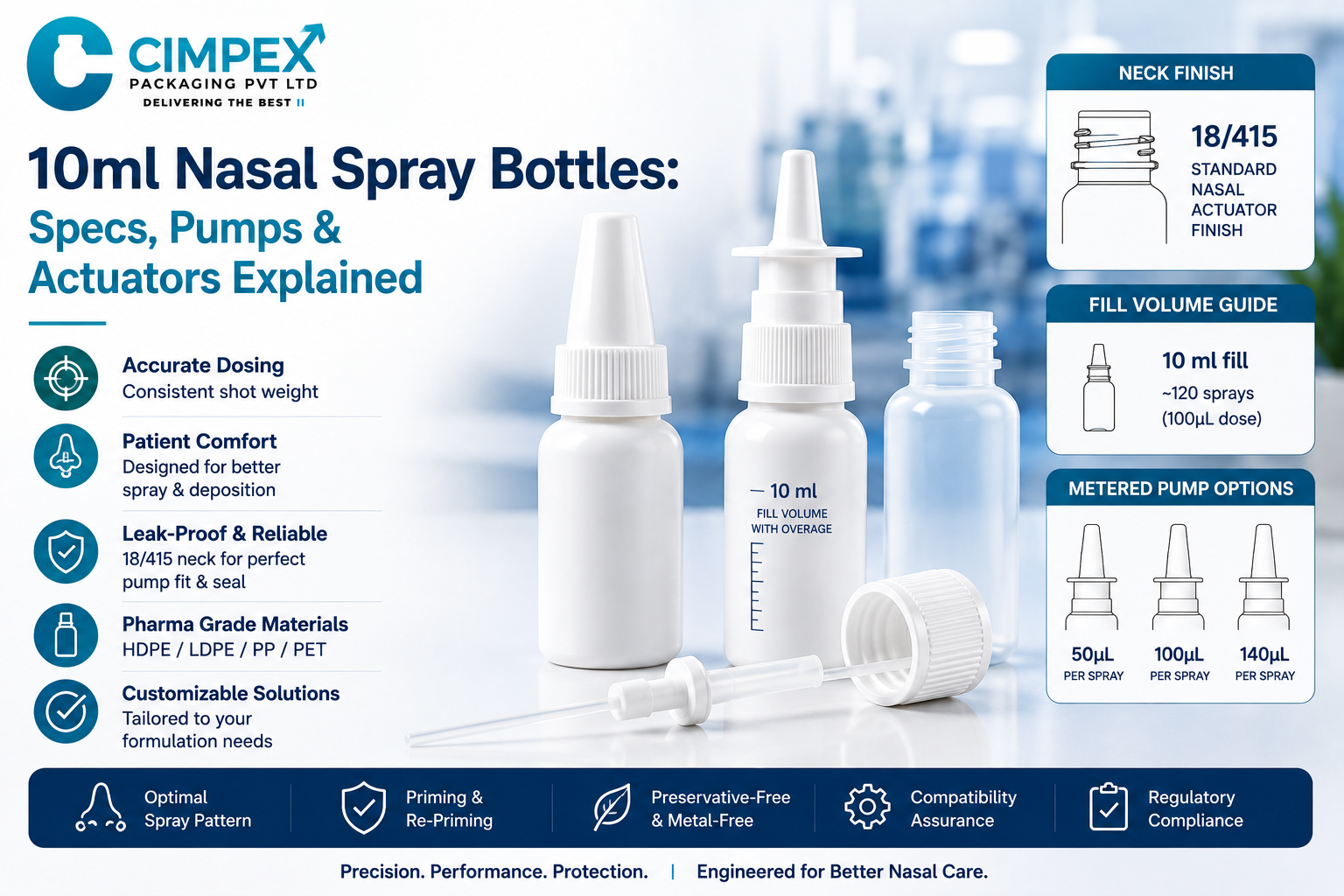
A nasal spray is not really a bottle. It is a dispensing system in which container, pump and actuator each do part of the work, and the patient only notices when one is wrong. That is why 10ml nasal spray bottles should be specified as an assembly, not bought as a container with fittings added later. Our range of nasal spray bottles and vials covers the common pharmaceutical configurations.
The 10 ml size is a workhorse: a useful quantity of formulation in a pack small enough to carry. This guide explains the components, what 18/415 really means, and what to confirm before committing to 10ml nasal spray bottles.
What Are 10ml Nasal Spray Bottles?
A 10ml nasal bottle is a plastic container fitted with a metered-dose spray pump and actuator, delivering a fine spray rather than a stream or drop. Applications include saline sprays, decongestants, allergy treatments and prescription nasal formulations.
What matters is that the three parts suit each other. A pump that fits the neck but not the formulation dispenses inconsistently however good the bottle is. Buyers need components that behave identically batch after batch. Our nasal bottles range shows standard 10ml nasal spray bottles.
Understanding the Main Components of a 10ml Nasal Spray Bottle
10ml nasal spray bottles are normally supplied as three matched parts.
Bottle
In 10ml nasal spray bottles the container holds the formulation and provides the neck. Define:
- Material, matched to the formulation
- Capacity as fill volume plus headspace
- Shape and dimensions, affecting grip and packing
- Wall thickness and its consistency
- Neck finish, which decides what pumps fit
- Dimensional consistency across runs
Neck dimensions, height and depth all influence how the pump and dip tube behave, so 10ml nasal spray bottles should be assessed with the closure fitted.
Nasal Spray Pump
The nasal spray pump fitted to 10ml nasal spray bottles is the metering element. A chamber fills with formulation and releases a set quantity on each actuation, so the dose comes from the chamber, not from how hard the user presses.
- Consistent actuation across the bottle’s life
- Metered volume, in microlitre options; confirm with your supplier
- Dip tube length, suited to bottle height
- Priming behaviour when new and after disuse
- Compatibility of every wetted component
Actuator
The actuator is the applicator the patient inserts and presses, turning pump output into a spray. Its geometry does more than it appears: the nozzle orifice and swirl features set the spray pattern, the shoulder controls insertion depth, the flange affects comfort. Poor actuator design shows as an uneven spray long before anyone blames the pump.
What Is an 18/415 Nasal Actuator?
The term describes a neck finish, and it is often used loosely.
- 18 is the nominal outside diameter of the bottle neck in millimetres.
- 415 identifies the thread finish style, corresponding to a particular thread form and neck height within standard designations.
An 18/415 nasal actuator more accurately a pump and actuator assembly built for that finish is common on 10ml nasal spray bottles because many stock pumps are made to the standard, which makes sourcing easier.
Two cautions. The designation describes a family of dimensions, not a guarantee of interchangeability: profiles, sealing surfaces and tolerances vary between manufacturers. And it is not right for every product.
Work from drawings and samples, not terminology. Confirm dimensions, fit and sealing against your filling equipment before standardising a finish for your 10ml nasal spray bottles.
How the Nasal Spray Pump and Actuator Work Together
- The user presses the actuator.
- The pump mechanism moves through its stroke.
- Formulation is drawn from the bottle and pressurised in the chamber.
- It travels through the dispensing path to the nozzle.
- Nozzle geometry breaks it into a spray and directs it.
Every stage depends on the one before, which is why these parts are chosen as a system. Pump stroke and actuation force decide whether a patient can use the device comfortably; dispensing consistency depends on correct metering and identical nozzle behaviour. Change one component and the others may behave differently, so re-test after substitution. Our dispenser pumps and actuators range takes that system view.
Important Specifications to Check Before Choosing 10ml Nasal Spray Bottles
Work through these with your supplier before ordering 10ml nasal spray bottles:
- Capacity: fill volume plus headspace
- Material: matched to the formulation
- Neck finish: confirmed dimensionally, not by name
- Bottle height and depth: for dip tube fit
- Pump compatibility: verified with samples
- Actuator compatibility: with pump and bottle
- Metered output: confirmed with your formulation
- Actuation force: assessed for intended users
- Spray characteristics: evaluated on filled samples
- Closure security and tip protection
- Leak resistance: tested by a defined method
- Product compatibility: tested over time
- Dimensional consistency across batches
- Manufacturing quality and in-process control
- Secondary packaging and labelling
Each item is a way 10ml nasal spray bottles fail: a neck finish nominally correct but dimensionally out will leak.
How Bottle Material Affects Nasal Spray Packaging
- Chemical compatibility with formulation and preservative
- Rigidity or flexibility, affecting handling
- Impact resistance in transport
- Weight, influencing shipping and handling
- Product protection, including light exclusion
- Moulding consistency and dimensional stability
- Appearance, from translucent to opaque or coloured
HDPE, LDPE, PP and PET all appear in pharmaceutical bottle applications; our HDPE bottles range covers one family. No material suits every nasal formulation, so selection for 10ml nasal spray bottles should follow compatibility testing, not habit.
Why Pump and Actuator Compatibility Matters
Buying 10ml nasal spray bottles in isolation is the commonest way to create avoidable problems. The neck must match the pump closure, the pump must seat and seal, and the actuator must fit the pump. Where dimensions do not align: inconsistent sealing, transit leakage, variable dispensing, difficult line assembly, or a pump that loosens. None appear on a specification sheet; all appear in complaints.
A pharma nasal bottle programme works best when bottle, pump and actuator are specified together and coordinated through one supplier who takes responsibility for the assembly.
Quality Checks for 10ml Nasal Spray Bottles
Routine checks for 10ml nasal spray bottles:
- Visual inspection for flash and moulding defects
- Dimensional inspection of neck, height and diameter
- Weight consistency, indicating wall distribution
- Neck-finish checks against the controlling drawing
- Leak testing with a stated acceptance level
- Closure and pump fit verification
- Actuator fit and retention
- Dispensing testing on filled samples
- Spray pattern evaluation
- Component consistency between deliveries
- Batch-to-batch comparison
These are ordinary manufacturing controls, not claims what matters is that they are documented and available for every batch.
How to Choose a Reliable Nasal Spray Bottle Manufacturer
For a pharma nasal bottle programme, assess:
- Moulding capability and pharmaceutical experience
- Material quality and traceable resin sourcing
- Production consistency across long runs
- Documented quality control and in-process checks
- Ability to supply matched pumps and actuators
- Customisation where a stock format will not do
- Realistic capacity and lead times
- Technical support during trials
- Documentation for your qualification work
Cimpex Packaging manufactures HDPE, LDPE and PP bottles, jars, caps and pumps from an ISO 9001:2015-certified facility in Baddi, supplying 10ml nasal spray bottles with matched closures. Our guide to selecting a nasal spray bottle manufacturer in India covers supplier evaluation.
Customization Options for 10ml Nasal Spray Bottles
Where a stock format will not do, 10ml nasal spray bottles can be adapted:
- Bottle shape and grip profile
- Dimensions, within your filling line’s limits
- Material, set by formulation requirements
- Colour, from natural to opaque white or amber
- Neck finish, matched to the pump
- Pump selection and metered output
- Actuator design, nozzle and shoulder geometry
- Closure type, including tamper-evident
- Label panel and decoration compatibility
- Cartoning and packing configuration
Customisation should follow formulation, dispensing performance and manufacturing feasibility. Changing a profile to suit artwork is easy; changing it so 10ml nasal spray bottles still dispense correctly takes engineering input. Our manufacturing and quality process page shows how bottles, caps and pumps are made and inspected.
Final Thoughts
10ml nasal spray bottles balance a useful fill volume against a compact, patient-friendly pack. Bottle specifications matter because dimensions govern fit; the nasal spray pump matters because it meters the dose; the actuator matters because it shapes the spray. An 18/415 designation is a starting point, not a guarantee verify it dimensionally against real samples. Evaluate 10ml nasal spray bottles as a complete system, and choose a manufacturer with the technical depth to support that.
Frequently Asked Questions
What are 10ml nasal spray bottles used for?
They package nasal formulations such as saline sprays, decongestants and allergy treatments, delivering a fine spray rather than drops. The format also appears in healthcare and veterinary products.
What is a nasal spray pump?
It is the metering component fitted to the bottle neck. A small chamber fills with formulation and releases a set quantity when actuated, so the dose comes from the pump rather than hand pressure.
What does 18/415 mean on a nasal spray component?
18 is the nominal neck diameter in millimetres; 415 identifies the thread finish style. It describes a dimensional family, so always confirm actual fit against drawings and samples.
Why is actuator compatibility important?
The actuator shapes and directs the spray. If it does not match the pump and bottle correctly, spray pattern, dispensing consistency and user handling can all be affected.
What material is commonly used for nasal spray bottles?
HDPE, LDPE, PP and PET are all used in pharmaceutical packaging. Suitability depends on the formulation, protection needs and compatibility testing, not on the material alone.
How do you choose a pharma nasal bottle?
Start from the formulation, then confirm neck finish, pump metering, actuator fit and leak resistance on assembled samples. Review supplier consistency and documentation before committing.
Can 10ml nasal bottles be customized?
Yes. Shape, dimensions, material, colour, neck finish, pump, actuator and closure can be adapted, provided changes suit both dispensing performance and manufacturing feasibility.
What should be tested before using a nasal spray packaging system?
Test the assembled system: fit and sealing, leak resistance, dispensing consistency, spray pattern and formulation compatibility over time, using filled samples from production tooling.