


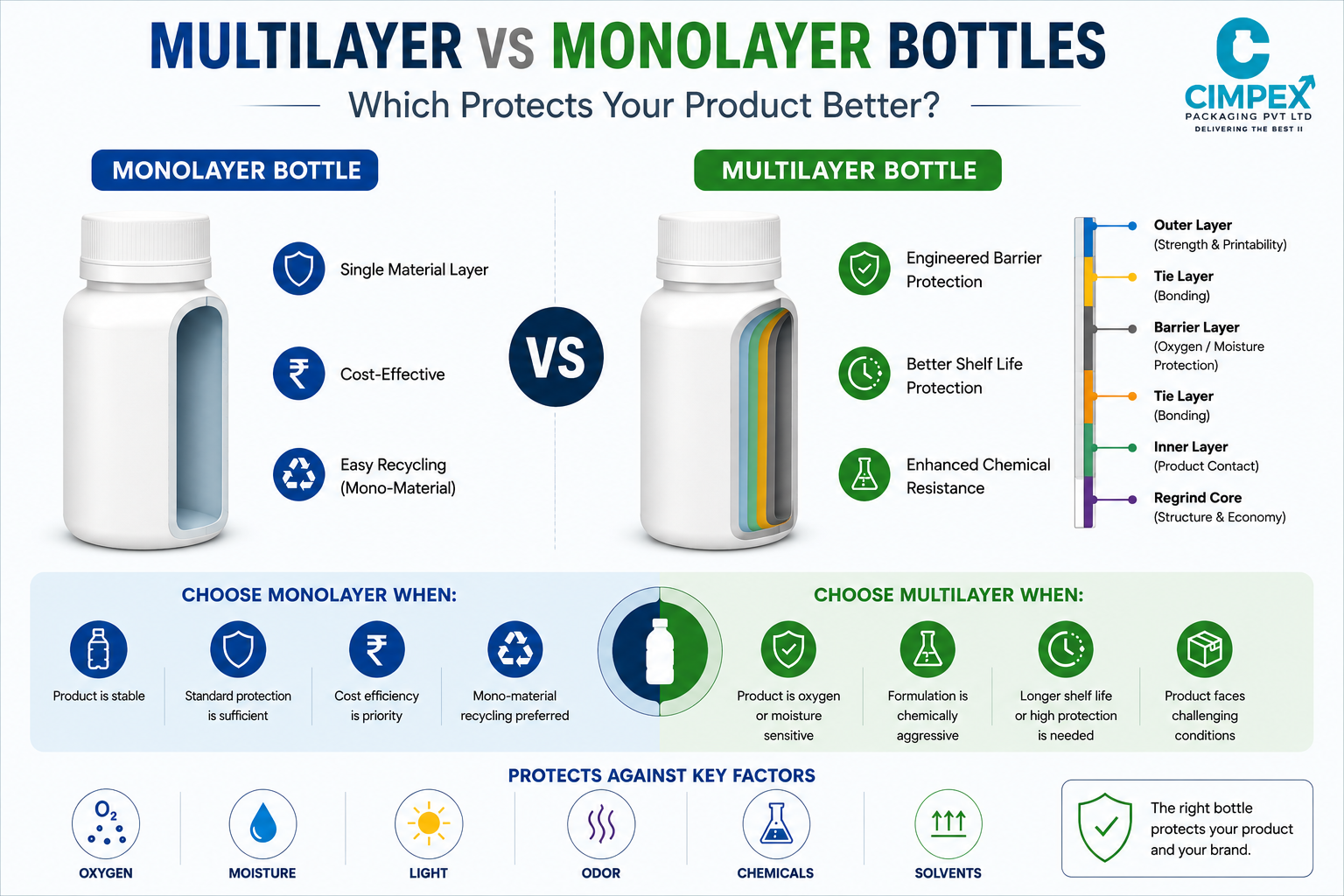
Most packaging failures are quiet: an oil turns rancid before expiry, a powder cakes, a solvent formulation loses weight. The bottle held the product and still failed it. That is the substance of multilayer vs monolayer bottles: not which container is stronger, but which wall suits what you are protecting against. Our multilayer bottles range covers the co-extruded formats here.
The wall stands between your formulation and oxygen, moisture, light and chemical attack, so multilayer vs monolayer bottles is a protection decision before a purchasing one.
What Is a Monolayer Bottle?
A monolayer bottle is moulded from a single material as one continuous wall. HDPE gives a good moisture barrier for pharmaceutical and chemical use; PET offers clarity for FMCG. One extruder and simpler tooling keep cost and lead time down. In multilayer vs monolayer bottles this is the baseline, suiting any product needing no engineered barrier.
Advantages of Monolayer Bottles
Arguments for the simpler wall in multilayer vs monolayer bottles:
- Simpler construction, fewer variables
- Mono-material, suiting compatible recycling streams
- Cost efficiency in tooling and price
- Well-established manufacturing
- Good lightweighting potential
- Broad application range
Limitations of Monolayer Bottles
One layer does every job, and no polymer excels at everything. HDPE resists moisture well but offers limited oxygen barrier. Where a formulation is oxygen-sensitive or chemically aggressive, one layer may not suffice though monolayer packaging is not therefore weak, since performance depends on resin, wall thickness and closure.
What Is a Multilayer Bottle?
A multilayer bottle is built from two or more materials co-extruded together, forming a laminated wall in one operation. Typical construction:
- Structural layers, usually a polyolefin, for strength
- A functional barrier layer for the protection needed
- Tie layers, where barrier and structural resins will not bond
- A regrind core, away from product contact
Multilayer HDPE is common, using HDPE skins around a functional layer. The value is engineering freedom: each layer does one job, so packaging is built around the product.
Advantages of Multilayer Bottles
Where multilayer vs monolayer bottles tips the other way:
- Enhanced barrier where one polymer falls short
- Better oxygen or moisture resistance when well designed
- Possible chemical-resistance gains
- Regrind buried away from product contact
- Light protection via an opaque core
- Contact layer unchanged, preserving compatibility
Limitations of Multilayer Bottles
- More complex construction, more variables
- Needs multiple extruders and a multi-channel head
- Materials must be compatible, often needing tie layers
- Recycling depends on composition and local infrastructure
- Higher unit cost and minimum order quantities
- Requires technical validation, not assumption
Multilayer is not automatically superior: applied where a monolayer bottle would serve, it adds cost without benefit.
Multilayer vs Monolayer Bottles: Key Differences
Side by side, multilayer vs monolayer bottles differ:
| Factor | Monolayer Bottle | Multilayer Bottle |
| Material structure | Single resin, one wall | Two or more co-extruded layers |
| Barrier protection | Set by that resin | Engineered via a functional layer |
| Manufacturing complexity | Lower | Higher; multiple extruders |
| Cost considerations | Generally lower | Higher; regrind cores offset |
| Chemical protection | Depends on the resin | Can be enhanced |
| Moisture protection | Strong in HDPE | Comparable |
| Oxygen protection | Limited in polyolefins | Improved with a barrier layer |
| Product compatibility | One contact material | Contact layer plus documented structure |
| Recycling considerations | Suits mono-material streams | Depends on composition |
| Typical applications | Tablets, powders, liquids | Oxygen-sensitive, solvent-based products |
Neither column is a ranking: a monolayer HDPE bottle with a well-chosen closure can outperform a poorly designed multilayer structure. In multilayer vs monolayer bottles, the useful question is which failure mode you are designing against.
How Barrier Packaging Protects Products
Barrier packaging, in multilayer vs monolayer bottles alike, uses the wall to slow movement into or out of the pack. Nothing is a perfect barrier; the aim is to reduce transmission enough that the product stays in specification. It can limit:
- Oxygen, which drives oxidation
- Moisture and water vapour, affecting hygroscopic products
- External odours, relevant in food and FMCG
- Chemicals and solvents, including outward permeation
- Light, where an opaque structure is used
Barrier performance is not fixed by bottle type. It depends on materials, structure, wall thickness, formulation, storage and the complete pack which is why multilayer vs monolayer bottles cannot be settled generically.
Oxygen Barrier
Oxygen transmission matters for products that oxidise: omega-3 oils, certain vitamins, some pharmaceutical actives. Polyolefins offer limited oxygen barrier alone, and no closure liner compensates for a permeable wall.
Moisture Barrier
In multilayer vs monolayer bottles, moisture is where the gap narrows. HDPE performs well for hygroscopic powders and effervescent tablets, so monolayer HDPE with an induction seal and desiccant closure remains common.
Multilayer HDPE vs Monolayer HDPE
Comparing like with like clarifies multilayer vs monolayer bottles.
Monolayer HDPE is one wall of HDPE: strong moisture barrier, good chemical resistance, clean recyclability. For many pharmaceutical, chemical and FMCG products it suffices see our HDPE bottles range.
Multilayer HDPE keeps HDPE as structural and contact material while adding a functional layer. Moisture performance stays strong; the gain lies in whatever the barrier addresses, commonly oxygen ingress or aggressive chemistries.
It is not an upgrade by default. If your product is neither oxygen-sensitive nor chemically aggressive, the extra structure may deliver no measurable benefit, and multilayer vs monolayer bottles resolves toward the simpler wall.
Important Factors to Consider Before Selecting Bottle Structure
Before settling multilayer vs monolayer bottles, work through:
- Formulation, which drives everything else
- Oxygen sensitivity, from stability data
- Moisture sensitivity, especially powders and effervescents
- Chemical compatibility with the contact layer
- Required shelf life and its conditions
- Storage and distribution climate
- Closure compatibility, since the seal is part of the barrier
- Dimensions, neck finish and line constraints
- Volumes and changeover requirements
- Sustainability objectives and recycling infrastructure
- Cost across the full pack, not the bottle
- Regulatory and quality requirements
- Testing needed to validate the choice
This usually settles multilayer vs monolayer bottles before any quotation. If base resin is still open, our HDPE vs PET vs PP guide covers that decision.
Quality Testing for Monolayer and Multilayer Bottles
Checks applying to multilayer vs monolayer bottles alike:
- Visual inspection for flash and moulding defects
- Dimensional inspection of neck, height and diameter
- Weight consistency, indicating material distribution
- Wall-thickness checks, vital for layer integrity
- Leak testing with a stated acceptance level
- Closure compatibility and torque verification
- Material verification against the declared grade
- Barrier testing where a barrier is claimed
- Chemical compatibility with the formulation
- Drop testing where distribution demands
- Batch comparison
Testing should reflect real conditions; in multilayer vs monolayer bottles the comparison must run with your own formulation.
Sustainability Considerations: Monolayer vs Multilayer
Mono-material packaging has real advantages where recycling systems handle it, since a single-resin bottle sorts cleanly. Multilayer structures may deliver higher functional performance but can be harder to recycle, depending on composition and local infrastructure.
Lightweighting reduces material use either way, and packaging that prevents product waste has environmental value. Sustainability in multilayer vs monolayer bottles should weigh protection, material use and recyclability together.
Common Mistakes When Choosing Between Monolayer and Multilayer Bottles
Recurring errors in multilayer vs monolayer bottles decisions:
- Deciding on unit price without costing product failure
- Assuming multilayer is always safer
- Overlooking compatibility with the contact layer
- Not establishing genuine oxygen or moisture sensitivity
- Selecting the bottle before evaluating closure and liner
- Testing the bottle but never the whole system
- Ignoring the storage conditions the pack faces
- Assuming shelf life without stability testing
- Not discussing requirements with the manufacturer
If you are weighing multilayer vs monolayer bottles for a specific product, talk to the Cimpex Packaging team about your formulation, protection requirements and target shelf life.
Final Thoughts
In multilayer vs monolayer bottles there is no universally superior structure. Monolayer bottles offer simplicity, cost efficiency and mono-material recyclability; multilayer bottles offer engineered barrier performance where one resin falls short.
The decision rests on what your product needs protecting from, whether the contact material suits your formulation, the shelf life required and the storage conditions none of it settled without testing. A manufacturer able to discuss barrier packaging honestly matters as much. Approached this way, multilayer vs monolayer bottles becomes a specification, not a debate.
Frequently Asked Questions
What is the difference between monolayer and multilayer bottles?
A monolayer bottle has one resin wall. A multilayer bottle uses two or more co-extruded layers, letting a barrier layer be built in for specific protection needs.
What is a monolayer bottle used for?
It suits products needing no engineered barrier: tablets, powders, general liquids and many FMCG or household items, usually moulded in HDPE, PET or PP with a suitable closure.
What is multilayer HDPE?
A co-extruded structure with HDPE as the structural and contact material, wrapped around a functional layer that addresses oxygen ingress, permeation or light, depending on design.
Why is barrier packaging important?
It slows movement of oxygen, moisture, chemicals or light through the wall, helping products stay within specification. Performance depends on structure, materials and closure.
Do multilayer bottles improve product shelf life?
They can reduce environmental exposure, which may support stability. Shelf life also depends on formulation, closure and storage, so confirm by testing rather than assumption.
When should I choose a multilayer bottle?
Consider one for oxygen-sensitive oils, solvent-based chemistries or demanding storage. Confirm suitability through compatibility and performance testing first.
Are monolayer bottles easier to recycle?
Generally yes, since a single resin sorts cleanly into established streams. Multilayer recyclability depends on composition and what local recycling infrastructure accepts.
How should I choose the right bottle structure?
Start from what degrades your product, check compatibility with the contact material, define the shelf life, then test the complete pack under realistic conditions.