


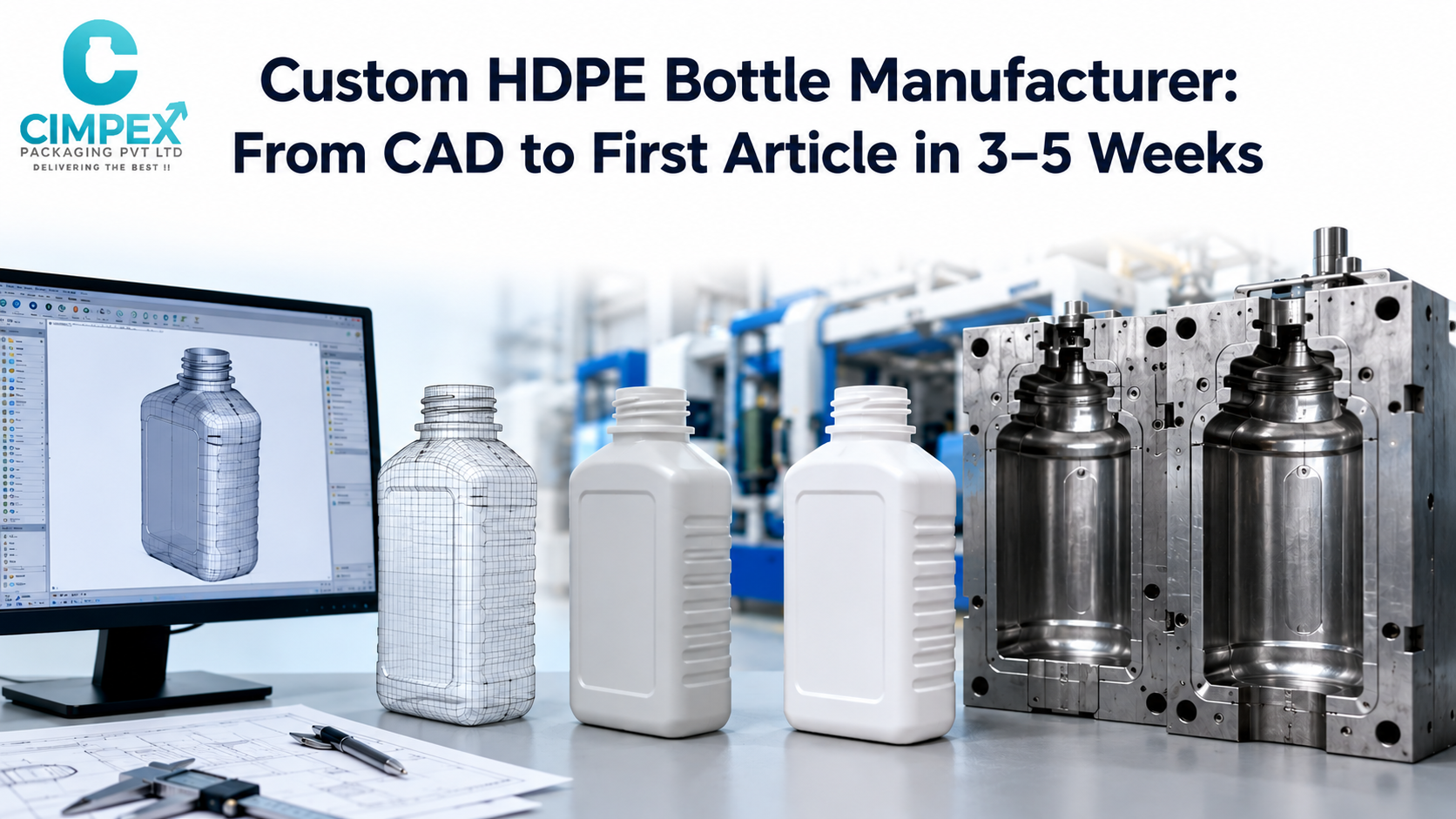
If you have ever tried to launch a new SKU using a stock bottle, you already know the compromise: the cap fits, the shelf presence doesn’t. Working with a genuine custom plastic bottle manufacturer changes that equation, because the bottle is built around your brand, your fill line, and your label artwork instead of the other way around. At Cimpex Packaging, our custom HDPE bottle & OEM supplier programme takes a brand from a rough sketch to a validated first article in as little as three to five weeks, using in-house tooling instead of outsourced mould shops that add both cost and delay.
This article walks procurement and packaging-development teams through exactly what that timeline looks like, what a custom plastic bottle manufacturer needs from you to start, and where the real risk points sit between CAD file and finished bottle.
Why Brands Are Moving Away From Stock Bottles
Stock bottles are fine for prototyping a concept or filling a short production run while you wait on tooling. They are not fine as a long-term packaging strategy for a brand that wants shelf differentiation, because every competitor sourcing from the same catalogue ends up with the same silhouette. A custom plastic bottle manufacturer solves three problems stock catalogues cannot:
- Brand distinction a proprietary shoulder profile, panel shape, or base design that competitors can’t simply reorder.
- Fit-for-fill engineering wall thickness and neck finish tuned to your actual formulation, whether that’s a viscous nutraceutical syrup or a low-viscosity agrochemical concentrate.
- Cost control at volume once tooling is amortised, a custom mould often costs less per unit than a stock bottle bought through a trading intermediary.
The trade-off is lead time and upfront tooling investment, which is exactly why the CAD-to-first-article process needs to be tight and predictable.
What “Custom” Actually Means in HDPE Bottle Manufacturing
Not every custom project starts from a blank page. Most fall into one of three tiers, and knowing which one you need changes both cost and timeline.
Tier 1: Cosmetic Customisation
Panel embossing, brand logo tooling, or a modified base built on an existing core shape. This is the fastest route through a custom plastic bottle manufacturer’s queue because the cavity geometry is largely proven.
Tier 2: Structural Customisation
A new bottle silhouette, neck finish, or capacity, engineered from scratch but using standard resin grades and known wall-thickness ranges (typically 0.6 mm–1.2 mm for HDPE, depending on capacity).
Tier 3: Full OEM Development
Complete private-label development bottle, cap, and often pump or trigger designed, tooled, and validated as a single system. This is where a private label bottle India programme delivers the most value, because the manufacturer owns every interface tolerance instead of matching components from different suppliers.
How Does the CAD-to-First-Article Timeline Work?
This is the question every packaging-development lead asks before committing budget, and the honest answer is: it depends on the tier, but a competent custom plastic bottle manufacturer with in-house tooling should hold to a 3–5 week band for Tier 1 and Tier 2 projects.
- Week 0 Brief and feasibility (2–4 days). You share target capacity, neck finish, resin preference, and any reference shape. The manufacturer confirms mould feasibility and quotes tooling cost.
- Week 1 CAD modelling and DFM review. Design-for-manufacture checks on wall thickness, draft angles, and gate placement happen here, before a single steel block is touched.
- Week 1–2 Mould machining begins. With in-house mould development, CNC machining of the cavity and core runs in parallel with EDM work on fine detail, cutting weeks off outsourced timelines.
- Week 3 Trial shots. The first physical bottles come off the tool, still rough flash, minor sink marks, and fit issues get flagged.
- Week 3–4 Mould correction (T1 to T2). Adjustments to gate size, cooling, or venting based on trial shot data.
- Week 4–5 First article approval. A validated sample batch, dimensionally checked against drawing tolerances, ships to you for sign-off.
Projects that skip DFM review or start with an incomplete brief routinely slip past six weeks the timeline above assumes a responsive brand-side contact and a manufacturer with tooling on-site rather than subcontracted.
Choosing Neck Finish, Wall Thickness and Resin Grade
A custom plastic bottle manufacturer earns its keep in the decisions that don’t show up on a rendering. Get these wrong and the bottle looks right but fails in the field.
- Neck finish: Common HDPE finishes run 18/415, 20/410, 24/410, and 28/410 the number pair denotes outer diameter (mm) and thread series. Match this to your cap or pump supplier’s spec sheet, not the other way around.
- Resin grade: Blow-moulding grade HDPE for pharma and nutraceutical fill typically meets USP Class VI where product contact requires it; FMCG and home-care grades can use standard commercial-grade resin.
- Wall thickness: Thicker walls (1.0 mm+) suit chemical or agrochemical fills needing stress-crack resistance; thinner walls suit cost-sensitive FMCG runs where the fill itself isn’t aggressive.
- Base design: A recessed or petaloid base improves stacking strength for bulk pallet shipping worth specifying if your bottle travels far before it’s filled.
What to Send a Custom Plastic Bottle Manufacturer Before You Brief
The single biggest cause of timeline slip isn’t mould machining it’s an incomplete brief that forces the manufacturer to chase missing information mid-project. Before you approach a custom plastic bottle manufacturer, have these ready:
- Target fill volume and headspace the actual capacity the bottle needs to hold, plus the air gap your filling line requires.
- Formulation type viscosity, pH, and whether the fill is oil-based, aqueous, or contains active solvents that could stress-crack certain resin grades.
- Cap or pump supplier spec sheet neck finish must be confirmed against the closure, not guessed at.
- Label application method pressure-sensitive labels, shrink sleeves, and direct screen printing each favour slightly different panel geometry.
- Reference images or a rough sketch even a hand-drawn silhouette speeds up the CAD stage meaningfully.
A custom plastic bottle manufacturer that receives this upfront can often collapse the Week 0 feasibility stage from four days to two, which matters when the whole programme is built around a 3–5 week band.
Validation Before You Scale
First article approval isn’t the finish line it’s the checkpoint before committing to production tooling runs. A disciplined custom plastic bottle manufacturer will run the sample batch through:
- Dimensional inspection against the approved drawing (neck OD/ID, height, base diameter)
- Drop testing at filled weight to catch base or shoulder weak points
- Cap/pump engagement and torque testing across a sample size, not a single unit
- Compatibility trial with your actual formulation, not water, if the fill is chemically active
- Visual QC for parting-line flash, gate vestige, and surface finish consistency
Skipping any of these steps to save a week is the single most common cause of costly reruns once full production starts. A custom plastic bottle manufacturer that builds validation into the quoted timeline rather than treating it as an optional extra is usually the one that avoids a second tooling correction cycle later.
Tooling Ownership and Long-Term Cost
One question that rarely comes up early enough: who owns the mould once it’s built? Most custom plastic bottle manufacturer agreements fall into one of two structures. In the first, the brand pays full tooling cost and owns the mould outright, giving them the option to move production elsewhere later, though few brands actually do. In the second, tooling cost is amortised into unit pricing over an agreed volume commitment, keeping upfront cash outlay lower but tying the brand to that manufacturer until the mould is paid off. Neither structure is inherently better it depends on your cash position and how confident you are in the volume forecast behind the launch.
OEM, Private Label and White-Label: What’s the Difference?
These terms get used loosely, so it’s worth being precise before you brief a custom plastic bottle manufacturer.
- OEM bottle manufacturer work means the manufacturer builds to your specification, on tooling you may own outright or license.
- Private label bottle India programmes typically mean the manufacturer holds a library of proven shapes you can brand without paying for new tooling faster, but less differentiated.
- White label HDPE bottle supplier arrangements are closer to stock supply with your artwork applied at the label or cap stage no engineering customisation at all.
Browse our product range to see which existing shapes could shortcut a private-label project, or brief a Tier 2/3 development if none fit.
When Custom Beats Stock and When It Doesn’t
Custom tooling isn’t always the right call. If you’re testing a new product category with uncertain volume, a stock bottle or a packer bottle manufacturer in India supplying standard packer-neck formats gets you to market without tooling risk. Move to custom once:
- Monthly volume comfortably amortises tooling cost within 12–18 months
- Brand differentiation is a genuine commercial priority, not a nice-to-have
- Your formulation has specific compatibility or barrier requirements a stock bottle can’t meet
From Concept to Shelf
A custom plastic bottle manufacturer with tooling under one roof turns what used to be a two-to-three-month outsourced ordeal into a controlled five-week sprint. The brief, the DFM review, and the trial-shot correction cycle are where most timelines are won or lost get those right and first article approval becomes a checkpoint, not a bottleneck. If you’re weighing a Tier 1 cosmetic tweak against a full OEM build, start a custom project with a feasibility conversation before committing to a brief.
Frequently Asked Questions
How long does custom HDPE bottle tooling take?
Cosmetic and structural customisation typically runs 3–5 weeks from CAD approval to first article, assuming in-house mould machining and a responsive brief.
What’s the minimum order quantity for a custom plastic bottle manufacturer?
MOQs vary by tier cosmetic customisation on existing tooling can start lower than full OEM development, which needs volume to justify new mould cost.
Can I get a private label bottle without paying for new tooling?
Yes private label programmes use proven shapes from the manufacturer’s existing mould library, branded to your specification without new tooling cost.
What neck finish should I choose for a custom HDPE bottle?
Match your cap or pump supplier’s spec first; common finishes are 18/415, 20/410, 24/410, and 28/410 depending on capacity and dispensing format.
Does custom tooling cost more than buying stock bottles?
Upfront tooling cost is higher, but per-unit cost usually drops below stock-bottle pricing once volume amortises the mould, typically within 12–18 months.
Can a custom plastic bottle manufacturer also develop the cap and pump?
Yes full OEM development covers bottle, cap, and pump or trigger as one engineered system, which avoids fit and torque issues between mismatched suppliers.
What happens if the first article sample fails validation?
The mould goes back for correction typically gate, venting, or cooling adjustments before a second trial shot, adding roughly one to two weeks.
Is it worth using a custom plastic bottle manufacturer for a small first order?
If volume is uncertain, start with a stock or private-label bottle; move to custom tooling once forecasted volume comfortably amortises the mould cost.