


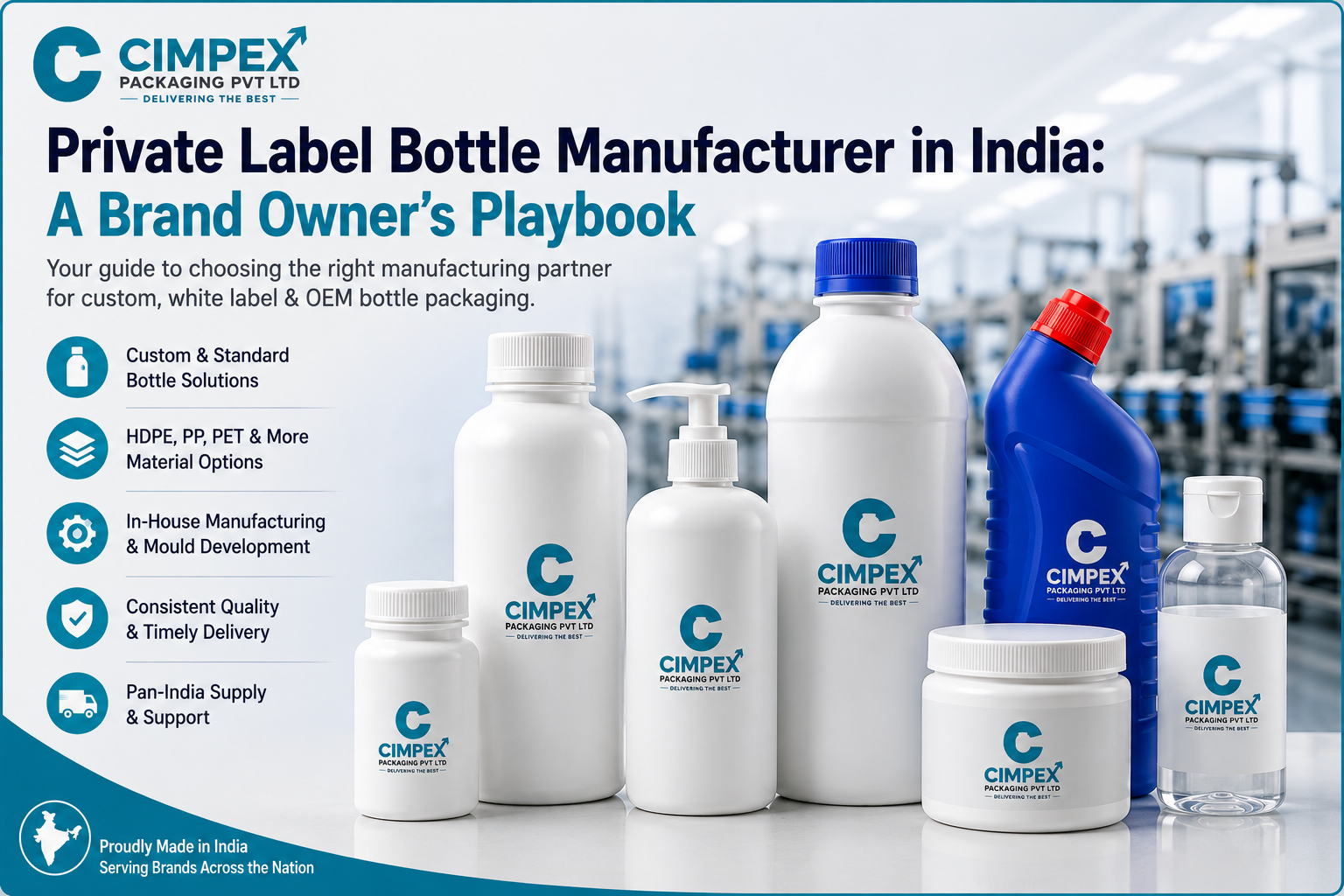
Launching a packaged product involves more than selecting a bottle that looks attractive. The right Private Label Bottle Manufacturer in India can influence product protection, shelf presentation, filling efficiency, minimum order quantities, lead times, and long-term brand consistency. For brand owners, packaging should therefore be treated as part of the product strategy rather than as a final procurement task.
This playbook explains how to evaluate a manufacturing partner, when to choose standard or custom packaging, how OEM and private-label models differ, and what questions to ask before placing a bulk order.
What Does a Private Label Bottle Manufacturer in India Actually Do?
A Private Label Bottle Manufacturer in India produces packaging that allows a brand to sell products under its own identity. Depending on the project, the manufacturer may supply an existing bottle design, modify a standard pack, develop a new mould, provide compatible closures, or support branding and labelling requirements.
Cimpex Packaging states that it manufactures HDPE, PP, LDPE, PET and PETG bottles, jars, caps and pumps, with custom and private-label options from its Baddi, Himachal Pradesh facility. Its published capabilities include blow and injection moulding, in-house mould development and pan-India dispatch.
Private Label, White Label and OEM: Know the Difference
These terms are often used interchangeably, but they represent different levels of involvement.
Private label packaging
Private label packaging generally allows a brand to select or develop a container and sell the finished product under its own brand. The bottle can be differentiated through colour, shape, label design, printing, closure selection or mould development.
White label supply
A white label HDPE bottle supplier typically offers proven bottle formats that can be branded for different customers. This model can reduce development time because the basic container already exists. It is useful for businesses testing a product category or launching several SKUs without investing immediately in new tooling.
OEM manufacturing
An OEM bottle manufacturer works to a customer’s specifications. The project may involve technical drawings, custom moulds, specific materials, proprietary shapes and defined quality parameters.
Choosing an OEM bottle manufacturer is particularly useful when packaging performance or visual identity is a competitive differentiator. It also makes sense when the bottle must work precisely with a filling, capping or labelling line.
When Should a Brand Choose Custom Bottles?
A custom plastic bottle manufacturer can build packaging around the product instead of forcing the product to fit an existing container. Customisation is worth considering when the bottle needs a distinctive silhouette, special capacity, unusual neck finish, specific grip, custom colour or specialised dispensing system.
However, custom tooling is not automatically better. New brands with uncertain demand may benefit from a standard bottle first. A practical decision should consider:
- expected annual volume and SKU growth;
- filling, capping and labelling equipment compatibility;
- product sensitivity, chemical characteristics and storage conditions;
- branding requirements and desired shelf differentiation;
- tooling investment, MOQ and expected payback period.
A professional custom plastic bottle manufacturer should help assess these factors before recommending a mould.
Why HDPE Remains a Strong Packaging Material
A Private Label Bottle Manufacturer in India should match the material choice to the product, not simply to the lowest packaging cost.
HDPE is widely used because it combines strength, light weight, chemical resistance and moisture resistance. Cimpex Packaging lists HDPE applications across pharmaceuticals, agrochemicals, lubricants, food and beverage, personal care, household chemicals and veterinary products.
HDPE can support practical logistics. A well-designed bottle can reduce the risk of leakage and deformation during handling while maintaining a professional appearance on the shelf.
How to Evaluate a Manufacturing Partner
The right Private Label Bottle Manufacturer in India should be evaluated on capability, consistency and communication, not quotation price alone.
1. Check manufacturing capability
Ask whether production is performed in-house or outsourced. In-house blow moulding, injection moulding and mould development can simplify communication and improve control over changes. Cimpex Packaging describes an in-house mould development unit and both blow and injection moulding capabilities.
2. Review material and quality controls
A white label HDPE bottle supplier should be able to explain the resin grade used, available material documentation, dimensional checks, wall-thickness controls and batch traceability.
3. Examine customisation options
A strong supplier should offer more than different bottle sizes. Depending on the application, options may include colour matching, neck finishes, printing or label-ready surfaces, embossing, closures and custom mould development.
The Packaging Development Process
Requirement and technical brief
The brand should define product type, fill volume, target quantity, application, preferred material, closure, label dimensions and performance requirements. Artwork and technical drawings should be shared in the correct formats.
Design and sampling
For custom projects, the custom plastic bottle manufacturer develops the design and mould concept. Samples are then reviewed for appearance, dimensions, closure fit, filling-line compatibility and handling.
Cimpex reports that its custom mould development can take approximately three to four weeks from approved design to first sample, while another company page describes CAD-to-first-article development in three to five weeks. Actual timing depends on design complexity and approval cycles.
What Should You Compare Before Placing an Order?
A procurement comparison becomes much clearer when all suppliers are evaluated against the same criteria. A Private Label Bottle Manufacturer in India should make each commercial and technical difference visible.
| Factor | What to Ask | Why It Matters |
| Material | Which resin grade is used? | Product compatibility and compliance |
| Capacity | What sizes are available? | Correct fill volume and headspace |
| MOQ | What is the minimum order? | Inventory and working-capital planning |
| Tooling | Is a new mould required? | Upfront cost and development time |
| Closures | Which caps or pumps fit? | Leak prevention and usability |
| Quality | What checks are performed? | Batch-to-batch consistency |
| Lead time | Stock vs custom timeline? | Product launch planning |
| Scale | Can output increase later? | Long-term supply security |
A Private Label Bottle Manufacturer in India that answers these questions clearly is easier to evaluate than one that only provides a unit price. This also makes future reordering easier.
Common Mistakes Brand Owners Should Avoid
Even experienced procurement teams can overlook packaging risks when a launch deadline is tight. The following mistakes are particularly costly:
- selecting a bottle based only on appearance without testing the filled product;
- approving samples without checking closure and filling-line compatibility;
- ignoring MOQ and storage requirements until after the quotation;
- changing bottle specifications between pilot and commercial production without documenting the revision.
A reliable white label HDPE bottle supplier should make the specification clear before production. Similarly, an OEM bottle manufacturer should document approved drawings, samples and quality parameters so that repeat orders remain consistent.
How Cimpex Packaging Fits the Brand-Owner Model
Cimpex Packaging positions itself as a direct manufacturer rather than a trader, supplying packaging for pharmaceutical, nutraceutical, FMCG, cosmetic, agrochemical, chemical and other industries. Its published range includes HDPE, PP, LDPE, PET and PETG packaging, along with caps, pumps and closures.
Questions to Ask Before You Sign the Purchase Order
Before selecting a Private Label Bottle Manufacturer in India, make the technical and commercial terms explicit.
- What is the exact bottle specification and approved sample reference?
- Which material and grade will be used for every production batch?
- What are the MOQ, tooling cost, unit price and payment terms?
- What is the expected lead time for samples, first production and repeat orders?
- Which quality checks and documentation will accompany the shipment?
A custom plastic bottle manufacturer should also clarify who owns the mould, how design revisions are handled and what happens if the approved specification changes.
CTA: Build Your Private Label Bottle With Cimpex Packaging
Ready to turn your packaging concept into a scalable product line? Contact Cimpex Packaging to discuss bottle size, material, quantity, closure requirements and customisation. The team can help you evaluate standard and custom options, request samples and develop a packaging solution suited to your brand.
Explore Cimpex Packaging and request a quote
Conclusion
Choosing a Private Label Bottle Manufacturer in India is ultimately a supply-chain decision as much as a packaging decision. For growing brands, the right Private Label Bottle Manufacturer in India can become a long-term packaging partner.
Well-planned private label packaging can provide a faster route to market, while OEM development can create stronger differentiation when a unique bottle is commercially justified. A white label HDPE bottle supplier may be the practical choice for a standard launch, while an OEM bottle manufacturer or custom plastic bottle manufacturer can be more appropriate for specialised requirements.
Cimpex Packaging gives brands access to multiple plastic materials, custom manufacturing options and supporting packaging components. By selecting a supplier that can grow with the product, brands can turn packaging from a basic container into a consistent part of their market identity and long-term brand marketing strategy.
Frequently Asked Questions
1. What is a Private Label Bottle Manufacturer in India?
A Private Label Bottle Manufacturer in India produces bottles that brands can sell under their own identity. Depending on the project, the supplier may provide standard, white-label or custom-moulded packaging.
2. What is the difference between private label and OEM bottles?
Private-label projects can use established bottle formats with branding or selected customisation. An OEM bottle manufacturer generally produces to a customer’s technical specifications, which may include a proprietary mould or design.
3. When should I use a white label HDPE bottle supplier?
A white label HDPE bottle supplier is useful when you want a proven bottle format, faster development and lower tooling requirements. It can be a practical starting point for new products or standard packaging needs.
4. Is HDPE suitable for pharmaceutical and chemical products?
HDPE is widely used for pharmaceutical, chemical, agrochemical, personal-care and other applications because of its strength and chemical resistance. The correct resin grade and bottle specification should be selected according to the product.
5. Can Cimpex provide custom bottle moulds?
Yes. Cimpex Packaging states that it develops custom moulds and supports custom bottle requirements, including colour and neck-finish options. Development time depends on the approved design and project requirements.
6. What MOQ should I expect for private label bottles?
MOQ varies according to bottle type, size and customisation. Cimpex states that standard HDPE bottle MOQ can start from 5,000 units, while fully custom moulds may require higher quantities.
7. How do I start a packaging project with Cimpex Packaging?
Share the product application, bottle capacity, expected quantity, material preference, closure requirements and any existing drawings or artwork. Cimpex can then advise on suitable packaging, samples, pricing and production timelines.