


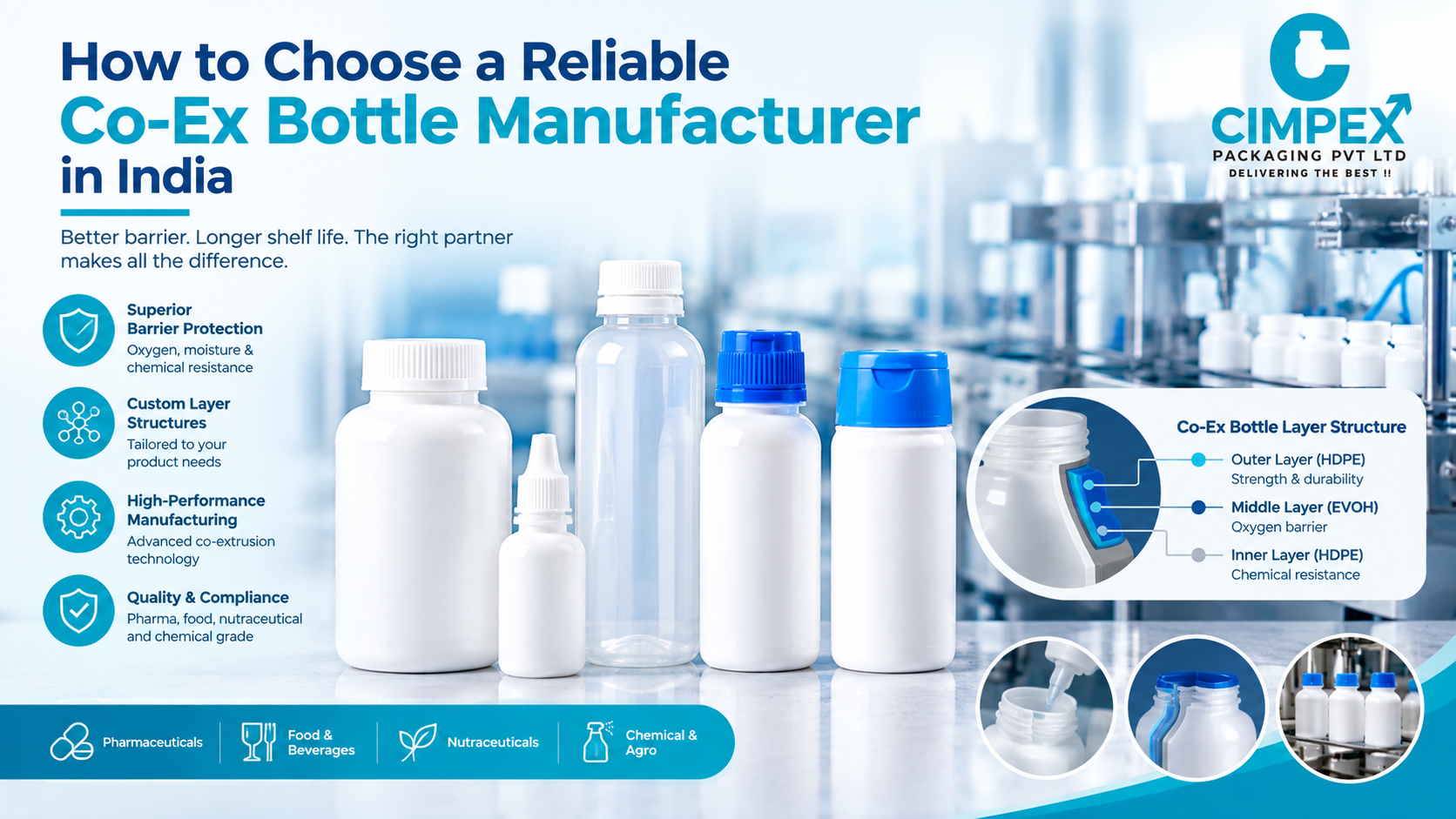
Finding the right co-ex bottle manufacturer matters more than most buyers expect, because a co-extruded bottle is doing a specific job that a single-layer plastic container simply cannot: keeping oxygen, moisture, or aggressive chemicals away from a sensitive product for the full length of its shelf life. Choosing the wrong supplier doesn’t usually show up immediately it shows up months later, when a pharmaceutical formulation degrades early or a food product loses freshness before its printed expiry date. This guide covers what a co-ex bottle actually is, why manufacturers use the format, and how to evaluate a co-ex bottle manufacturer before placing a bulk order.
What Is a Co-Ex Bottle?
A co-ex bottle, short for co-extruded bottle, is manufactured by extruding two or more plastic layers simultaneously through a single die, fusing them into one wall structure. Each layer contributes a different property one layer might provide structural strength and cost efficiency, while another layer, often a specialised barrier resin like EVOH, blocks oxygen or moisture transmission. The result is a single bottle wall that performs functions no single plastic resin could deliver on its own. This process, known as co-extrusion technology, is well documented in plastics engineering literature.
Why Choose Co-Ex Bottles for Product Packaging?
Multilayer packaging exists because single-layer plastic bottles have real limitations. Standard HDPE, for instance, offers decent moisture resistance but comparatively weak oxygen barrier properties, which becomes a problem for products sensitive to oxidation. A co-ex bottle manufacturer solves this by combining resins so that the finished bottle gets the strengths of each layer without the weaknesses of relying on just one material a category broadly referred to as barrier packaging.
Barrier packaging is not a single specification; it’s a spectrum, and different products need protection from different threats. A formulation sensitive to oxidation needs an oxygen barrier, a hygroscopic powder needs a moisture barrier, and an aggressive solvent needs chemical resistance built into the wall itself. This is exactly why a capable co-ex bottle manufacturer will ask detailed questions about your formulation before recommending a layer structure, rather than offering a single generic barrier packaging solution for every product.
- Oxygen barrier bottles protect products like pharmaceuticals, nutraceuticals, and certain food items from oxidative degradation that would otherwise shorten shelf life.
- Moisture barrier bottles keep hygroscopic powders, tablets, and supplements from absorbing ambient humidity during storage and transport.
- Chemical-resistant bottles allow aggressive solvents, agrochemicals, or industrial formulations to be packaged without the container degrading from the inside out.
- Cost efficiency is preserved by using expensive barrier resins only in a thin internal layer, while the bulk of the bottle wall uses more economical plastics like HDPE.
7 Factors to Consider When Choosing a Co-Ex Bottle Manufacturer
Not every plastic packaging manufacturer that claims to produce multilayer bottles has genuine co-extrusion capability, so it’s worth checking these factors before committing to a supplier.
- Actual co-extrusion equipment on-site ask whether barrier layers are produced through true co-extrusion or through a secondary coating process, since the two approaches perform very differently over time.
- Barrier layer material options a capable co-ex bottle manufacturer should be able to explain which barrier resins (such as EVOH or nylon) suit oxygen-sensitive versus moisture-sensitive products.
- Industry-specific compliance pharmaceutical packaging solutions in particular may require documentation such as drug master file support or compliance with relevant pharmacopoeia standards.
- Sample and testing support a reliable supplier will provide barrier performance data or samples for accelerated shelf-life testing before committing to bulk production.
- Consistency across production batches multilayer bottles are more sensitive to process variation than single-layer bottles, so ask about in-house quality control specific to layer thickness consistency.
- Minimum order quantities and lead times co-extrusion tooling is more specialised than standard blow moulding, which can affect MOQs and development timelines.
- Track record with similar products a plastic packaging manufacturer with prior experience in your specific category (pharma, agrochemical, food) is generally lower risk than one working with barrier bottles for the first time.
Co-Ex Bottle Applications Across Different Industries
High-barrier containers built through co-extrusion serve a wide range of industries, each with different reasons for needing barrier performance. Because multilayer plastic packaging can be engineered toward oxygen resistance, moisture resistance, or chemical resistance depending on which resin sits in the barrier layer, the same basic co-extrusion process can serve very different product categories.
| Industry | Typical Requirement | Common Co-Ex Layer |
| Pharmaceuticals | Oxygen and moisture protection for sensitive actives | EVOH barrier layer |
| Agrochemicals | Chemical resistance to solvents and active ingredients | Nylon or specialty barrier resin |
| Food & beverage | Oxygen barrier to preserve flavour and shelf life | EVOH barrier layer |
| Nutraceuticals | Moisture protection for hygroscopic powders and tablets | EVOH or PVDC-based layer |
| Industrial chemicals | Resistance to aggressive solvents and permeation | Nylon barrier layer |
Pharmaceutical Packaging Solutions
Pharmaceutical packaging solutions built on co-extrusion technology are particularly common for liquid syrups, oral suspensions, and certain solid-dosage formats where oxygen ingress can affect potency over the labelled shelf life. Multilayer plastic packaging in this category often needs to meet specific regulatory documentation requirements alongside barrier performance.
Food, Agro, and Industrial Uses
Beyond pharma, multilayer packaging shows up in edible oil bottles, sauces, agrochemical concentrates, and industrial solvent containers anywhere a single-layer bottle would either degrade from chemical exposure or fail to protect the product from oxygen and moisture over time. Chemical-resistant bottles built through co-extrusion are especially valuable in agrochemical and industrial solvent packaging, where the inner layer has to withstand direct, prolonged contact with the product rather than just brief exposure during filling. In food and beverage applications, oxygen barrier bottles help preserve flavour, colour, and nutritional value for products that would otherwise oxidise well before their intended shelf life ends, while moisture barrier bottles protect powdered or freeze-dried ingredients from clumping or degrading in humid storage conditions.
How to Evaluate a Co-Ex Bottle Supplier Before Placing an Order
- Request barrier performance data specific to your product category rather than generic marketing claims about “high barrier” performance.
- Ask for reference samples so your quality team can test compatibility with your actual formulation, not just a similar one.
- Confirm the manufacturer’s experience with your neck finish and closure requirements, since barrier bottles still need to pair correctly with caps, pumps, or sprayers.
- Clarify minimum order quantities, mould development timelines, and whether a trial run is possible before a full production commitment.
- Check whether the plastic packaging manufacturer can support your specific regulatory or documentation needs, particularly for pharmaceutical or food-contact applications.
Co-Ex Bottle Manufacturer vs Standard Plastic Bottle Manufacturer
| Factor | Co-Ex Bottle Manufacturer | Standard Plastic Bottle Manufacturer |
| Wall structure | Multiple fused layers, each with a distinct function | Single homogeneous plastic layer |
| Barrier performance | High engineered against oxygen, moisture, or chemicals | Limited to the base resin’s natural properties |
| Typical applications | Pharma, agrochemical, sensitive food products | General liquids, cosmetics, household products |
| Tooling complexity | Higher requires co-extrusion dies and process control | Lower standard blow moulding |
| Cost per unit | Generally higher due to specialised resins and process | Generally lower |
Choosing between the two isn’t about which is “better” in absolute terms it’s about whether your product genuinely needs barrier protection or whether a standard HDPE bottle already meets your shelf-life and chemical-resistance requirements.
Cimpex Packaging’s Approach to Barrier and Multilayer Solutions
Cimpex Packaging works across a wide range of chemical-resistant and barrier-oriented applications, including pesticide and agrochemical bottles that need to withstand aggressive formulations over extended storage, and pharmaceutical containers built to hygienic standards for sensitive dosage forms. Our manufacturing process is backed by strict quality control across every production batch, and our team can walk you through which barrier or material approach best fits your product’s specific chemical-resistance and shelf-life requirements. If you’re evaluating suppliers for a barrier packaging project, get in touch to discuss your formulation and application needs directly.
Frequently Asked Questions
What makes a co-ex bottle different from a regular plastic bottle?
A co-ex bottle is built from multiple fused plastic layers, each contributing a specific property such as barrier resistance or structural strength, while a regular bottle is made from a single plastic layer with only that resin’s natural properties.
Which industries benefit most from co-ex bottles?
Pharmaceuticals, agrochemicals, food and beverage, and nutraceuticals benefit most, since these industries commonly package products sensitive to oxygen, moisture, or chemical degradation over their shelf life.
Is co-extrusion technology more expensive than standard blow moulding?
Generally yes, because co-extrusion requires specialised dies, tighter process control, and often more expensive barrier resins, though the added cost is usually justified when the product genuinely needs barrier protection.
How do I know if my product needs a barrier bottle?
If your product is sensitive to oxygen, moisture, or chemical exposure and needs to maintain quality over an extended shelf life, a barrier or co-ex format is worth evaluating. Your packaging supplier can review your formulation and recommend whether standard HDPE is sufficient or barrier protection is warranted.
What barrier materials are commonly used in co-ex bottles?
EVOH (ethylene vinyl alcohol) is the most common oxygen barrier resin, while nylon-based layers are often used for chemical resistance. The right choice depends on whether oxygen, moisture, or specific chemicals are the primary concern.
Can a co-ex bottle manufacturer also produce standard HDPE bottles?
Many manufacturers, including those with co-extrusion capability, also produce standard single-layer HDPE bottles, since not every product in a company’s range requires barrier performance.
How long does it take to develop a custom co-ex bottle?
Development timelines vary by supplier and design complexity, but co-extrusion tooling generally takes longer than standard blow-moulded tooling due to the additional process engineering involved. Ask your manufacturer for a specific timeline based on your design.
Conclusion
Selecting the right co-ex bottle manufacturer comes down to verifying genuine co-extrusion capability, confirming barrier material options suited to your product, and checking that the supplier can support your specific industry’s compliance and testing needs. Multilayer packaging solves real problems for oxygen-, moisture-, and chemical-sensitive products, but only when it’s manufactured correctly and matched to the right application. Taking the time to evaluate a co-ex bottle manufacturer properly rather than choosing on price alone protects both your product’s shelf life and your brand’s reputation.
If you’re developing a product that needs oxygen, moisture, or chemical barrier protection, share your formulation details with the Cimpex Packaging team and we’ll help you determine whether a barrier bottle or a standard HDPE format best fits your requirements.