


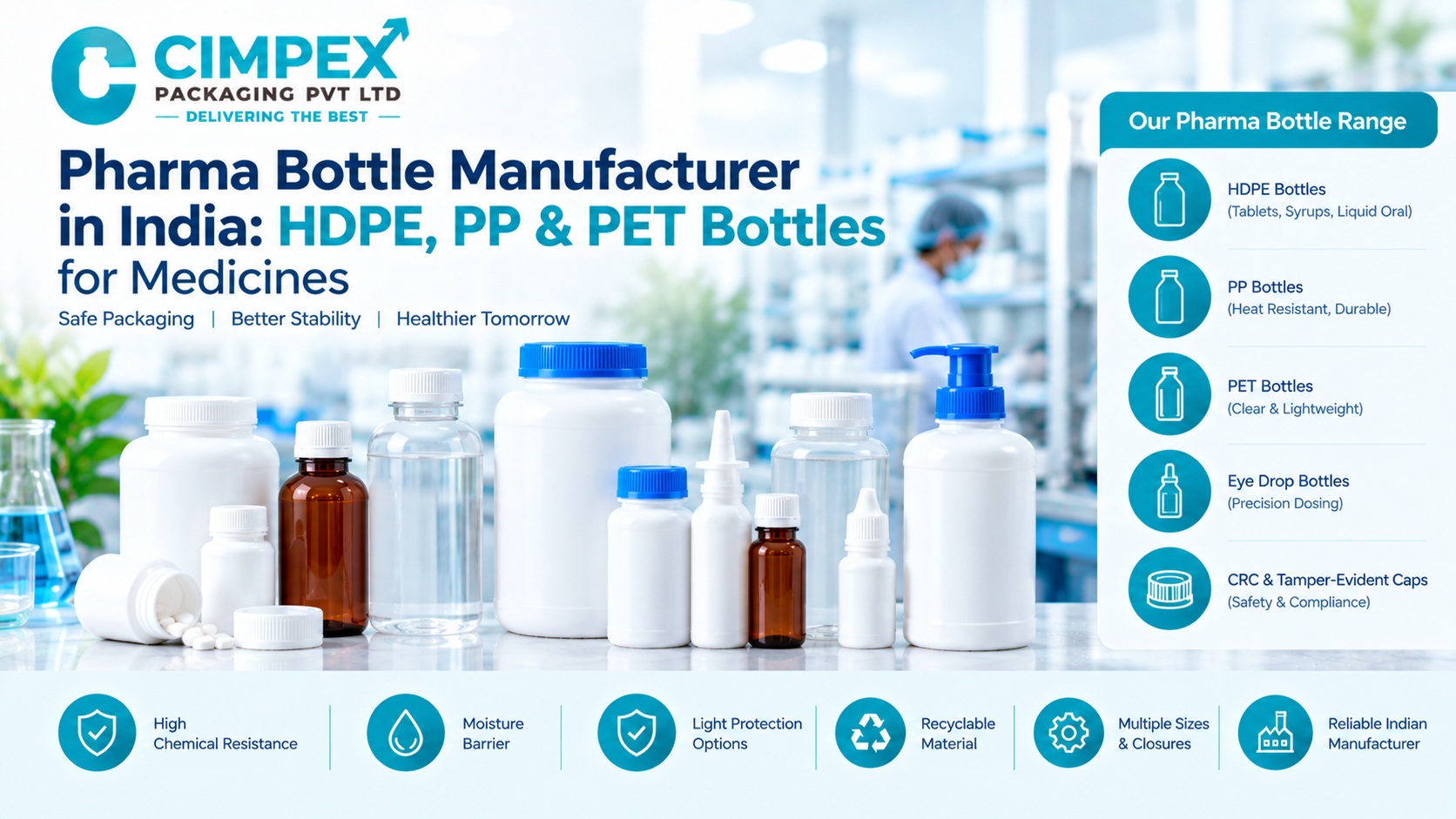
Why Packaging Matters in Pharma
A medicine is only as stable as the container that holds it. Moisture can soften tablets, light can degrade sensitive formulations, and a poorly fitted cap can allow leakage or contamination before the product reaches the patient. For that reason, most drug makers treat a pharma bottle manufacturer in India as a quality partner rather than a commodity vendor. The container also affects dosing accuracy, shelf life, transport safety and the experience at home. A dependable pharmaceutical packaging manufacturer considers resin choice, wall thickness, neck finish, closure design and testing together, instead of treating them as separate decisions. Buyers who ask for complete pharmaceutical packaging solutions, covering bottles, closures and dispensing parts, usually find approvals and reorders simpler. In practice, the best pharma bottle manufacturer in India for one product may differ from the best for another, because a dry syrup, an eye drop and a tablet each place different demands on the container.Core Materials Used in Pharma Bottles
HDPE Pharma Bottles
High-density polyethylene is the most widely used resin for solid and liquid dosage packaging. A capable HDPE bottle manufacturer in India offers containers with strong moisture resistance, good impact strength and chemical stability against most oral formulations. HDPE pharma bottles are usually opaque or tinted, which limits light exposure, and the semi-rigid wall survives filling, packing and transport well. For many oral dosage forms, HDPE pharma bottles remain the default starting point because the resin is predictable in moulding and consistent in wall thickness. The general properties of the resin are summarised in this overview of high-density polyethylene.PP Plastic Containers
Polypropylene offers higher heat tolerance and good chemical resistance. PP plastic containers are often chosen for products filled warm or for formulations where a firmer feel is wanted. PP is stiffer and less impact-resistant at low temperatures than HDPE, so many buyers specify it for particular applications rather than as a default. Whichever resin you pick, an experienced HDPE bottle manufacturer in India will usually advise on PP as well, since the two are often moulded in the same facility. PP plastic containers are also common for wide-mouth formats where the lid must feel secure when pressed or twisted.PET Bottles
PET bottles are valued for clarity, which suits liquids where the patient should see the colour or level of the contents. They are light and rigid, but PET generally gives less moisture protection than HDPE for solid dosage forms, so it is usually reserved for specific liquids. Cimpex Packaging’s range centres on HDPE and PP, so PET is covered here only to help you compare options fairly. If a project truly needs PET bottles, ask the supplier plainly whether they make them, rather than assuming every pharma bottle manufacturer in India covers every resin.Comparing HDPE, PP and PET for Pharma Use
| Factor | HDPE | PP | PET |
| Appearance | Opaque or tinted, semi-rigid | Opaque or translucent, stiffer | Clear, glass-like |
| Moisture protection | Strong | Good | Depends on the product |
| Heat tolerance | Moderate | Higher | Moderate |
| Typical use | Tablets, capsules, syrups, drops | Products needing a firmer feel or heat tolerance | Clear liquids |
| Best suited for | General oral solid and liquid dosage | Specific heat or chemical needs | Products where visibility matters |
Bottle Types by Dosage Form
Tablet Containers
Tablet containers must keep humidity out and hold the product securely in transit. Wide-mouth HDPE designs make filling and dispensing easier, and a tight closure keeps contents dry. For moisture-sensitive products, ask about liner options and closure torque as well as the bottle itself. For high-volume lines, tablet containers should also be checked for consistent neck dimensions, since small variations can slow filling and capping.Liquid Oral Bottles and Dry Syrup Bottles
Liquid oral bottles carry syrups, suspensions and tonics, so pouring behaviour, neck finish and compatibility with measuring caps all matter. Dry syrup bottles hold powder that is reconstituted with water at home, so they need a wide enough neck for easy filling and shaking, and often a fill-level mark. In both cases the closure must seal reliably, because even small leaks affect dose accuracy. Many buyers treat liquid oral bottles and dry syrup bottles as one product family with different neck sizes, which makes it easier to standardise closures across a range.Eye Drop Bottles, Nasal Spray Bottles and Dropper Bottles
These small-volume formats are demanding. Eye drop bottles depend on a controlled drop size and a clean dispensing tip. Nasal spray bottles need a compatible pump and a neck finish that holds it firmly. Dropper bottles serve oral drops and similar products, where dropper fit and squeeze consistency matter. Because patients use these formats repeatedly, ask how tip dimensions and neck accuracy are controlled. Eye drop bottles in particular should be discussed together with the intended sterilisation or filling process. Nasal spray bottles and dropper bottles deserve the same discussion, since the dispensing part and the bottle neck must work as one assembly.Caps and Closures: The Part Buyers Often Overlook
Even a well-made bottle fails if the closure does not match the neck. Pharma caps and closures are specified for sealing performance, tamper evidence and ease of use. CRC caps, the child-resistant type that must be pressed and turned to open, are common on products where regulations or safety practice call for them. Good pharma caps and closures also keep the product consistent across batches, because a cap that seats slightly differently each time creates hidden leakage risk. Whether CRC caps are required depends on the product and the market, so confirm this with your regulatory team.What to Check on Closures
- Neck finish compatibility: the cap and bottle must share the same thread specification, or leakage becomes likely.
- Liner or seal type: induction or pressure-sensitive liners suit different products, so match the liner to the formulation.
- Tamper evidence: a visible band or seal reassures patients and distributors.
- Child resistance: choose CRC caps where required, and check that the target user group can still open them.
- Common mistake: approving the bottle sample and testing the cap separately, later. Test them together.
Advantages and Disadvantages of Plastic Pharma Bottles
Advantages
- Lightweight and shatter-resistant compared with glass, which lowers breakage and handling risk.
- Flexible design: sizes, neck finishes, colours and wall thicknesses can be customised.
- Good moisture protection, especially with HDPE pharma bottles.
- Cost-efficient at scale, with consistent output from moulded production.
Disadvantages
- Some oxygen-sensitive or highly volatile formulations need better barrier performance than a single-layer plastic provides.
- Certain active ingredients can interact with plastic, so compatibility and stability testing is essential.
- Heat tolerance is lower than glass for some processes.
- Recycling and disposal need planning as part of your sustainability goals.
How to Choose a Pharma Bottle Manufacturer in India
When you compare a pharma bottle manufacturer in India, look past price and ask for evidence of process control. A pharma bottle manufacturer in India that is confident in its process will explain how it controls moulding, trimming, inspection and packing, and will share sample data when asked.Selection Checklist for a Pharma Bottle Manufacturer in India
- Material documentation: ask which resin grades are used and how they are sourced.
- Customisation: confirm available sizes, neck finishes and colours for your range.
- Quality testing: leak testing, strength evaluation and dimensional checks should be routine.
- Capacity and lead time: confirm that bulk orders can be supplied consistently.
- Location and logistics: as a pharma bottle manufacturer in India, Cimpex Packaging operates from Baddi in Himachal Pradesh, an area home to many pharmaceutical units, which can simplify delivery to formulators.
- Single-source range: a pharmaceutical packaging manufacturer offering joined-up pharmaceutical packaging solutions across bottles, caps and dispensers reduces coordination between vendors. Ask whether the supplier can support both your current bottles and any future formats, such as HDPE pharma bottles in new sizes or dropper bottles for a line extension.
Mistakes to Avoid When Sourcing
The most common error is selecting a bottle on appearance alone, then discovering during stability testing that the closure or liner does not hold. Another is switching a pharma bottle manufacturer in India mid-project without re-validating the container, which can invalidate earlier test results. Finally, buyers sometimes ignore bulk-supply planning; a good sample means little if the pharmaceutical packaging manufacturer cannot meet monthly volumes consistently.Conclusion
The right container protects the medicine, supports accurate dosing and keeps supply reliable. Match the resin to the formulation, treat bottle and closure as one system, and test them together under your real conditions. A trustworthy pharma bottle manufacturer in India will welcome these questions and answer them with clear documentation and consistent quality checks, supported by pharmaceutical packaging solutions that cover the full pack. Whether the need is HDPE pharma bottles for tablets, liquid oral bottles for syrups or eye drop bottles for ophthalmic products, the same principle applies: choose the container for the product, not the other way round. If you are planning a new product or reviewing your current packaging, compare your dosage forms against the options above, then contact the Cimpex Packaging team with your volumes, neck finishes and closure requirements for guidance.Frequently Asked Questions
A pharma bottle manufacturer in India produces plastic containers and closures for medicines, usually by blow moulding or injection moulding. The work includes selecting resin, designing neck finishes, moulding bottles, testing for leaks and dimensions, and supplying bulk quantities to pharmaceutical companies for tablets, syrups, drops and sprays.
HDPE is the most common choice because it resists moisture, handles impact and works with most oral formulations. PP suits products needing higher heat tolerance, and PET suits clear liquids. The best material depends on your formulation, so confirm it through compatibility and stability testing before approving.
HDPE pharma bottles are widely used for tablets and capsules because they protect against moisture and are strong enough for transport. Safety depends on resin grade, clean production and a well-fitted closure, so request material details and test the complete bottle-and-cap system with your product.
CRC caps are child-resistant closures that require a specific action, such as pressing down while turning, to open. They reduce the chance of accidental access by young children. Whether they are required depends on your product category and market, so check with your regulatory team.
Liquid oral bottles hold ready-to-use syrups, suspensions and tonics. Dry syrup bottles hold powder that the patient mixes with water, so they usually have a wider neck and a fill-level mark. Both need a reliable closure to prevent leakage and protect dose accuracy.
Yes. A good HDPE bottle manufacturer in India can customise this: sizes, neck finishes, colours and closure types can generally be customised to match a product range and filling line. Share your fill volume, closure preference and filling process with the manufacturer early, because custom tooling affects timelines and minimum order quantities.
Test the bottle and pharma caps and closures together. Check neck compatibility, leakage, closure torque, drop resistance and dimensional accuracy, then run stability studies with your actual formulation. Request samples from the production process rather than prototypes, so the results reflect what you will receive in bulk.