


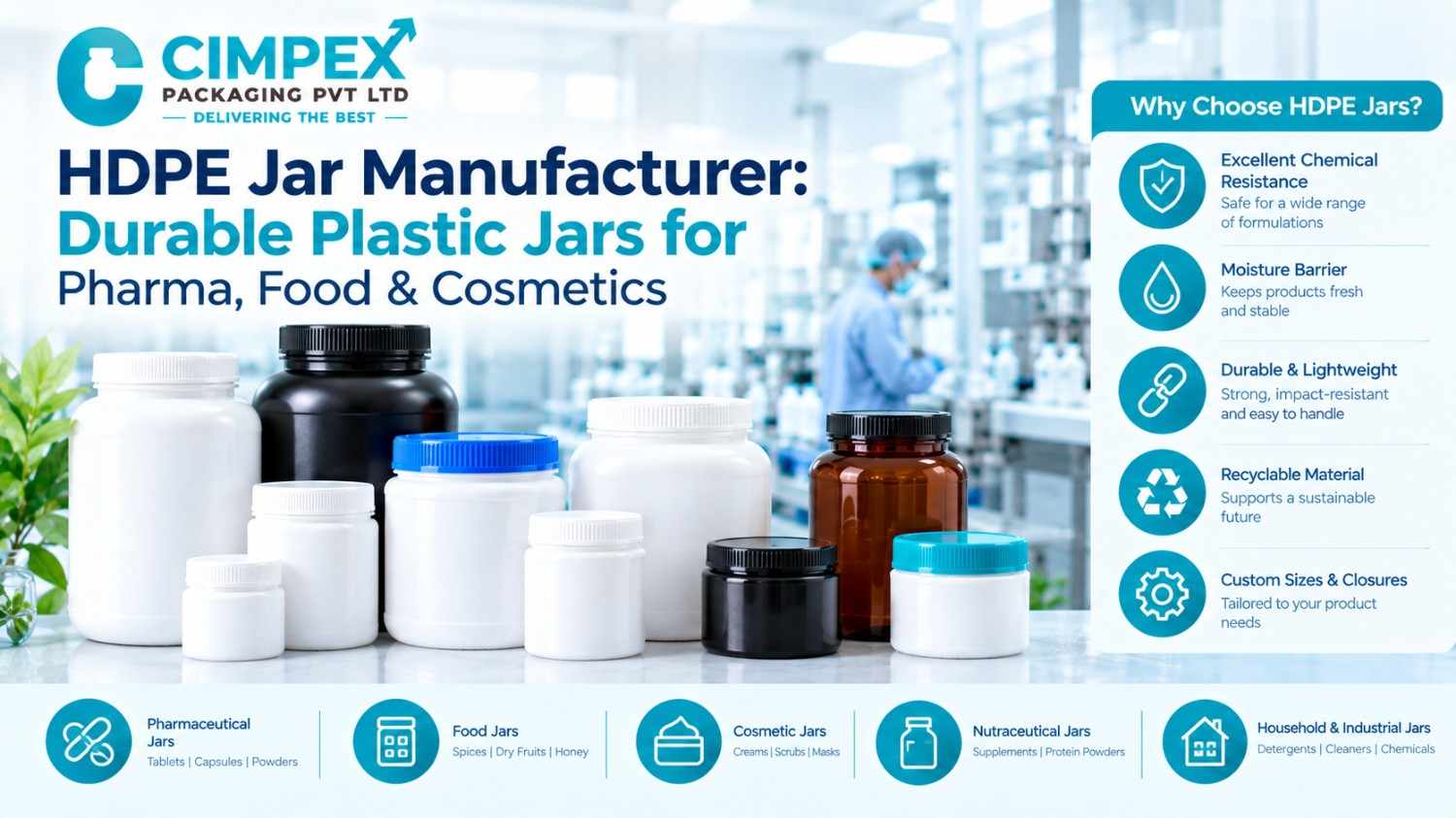
What Makes HDPE a Preferred Material for Jars
High-density polyethylene is a rigid, chemical-resistant plastic with strong moisture protection and good impact strength. These traits make it a practical choice for dry and semi-solid products that must stay stable on a shelf and survive transport. An experienced HDPE container manufacturer can mould the resin into many forms, from small tablet jars to large wide mouth tubs, while keeping wall thickness and neck dimensions consistent. You can read more about the polymer in this overview of high-density polyethylene. Compared with glass, HDPE is lighter and does not shatter. Compared with many other plastics, it is cost-efficient and widely accepted for pharmaceutical, nutraceutical, food and cosmetic packaging. That versatility is why an HDPE jar manufacturer often serves several industries from the same moulding facility. It also explains why a buyer should treat any HDPE container manufacturer as a long-term partner: the tooling, the resin and the closure all need to stay aligned across repeat orders.How HDPE Jars Are Made
HDPE jars are commonly produced by blow moulding or injection moulding, depending on the design, capacity and neck requirements. Blow moulding suits many bottle-like and jar-like shapes, while injection moulding is often used for closures and for parts that need tight dimensional control. A capable HDPE jar manufacturer chooses the process to suit the product, then controls wall thickness, neck finish and trimming so that every jar fits its cap. Ask to see how these checks are carried out, because consistency from batch to batch is what keeps your filling line running smoothly.Types of HDPE Jars and Where They Are Used
Pharmaceutical HDPE Jars
Pharmaceutical HDPE jars hold tablets, capsules, powders and granules, and they are often specified when a product needs a larger pack than a standard bottle. Strong pharmaceutical HDPE jars combine moisture protection with a neck that accepts liners and tamper-evident closures. Their main job is protecting the contents from humidity and contamination while allowing easy dispensing. Buyers usually specify the neck finish, closure type and liner together, because the jar and the cap must perform as one sealing system. Any caps and closures manufacturer in India or jar supplier serving drug makers should be comfortable discussing these details and supporting your stability and compatibility testing.HDPE Jars for Tablets
HDPE jars for tablets are typically wide enough for easy filling by machine or by hand, with a smooth interior that keeps tablets from catching. Where tablets are moisture-sensitive, a tightly fitting closure and a suitable liner matter as much as the jar. For high-volume lines, consistent neck dimensions help avoid capping problems and line stoppages.Nutraceutical Jars
Nutraceutical jars package vitamins, herbal supplements, gummies and similar products. Shelf appearance matters here as much as protection, so buyers often ask for specific colours, clean surfaces for labels or printing, and tamper-evident closures. A good HDPE jar manufacturer will advise on which finishes work with your labelling method. Nutraceutical jars also need to keep powders and tablets dry through repeated opening.Powder Jars and Protein Powder Jars
Powder jars are designed for products that are scooped or poured, so the opening size and interior shape are important. Protein powder jars are usually larger, and they often include a scoop. The neck must be wide enough for scoop access, and the closure must reseal firmly after each use, since powders absorb moisture easily and can clump.Food-Grade HDPE Jars
Food-grade HDPE jars are used for spices, dry foods and similar products. Resin selection is critical for food contact, so ask the supplier to confirm that the grade is suitable for food packaging and to provide documentation your compliance team can review.Cosmetic HDPE Jars
Cosmetic HDPE jars hold creams, balms, scrubs and powders. Here, surface finish, colour consistency and a smooth-opening closure influence how the product feels to the customer. Many brands choose cosmetic HDPE jars because they are lighter than glass and easier to ship. Compatibility testing remains essential, because some cosmetic ingredients, such as certain oils and fragrances, can interact with plastics over time.Wide Mouth HDPE Jars: Why Opening Size Matters
Wide mouth HDPE jars have a larger neck opening than standard bottles. That design supports easy filling, scooping and dispensing of solids, powders and thick products. It also helps customers reach the last portion of the product without struggle. The trade-off is a larger closure, which needs careful sealing design to prevent leakage or moisture entry. When you evaluate wide mouth HDPE jars from any HDPE jar manufacturer, check how the closure seats, how much torque is needed and whether the jar keeps its shape under pressure.Key Factors When Selecting a Jar
- Product form: powders, tablets, granules and creams each need different neck widths and closure styles.
- Moisture sensitivity: a product that absorbs humidity needs a tight seal, a suitable liner and consistent neck dimensions.
- Handling and transport: consider drop resistance, stacking and the filling method on your line.
- Labelling: check that the jar surface suits your label, sleeve or printing approach.
- Common mistake: choosing a jar by capacity alone and ignoring neck finish, which causes problems at the capping stage.
HDPE vs PP Jars: A Practical Comparison
| Factor | HDPE jars | PP jars |
| Moisture protection | Strong | Good |
| Rigidity | Semi-rigid, impact-resistant | Stiffer, more brittle in cold conditions |
| Heat tolerance | Moderate | Higher |
| Typical use | Tablets, powders, supplements, creams | Products needing higher heat tolerance or a firmer feel |
| Best suited for | General dry and semi-solid packaging | Specific heat or chemical requirements |
Caps and Closures: Matching the Jar to the Seal
A jar is only as reliable as its closure. A dependable caps and closures manufacturer in India will offer caps and closures matched to the jar neck, with options such as induction seal liners, tamper-evident bands and child-resistant designs where required. Working with a caps and closures manufacturer in India that also makes the jar lowers the burden on your team, and sourcing both from a single HDPE jar manufacturer lowers the risk of mismatched threads, because both parts are developed together. If you buy them separately, test fitment and leakage before approving bulk supply.Advantages and Disadvantages of HDPE Jars
Advantages
- Strong moisture resistance, which protects powders, tablets and supplements.
- Lightweight and shatter-resistant, which reduces breakage during transport.
- Customisable sizes, neck finishes and colours.
- Cost-efficient for high-volume production.
Disadvantages
- Less barrier protection than multilayer containers for oxygen-sensitive formulations.
- Potential interaction with some oils, solvents and fragrances, so compatibility testing is necessary.
- Lower heat tolerance than glass or PP in certain processes.
- Recycling and disposal require planning in line with your sustainability goals.
How to Choose an HDPE Jar Manufacturer in India
Selecting an HDPE jar manufacturer in India works best when you ask for evidence, not promises. Look for a supplier that can explain its resin sourcing, moulding process, inspection routine and packing method. The same HDPE jar manufacturer in India should also be able to support custom neck finishes, colours and sizes. A strong HDPE bottle manufacturer in India is often also a capable jar supplier, since both products share raw material expertise, tooling knowledge and quality systems. Ask whether the facility offers complete pharma packaging solutions as well as jars for food and cosmetics, because experience across sectors often means stronger process discipline. Buyers who source pharma packaging solutions in one place also reduce audit effort, since fewer suppliers need to be qualified. For range extensions, you can also review the HDPE bottle manufacturer in India offering from the same supplier, which keeps neck finishes and closures consistent across jars and bottles. Cimpex Packaging is based in Baddi, Himachal Pradesh, a region with many pharmaceutical units, and supplies HDPE jars alongside bottles and closures.Mistakes to Avoid
Many problems come from rushed approvals. Buyers sometimes approve a jar sample but never test it with the real closure, or they change suppliers without revalidating fitment. Others overlook bulk-supply planning and discover too late that the HDPE jar manufacturer cannot match the volume of a successful launch. Planning these points in advance saves time and avoids costly rework.Questions to Ask Before You Order
- Which resin grades are used, and can documentation be provided?
- Which sizes and neck finishes are available, and can they be customised?
- How are leakage, fitment and dimensional accuracy checked?
- What are the lead times and capacity for bulk orders?
- Can the supplier provide matching caps and closures?
Conclusion
HDPE jars protect dry and semi-solid products through strong moisture resistance, durable construction and flexible design. The most reliable results come from matching jar type to product form, treating the closure as part of the same system and testing everything under real conditions. A dependable HDPE jar manufacturer in India will explain its materials, support customisation and share clear quality-check practices, along with wider pharma packaging solutions where needed. Before you shortlist suppliers, list your product form, fill volume, closure needs and expected order size, then contact the Cimpex Packaging team for guidance on the right jar for your range.Frequently Asked Questions
An HDPE jar manufacturer, sometimes described as an HDPE container manufacturer, moulds high-density polyethylene into jars and matching closures for pharmaceutical, nutraceutical, food and cosmetic products. The work includes resin selection, tooling, moulding, quality checks and bulk supply, with customisation of size, neck finish and colour based on the customer’s product.
Food-grade HDPE jars are widely used for dry foods and supplements, provided the resin grade is suitable for food contact. Ask your supplier for material documentation and confirm compliance with the rules that apply to your product and market before approving production.
A wide mouth HDPE jar is used for products that are filled or removed through a large opening, such as powders, tablets, granules and creams. The wide neck makes filling and scooping easier, though it requires a well-designed closure to maintain a reliable seal.
Yes. HDPE jars for tablets and capsules are common because they resist moisture and withstand handling. Choose a neck finish and closure that suit your filling line, and test the complete jar-and-cap system with your actual product to confirm stability.
Protein powder jars are usually wide mouth HDPE jars with enough capacity for bulk powder and a neck wide enough for a scoop. A tight, resealable closure is important because powders absorb moisture and clump. Check scoop fit and closure seating together before ordering.
A good HDPE jar manufacturer or HDPE bottle manufacturer in India can customise capacity, neck finish, colour and closure type, though custom tooling affects timelines and minimum quantities. Share your product form, fill volume and filling method early so the supplier can recommend a suitable design.
Test the jar and cap together. Check thread fit, leakage, closure torque and sealing under transport conditions, then run stability studies with your product. Requesting production samples instead of prototypes gives results that reflect what you will receive in bulk.