


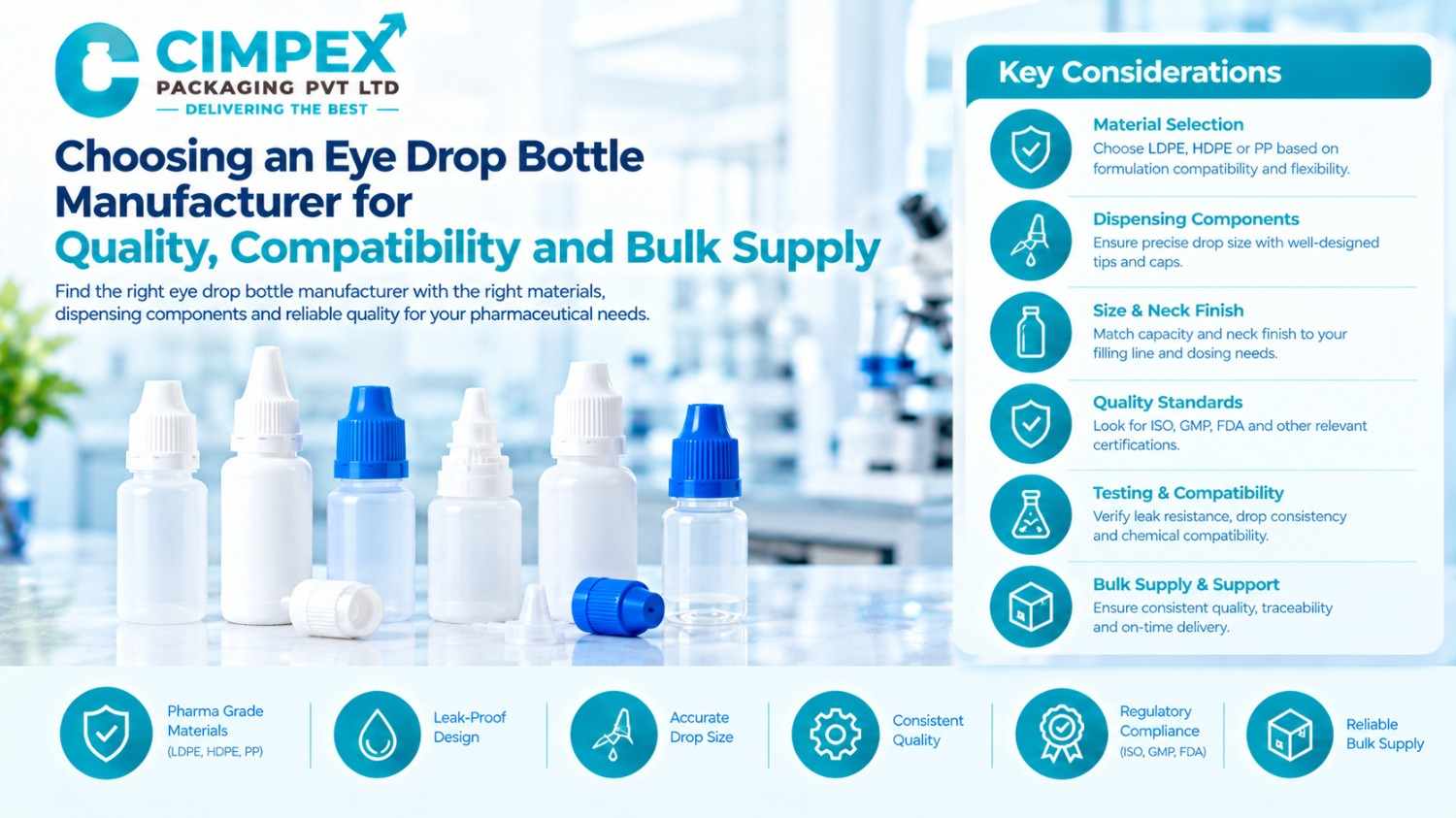
Why Eye Drop Packaging Demands Close Attention
Ophthalmic products are applied to a sensitive area, so packaging faults have a direct effect on patient comfort and product performance. A nozzle that drips too freely wastes medicine, while one that restricts flow frustrates the user. Loose closures can lead to leakage, and poor cleanliness in production can affect product safety. For these reasons, an experienced eye drop bottle manufacturer controls three areas closely: the resin used, the accuracy of the dropper tip and neck, and the cleanliness and consistency of manufacturing. Brands that understand these three points ask better questions during supplier selection and avoid costly corrections after launch. A capable eye drop bottle manufacturer will welcome those questions and answer them with samples and test records rather than general promises.Materials Used in Pharmaceutical Eye Drop Bottles
LDPE for Squeezable Dispensing
LDPE eye drop bottles are widely used because low-density polyethylene is soft, flexible and easy to squeeze, which allows controlled drop release. It also resists many aqueous formulations and handles repeated use well. The polymer is described in more detail in this reference on low-density polyethylene. Since LDPE is flexible, LDPE eye drop bottles suit the gentle squeeze that eye drop dispensing needs.HDPE and PP Components
HDPE is stiffer and is often used for caps or for formats that need more rigidity. Polypropylene is common in caps and closures where heat tolerance or strength matters. In many pharmaceutical eye drop bottles, the body, tip and cap are made from different resins, each selected for its role.Key Material Selection Points
- Formulation compatibility: confirm that the resin does not interact with the active ingredient, preservative or pH of the solution.
- Flexibility: the body should return to shape after each squeeze so the next drop is consistent.
- Light protection: opaque or tinted walls help protect light-sensitive formulations.
- Material suitability: ask the manufacturer to confirm the resin grade is suitable for pharmaceutical contact.
Why Pharmaceutical Eye Drop Bottles Differ From General Plastic Bottles
Pharmaceutical eye drop bottles are made with tighter control than general-purpose squeeze bottles. The tip orifice, wall thickness and neck finish are all designed for one job: delivering a controlled drop without contaminating the contents. LDPE eye drop bottles are a common format because the flexible body lets the user dose gently. When you speak with an eye drop bottle manufacturer, ask how these features are controlled during production and how they are checked.Dropper Tips, Caps and Dispensing Performance
The dropper tip is the most important functional part of the pack. Eye drop bottles with dropper caps rely on a precisely sized orifice to control drop formation, and even a small variation in tip geometry can change the drop size. Tips should be smooth, free from burrs and well seated in the neck. The cap protects the tip and creates the seal. Tamper-evident bands, child-resistant options and screw-on closures are common features, and the choice depends on the product and local requirements. Eye drop bottles with dropper caps should always be evaluated as a complete assembly, since a good bottle with a poorly fitting cap can leak during transport. Cimpex Packaging also produces caps and closures, and you can see the range of eye drop bottles with dropper caps and matching closures on its website.What to Check on a Sample
- Drop size and consistency across repeated squeezes.
- Cap fit and tamper-evident band behaviour.
- Smoothness of the tip and absence of flash or burrs.
- Leak resistance when the bottle is inverted and lightly pressed.
Understanding Eye Drop Bottle Sizes
Eye drop bottle sizes are selected according to the dose volume, the treatment duration and the product’s category. Small capacities are common for ophthalmic products because patients use them in small amounts and because many formulations should not be kept open for long periods. Sizes are specified by nominal capacity, and actual availability depends on each manufacturer’s mould range. When comparing eye drop bottle sizes, ask for the filling volume, headspace and neck finish, not just the label capacity. Headspace matters because it affects squeeze feel and prevents overflow during capping. Request exact dimensions rather than assuming that a similar looking bottle from another supplier will fit your filling line.Eye Drop Packaging Containers: Format Comparison
Eye drop packaging containers come in several formats. The table compares them qualitatively so that you can see where each one fits.| Factor | Standard LDPE Bottle with Dropper Tip | Rigid HDPE or PP Bottle | Nasal or Spray Style Container |
| Dispensing control | Good drop control through squeeze | Limited unless fitted with a special tip | Designed for sprays, not drops |
| Flexibility | High | Low | Moderate |
| Typical use | Ophthalmic drops | Oral liquids and general pharma | Nasal products |
| Closure style | Screw cap with tamper evidence | Screw or snap cap | Pump or spray cap |
| Best suited for | Eye drops and ear drops | Syrups, suspensions | Nasal sprays |
Choosing a Plastic Eye Drop Bottle Supplier
A reliable plastic eye drop bottle supplier is one that can explain its process, share its quality checks and give consistent results across batches. Compared with a general plastic converter, a specialist eye drop bottle manufacturer should be able to describe tip design and neck control in detail. Ask which resins are used, how the nozzle is produced and how closures are matched to bottle necks. The supplier should also be able to describe its cleanliness practices in production, and you should confirm whether they meet the requirements of your own quality system.Supplier Questions That Reveal Quality
- Process control: how are moulding parameters monitored and recorded?
- Quality checks: what leak, dimension and visual inspections are carried out, and how often?
- Traceability: can batches be traced back to resin lots?
- Customisation: can neck finishes, colours and capacities be adjusted for your range?
- Communication: does the team respond clearly to technical queries?
Working With an Eye Drop Bottle Manufacturer in India
India has a large pharmaceutical packaging base, and choosing an eye drop bottle manufacturer in India can shorten lead times and simplify logistics for domestic and export formulators. Eye drop bottles from Cimpex Packaging are produced alongside its HDPE and PP bottles, jars and closures at Baddi, Himachal Pradesh, and lists eye drop bottles among its products. When you contact any eye drop bottle manufacturer in India, share your formulation type, expected volumes and closure requirements so the response is specific rather than generic. You can learn how bottles are made through the company’s process and manufacturing page, which helps you understand what to ask during a supplier audit of eye drop packaging containers.Planning Bulk Supply
A bulk eye drop bottle supplier must deliver the same bottle in the thousandth batch as in the first. Before placing a large order with any eye drop bottle manufacturer, approve a pre-production sample, agree acceptance criteria in writing and confirm packing methods that protect cleanliness in transit. Ask about stock-holding for repeat orders and the typical lead time for tooling changes. If you plan large runs, shortlist a bulk eye drop bottle supplier only after checking its capacity and sample quality. Brands often underestimate how much a bulk eye drop bottle supplier affects production planning. Lead time delays, inconsistent dimensions or packaging damage can stop a filling line for days. A plastic eye drop bottle supplier that also controls closures can reduce fit problems between bottle and cap. Choosing a supplier with proven capacity, clear communication and defined quality checks reduces that risk.Common Mistakes to Avoid
- Selecting a bottle based on appearance without testing drop size.
- Skipping compatibility testing with the actual formulation.
- Ordering volume before approving a sample.
- Treating the cap and bottle as separate purchases from different suppliers.
- Choosing an eye drop bottle manufacturer on unit price alone, without comparing testing records.
- Overlooking storage and transport conditions for cleaned bottles.
Conclusion
The right eye drop bottle manufacturer combines material knowledge, precise dispensing components and dependable batch-to-batch quality. Focus on the flexibility of LDPE eye drop bottles, a well-fitted dropper tip and cap, correct capacity and a supplier whose process you can verify. Test samples with your own formulation, approve them in writing and plan bulk volumes with realistic lead times. A dependable eye drop bottle manufacturer will support that process with samples, records and clear communication. If you are sourcing from an eye drop bottle manufacturer for an ophthalmic product, list your formulation type, capacity, closure requirements and expected volumes before requesting quotations. You can review the eye drop bottle range on the Cimpex Packaging website or contact the team for guidance based on your product and order volume.Frequently Asked Questions
Most eye drop bottles are made from low-density polyethylene because it is soft, squeezable and resists many aqueous formulations. Caps are often made from HDPE or polypropylene for stiffness. The right combination depends on your formulation, so compatibility testing is important.
Eye drop bottles are generally made in small capacities because ophthalmic products are used in small doses. The exact sizes available depend on each manufacturer’s moulds. Request nominal capacity, fill volume and neck finish from your supplier so the bottle fits your filling line.
LDPE bottles are preferred because their flexible walls let the user squeeze out controlled drops and then return to shape. They are also lightweight and compatible with many formulations. Confirm compatibility with your product and test the drop size before committing.
Check the resin grade, dropper tip accuracy, cap fit, cleanliness practices, quality testing and batch traceability. Request samples and test drop size and leakage. A manufacturer that explains its process clearly and documents its checks is a stronger partner for ophthalmic packaging.
Yes, manufacturers can often customise capacity, neck finish, colour and cap style. Changes to shape or tip design usually need new tooling, so confirm timelines and minimum quantities early. Share your filling line details so the design works with your equipment.
Tamper-evident caps are widely used on eye drop bottles because they show that the pack has not been opened. Whether they are required depends on the product category and applicable regulations. Check your regulatory requirements and confirm cap compatibility with the bottle neck.
Contact the supplier with your capacity, quantity, closure type and delivery schedule, then request and approve a sample before production. Confirm minimum order quantities, lead times and acceptance criteria in writing. This reduces risk and ensures consistent quality across batches.