


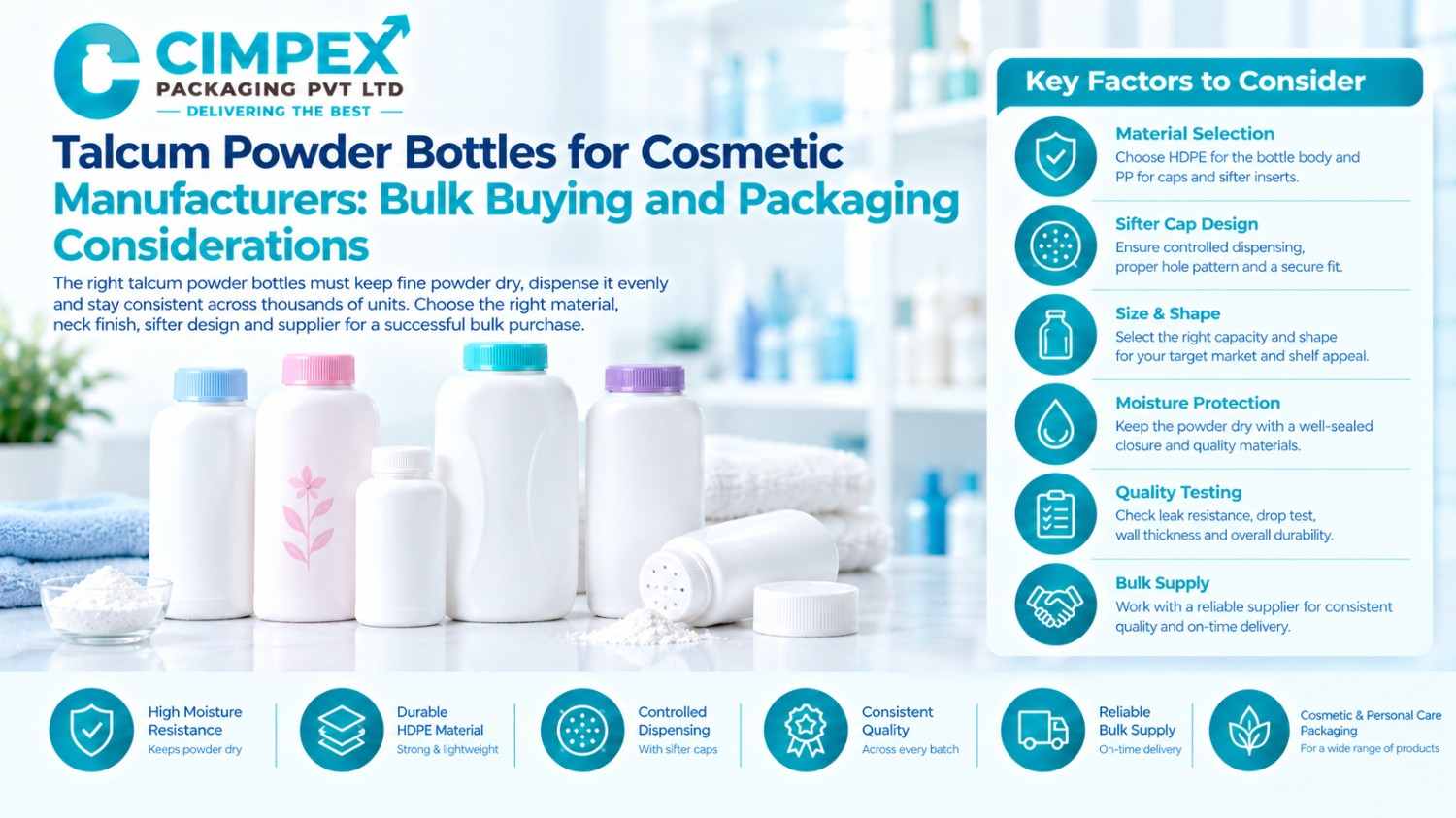
Why Packaging Matters for Powder Products
Powders behave differently from liquids and creams. Fine particles can escape through small gaps, absorb moisture from the air and form lumps if the container does not protect them. Packaging also decides how the product is used: a poorly designed opening can release too much powder at once, while a blocked one frustrates the customer. For talcum powder, the container needs to do three things well. It should seal firmly so moisture stays out, it should dispense in a controlled way and it should be comfortable to hold and shake. Bottles that meet these needs support repeat purchases, while poor ones lead to complaints about clumping, spillage and difficult dispensing. Talc itself is a mineral with a long history of use in personal care, and you can read a general description in this overview of talc.Choosing the Material: HDPE and Alternatives
HDPE for Strength and Moisture Resistance
HDPE talcum powder bottles are a common choice because high-density polyethylene is strong, light and resistant to moisture. The wall holds its shape when pressed, which helps when the customer squeezes or taps the bottle to release powder. HDPE also handles shipping and stacking well and costs less to transport than glass.Polypropylene for Caps and Rigid Designs
Polypropylene is often used for caps and sifter inserts because it is stiff and holds thread detail accurately. In many designs, the bottle body is HDPE and the closure is PP, with each material chosen for its function.Key Material Selection Points
- Moisture protection: a dense, well-moulded wall reduces moisture entry over the shelf life of the powder.
- Wall flexibility: a slightly flexible body helps dispensing, but excessive softness can cause the bottle to dent.
- Surface finish: a smooth surface supports labelling, sleeves and printing for retail presentation.
- Weight and shipping: lightweight bottles lower freight cost, but should still resist crushing in cartons.
Sifter Caps and Dispensing Control
The cap is the working part of the pack. Talcum powder bottles with sifter caps use a perforated insert or flip-top cover to release powder in a controlled stream. The number and size of holes, the cap fit and the neck finish all affect how the powder flows. Cimpex Packaging also manufactures caps and closures, so talcum powder bottles with sifter caps can be matched as a set rather than sourced from two vendors. That matters because a sifter that is slightly loose will leak powder and spoil the product’s appearance in transit.Sifter Cap Points to Check
- Hole pattern suited to your powder’s fineness, so it neither clogs nor over-pours.
- A secure fit between the cap, insert and neck.
- A cover or flip lid that closes tightly after use.
- A tamper-evident seal or liner, if your brand requires one.
- Smooth edges on the insert, so the user is not irritated when shaking.
Talcum Powder Packaging Bottles: Shape and Capacity
Talcum powder packaging bottles are usually round or oval with a short neck, which makes them easy to hold and shake. Round bodies are easier to fill and label, while oval and flat-sided designs can offer more label area and shelf presence. Capacity should be chosen according to your product positioning, retail channel and expected consumption. Larger packs suit family use and travel packs suit trial or on-the-go customers, so many brands launch two or three capacities from the same neck finish. Customers also notice small details such as how firmly the cap clicks shut and whether the label stays clean after repeated handling. Since available capacities depend on each manufacturer’s moulds, request exact dimensions, neck finishes and weights. Also check how talcum powder packaging bottles perform in cartons, because shape affects stacking stability and freight efficiency.Plastic Talcum Powder Containers for Different Segments
Plastic talcum powder containers serve many categories, including body powders, medicated powders, prickly heat powders, foot powders and baby powders. Each category has its own needs. Baby products require gentle edges and secure closures, while medicated powders may need a more careful material and closure review. Premium cosmetic powders often use specific colours, matte finishes or printed sleeves to stand out. If you plan a range with several variants, using one container family across variants simplifies inventory and keeps branding consistent. Plastic talcum powder containers that share the same neck finish also let you use one cap style across the range.Comparing Container Options
The table compares common packaging approaches using qualitative factors only.| Factor | HDPE Bottle with Sifter Cap | Glass Jar with Perforated Lid | Paperboard Canister |
| Moisture protection | Good with a tight cap | Excellent | Limited unless lined |
| Weight | Light | Heavy | Very light |
| Breakage risk | Low | Higher | Low, but can dent |
| Dispensing control | Good with sifter design | Moderate | Moderate |
| Shipping cost | Lower | Higher | Low |
| Best suited for | Mass and mid-market talcum powder | Premium or gift positioning | Short shelf life or economy products |
Selecting a Cosmetic Powder Bottle Manufacturer
What a Good Manufacturer Offers
A capable cosmetic powder bottle manufacturer controls resin quality, mould accuracy and closure fit. Ask which resin grades are used, how dimensions are checked and whether the supplier can make caps that match the bottle neck. A cosmetic powder bottle manufacturer should be able to supply samples and explain their inspection process in plain terms.Talcum Powder Bottle Manufacturer in India
Working with a talcum powder bottle manufacturer in India can reduce lead times and simplify logistics for domestic brands and exporters. Cimpex Packaging produces HDPE and PP bottles, jars and closures at its facility in Baddi, Himachal Pradesh, and lists talcum and dusting powder bottles in its range. When you contact any talcum powder bottle manufacturer in India, share your powder type, capacity, cap style and expected volumes so the response is specific.Cosmetic Packaging Bottle Supplier Checklist
A reliable cosmetic packaging bottle supplier should be able to answer the following:- Which resin grade is used and how are batches tracked?
- What leak, dimension and visual inspections are performed?
- Can capacity, neck finish and colour be customised?
- What are the typical lead time and minimum order quantity?
- Can the supplier provide talcum powder bottles with sifter caps as a matched set?
Bulk Buying: What to Plan Before You Order
Bulk talcum powder bottles require more preparation than a trial order. Dimensions must be consistent so caps fit every bottle, and delivery must match your filling schedule. Before placing a large order, approve a pre-production sample, agree acceptance criteria in writing and confirm how cartons will be packed. If you are comparing quotes, a cosmetic packaging bottle supplier that publishes clear specifications and sample policies makes the evaluation easier. Buyers of bulk talcum powder bottles should also ask about tooling ownership for custom shapes, repeat-order lead times and stock-holding arrangements. If your range includes several sizes, plan the sequence so that the highest-volume pack is secured first.Common Mistakes to Avoid
- Assuming all HDPE talcum powder bottles perform the same, when neck finish and wall thickness differ between suppliers.
- Choosing a bottle on appearance without testing the sifter cap.
- Using a cap that was not matched to the neck finish.
- Skipping a sample run on your own filling line.
- Placing a large first order before approving a sample.
- Ignoring how cartons are packed, which can lead to dented or scratched bottles.
Conclusion
Choosing talcum powder bottles is a practical decision that combines material, closure design, capacity and supplier reliability. HDPE bottles with a well-matched sifter cap suit most cosmetic powders, provided the neck finish, insert and cap are planned together. Test bulk talcum powder bottles with your own powder, review how cartons arrive and avoid committing to a full order before approving a pre-production sample. If you are preparing a bulk order, list your powder type, capacity, cap style and expected monthly volume before requesting quotations. You can review the talcum and dusting powder bottle range on the Cimpex Packaging website or contact the team for guidance based on your product and requirements.Frequently Asked Questions
HDPE is the most common material for talcum powder bottles because it resists moisture, holds its shape and keeps shipping weight low. Polypropylene is often used for caps and sifters. The best choice depends on your powder, branding and dispensing needs, so test samples first.
A sifter cap has small perforations in an insert or lid that release powder in a controlled stream when the bottle is shaken. It usually includes a cover or flip lid to close the openings. The hole pattern should suit the fineness of your powder.
Choose the size according to your target customer, retail channel and expected usage, then confirm filling volume and headspace with the manufacturer. Larger bottles suit family packs, while smaller ones suit travel and trial. Always request exact dimensions and neck finish.
Yes, manufacturers can often customise capacity, colour, neck finish and cap style. Changes to shape usually need new tooling, so confirm minimum quantities and timelines early. Share your filling line details and label requirements so the design fits your process.
Check resin grade, dimensional consistency, cap and sifter fit, quality testing, production capacity and lead time. Approve a pre-production sample and confirm acceptance criteria in writing. This reduces the risk of fit problems and delays across large production runs.
HDPE bottles are widely used for baby and cosmetic powders because they are light, durable and moisture resistant. Suitability still depends on the specific formulation and applicable regulations, so confirm material and closure requirements with the manufacturer and your regulatory team.
Look for a supplier that explains its process, provides samples, documents its quality checks and can supply matched caps and sifters. Compare lead times and minimum quantities, and ask for specific answers rather than general claims. Clear communication is usually a good sign.