


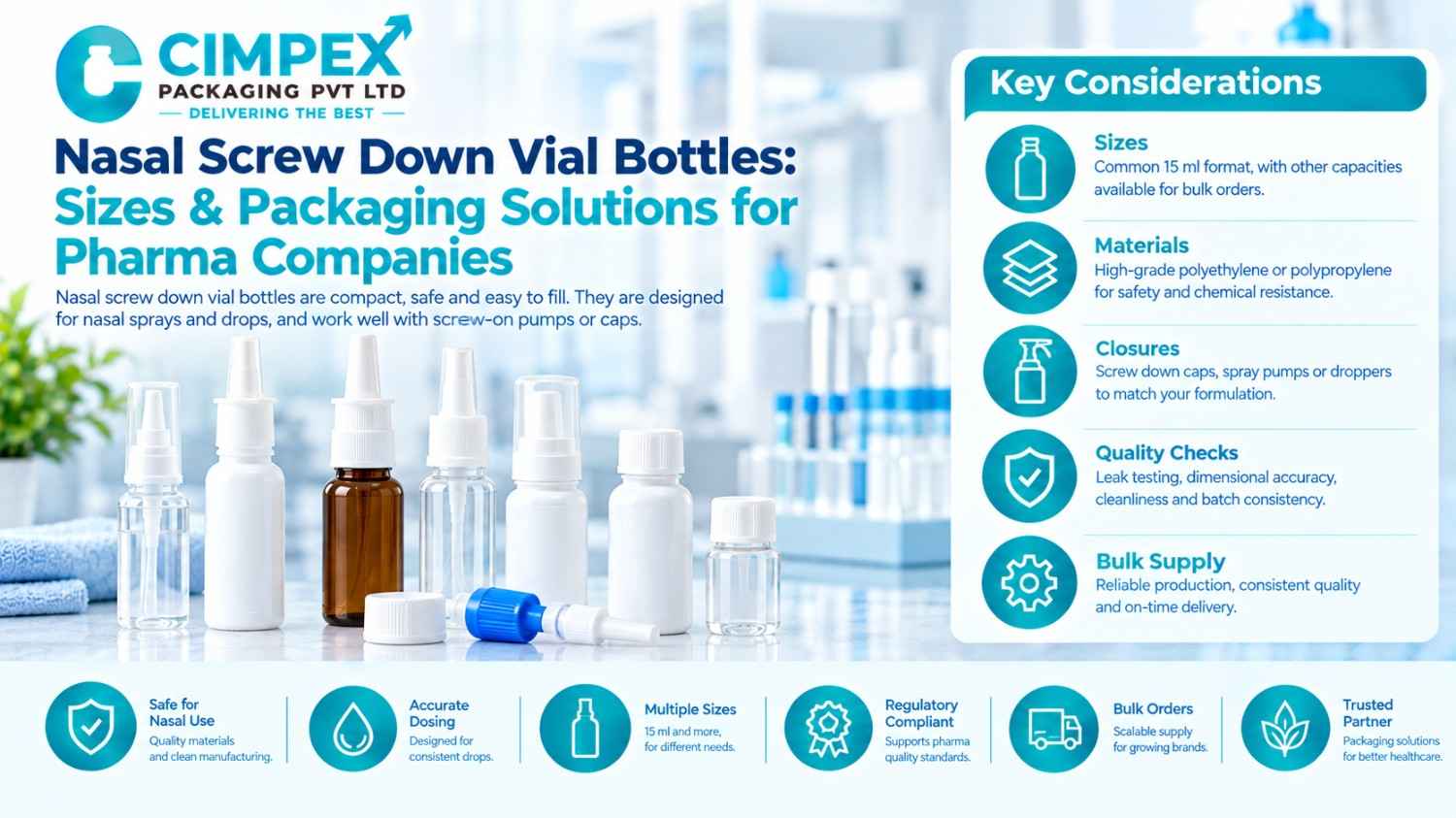
What Are Nasal Screw Down Vial Bottles?
A nasal vial is a small bottle, usually between ten and thirty millilitres, used to deliver medication into the nasal passages as a spray or as drops. The “screw down” description refers to the neck finish: the closure or pump collar threads onto the neck and is tightened by hand or by a capping machine. For general background on how these products work, see the FDA guidance on nasal spray drug products. Nasal screw down vial bottles are used for saline sprays, decongestants, allergy relief sprays, herbal and Ayurvedic nasal drops and a range of other pharmaceutical liquids. Because the bottle is small, each design decision, from neck accuracy to wall flexibility, has a visible effect on dosing and leakage.Nasal Screw Down Vial Bottles Versus Crimp Neck Vials
The closure method is the first decision a packaging team makes. Both formats are used in nasal packaging, and the right one depends on the pump, the product and the filling line.| Factor | Screw down vial | Crimp vial |
| Closure method | Threaded collar tightened onto the neck | Metal collar crimped onto the neck |
| Filling line | Capping by hand or torque capper | Needs a crimping tool or machine |
| Reuse or refill | Closure can be removed | Closure is generally not removed |
| Tamper resistance | Depends on added seal or shrink band | Inherently harder to open |
| Typical choice | Cost-sensitive and flexible packaging | Pumps that need a firm, fixed seal |
Sizes: Why 15 ml Is So Common
Capacity affects patient use, dosing and shelf appeal. A 15 ml nasal spray vial is one of the most widely used sizes because it holds enough product for a typical course while remaining small enough for a pocket or bag. Our standard capacity is 15 ml, offered as a nasal translucent vial bottle, and other capacities are possible for bulk orders subject to minimum order quantity. When you select a size, consider the following: Dose count: how many sprays the bottle must deliver across its use period. Fill volume: leave appropriate headspace so the pump can prime properly. Patient handling: smaller bottles suit travel, while larger ones suit family use. Carton and shipping: consider how many bottles fit in a shipper and on a pallet. A 15 ml nasal spray vial often serves as the main trade pack, with smaller bottles used for sampling.Materials for Nasal Screw Down Vial Bottles
Plastic nasal spray bottle manufacturers generally work with polyethylene or polypropylene, chosen for chemical resistance. Our vials are made from high-grade translucent plastic that is food and pharma safe. Translucent bottles let patients see the remaining liquid, which is useful for a product used daily. Fully coloured or opaque bottles may be preferred when a formula is light sensitive. A plastic nasal spray bottle manufacturer can advise on options, and a good plastic nasal spray bottle manufacturer will also supply samples, as we do. The choice of material should always be validated against your own formulation and stability studies.Pharmaceutical Nasal Spray Bottles: Quality Considerations
Pharmaceutical nasal spray bottles are held to a higher standard than general consumer packaging because they contact a medicine and are used in a sensitive part of the body. The following areas deserve attention: Cleanliness: bottles should be moulded and packed in a way that limits dust and particulate matter. Neck finish accuracy: threads must be consistent so the pump seats evenly and does not leak. Material suitability: the plastic should be suitable for contact with your formulation and supported by the right documentation. Batch consistency: weight, dimensions and appearance should be steady from lot to lot. Pharmaceutical nasal spray bottles should be accompanied by documentation that suits your regulatory requirements. Ask your supplier what material documentation and quality records are available before you finalise the order, and involve your regulatory and quality teams early, since bottle and pump are validated together.Nasal Vial Bottles for Pharmaceutical Packaging
Nasal vial bottles for pharmaceutical packaging are used well beyond conventional sprays. Typical applications include saline nasal products, medicated drops, herbal and Ayurvedic preparations and allergy relief sprays. The same vials are also used for facial mists, aromatherapy oils and veterinary liquids. When you specify nasal vial bottles for pharmaceutical packaging, think about the full pack: bottle, pump or cap, label, carton and leaflet. A well-chosen vial that matches the pump neck, the label area and the carton dimensions makes production far smoother. Many brands also use nasal vial bottles for pharmaceutical packaging as a platform bottle across several products, changing only the label and colour.Closures and Customisation for Nasal Screw Down Vial Bottles
We can customise our nasal vials with colours, screw-down caps, crimp closures and nasal pumps, along with screen printing, hot stamping, labels and private labelling. Custom mould development is also available for larger programmes.Matching the Pump
Always select the spray pump first, then confirm the neck finish on the vial. A mismatch is usually discovered only when the pump is assembled on the filling line. Ask for a trial set that includes the bottle and pump so that you can test the spray pattern, the dose and the seal before approving production.Choosing a Manufacturer for Nasal Screw Down Vial Bottles
Buyers can approach a plant directly or work through a distributor. A nasal spray bottle manufacturer in India with its own tooling controls the mould, the resin and the production schedule, which suits brands that need custom colours, neck finishes or decoration. A nasal screw down vial supplier is often a good starting point for trial runs and smaller lots, because stock designs can be quoted and shipped quickly. We manufacture at Baddi in Himachal Pradesh and supply pharmaceutical companies across India and export markets. When you compare any nasal spray bottle manufacturer in India, look at documentation, sample quality, communication and lead time as well as price. A nasal screw down vial supplier should be judged on the same points.Questions to Ask Before You Order
- Which resin is used, and can the material be documented for pharmaceutical use?
- Is the neck finish compatible with the pump you have selected?
- What is the minimum order quantity for stock and custom designs?
- How are bottles cleaned, packed and protected during transport?
- What lead time applies to standard and custom orders?
Bulk Supply and Planning
Pharma packaging is planned months ahead, and pack changes take time to validate. Nasal spray bottles wholesale supplier arrangements are most useful when you know your annual volume, expected pack variants and delivery schedule. A nasal spray bottles wholesale supplier will often quote better pricing when a single design runs across several SKUs. Planning points: Standardise the bottle: use one vial design across products where regulatory rules allow. Plan colour decisions early: custom colours and moulds extend lead times. Hold safety stock: pharma filling lines cannot wait for a missing component. Agree incoming inspection: define visual, dimensional and fit checks in advance. If you source an HDPE nasal spray bottle supplier range alongside other pharmaceutical bottles, one vendor can supply several formats and reduce purchasing complexity. An HDPE nasal spray bottle supplier that also offers caps and closures makes pump and neck matching easier. If you prefer HDPE, ask us to confirm that the specific vial design is available in that material, since our standard vial page does not name the polymer. Nasal spray bottles wholesale supplier terms should also state packing, dispatch and replacement policies for any defects found on receipt.Conclusion
Choosing nasal screw down vial bottles is a technical decision that affects dosing, leakage, patient experience and regulatory documentation. Start with the pump, confirm the neck finish, select a size such as 15 ml that suits the product, and validate the material against your formulation. Working with a nasal spray bottle manufacturer in India that can explain its process, supply samples and document its materials turns packaging from a risk into a dependable part of your product. When nasal screw down vial bottles are specified carefully, filling runs smoothly and the finished pack performs as intended. If you are developing a nasal spray or drop product, prepare your bottle size, neck finish, pump details and expected volumes, then contact the Cimpex team to request samples and a quotation.Frequently Asked Questions
Nasal screw down vial bottles are small plastic bottles with a threaded neck that accepts a screw-on spray pump or cap. They are used for nasal sprays and drops, and are valued for easy filling, simple assembly and compact size.
A 15 ml nasal spray vial is widely used for nasal sprays and is our standard capacity. Other sizes may be available for bulk orders, depending on tooling and minimum order quantity, so confirm availability with us.
A screw down vial uses a threaded collar that is tightened onto the neck, while a crimp vial uses a metal collar that is crimped in place. Crimp closures are harder to remove, and the right choice depends on your pump.
Nasal spray bottles are commonly made from polyethylene or polypropylene because of their chemical resistance. Always ask the supplier to confirm the exact resin and supporting documentation, and validate it against your own formulation.
Yes. Customisation can include colour, closures, screen printing, hot stamping, labels, private labelling and custom mould development. Larger customisation usually affects minimum order quantity and lead time, so discuss your requirements with us early.
Minimum order quantity depends on customisation and volume. We provide MOQ on request, so share your size, colour, closure and annual requirement and we will give you a firm quotation.
No. Besides nasal sprays and drops, small vials are used for herbal preparations, facial mists, aromatherapy oils and veterinary products. For medicinal use, confirm material suitability and documentation with your regulatory team.