


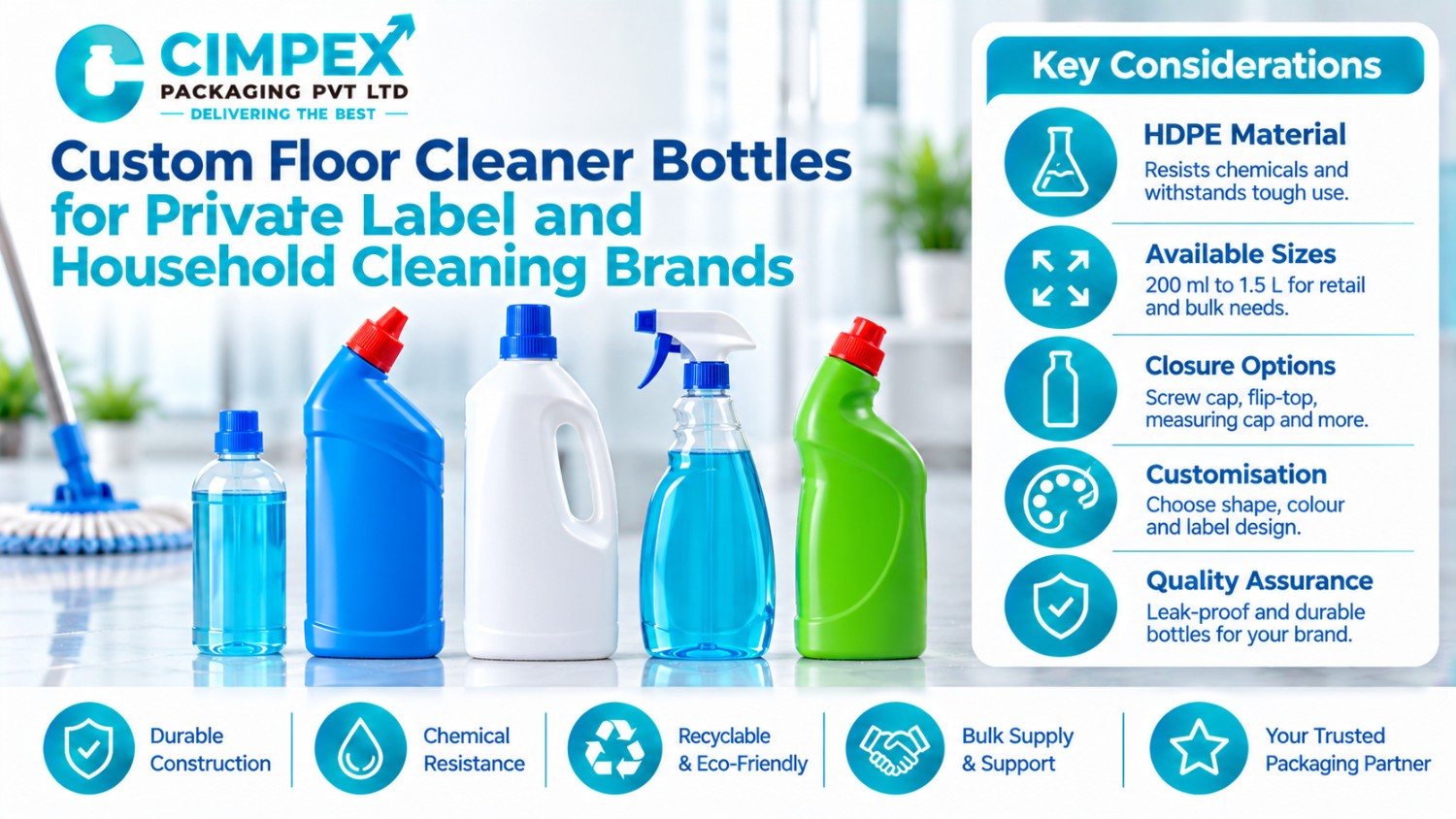
Why Packaging Matters for Floor Cleaning Liquids
Floor cleaners combine surfactants, fragrances, dyes and sometimes solvents or disinfecting agents. Each of these can interact with plastic. A poorly matched bottle may soften, deform, develop stress cracks near the base or neck, or allow fragrance loss. The result is leaks in transit, damaged cartons and unhappy retailers. The bottle is also what the customer picks up first. Shape, grip, colour and label space decide whether a floor cleaner looks premium, economical or forgettable. Strong floor cleaner bottles therefore protect the formula and carry the brand.Plastic Bottles for Household Cleaning Products: Why HDPE Is Common
Plastic bottles for household cleaning products are most often made from high-density polyethylene. HDPE resists many acids, alkalis, alcohols and common solvents, and it tolerates impact better than brittle materials. It is widely used for household and industrial chemicals, including detergents, cleaners and disinfectants, and the resin is recyclable.Why HDPE Suits Cleaning Products
- Chemical resistance: it handles the surfactants and many additives found in floor cleaning liquids.
- Impact strength: bottles survive transport, stacking and drops better than rigid, brittle alternatives.
- Moisture barrier: it protects liquids from humidity and water vapour.
- Cost efficiency: it is practical for the high volumes typical of FMCG cleaning.
- Recyclability: HDPE carries resin identification code 2, which supports sustainability claims when used with a compatible closure.
HDPE Bottles for Floor Cleaning Liquid: Material and Manufacturing Checks
HDPE bottles for floor cleaning liquid should be made from virgin resin of an appropriate grade, with consistent wall thickness. Good cleaner bottles are produced by extrusion blow moulding and checked through drop, leak, top-load and chemical compatibility tests. Uneven walls create weak spots that fail first under load or drop. Ask a supplier how wall thickness is checked and how often. Also ask for material data sheets, especially if the cleaner contains strong acids, hypochlorite or concentrated solvents.Floor Cleaner Bottle Sizes and Packaging Options
Floor cleaner bottle sizes and packaging options depend on the sales channel. Retail shelves favour manageable sizes that fit a hand and a cabinet. Institutional buyers such as hotels, hospitals and housekeeping contractors prefer larger containers that reduce refilling. Common cleaning bottle sizes include 200 ml, 500 ml, 750 ml, 1 L, 1.25 L and 1.5 L, and HDPE bottles overall cover roughly 30 ml to 5 litres, so both retail and bulk formats are possible for floor cleaner bottles. Closure choice shapes how usable floor cleaner bottles feel in daily use. Many floor cleaners use measuring caps so users can dose concentrated liquid, and measuring cups and caps can be sourced to match the bottle neck.| Closure option | Best suited for | Consideration |
| Screw cap | Basic retail packs | Simple and economical, little dosing control |
| Flip-top cap | Everyday pouring | Convenient, check leak resistance in transit |
| Measuring cap | Concentrated floor cleaners | Helps users dose correctly, needs a compatible neck |
| Child-resistant or tamper-evident closure | Products with safety requirements | Confirm availability with the chosen neck finish |
How to Choose the Right Size
- Match size to usage: single-room cleaners differ from whole-house concentrates
- Consider how consumers store the bottle under sinks or in cabinets
- Check shelf and carton dimensions for logistics efficiency
- Review pricing slabs, since larger volumes change per-unit cost
Custom Floor Cleaner Bottles for Brands
Custom floor cleaner bottles for brands can be differentiated in shape, colour, neck finish and decoration. Suppliers can develop custom moulds for unusual designs, match Pantone colours, and offer bottle surfaces suited to labels, screen printing, hot stamping, in-mould labelling and shrink sleeves. Custom mould development typically takes three to four weeks from approved design to first sample, and once a mould is made, reorders run without repeated setup. A distinctive bottle is an asset, but it carries cost, and custom moulds for floor cleaner bottles need enough volume to justify it. A custom mould needs enough volume to justify it, so many brands begin with a stock design, learn what customers respond to, and invest in tooling afterwards.Floor Cleaner Packaging for Private Label Brands
Floor cleaner packaging for private label brands has to balance cost, shelf appeal and flexibility. Private label owners often change fragrance, size or label regularly, so they need a packaging partner that supports repeatable supply and clear documentation. Ask whether the supplier provides GST invoicing, material test certificates and compliance documentation. Labelling rules also affect design. In India, the Legal Metrology (Packaged Commodities) Rules, 2011 require mandatory declarations on packaged goods, such as the name and address of the manufacturer or packer, so the bottle needs enough label space for these alongside branding. Confirm current requirements with your compliance adviser, since rules are amended from time to time.Custom Plastic Bottles for Cleaning Chemicals
Custom plastic bottles for cleaning chemicals are particularly important when a formula is aggressive, such as acid-based or hypochlorite-based products. HDPE cleaning bottles can generally hold acids and sodium hypochlorite without leaching, swelling or degrading, but for unusual chemicals compatibility should be confirmed before an order. Neck design matters as much as material. Standard 28 mm and 33 mm neck finishes are common, with custom profiles available for caps, flip-tops and trigger sprays, so the same bottle line can often serve more than one product type.Cleaning Liquid Bottle Manufacturer for FMCG Brands
A cleaning liquid bottle manufacturer for FMCG brands must deliver the same bottle on the hundredth order as on the first. Consistency matters because filling lines are set to precise dimensions, and variation causes jams and rejects. An ISO 9001:2015 certified plant and batch-wise documentation help keep quality predictable.Questions to Ask Before Choosing a Supplier
- Can you share material data and compatibility advice for my formula?
- How do you check wall thickness, leakage and top-load strength?
- What are the MOQ, lead time and sample terms for standard and custom bottles?
- Do neck finishes follow industry standards so I can source caps separately?
- Can you supply documentation with every batch?
Bulk Floor Cleaner Bottle Supplier in India: Ordering Terms
A bulk floor cleaner bottle supplier in India should be transparent about quantities and timelines. For cleaning bottles, MOQ often starts from around 5,000 units for standard SKUs, with higher MOQs for custom moulds. Typical lead times are 7 to 15 working days for stock designs and 25 to 40 days for fully customised bottles with new tooling, and good suppliers also offer free samples on request, tiered bulk pricing and pan-India dispatch. Always confirm current terms in your quotation, because specifications and volumes affect both price and schedule.Common Mistakes with Floor Cleaner Bottles
- Skipping sample trials: test floor cleaner bottles with the real formula, not water.
- Ignoring fragrance effects: strong fragrances and solvents can stress some plastics.
- Forgetting label space: regulatory declarations and branding both need room.
- Choosing a custom mould too early: custom floor cleaner bottles for brands should be validated with a stock design first.
- Overlooking closures: a leak-prone cap undoes a well-made bottle.
Conclusion
Good floor cleaner bottles combine chemical-resistant HDPE, sensible sizes, reliable closures and enough label space for both branding and regulatory information. Floor cleaner bottles, custom floor cleaner bottles for brands and floor cleaner packaging for private label brands all depend on the same discipline. For private label and household cleaning brands, success depends on testing samples with the real formula, confirming MOQ and lead times, and choosing a supplier that documents every batch. Before requesting quotations, list your formula type, preferred sizes, closure style and annual volume. Then contact the Cimpex team with your requirements for guidance on customisation, sampling and bulk supply.Frequently Asked Questions
HDPE is the most common choice for floor cleaner bottles because it resists many cleaning chemicals, tolerates impact and offers a good moisture barrier, which is why plastic bottles for household cleaning products are usually HDPE. Always test your own formulation, since fragrances, solvents and surfactants can affect any plastic over time.
Floor cleaner bottle sizes and packaging options depend on the sales channel. Retail packs are commonly mid-sized, while institutional supply uses larger containers. Cleaning bottles commonly range from 200 ml to 1.5 L, and the wider HDPE bottle range covers roughly 30 ml to 5 litres, with custom sizes available.
Yes, and custom plastic bottles for cleaning chemicals follow the same route. Options include custom shapes through new moulds, Pantone colour matching, neck finish selection and decoration by screen printing, hot stamping, in-mould labelling or shrink sleeves. Custom moulds require higher volumes, so many brands start with a stock design.
MOQ often starts from around 5,000 units for standard bottles, with higher quantities for custom moulds. A bulk floor cleaner bottle supplier in India will quote by SKU, and MOQs vary by supplier, size and customisation, so request a written quotation for your exact specification and annual volume.
Typical timelines are 7 to 15 working days for stock designs and 25 to 40 days for fully customised bottles requiring new tooling. Actual timelines depend on design complexity and order size, so confirm dates in writing before production begins.
Yes. Free physical samples are commonly available on request. A cleaning liquid bottle manufacturer for FMCG brands should offer them as standard. Samples allow you to check dimensions, finish, closure fit and chemical compatibility with your floor cleaner before committing to a bulk order.
Sometimes. A bottle with a standard neck finish can often be reused with different closures for floor cleaners, toilet cleaners or disinfectants. This is common in floor cleaner packaging for private label brands. Chemical compatibility must still be checked for each formulation, including HDPE bottles for floor cleaning liquid, because a bottle suitable for one liquid may not suit another.