


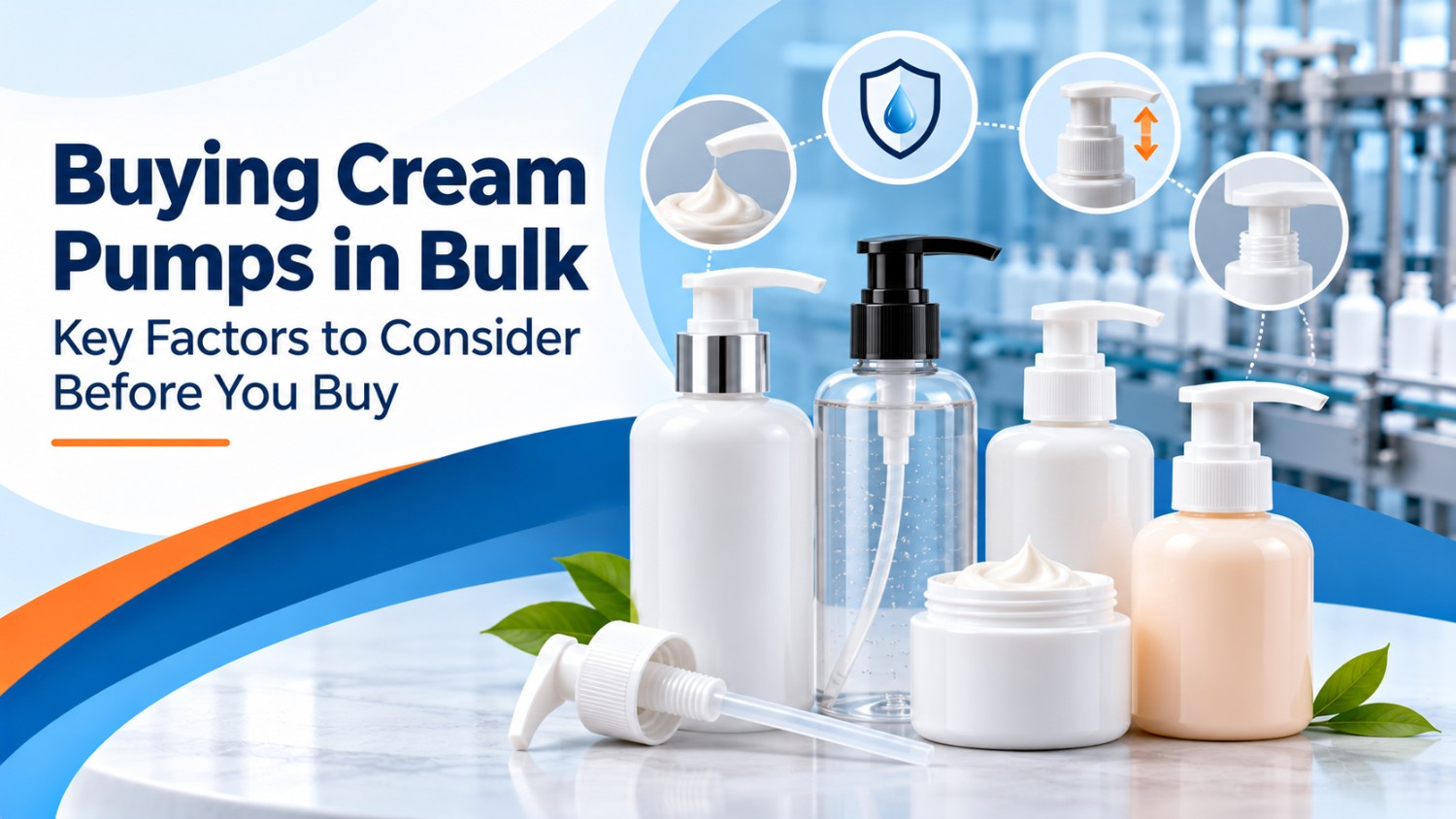
What Cream Pumps Do and Where They Are Used
Cream pumps are manual dispensing closures designed for thicker products such as moisturisers, body creams, hand creams, gels and similar semi-viscous formulations. Pressing the actuator moves a piston inside the pump body, drawing product up through a dip tube and releasing it through the nozzle. The same working principle appears in many industrial devices described as positive displacement pumps. Compared with a screw cap or a flip-top closure, cream pumps give users hygienic, one-handed dispensing and help control how much product leaves the bottle. For brands, they also affect perceived quality. A smooth, quiet, consistent stroke suggests a well-made product; a gritty or sticky pump suggests the opposite. Because cream pumps are small assemblies containing several parts, small differences in tolerance or material show up as big differences in user experience. That is why a structured buying checklist helps.Pump Quality and Durability
Few buyers can test every pump in a consignment, so pump quality and durability need to be judged through samples, documentation and process evidence. Start by cycling sample pumps repeatedly with your actual product, not with water. Thick creams reveal weak springs, poorly seated valves and rough piston movement that water hides. Look at how the pump behaves after repeated use. The actuator should return smoothly, the stroke should feel consistent from the first press to the last, and the pump should not lose prime easily. Inspect moulded parts for flash, short shots and uneven surfaces, since these indicate inconsistent production. A manufacturer that tracks defects per lot and can explain its inspection steps is more likely to deliver stable pump quality and durability across repeat orders. Ask what checks are done on incoming components and on finished, assembled pumps. Reliable cream pumps should feel the same from the first carton to the last.Practical Checks for Durability
- Press-test a sample from several cartons, not just the top layer
- Check that the actuator and collar fit tightly without wobble
- Confirm the spring returns the actuator fully each time
- Look for cracks or stress marks around the neck and nozzle
- Store samples for several weeks with your formula and inspect again
Dispensing Mechanism
The dispensing mechanism determines how product travels from the bottle to the user’s hand. In a typical cream pump, a piston and cylinder create suction on the upstroke and pressure on the downstroke, while one-way valves keep product moving in the correct direction. Not all cream pumps handle thick products equally. A design intended for thin lotions may struggle with dense creams, causing slow return, air pockets or incomplete dispensing. Ask the supplier which dispensing mechanism suits your viscosity range and request evidence, such as test samples run with a similar formulation. Consider also whether you need a locking feature. A lockable or twist-to-lock actuator reduces accidental discharge during shipping and travel, which is helpful for e-commerce and for products carried in bags. Airless systems use a different principle, pushing product up with a moving base instead of a dip tube, and they suit formulations that need protection from air, though they cost more and have different compatibility requirements.| Factor | Standard cream pump | Lotion pump | Airless pump |
| Typical product | Thick creams and gels | Fluid lotions and thin creams | Sensitive or high-value formulations |
| Product path | Dip tube | Dip tube | Piston base, no dip tube |
| Air exposure | Some air enters the bottle | Some air enters the bottle | Minimal |
| Relative cost | Moderate | Lower to moderate | Typically higher |
| Best suited for | Everyday skincare and body care | Fluid personal care products | Premium or air-sensitive products |
Pump Compatibility
Pump compatibility has two parts: how the pump fits the container, and how it interacts with the formulation. Mechanical fit is straightforward to verify. Cream pumps are made in several neck finishes, so check the neck finish, thread, dip tube length and collar diameter against the bottle you plan to use. A pump that is slightly too loose or too tight will leak, strip threads or fail to seat correctly. Chemical and physical compatibility is less visible. Some formulations contain oils, fragrances, alcohol or active ingredients that can soften certain plastics or swell seals. Run stability and compatibility checks with the pump and bottle together, because problems often appear only after weeks of contact. Also confirm that pump compatibility extends to your filling line. If the line applies a capping torque or uses automatic cappers, ask the supplier about recommended torque and any pump features, such as the closure type, that could interfere with automated assembly.Material Selection
Material selection affects chemical resistance, appearance, recyclability and cost. Most cream pumps are built mainly from polypropylene (PP) for the collar, actuator and body, often combined with other plastics for gaskets and seals, and sometimes with a metal spring. Each choice has trade-offs. Metal springs are common because they give a reliable return action, but they can contact the product in some designs, which matters for formulations sensitive to metal. All-plastic pumps avoid that contact and can simplify recycling, although they may behave differently in the return stroke. Dip tubes, gaskets and the actuator finish should also be reviewed. Good material selection starts with your formula, not the pump catalogue. Share your ingredient list with the supplier and ask which materials they recommend and why. Where regulatory requirements apply to your market, request the relevant material declarations from the supplier.Leak-Proof Design
A leak-proof design protects the product during transport, storage and use. Leaks in cream pumps usually come from three places: the thread between pump and bottle, the seal at the pump base, and the nozzle or actuator, where product can seep when the pump is pressed or knocked. Look for a pump with a well-fitted gasket or sealing ring, a tight thread and, where relevant, a lock mechanism. Drop and transit trials with filled samples reveal weaknesses that desk inspection misses. Place filled bottles on their sides, shake them, and expose them to temperature changes similar to your distribution route. Remember that leak-proof design is a system property. A good pump on a poorly moulded bottle neck can still leak, so test the pump and bottle as a complete assembly before approving volume.Dosage and Output
The dosage and output of a pump determine how much product reaches the user with each press. Cream pumps are manufactured with different output volumes, and the correct choice depends on product type and use. A facial cream needs a small, controlled dose, while a body cream may suit a larger one. Dose uniformity matters as much as the stated figure. Ask the supplier how output consistency is checked and test samples yourself by weighing several strokes of your product. Thicker formulations can reduce the amount delivered per stroke, so the number printed in a catalogue may not match real-world performance. Selecting the right dosage and output also reduces waste, improves perceived value and supports accurate usage instructions. If you advertise a number of uses per bottle, confirm it against measured output before printing claims.Bulk Pricing and Supply Capacity
Bulk pricing and supply capacity should be assessed together. A low quotation for cream pumps means little if the supplier cannot deliver on schedule or if quality varies from lot to lot. Request a clear price structure that covers minimum order quantity, price breaks at higher volumes, packing, freight and any tooling or customisation charges. Ask how much production capacity is reserved for your product and how the supplier handles demand spikes. Rolling forecasts help both sides plan resin, components and assembly time. For regular programmes, agree on lead times for repeat orders and on a process for urgent top-ups.Commercial Points to Confirm
- Minimum order quantity and price breaks at higher volumes
- Lead time for first orders and repeat orders
- Packing method and carton quality to protect pumps in transit
- Payment terms and any charges for colours or printing
- How shortages of components or resin are managed
Supplier Reliability
Supplier reliability is the factor that holds the other seven together. A dependable partner for cream pumps provides consistent samples and production, answers technical questions clearly, documents quality checks and communicates early when delays occur. Evaluate reliability through evidence rather than promises. Ask for a sample from production tooling, request quality records, and speak to existing customers where possible. Visit the facility or review a virtual tour to see how parts are assembled, inspected and packed. A trial order before a major commitment is a low-risk way to learn how a supplier performs under real conditions. Pay attention to responsiveness during the quotation stage. A supplier who is slow or vague before you buy rarely improves afterwards.Common Mistakes to Avoid
Approving cream pumps based on appearance alone is the most frequent error. Others include testing with water instead of the real formula, ignoring neck finish details, skipping drop and leak tests, and comparing quotations without checking equivalent specifications. Each of these mistakes is easy to avoid with a written specification and an approval sample signed by both sides.Conclusion
Buying cream pumps in bulk works best when technical and commercial checks happen together. Test durability and dispensing with your own formulation, confirm compatibility with bottle and filling line, choose materials with your formula in mind, verify leak resistance, measure real output and weigh bulk pricing and supply capacity against supplier track record. Before you shortlist, write a short specification covering product viscosity, neck finish, dose, materials and packing requirements, then compare suppliers against it. You can review the cream pumps and closure options available at Cimpex Packaging or contact the team for guidance based on your product and volume needs.Frequently Asked Questions
Start with compatibility and performance with your own product. Confirm neck finish, dip tube length and output, then cycle sample pumps with your actual cream. Check leak resistance, stroke consistency and supplier quality records before comparing prices or placing volume orders.
Test it with your formulation. Thick creams need a pump that returns smoothly, primes reliably and delivers a consistent dose. Ask the supplier which dispensing mechanism suits your viscosity range and run repeated strokes to confirm there is no clogging or air locking.
Most cream pumps use polypropylene for the collar, actuator and body, with additional plastics for seals and sometimes a metal spring. All-plastic versions are also available. The right material selection depends on your formulation, market requirements and recycling goals.
Leaks usually come from loose or mismatched threads, worn or missing gaskets, nozzle seepage or poor bottle neck finish. Choosing a leak-proof design, tightening to the recommended torque and testing the pump and bottle together as one assembly reduces leakage risk considerably.
Output is the amount of product delivered per stroke. Measure it by weighing several strokes of your actual product and averaging the result. Catalogue figures are a starting point, but dosage and output vary with viscosity, temperature and how fully the actuator is pressed.
Price depends on order quantity, materials, design complexity, colour, printing, packing and freight. Larger volumes usually unlock better unit pricing, but compare total cost, including rejections and downtime, rather than only the quoted price per piece.
Request production-tool samples, quality records and customer references. Ask about capacity, lead times and shortage handling, then place a trial order. Consistent communication, clear specifications and repeatable sample quality are the most reliable early signs of a dependable supplier.