


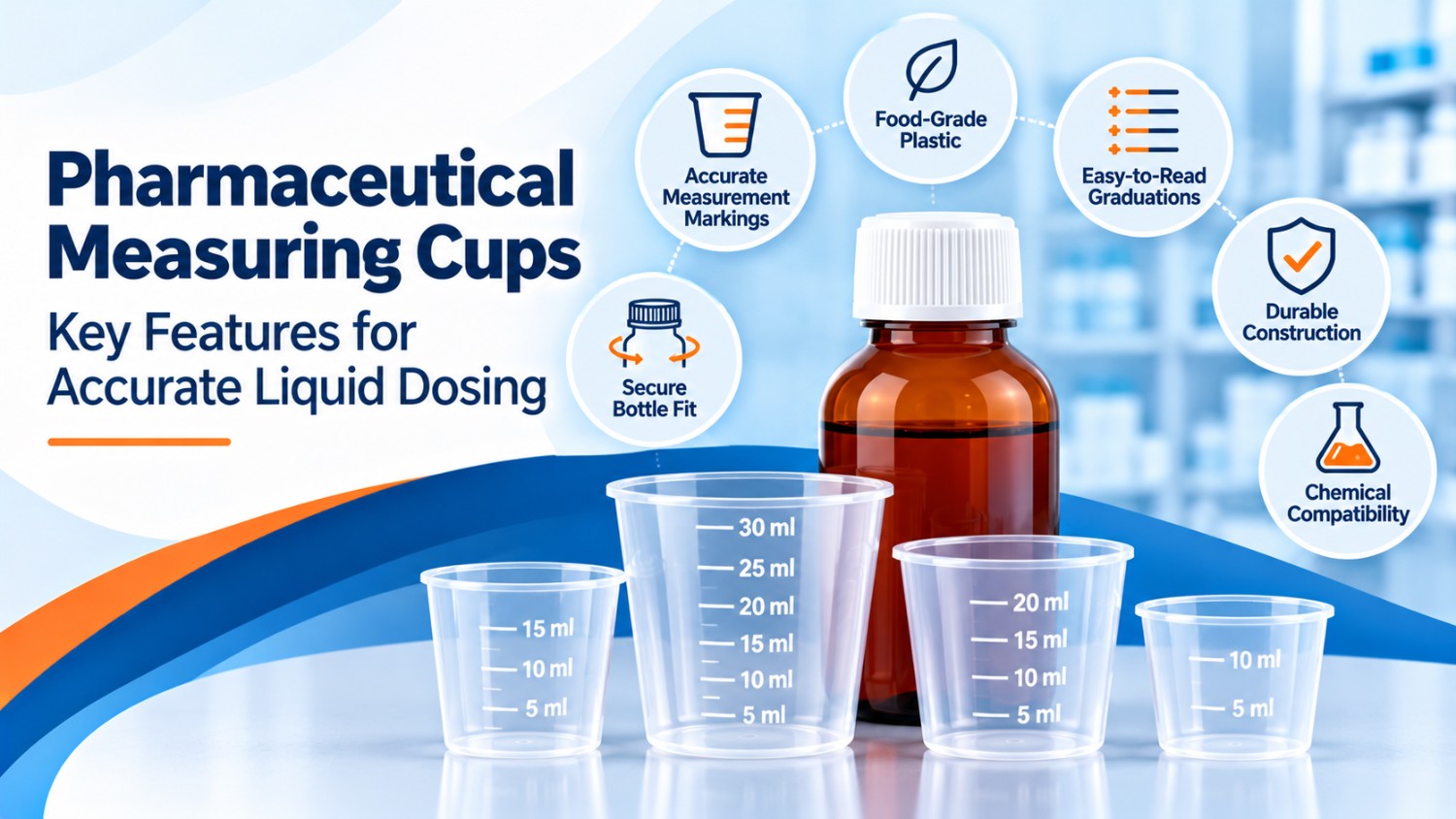
Why the Measuring Cup Matters in Liquid Dosing
Liquid medicines are often dosed by volume, and household spoons vary widely in size. Pharmaceutical measuring cups remove that uncertainty by giving patients a standard reference. Understanding how oral liquids fit among other dosage forms helps explain why dosing accessories deserve careful specification. For manufacturers, pharmaceutical measuring cups are also part of the brand experience. A cup that is blurry, fragile or ill-fitting can reduce confidence in the whole product, even if the medicine itself is excellent. Poorly designed cups can also contribute to dosing mistakes, which is a safety concern rather than only a quality concern. The cup usually sits on top of the bottle and doubles as a cap in some designs, or it is supplied separately and placed over a screw closure. Either way, pharmaceutical measuring cups must be selected with the bottle, closure and formulation in view.Accurate Measurement Markings
Accurate measurement markings are the core function of the cup. Everything else supports them. Markings should correspond to the doses stated on your label and leaflet, and they should be placed so that the user can read them at eye level without guessing. On pharmaceutical measuring cups, markings are usually either printed on the surface or moulded into the cup wall. Each method has strengths, and the best choice depends on your product and filling environment.| Factor | Printed markings | Moulded or embossed markings |
| Appearance | Bold, can use colour for contrast | Clear plastic look, subtle in some lighting |
| Durability | Depends on ink and handling; may wear with abrasion | Part of the cup, cannot rub off |
| Readability | High contrast when well printed | Can be harder to read with clear liquids |
| Flexibility | Easy to change for new dose schedules | Requires tooling changes |
| Best suited for | Brands wanting strong visibility | Products needing permanent marks |
Food-Grade Plastic Material
Because pharmaceutical measuring cups come into contact with liquid medicines, the material must be appropriate for that use. Food-grade plastic material, commonly polypropylene (PP), is widely chosen because it is rigid, light and resistant to many liquid formulations. When specifying food-grade plastic material, ask for documentation that confirms suitability for the intended contact, and check which standards or regulations apply in your market. Virgin resin is generally preferred for pharmaceutical use because it reduces the risk of unknown additives or contaminants. Clean production also matters. Cups should be moulded and packed in a hygienic environment, protected from dust and handled with care. Ask how the supplier packs finished cups, for example in clean liners and sealed cartons, because contamination during packing can be as harmful as a poor material choice.Easy-to-Read Graduations
Easy-to-read graduations help patients, caregivers and elderly users measure correctly, sometimes in poor lighting or under stress. Design choices on pharmaceutical measuring cups have a large influence on legibility.Features That Improve Readability
- Clear numbers placed next to each major mark, with a readable font size
- Consistent line length and thickness, with longer lines for main doses
- Strong contrast between the marking colour and the cup body
- Markings placed on a flat, even section of the wall to avoid distortion
- Units that match your label, such as ml, avoiding mixed or confusing units
Durable Construction
Pharmaceutical measuring cups are handled, washed, dropped and reused. Durable construction therefore means more than stiffness. The wall should resist cracking, the rim should stay smooth, and the cup should not deform when pressed onto the bottle neck or when washed in warm water. Check the rim in particular. A rough or chipped rim can affect comfort, while a distorted one may not seat evenly on the closure. Look for uniform wall thickness, clean gate marks and the absence of flash or sharp edges. These signs indicate stable moulding. Durable construction also affects marking life. If printed marks fade after repeated washing, the cup stops doing its job. Ask the supplier about wash and rub tests, or perform simple ones yourself using warm water and mild cleaning.Lightweight Design
A lightweight design lowers freight cost, makes the cup comfortable for children and elderly users to handle, and reduces the load on the bottle neck when the cup sits on top. It also suits secondary packaging, where pharmaceutical measuring cups are shipped in large quantities. Light does not have to mean flimsy. Good lightweight design balances thin walls with ribs, rim reinforcement or a sensible shape so that the cup still feels solid. Test a sample by pressing the sides firmly and check that it holds its shape without cracking. Weight is also useful as a manufacturing control. Consistent cup weight across a batch is a simple indicator that moulding conditions are stable, which supports uniform capacity and fit.Chemical Compatibility
Chemical compatibility describes how the cup material behaves in contact with your liquid. Some formulations contain alcohol, essential oils, flavours, acids or surfactants that can interact with certain plastics, causing staining, odour transfer, softening or marking loss. Never assume that because one of your pharmaceutical measuring cups suits one syrup it will suit another. Run compatibility tests that expose cups to the actual formulation, ideally over the time and temperature range relevant to your product’s shelf life and use. Inspect for colour change, odour, deformation and fading of the markings. Also consider cleaning agents. If cups are likely to be rinsed repeatedly, check how they respond to warm water and mild detergent. Share your formula and use conditions with the supplier so that this is discussed before you approve the cup.Proper Cup Capacity
Proper cup capacity means the total volume is suited to the dose range of your product. A cup much larger than the maximum dose invites spills and makes small volumes harder to read, while a cup that is too small forces patients to dose twice. Work backwards from the label. Identify the smallest and largest doses and choose a cup whose scale covers them with sensible spacing. Leave a little headroom above the top mark so that liquid does not spill when the cup is carried. Think about different user groups as well. Paediatric pharmaceutical measuring cups often need finer gradations at the low end, while adult products may emphasise a single standard dose. Proper cup capacity should reflect how the medicine is actually used, not only how it is packed.Bottle and Packaging Compatibility
Bottle and packaging compatibility is where many otherwise good cups fail. The cup must fit the closure, sit securely and not interfere with sealing, tamper-evident features or child-resistant mechanisms. It must also fit the carton or shipper without crushing. Check the diameter and height of the cup against the neck finish and closure used on your bottles. If the cup is designed to double as a cap or to sit over a screw closure, test its fit and removal force. Confirm that it does not rattle during transport or pop off when bottles are stacked. Bottle and packaging compatibility also covers automation. If your filling line places cups automatically, ask whether the cup’s shape suits the line’s feeding and orienting system.Compatibility Checklist
- Neck finish and closure diameter confirmed with sample bottles
- Cup seats securely without distorting the closure or seal
- Carton and shipper dimensions checked for fit and protection
- Automatic feeding tested if the line uses cup placement equipment
- Tamper-evident and child-resistant features not obstructed by the cup
Common Mistakes to Avoid
Buyers often approve pharmaceutical measuring cups on appearance alone, without testing with real formulations. They also overlook the match between dose and capacity, compare quotations for non-equivalent specifications and skip accuracy checks on the markings. Each mistake is preventable through written specifications, approval samples and basic bench testing.Conclusion
Pharmaceutical measuring cups succeed when small details are right: accurate measurement markings, suitable food-grade plastic material, easy-to-read graduations, durable construction, lightweight design, chemical compatibility, proper capacity and secure fit with the bottle. Treat each as a testable requirement and approve production only after samples have been checked with your real formulation. Before selecting a supplier, write down your dose range, bottle and closure details and formulation, then compare cups against that brief. You can explore the pharmaceutical measuring cups and closure options at Cimpex Packaging or contact the team for guidance based on your product and packaging needs.Frequently Asked Questions
Pharmaceutical measuring cups let patients measure oral liquid medicines, such as syrups and suspensions, in accurate volumes. They are usually supplied with the bottle and marked with doses that match the label, reducing the guesswork and variation that come from using household spoons.
Polypropylene is widely used because it is light, rigid and resistant to many liquids. The best choice depends on your formulation and market requirements, so confirm suitability for contact with your product and request material documentation from your supplier.
Markings should correspond to the doses on your label and give consistent volumes from cup to cup. Verify accuracy by dispensing measured liquid to each line on sample cups. Accurate measurement markings protect patients and support compliance with your own quality standards.
Neither is universally better. Printed markings offer strong visibility and colour contrast, while moulded markings cannot rub off. Choose based on your product, wash exposure and readability tests, and check that the chosen method stays clear with your actual liquid.
Match the cup to the smallest and largest doses on your label. Choose a scale that covers that range with readable spacing and some headroom above the top mark. Test with the real liquid to confirm that doses are easy to measure and carry without spilling.
Some liquids can stain, soften or fade the markings on certain plastics. Compatibility testing with your formulation over realistic time and temperature conditions shows whether the cup keeps its shape, clarity and markings throughout the product’s shelf life.
Test sample pharmaceutical measuring cups on actual bottles and closures. Check neck finish, seating, removal force and stacking behaviour, and confirm that tamper-evident or child-resistant features still work. Share bottle drawings with the supplier before approving production.