


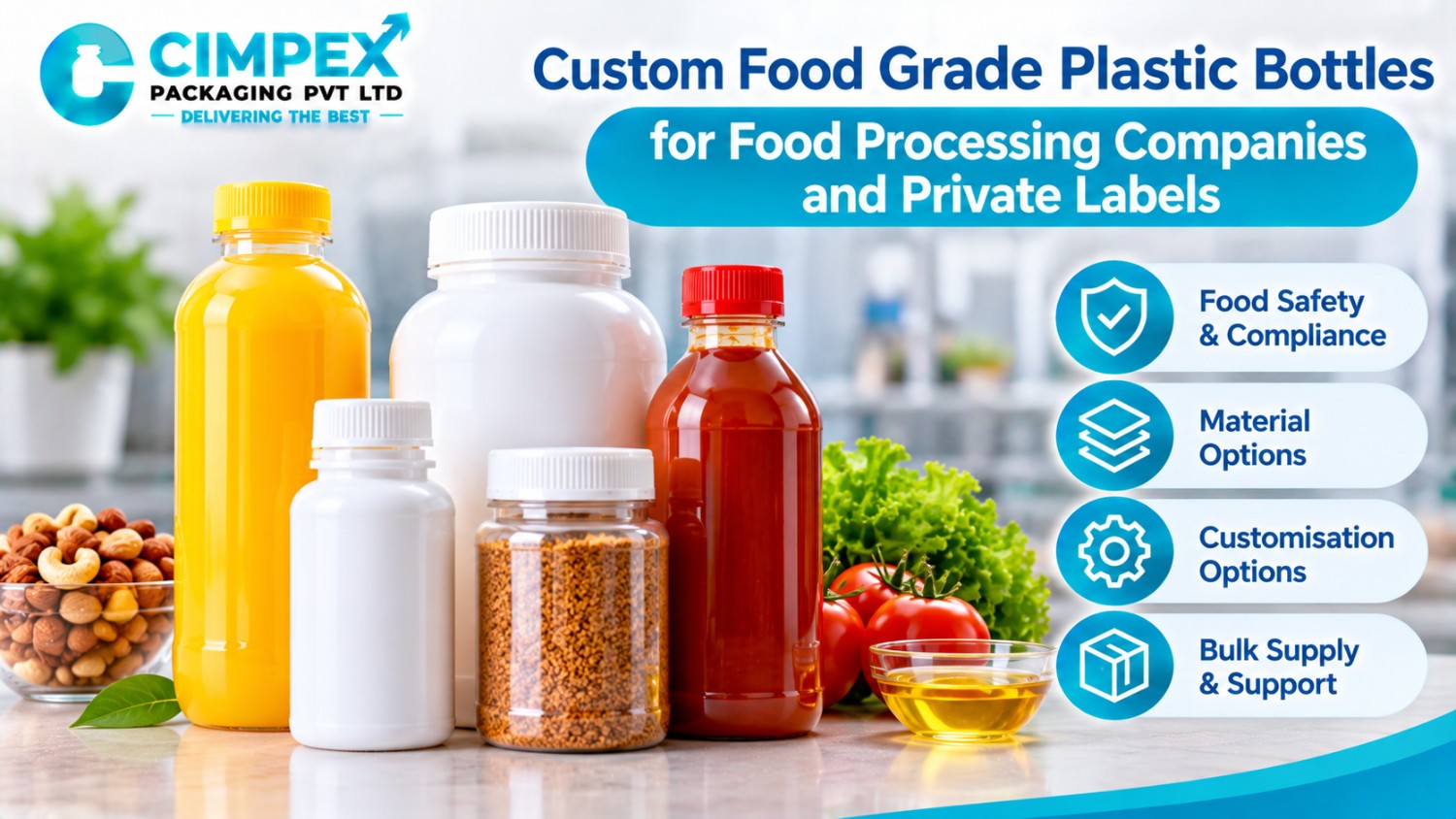
What Makes Food Grade Plastic Bottles Different?
Food grade plastic bottles are made from resins, colourants and additives that are approved for food contact, and they are produced and handled in a way that avoids contamination. A “food grade” label on its own is not enough. Suitability depends on the material, the manufacturing process and the intended use, including the type of food, the filling method and the storage period. In India, food packaging falls under the Food Safety and Standards (Packaging) Regulations, 2018, published by the FSSAI. For plastics, the regulations point to Indian Standards for each material, including IS 10146 for polyethylene, IS 10910 for polypropylene and IS 12252 for PET, and they set an overall migration limit for plastic packaging. As the brand owner, you are responsible for confirming that the bottles you choose meet the requirements for your product. A good supplier will help with specifications and test documents, but the final check is yours. Migration testing is normally done with food simulants, so ask whether the report covers a food type similar to yours, such as oily, acidic or aqueous.Choosing Between HDPE, PET and PP for Food Grade Plastic Bottles
Three plastics cover most food bottle requirements, and each suits different products. A capable food grade plastic bottle manufacturer in India will explain the trade-offs rather than recommend one material for every job. A food grade HDPE bottle manufacturer will often suggest HDPE for edible oils, sauces, syrups and dry powders. It is tough, resists many ingredients and copes well with transport. A food grade PET bottle supplier is the usual choice when visibility matters, as with beverages, juices and clear syrups, because PET offers clarity and a smooth finish. PP is widely used for closures and for products that need more heat tolerance.| Factor | HDPE | PET | PP |
| Appearance | Opaque or translucent | Clear and glossy | Translucent to opaque |
| Typical food uses | Oils, sauces, powders, supplements | Beverages, juices, clear syrups | Closures, some heat-tolerant items |
| Product visibility | Low to moderate | High | Moderate |
| Light protection | Good when opaque | Limited unless tinted | Moderate |
| Main consideration | Less transparent | Standard PET does not suit hot filling; check the bottle type | Check compatibility with the product |
Matching the Bottle to the Product
Food is not one category. Edible oil, a thick sauce, a powdered drink mix and a dairy-based beverage all place different demands on food grade plastic bottles.Factors That Shape the Right Choice
- Product type: liquid, viscous, powder or granular
- Filling method: cold fill, hot fill or aseptic
- Shelf life and storage conditions
- Light sensitivity, which may call for opaque or tinted bottles
- Oxygen sensitivity, which may call for a barrier structure
- How the consumer will pour, dispense or scoop the product
Closures, Seals and Tamper Evidence
Food buyers expect a pack to arrive sealed and stay fresh. Food grade plastic bottles are only as good as their closures, because the closure affects leakage, shelf life and consumer trust. Specify it as carefully as the bottle.Closure Features Worth Specifying
- Tamper-evident bands that show the pack has not been opened
- Induction seal liners that protect contents in transit and storage
- Pour spouts or flip-top caps for controlled dispensing
- Wide-neck options for easy scooping of powders
- Measuring caps or scoops where portion control matters
Custom Food Packaging Bottles for Private Labels
Private label brands compete on presentation as much as on product quality. Stock food grade plastic bottles can work for an early launch, but many brands move to a more distinctive pack as they grow. When planning custom food packaging bottles, be clear about what can realistically change. Capacity, colour, neck finish and label area are usually adjustable. A completely new shape generally needs new tooling, which adds development time and a larger minimum commitment. Ask about both before you fall in love with a design.Containers Beyond Bottles
Not every food product belongs in a bottle. Powders, spices, supplements and granular products often work better in jars with wider openings. A food grade plastic containers manufacturer can supply jars, scoops and closures alongside bottles, which helps a brand keep a consistent look across a product line, with food grade plastic bottles and jars sharing colours and closures. If your range includes both liquids and dry products, working with one food grade plastic containers manufacturer for bottles and jars reduces coordination effort and makes it easier to match colours, neck sizes and closures.Hygiene, Quality Control and Documentation
Food grade plastic bottles must be made and handled cleanly. Ask any food grade HDPE bottle manufacturer how bottles are protected from contamination during production, packing and dispatch, and which quality checks are applied.Quality Checks to Ask About
- Leak testing of bottles and closures
- Drop and strength evaluation for handling and transport
- Dimensional checks on neck finish, weight and height
- Visual inspection for specks, flash and surface defects
- Traceability of resin batches and production runs
- Clean packing and dispatch practices
Planning Supply of Bulk Food Packaging Bottles
Filling lines run to a schedule, so food grade plastic bottles need to arrive on time. When ordering bulk food packaging bottles, ask about production capacity, lead times for repeat orders and how the supplier handles seasonal peaks. Delivery packaging matters too. Bulk food packaging bottles should be packed so they stay clean and undamaged, in a form that suits your warehouse and line-side handling. Agree on carton size, pallet configuration and labelling for incoming goods so that receiving is straightforward.Common Mistakes Food Brands Make
Many packaging problems begin before production starts:- Assuming all food grade plastic bottles suit every food and filling method
- Overlooking the filling method, especially hot fill, when sourcing from a food grade PET bottle supplier
- Approving a sample without a pilot run on the real filling line
- Ignoring closure fit and tamper-evidence requirements
- Not confirming specifications and test documents in writing
- Choosing on unit price rather than consistency and supply reliability
How to Start a Custom Bottle Project
A clear process saves time. Write a brief for your food grade plastic bottles that describes your product, filling method, shelf life, preferred capacity, closure type and annual volume. Send it to shortlisted manufacturers, including a food grade plastic containers manufacturer if you also need jars, and ask for recommendations as well as quotations. Test samples with your actual product and filling equipment. If the design is custom, confirm the development timeline, the number of sampling rounds and the minimum order before approving tooling. Taking these steps in order leaves room to fix problems while the cost of change is still low. Many brands also find it useful to approve a first-article sample from the production tool, not just a prototype, because small differences in wall thickness or neck finish often appear only at that stage.Conclusion
Choosing food grade plastic bottles comes down to material suitability, closure performance, hygiene and consistent supply. Start with the product and the filling method, select the material that fits, test samples on your own line and document the specification before you scale. If you are developing custom food packaging bottles or reviewing an existing supplier, share your product details, capacity and volume with the Cimpex Packaging team. You can also explore the HDPE and PP bottle and jar ranges to shortlist options, then request samples to evaluate your food grade plastic bottles against your own product and filling process.Frequently Asked Questions
They are containers made from resins and additives approved for food contact and produced under hygienic conditions, so that the packaging does not contaminate the contents. Suitability still depends on the specific food, the filling method and the storage conditions, so it should be confirmed for each product.
HDPE suits oils, sauces and many dry products because it is tough and resistant. A food grade PET bottle supplier will usually recommend PET for clear beverages and syrups, and PP is common for closures and heat-tolerant uses. The best choice depends on the product, the filling method and the shelf life you need.
Food grade HDPE is widely used for food and beverage packaging. Safety depends on approved resin, clean production and suitable use conditions. Confirm the material specifications with your food grade HDPE bottle manufacturer and check them against the packaging regulations that apply to your product.
Yes. Capacity, colour, neck finish and label area can generally be customized, and new shapes usually need tooling. Share your product details, volume and closure requirements early so the manufacturer can advise on design, development time and minimum order quantities.
Check material suitability, closure fit, quality testing, documentation, production capacity and lead time. Test samples with your real product and filling line before approving a large order, and agree specifications and tolerances in writing so every batch matches the approved sample.
Tamper-evident caps, induction seal liners, flip-top caps, pour spouts and measuring caps are common choices. The right one depends on the food and how it is dispensed. Test the closure together with the bottle to confirm that the seal holds.
Compare suppliers on material range, hygiene practices, quality testing, customization ability, capacity and documentation. Request samples, run a pilot on your line and ask for clear written specifications. A reliable food grade plastic bottle manufacturer in India will answer these points directly and support you through development and repeat orders.