


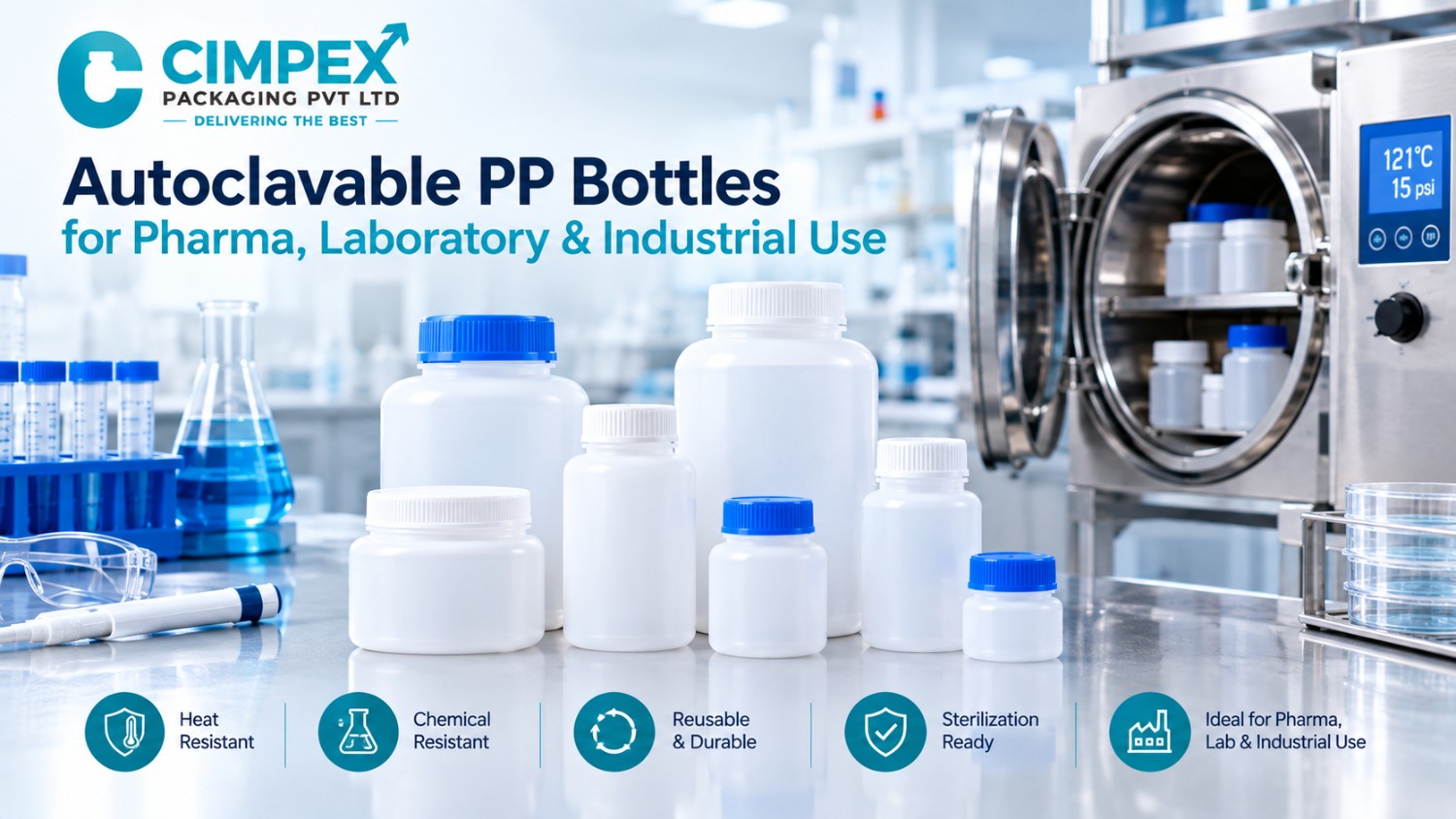
What “Autoclavable” Actually Means for PP Bottles
Autoclaving exposes a container to saturated steam, typically around 121°C at roughly 15 psi, for a set cycle time to eliminate bacteria, spores and other microorganisms. Not every plastic tolerates this. HDPE, for instance, tends to soften and deform well before reaching typical autoclave temperatures. Polypropylene has a higher melting point and better dimensional stability under heat, which is exactly why autoclavable PP bottles hold their shape, their cap seal, and their optical clarity through repeated cycles far better than most other commodity plastics. That said, “autoclavable” is not an unlimited claim. Wall thickness, cap design, and even the resin grade all affect how many cycles a bottle can realistically withstand before performance starts to degrade. A reputable manufacturer should be able to tell you the expected cycle life for a given bottle design rather than simply labelling it autoclavable and leaving the rest to trial and error. Understanding this distinction early saves teams from an unpleasant surprise months into a validated process, when a bottle that performed fine in initial testing starts to show stress marks or seal weakness after dozens of routine cycles.Why Autoclavable Polypropylene Bottles Are Preferred in Pharma and Labs
Autoclavable polypropylene bottles show up constantly in pharmaceutical and laboratory settings because they solve a very specific reliability problem: containers that must be sterilized, reused or heat-treated as part of a validated process. A few properties explain why PP earns that trust:- Higher heat deflection temperature than HDPE or LDPE, allowing it to withstand standard autoclave cycles without warping
- Good chemical resistance to acids, alkalis and many solvents used in laboratory and pharmaceutical environments
- Lower moisture absorption, which helps preserve dimensional accuracy after repeated heat exposure
- Reasonable clarity in natural or translucent grades, useful where visual inspection of contents matters
Autoclavable PP Bottle Supplier: What to Look for
Choosing an autoclavable PP bottle supplier is less about the lowest quote and more about consistency. Ask specifically about resin grade certification, batch-to-batch wall thickness tolerance, and whether the supplier tests sample bottles through actual autoclave cycles before approving a design. A supplier who can share manufacturing process documentation and quality control data is usually a safer long-term partner than one who simply confirms the material is “PP” without further detail.PP Bottles for Pharmaceutical Packaging
In regulated pharmaceutical environments, PP bottles for pharmaceutical packaging often need to satisfy more than heat resistance alone. They may need to be compatible with specific closures, resist interaction with active ingredients, and maintain consistent tolerances across large production runs. Autoclavable PP is frequently chosen for sample containers, reagent bottles, and certain liquid formulation packaging where terminal sterilization is part of the manufacturing process.PP Laboratory Bottles: Common Use Cases
PP laboratory bottles are a staple across research and quality-control environments. Typical applications include:- Storage of buffers, reagents and culture media that require periodic autoclaving between uses
- Sample collection bottles in diagnostic and clinical laboratories
- Media preparation bottles used in microbiology and biotech workflows
- General-purpose lab storage where chemical resistance and heat tolerance both matter
Sterilizable PP Bottles vs Other Materials
Sterilizable PP bottles are frequently compared against glass and HDPE when a team is deciding on primary packaging. Each material carries a different set of trade-offs, summarised below.| Factor | Autoclavable PP Bottles | Glass Bottles | Standard HDPE Bottles |
| Heat resistance | Withstands standard autoclave cycles (~121°C) | Withstands higher temperatures, but risk of breakage | Softens and deforms near autoclave temperatures |
| Weight | Lightweight, easy to handle | Heavy, adds shipping cost | Lightweight |
| Breakage risk | Low | High, especially in transport | Low |
| Chemical resistance | Good across acids, alkalis, most solvents | Excellent, largely inert | Good, but lower heat tolerance limits sterilizable use |
| Best suited for | Repeated sterilization, lab and pharma reuse | Long-term chemical storage, visual clarity needs | Ambient-temperature liquid and powder packaging |
PP Bottles for Laboratory Use: Choosing the Right Specification
Before finalising an order of PP bottles for laboratory use, a few specification details are worth confirming directly with your manufacturer:- Cap type and thread compatibility – Screw caps used in autoclave cycles should be vented or designed to release pressure safely during heating
- Wall thickness – Thicker walls generally tolerate more autoclave cycles before showing stress marks or slight deformation
- Resin grade – Confirm whether the grade is standard industrial PP or a higher-purity grade suited to pharmaceutical or diagnostic use
- Volume tolerance – For lab applications involving precise measurements, ask about volume accuracy tolerances at the neck and body
Quality Control and Testing for Autoclavable PP Bottles
A bottle labelled autoclavable should ideally come with evidence, not just a claim. Manufacturers who take this seriously typically run new bottle-and-cap designs through several actual autoclave cycles at the target temperature and duration before approving the design for production, checking for visible deformation, seal integrity, and any change in cap thread fit after repeated heat exposure. This kind of validation is especially important when the closure includes a liner or gasket, since these secondary components can degrade at a different rate than the bottle body itself. Batch consistency matters just as much as the initial design approval. Resin grade, colourant additives, and even minor variations in wall thickness across a production run can all shift how a bottle performs under repeated heat cycling. A supplier who documents batch-level quality checks rather than relying solely on the original approved sample gives you a much more reliable basis for specifying autoclavable PP bottles across a long production relationship, particularly if your application involves reuse over months or years rather than a single sterilization event.Environmental and Cost Considerations
Because autoclavable PP bottles are often designed for reuse rather than single-use disposal, they can offer a genuine sustainability advantage over single-use glass or disposable plastic containers in laboratory settings, provided the bottles are actually reused for their intended cycle life rather than discarded early. Polypropylene is also widely recyclable at end of life, which is a relevant factor for institutions tracking their packaging and consumables footprint. From a cost perspective, while individual PP bottles may carry a modest premium over basic HDPE containers, the ability to reuse them across dozens of sterilization cycles usually offsets that difference well before the bottle reaches the end of its practical life.Common Mistakes When Specifying Autoclavable PP Bottles
- Assuming every polypropylene bottle is automatically autoclave-safe without checking cycle-life data from the manufacturer
- Overlooking cap venting requirements, which can cause pressure build-up or seal failure during sterilization
- Running bottles through significantly longer or hotter cycles than the design was tested for
- Failing to sample-test the actual bottle-and-cap combination before committing to a full production order
Conclusion
Autoclavable PP bottles remain the practical choice wherever sterilization, reuse or heat resistance is a genuine part of the workflow from pharmaceutical reagent storage to everyday laboratory sample handling. The material’s heat tolerance and chemical resistance make it dependable, but the details that actually determine performance are wall thickness, cap venting, and resin grade, not the word “autoclavable” printed on a spec sheet. If your team is specifying PP bottles for pharmaceutical packaging or lab-grade containers that need to survive repeated sterilization, it’s worth requesting sample bottles and running them through your actual autoclave cycle before committing to a bulk order. That single step catches most compatibility issues early, long before they become a production problem. For a technical overview of how steam sterilization works and the standard time-temperature parameters involved, see Wikipedia’s entry on autoclaves.Frequently Asked Questions
Most autoclavable PP bottles are designed to withstand standard steam sterilization cycles at around 121°C. Exact tolerance varies by wall thickness and resin grade, so it’s best to confirm cycle limits with your manufacturer for your specific bottle design.
This depends heavily on wall thickness, cap design and cycle conditions, so there’s no universal number. A reliable supplier should be able to share cycle-life testing data or recommend a replacement interval based on your specific usage pattern.
Autoclavable PP bottles are lighter and far less prone to breakage than glass, which makes them attractive for everyday lab use. Glass may still be preferred where absolute chemical inertness or optical clarity is critical, so the right choice depends on the application.
Yes, PP bottles are widely used for pharmaceutical liquids and reagents that require terminal sterilization, provided the resin grade and closure system meet the relevant regulatory and compatibility requirements for the formulation.
Many autoclave-rated caps include venting features to release internal pressure safely during heating and cooling. Using a standard, non-vented cap in high-heat cycles can risk seal failure or bottle deformation.
Autoclavable PP bottles are typically manufactured and tested to confirm they hold shape and seal integrity through repeated steam sterilization cycles, while standard industrial PP bottles may not be validated for that specific use.
Look for a supplier who can provide resin certification, batch consistency data, and evidence of actual autoclave cycle testing on sample bottles, rather than one who only confirms the base material without further verification.