


What Makes a Bottle Suitable for Chemicals?
A chemical bottle is not simply a bottle that holds liquid. It has to resist the chemical it contains, stay leak-tight through transport and storage, survive drops and stacking, and work with a closure that seals reliably. If any of these fails, the result can be product loss, contamination or a safety incident. For that reason, a good chemical bottle manufacturer in India treats material selection, wall thickness, neck accuracy and closure fit as one engineering problem rather than separate line items. The following sections show how each element affects performance.Why HDPE Is the Standard Material
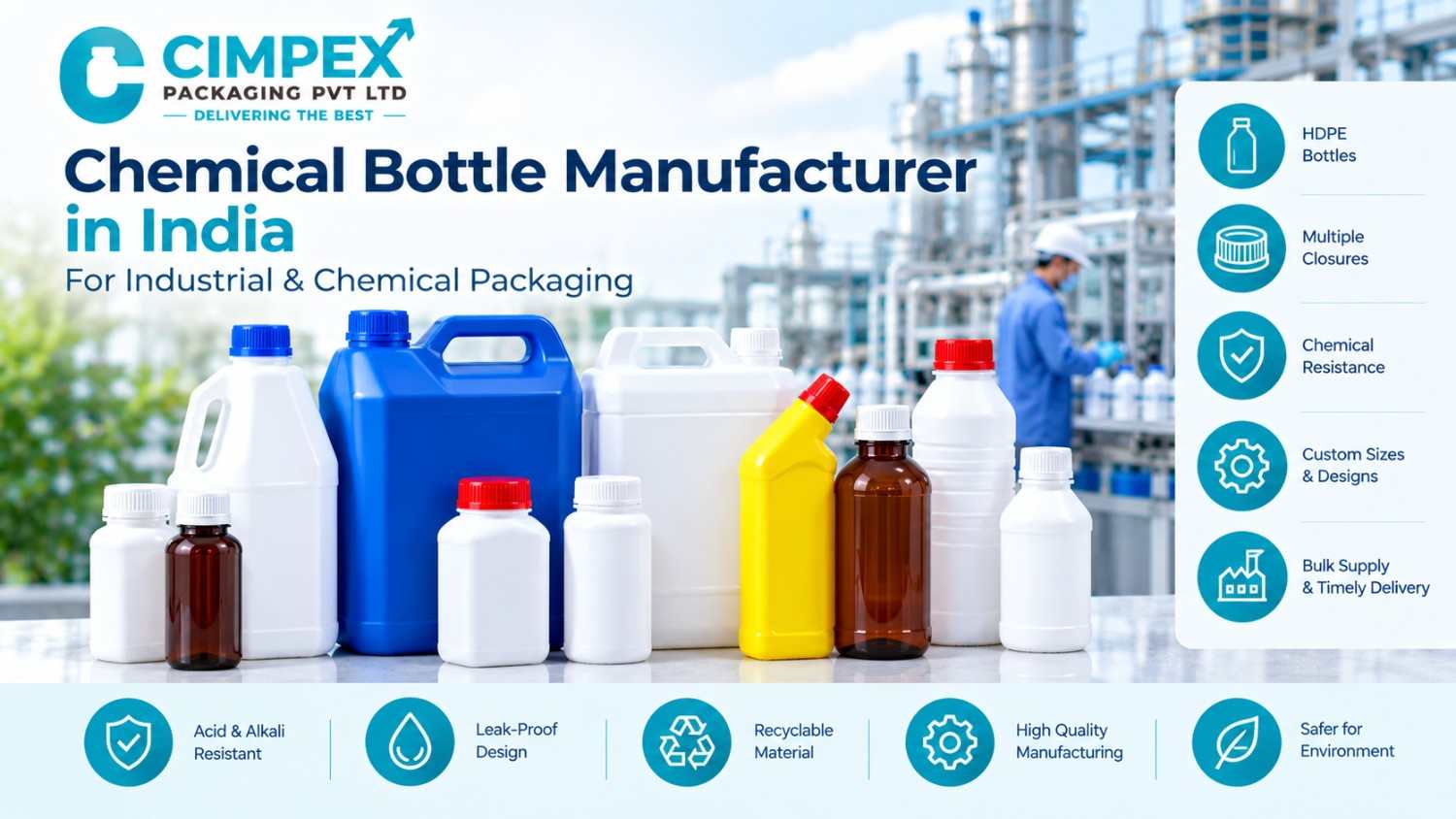
High-density polyethylene is widely used for chemical bottles because it combines toughness, low weight and broad chemical resistance. Cimpex Packaging describes its HDPE bottles as having excellent resistance to acids, alkalis, alcohols and most solvents, along with a strong moisture barrier and recyclability. HDPE is not universal, however. Certain aromatic or chlorinated solvents and strong oxidising agents can affect polyethylene, and some products need extra barrier protection. Cimpex Packaging advises sharing unusual chemical or temperature requirements early so that compatibility can be confirmed before an order. Treat that as standard practice with any chemical bottle manufacturer in India: give the exact formulation, concentration and storage temperature, then test the sample.Types of Chemical Bottles and Their Applications
The same moulding technology produces bottles for very different chemical uses:- Agrochemical bottles: pesticide, herbicide and fertiliser liquids need tough walls and dependable closures.
- Household and industrial cleaners: toilet cleaner, disinfectant and detergent bottles, including acid-resistant bent-neck designs.
- Automotive and lubricant bottles: engine oil, brake fluid and coolant packs in mid to large capacities.
- Laboratory and specialty chemicals: smaller bottles where compatibility and clean handling are critical.
- Sanitizer and disinfectant bottles: common in pharma, healthcare and institutional supply.
Features to Look for in a Chemical Bottle
Specify the following before you request samples:- Closure and liner: the cap style, liner material and any induction seal, tamper-evident or child-resistant requirement.
- Neck finish: a standard neck helps you avoid being locked into one closure supplier.
- Wall thickness and weight: uniform walls reduce weak points that can leak or crack under stress.
- Colour and light protection: opaque, amber or UV-stabilised grades where the product is light-sensitive.
- Label surface: a smooth area suited to paper labels, shrink sleeves or printing.
How a Chemical Bottle Manufacturer in India Makes Bottles
Most HDPE chemical bottles are produced by extrusion blow moulding. Molten polymer is extruded into a tube, called a parison, and inflated inside a precision mould to take the bottle shape. Closures are generally injection moulded. Cimpex Packaging describes automated blow and injection moulding lines, with capacities from 5 ml to 5 litres, and in-house testing of each batch. A chemical bottle manufacturer in India that documents these steps gives you something concrete to audit, including how resin is inspected on arrival and how wall thickness is monitored during production.Choosing a Chemical Bottle Manufacturer in India
Choosing a chemical bottle manufacturer in India is a risk decision as much as a purchasing decision, because packaging failure affects your product and your customers.Chemical Bottle Manufacturing Company in India: Capabilities to Verify
A credible chemical bottle manufacturing company in India should be able to explain its resin sourcing, moulding process and testing programme. Cimpex Packaging’s process and quality page describes incoming inspection of resin for density and purity, blow moulding, and batch testing for wall thickness, leak resistance, drop performance, top-load strength and neck dimensions. It also lists ISO 9001:2015 and GMP compliance. Ask any supplier for supporting documents instead of relying on statements alone.Top Chemical Bottle Suppliers in India: Selection Checklist
Buyers comparing top chemical bottle suppliers in India can use this checklist:- Does the supplier manufacture in-house or trade other companies’ products?
- Can it explain resin grade and confirm compatibility with your chemical?
- Does it provide samples before bulk production?
- Are test records and batch documents available?
- Does it commit to lead times that include tooling for custom designs?
Custom Chemical Bottle Manufacturer in India
If your brand needs a distinctive shape or a specific neck, look for a supplier that develops moulds in-house or through a controlled partner. Cimpex Packaging states that custom moulds typically take three to four weeks from approved design to first sample and that Pantone colour matching is available.Local Sourcing: Baddi, Himachal Pradesh and Nearby Buyers
Domestic sourcing shortens the loop between enquiry, sample and production. A local chemical bottle manufacturer in India can respond quickly to neck-fit issues, closure changes or urgent reorders, which matters when a filling line is waiting for packaging. It also makes site visits and audits practical, and that is valuable when a chemical or pharma customer asks you to demonstrate control over your packaging supply chain.Chemical Bottle Manufacturer in Baddi
Baddi is one of northern India’s busiest industrial clusters for pharmaceuticals, chemicals and FMCG. Cimpex Packaging operates from Village Thana in Baddi and serves buyers as a chemical bottle manufacturer in Baddi with dispatch across India. Being close to the filling unit shortens sampling cycles and simplifies urgent reorders.Chemical Bottle Supplier in Himachal Pradesh
Units across the state can work with a chemical bottle supplier in Himachal Pradesh that understands regional logistics and can deliver bottles and closures in coordinated shipments.Chemical Bottle Supplier Near Me
When people search for a chemical bottle supplier near me, the real question is how quickly they can get samples, technical answers and repeat supply. Distance helps, but process quality and communication matter just as much.Bulk Orders, Exports and Pricing
Buy Chemical Bottles in Bulk India: MOQ and Lead Time
Companies that buy chemical bottles in bulk in India on a recurring basis should plan around MOQ and lead time. Cimpex Packaging lists a standard MOQ starting at 5,000 units for its HDPE bottles, with higher quantities for fully custom moulds, and it states that quotations are typically returned within 24 to 30 hours. Confirm the current figures for your specific size and design.Chemical Bottle Exporter in India
An experienced chemical bottle exporter in India should be comfortable with export documentation, robust outer packing and compliance queries from overseas customers. Cimpex Packaging notes that it handles export orders. Overseas buyers should confirm destination-market material and labelling requirements themselves.What Influences Price
Chemical bottle rates change with:- Capacity and the weight of resin used.
- Resin grade and any UV-stabilised or specialty requirements.
- Closure and liner type.
- Custom mould development and colour matching.
- Order volume and delivery location.
Why Buyers Prefer a Domestic Chemical Bottle Manufacturer in India
A domestic partner is easier to reach, audit and correct. When a closure does not fit or a sample needs adjustment, a chemical bottle manufacturer in India within the same country can act within days rather than weeks, without customs delays or long shipping cycles. For chemical, agrochemical and pharma brands, that predictability protects filling schedules and delivery commitments. It also helps when regulators or customers request packaging documentation, because the supplier is nearby and used to the local compliance environment.Comparing Chemical Bottle Materials
Before you brief a chemical bottle manufacturer in India, compare the main material options:| Factor | HDPE | PET | Glass |
| Impact resistance | Tough and resilient | Moderate | Breakable |
| Chemical resistance | Strong against many acids and alkalis | Varies by chemical | Very high |
| Weight | Light | Light | Heavy |
| Transparency | Opaque or translucent | Clear | Clear |
| Best suited for | Cleaners, agrochemicals, industrial liquids | Selected clear-display products | Specialty or inert-critical products |
Advantages and Disadvantages of HDPE Chemical Bottles
Whichever chemical bottle manufacturer in India you choose, the material trade-offs are the same. HDPE bottles offer durability, low weight, moisture protection and recyclability, and they are cost-effective in volume. Their limitations include restricted transparency and sensitivity to certain solvents and oxidisers, which is why compatibility testing is essential.Common Mistakes to Avoid
The most frequent mistakes when working with a chemical bottle manufacturer in India are choosing a bottle without confirming chemical compatibility, ignoring the closure liner, comparing quotes with different resin grades and forgetting regulatory requirements. If your product is classified as hazardous for transport, check whether UN-approved packaging is required with your compliance team or transporter, because a bottle maker cannot decide that for you.Conclusion
Choosing the right chemical bottle comes down to compatibility, closure integrity and consistent moulding. Define your formulation, capacity, neck and closure requirements, request samples, and test the complete pack under real conditions. The most reliable chemical bottle manufacturer in India will be open about resin grade, testing and lead times, and will welcome a compatibility discussion before quoting. For units in northern India, a supplier in Baddi can also simplify sampling and dispatch. If you are planning new chemical or agrochemical packaging, prepare your product details, expected volume and closure needs, then request samples and a written quotation. Explore the Cimpex Packaging product range, or ask any chemical bottle manufacturer in India for samples, and contact the team at sales@cimpexpackaging.com for guidance based on your product and order size.Frequently Asked Questions
HDPE is the most widely used material because it resists many acids, alkalis and alcohols while staying light and durable. A reliable supplier will still confirm compatibility with your specific formulation.
Compare in-house manufacturing, resin grade transparency, sampling policy and batch testing records. Ask each supplier to quote against the same specification so that comparisons are fair.
Yes. Cimpex Packaging is a chemical bottle manufacturer in India with its plant in Baddi, Himachal Pradesh, supplying buyers across the state and the rest of India. Contact the team to request samples.
Approach a manufacturer directly with your size, closure, colour and annual volume. Request samples, confirm MOQ and lead time, and test the bottle with your product before approving bulk production.
Every product goes through a strict multi-stage quality assurance process, including leak testing, strength evaluation, and dimensional accuracy checks. We use high-grade raw materials and advanced manufacturing techniques to ensure each product meets industry standards and performs reliably in real-world conditions.
A capable exporter should provide export packing and documentation support. Cimpex Packaging states that it handles export orders, but overseas buyers should also verify destination-market requirements.
Search for manufacturers near your filling unit, then compare sampling speed, quality records and lead times. Proximity reduces freight time, but consistent quality and communication are equally important.
Yes, custom moulds are possible. Cimpex Packaging lists three to four weeks from approved design to first sample, and MOQs are higher for fully custom designs than for standard ranges.