


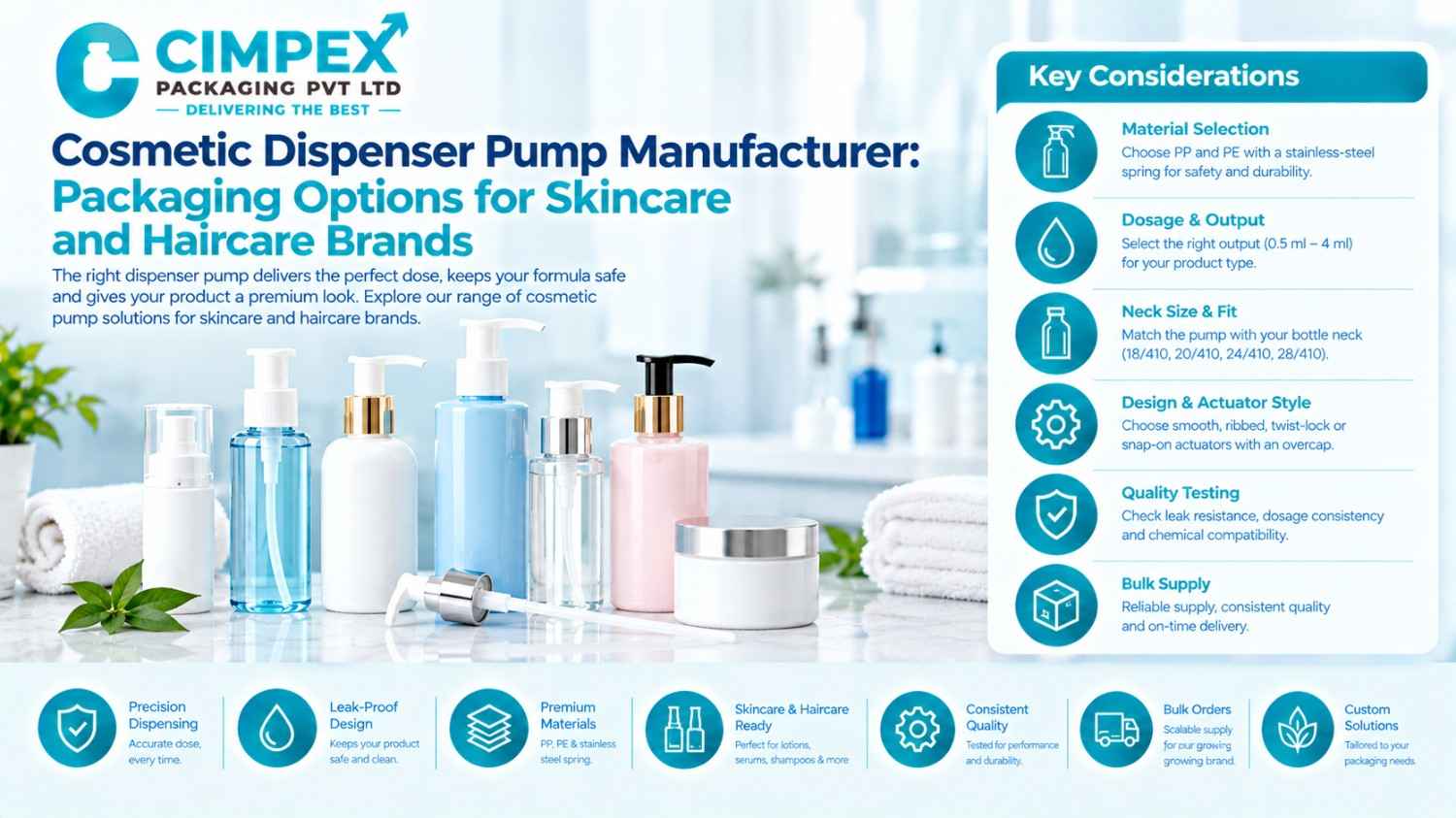
What a Dispenser Pump Manufacturer Offers for Cosmetic Packaging
A pump converts a downward press into a measured discharge. Inside the housing, a piston, a spring and a pair of valves draw product up a dip tube and push it through the actuator nozzle. Because the mechanism closes between strokes, the formula stays protected from air and contamination, which is one reason pumps are preferred over open-neck bottles for lotions, serums and shampoos. Dispenser pumps for cosmetic packaging are valued for three practical reasons: they control the dose and reduce waste, they keep hands cleaner than squeeze or flip-top closures, and they give the pack a finished, professional look. A reliable dispenser pump manufacturer will also help you match the mechanism to the viscosity of your product, because a thin toner and a thick body lotion behave very differently in the same pump. That is the kind of guidance we give our customers before they commit to a design.Specifications to Confirm With a Dispenser Pump Manufacturer
Before requesting quotes, it helps to know the vocabulary. The following points appear in almost every pump enquiry we receive: Neck size: the diameter and thread of the bottle neck, written as 18/410, 20/410, 24/410 or 28/410. The pump closure must match the bottle exactly. Dosage per stroke: the volume released with each press. We offer output options from 0.5 ml to 4 ml. Dip tube length: it should be cut to the height of the bottle so the pump can draw product down to the base. Actuator style: smooth, ribbed, twist-lock or snap-on designs change the look and the locking behaviour. Overcap: a clear or coloured hood protects the actuator and nozzle in transit. Any cosmetic dispenser pump supplier, and any serious cosmetic dispenser pump manufacturer, should be able to confirm each of these items before sampling. If a quotation leaves one of them open, ask for clarification, since a mismatch usually appears only after the pumps arrive at the filling line.Materials Used in Plastic Lotion Pumps
Most plastic lotion pump components are made from polypropylene and polyethylene, with a stainless-steel spring so that the metal never contacts the formula. Polypropylene is a widely used thermoplastic known for stiffness and chemical resistance. A plastic lotion pump manufacturer will normally choose materials according to the formula it must dispense. Water-based lotions, shampoos and hand washes are generally straightforward. Formulas with strong solvents, essential oils or high alcohol content need closer attention, so we recommend a compatibility test using your own product before approving production.Choosing a Pump for Skincare, Haircare and Body Care
Different categories place different demands on the pump. The table below is a qualitative guide, not a technical specification.| Category | Typical formula | What to look for in the pump |
| Facial skincare | Serums, light lotions | Fine, consistent dose; clean cut-off at the nozzle |
| Body care | Creams, thicker lotions | Larger dose per stroke; smooth return of the actuator |
| Shampoo and conditioner | Medium viscosity liquids | Robust actuator; reliable lock for transit |
| Hand wash and sanitizer | Soaps and alcohol-based liquids | Chemical compatibility; durable spring and seals |
Skincare Bottle With Dispenser Pump
A skincare bottle with dispenser pump suits formulas that are used in small, precise amounts. Lower dosage options of around 0.5 to 1 ml are often chosen for serums and treatment products, whereas moisturisers usually use a larger dose. Dispenser pumps for cosmetic packaging in this segment are often chosen as much for appearance as for function. The bottle shape also matters: a rounded shoulder and a tapered base help the dip tube reach the last of the product. When you design a skincare bottle with dispenser pump, test the dose with your actual cream, not water, because viscosity changes the discharge.Haircare Bottle Pump Supplier Considerations
Haircare products are heavier users of pumps because shampoos and conditioners are dispensed daily and often in a wet environment. A haircare bottle pump supplier should offer a sturdy actuator and a locking design that holds during courier handling. When you evaluate a haircare bottle pump supplier, ask about the grip surface of the actuator, since wet hands need something easy to press.Shampoo Bottle With Pump Dispenser
A shampoo bottle with pump dispenser is typically larger, so the bottle wall and base must carry the weight of a full pack. Dose per stroke is usually higher, and a ribbed or textured actuator helps with wet hands. Choose a neck size that suits your bottle volume, and test the shampoo bottle with pump dispenser for leakage by inverting a filled sample for a set period.Matching the Pump to the Bottle
The bottle and pump are a system. A dispenser pump manufacturer with an in-house bottle range simplifies this step, and that is the setup we have at Cimpex. Our pumps are compatible with HDPE, PET and PP bottles, and we can cut dip tubes for bottles ranging from 50 ml to 1,000 ml. A few matching rules save time:- Confirm the neck finish on the bottle drawing before ordering pumps.
- Make sure the dip-tube length leaves a small gap above the base of the bottle.
- Check that the pump collar does not interfere with the shoulder of the bottle.
- Allow for the overcap height when designing cartons and shelf packs.
Customisation From a Dispenser Pump Manufacturer
Our standard pumps come in white, black and transparent, with brand colours matched for larger orders. We also offer metallic and Pantone-matched colours, logo embossing or printing on the actuator subject to MOQ, and a choice of locking styles. Dispenser pumps for cosmetic packaging can be colour matched so that a haircare range, a skincare range and a body wash line look related even when each uses a different bottle. A cosmetic dispenser pump supplier can also advise on stock colours. For brands that run several product lines, standardise the neck size across the range where possible. A cosmetic lotion pump wholesale supplier can quote far more efficiently when most SKUs share a few pump variants, and the filling line changes over faster as well. Brands that follow cosmetic good manufacturing practice, such as ISO 22716, should share their packaging expectations with the supplier early.Dispenser Pump Manufacturer or Supplier: Which Should You Approach?
Buyers use both routes. A lotion pump manufacturer in India owns the mould and the production process, which gives you more control over colour, dose and design. A cosmetic dispenser pump supplier may hold stock of common sizes and sell smaller lots, which suits trials and small launches.Buying in Volume
A cosmetic lotion pump wholesale supplier prices according to volume, level of customisation and packaging. Useful planning points include:- Order pumps and bottles together so both arrive for the same filling window.
- Keep a small reserve stock of pumps, because a line stoppage caused by a missing component is expensive.
- Agree an incoming inspection routine covering dose, lock function and leakage.
- Ask how pumps are packed, since dust and scuffing spoil the finish of clear overcaps.
Testing Samples From Your Dispenser Pump Manufacturer
A short test programme prevents most field problems: Priming test: count the strokes needed before the first full dose. Dose check: weigh several discharges and compare against the stated dose. Leak test: invert filled sample bottles and check the collar and nozzle. Compatibility test: store a filled sample and watch for swelling, discolouration or sticking. The same checks can later serve as your incoming quality routine.Conclusion
The best pump is the one that fits your bottle, suits your formula and keeps working after months on a bathroom shelf. Matching neck size, dose, materials and actuator style, then testing real samples with your own product, prevents most of the problems brands meet after launch. We see ourselves as part of our customers’ packaging team, so share the bottle drawing, the formula type and the expected volumes with us, and expect transparent answers on tooling, lead time and quality checks. If you are planning a new skincare or haircare launch, collect your bottle specifications, preferred dose and annual volume, then contact the Cimpex team to request samples and a quotation. You can also browse our full pump and bottle range to shortlist components before you call.Frequently Asked Questions
A cosmetic dispenser pump manufacturer produces the pump closures that fit lotion, shampoo, serum and sanitizer bottles. Each pump includes an actuator, housing, spring, valves and dip tube. Manufacturers also offer neck sizes, dosages, colours and finishes to match a brand’s bottle.
Common neck sizes include 18/410, 20/410, 24/410 and 28/410. The first number is the neck diameter in millimetres and the second describes the thread finish. Always match the pump neck to your bottle drawing before ordering.
Dose depends on the pump design. We offer customisable output from 0.5 ml to 4 ml per stroke. Light serums use a lower dose, while body lotions and shampoos generally use a higher one. Test the dose with your own formula.
Plastic lotion pumps are generally made from polypropylene and polyethylene, with a stainless-steel spring. Material choice depends on formula compatibility, so share your product details with us, ask for guidance and run a stability test before bulk approval.
Yes. Colours, actuator styles and overcaps can be customised, and logo printing or embossing is possible on the actuator subject to minimum order quantity. Share your artwork and Pantone references with us early so we can confirm feasibility.
Our standard MOQ is 10,000 units per SKU, and 25,000 units for customised pumps. We will confirm the exact figure in your quotation, as it can vary with colour, design and current production planning.
Choose a lockable or twist-lock actuator, fit an overcap and make sure the neck finish matches the bottle. Then test filled samples by inverting them for a set period and by shipping a trial carton before approving full production.