


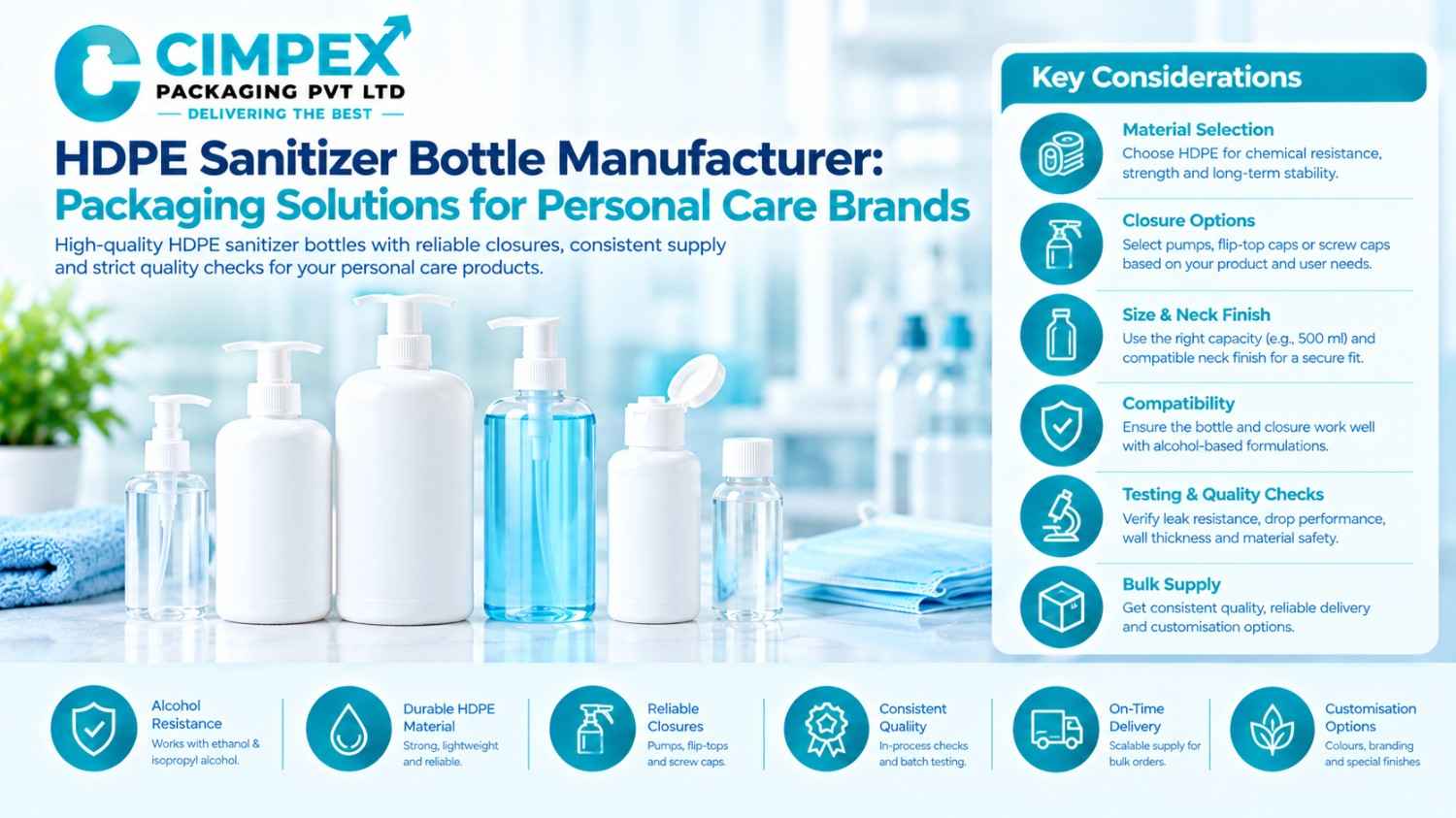
Why Work With an HDPE Sanitizer Bottle Manufacturer
Hand sanitizer is usually an alcohol-rich liquid or gel, and not every plastic copes with it equally well over months of storage. High-density polyethylene is a semi-crystalline polymer with good chemical resistance, a rigid wall and low moisture uptake, which is why it is widely used for household, personal care and pharmaceutical liquids. For a sanitizer brand, the useful properties are straightforward. HDPE does not shatter when dropped, it is light enough to keep freight costs reasonable, and it can be blow moulded into the cylindrical or round-shoulder shapes that retailers expect. A dependable HDPE sanitizer bottle manufacturer should be able to tell you which resin grade it uses, how the bottle is made and what testing is done before dispatch. We answer those questions for every customer, and we suggest you hold any plastic sanitizer bottle manufacturer to the same standard. If a supplier cannot answer them clearly, treat that as a signal to look elsewhere.How We Make an HDPE Sanitizer Bottle
At our plant in Baddi, we produce sanitizer bottles by extrusion blow moulding, which is how most sanitizer bottles are made. A heated tube of HDPE, called a parison, is extruded into a mould, inflated with air until it takes the shape of the cavity, then cooled and trimmed. We form the neck precisely so that closure threads fit accurately, which is what prevents leakage. Several details decide whether a bottle performs well in the field: Wall thickness distribution: thin shoulders or bases can deform when the bottle is squeezed or stacked. Neck finish accuracy: a poorly moulded neck leaks even with a good pump. Bottle weight consistency: stable weight from batch to batch usually indicates stable process control. We make our bottles from virgin HDPE, with in-line quality control, wall thickness and weight checks, and dust-free carton packing. Our manufacturing process is documented on our website, and it is a useful starting point whenever you evaluate a plant, ours or anyone else’s.Choosing the Right Size: The 500 ml Format
Sanitizer packaging spans pocket bottles, countertop pump bottles and refill formats. The right capacity depends on where the product is used and how it is sold. A 500 ml HDPE sanitizer bottle is a common size for offices, clinics, shops and households because it holds enough volume for repeated pumping without being awkward to handle. We list a 500 ml HDPE sanitizer bottle with a standard 28 mm neck, available in white, blue, green or transparent shades, and we can match brand colours on request. If you need other capacities, please confirm them with our sales team rather than assuming. For many shoppers, the 500 ml HDPE sanitizer bottle is the pack they see on counters and reception desks. Brands that sell several sizes often keep one neck finish across the range so the same pump or flip-top cap fits every bottle, which reduces the number of components to qualify.Closure Options: Pump, Flip-Top and Screw Cap
The closure shapes the user experience as much as the bottle does. Three options are common: Dispenser pump: delivers a measured dose and keeps the product hygienic in use. Lockable versions prevent accidental discharge during transport. Flip-top cap: convenient for small, portable bottles and for gel formats that are squeezed out. Screw cap: simple and economical, suited to refill packs and bulk containers. A sanitizer bottle with pump dispenser must be matched carefully. Pump neck size, dip-tube length and spring material all affect dose delivery and long-term reliability with alcohol. Our dispenser pump range includes a sanitizer pump that we have tested with 70 to 80 percent ethanol formulations, in lockable and non-lockable designs. Whichever supplier you use, ask for a trial set before ordering any sanitizer bottle with pump dispenser, so you can test priming, dose and sealing with your own formula.Alcohol Resistance and Compatibility
Alcohol compatibility is the most important technical question in sanitizer packaging. Ethanol and isopropyl alcohol can affect some plastics, labels, inks and gasket materials. Polyethylene generally performs well with both, but the entire pack has to be considered, not just the bottle. The WHO guide to handrub formulations is a useful reference for the alcohol-based formulas that sanitizer packaging must hold. Alcohol-resistant HDPE bottles for sanitizer are standard practice rather than a premium feature, yet the finished combination still needs testing. Before approving a design, we suggest you check the following:- Whether the bottle, pump and liner materials have been used with ethanol or isopropyl alcohol formulas.
- Whether printing inks and label adhesives hold up when the product contacts them.
- How the filled bottle behaves in a short stability test with your own formulation.
- Whether the closure keeps its seal after repeated opening, since a loose closure allows alcohol to evaporate. Alcohol-resistant HDPE bottles for sanitizer still depend on a well-fitted cap or pump.
HDPE Compared With Other Bottle Materials
The table below compares the main options that sanitizer brands consider. It is a qualitative guide, not a technical specification, and any plastic sanitizer bottle manufacturer should be able to discuss each row with you.| Factor | HDPE bottle | PET bottle | Glass bottle |
| Impact resistance | Strong, does not shatter | Reasonable | Fragile |
| Alcohol compatibility | Generally good | Needs checking with the formula | Excellent |
| Weight | Light | Light | Heavy |
| Appearance | Opaque or translucent | Often clear | Premium look |
| Freight and handling | Economical | Economical | Higher breakage risk |
| Best suited for | Everyday sanitizer, bulk and institutional packs | Clear display packs | Specialty or premium products |
HDPE Sanitizer Bottle Manufacturer or Supplier: What Is the Difference?
Brands buy in different ways. Some deal directly with a plant, while others work through a distributor. An HDPE sanitizer bottle supplier may stock standard shapes and sell smaller quantities, while a manufacturer controls the mould, the resin and the process. Working directly with a manufacturer gives you more say over colour, weight, neck finish and decoration, and makes quality questions easier to resolve. Some buyers start with an HDPE sanitizer bottle supplier for a pilot run, and a good HDPE sanitizer bottle supplier will say clearly which items are stock and which are made to order. As volumes grow, many of our customers move to direct manufacturing with us. We produce in Baddi, Himachal Pradesh and supply across India and export markets, so we can serve as your hand sanitizer bottle manufacturer in India for both domestic and export programmes.Buying in Bulk From an HDPE Sanitizer Bottle Manufacturer
Demand for bulk sanitizer bottles for personal care brands can be uneven, so purchasing plans matter. A sanitizer bottle wholesale supplier will usually quote on volume, customisation level and packing, and the price changes depending on whether you use stock tooling or a custom mould. A sanitizer bottle wholesale supplier should state this plainly. Our minimum order quantity is flexible and depends on customisation, so we ask you to share your exact requirements and we will prepare a quotation around them. Planning points for bulk buyers: Standardise where you can: one bottle and one neck finish across several SKUs reduces complexity. Decide on decoration early: shrink sleeves, screen printing and adhesive labels each have different lead times. Brands that source bulk sanitizer bottles for personal care brands from one source also benefit from consistent quality across batches. When you compare any sanitizer bottle wholesale supplier, ask how batch consistency is controlled.Customisation From an HDPE Sanitizer Bottle Manufacturer
A plain HDPE bottle becomes a recognisable pack through colour, finish and decoration. We can offer matte or glossy surfaces, brand-matched colours, shrink sleeves, screen printing and pressure-sensitive labels, plus private labelling. Please confirm mandatory label information with your compliance team, since a packaging company cannot take responsibility for your labelling claims. We can also match the colour of bulk sanitizer bottles for personal care brands to the rest of your line, so hand wash and sanitizer packs look related on the shelf.Conclusion
The right HDPE sanitizer bottle manufacturer matters far more than the bottle’s shape. Material quality, neck accuracy, closure compatibility, alcohol resistance and consistent supply all influence how your product performs once it leaves the factory. Test samples with your own formulation, standardise components across your range, and work with a partner that explains its process openly. At Cimpex, we want to be part of your quality system rather than just another vendor. If you are planning a new sanitizer launch or a bulk reorder, list your bottle size, neck finish, closure type and expected volumes, then contact the Cimpex team for samples and a quotation based on your requirements.Frequently Asked Questions
An HDPE sanitizer bottle manufacturer makes containers from high-density polyethylene for hand sanitizer liquids and gels. The bottles resist impact, handle alcohol-based formulas well and work with pumps, flip-top caps and screw caps.
Yes, HDPE is generally suitable for alcohol-based sanitizers because it resists ethanol and isopropyl alcohol. Even so, we recommend running a compatibility check with your own formula, pump and label materials before approving a pack, since the closure and decoration are part of the system.
A 28 mm neck is commonly used for sanitizer bottles that take a dispenser pump, flip-top or screw cap. Other finishes exist, so match the neck to the closure you plan to use and confirm the exact specification with us before you order.
Minimum order quantity for bulk sanitizer bottles depends on whether you choose a stock design or a customised bottle, and on colour and decoration. Our MOQ is flexible and customisation-dependent, so send us your exact requirements and we will quote against them.
Lead time depends on the product and level of customisation. Our standard orders take about seven to fifteen working days, while fully customised batches take longer. We always recommend confirming the timeline in writing when you place the order.
Yes. Typical options include custom colours, matte or glossy finish, shrink sleeves, screen printing and adhesive labels. Private labelling is also available. Customisation can affect minimum order quantity and lead time, so share your artwork and brand colours with us early.
Choose a sanitizer bottle with pump dispenser for countertop use where dosing and hygiene matter, and a flip-top cap for portable or gel formats. Pumps need careful matching to neck size and formula, so test a sample set with your product before ordering in volume.