


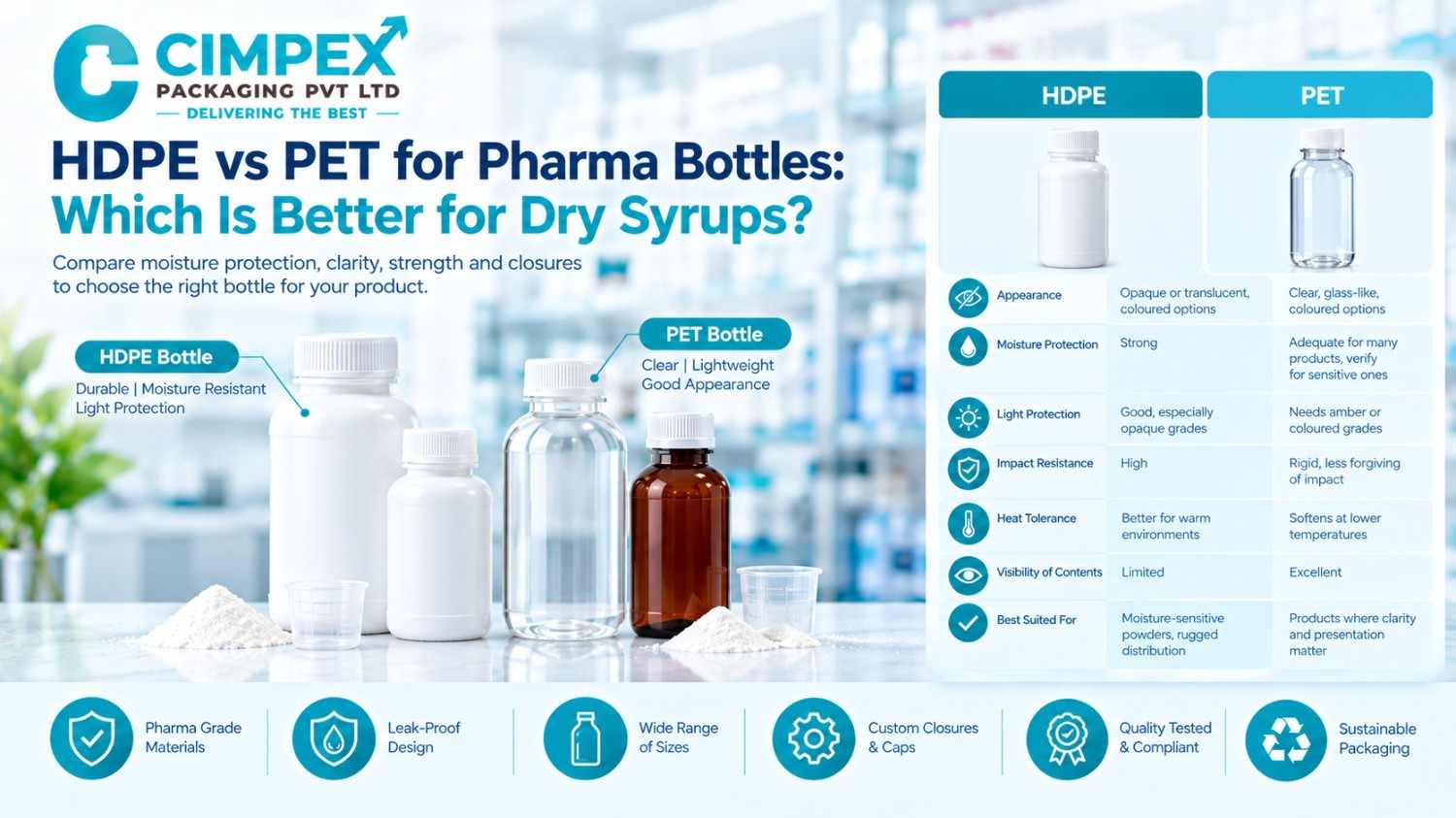
For most dry syrups, HDPE is the safer default and PET is the choice when clarity matters, but the right answer depends on your formulation, shelf life and filling process. The decision of HDPE vs PET for pharma bottles affects moisture protection, light protection, patient handling and cost. This guide compares both materials in practical terms, explains what a dry syrup needs from its container and lists what to confirm with a supplier before approving a pack.
A dry syrup is a powder or granule that the pharmacist or caregiver reconstitutes with water. The bottle therefore does two jobs. It must keep the powder stable and dry on the shelf, and it must later hold the liquid, be shaken, and be poured or measured accurately. That combination is why material choice deserves more than a quick price comparison.
What a Dry Syrup Bottle Must Do
Before comparing materials, define the job. A dry syrup bottle has to:
- Protect against moisture: Powder that absorbs humidity can cake, degrade or lose potency before it is ever reconstituted.
- Allow efficient filling: The neck and bottle shape should suit powder or granule filling on your line.
- Survive reconstitution: The bottle is filled with water to a marked level and shaken, so the body must handle that without deforming.
- Work with the closure: Child-resistant, tamper-evident or induction-sealed closures must fit the neck properly.
- Support dosing: Many packs are supplied with a measuring cap or cup, so the neck finish must suit it.
These requirements are the same whichever resin you pick, so HDPE vs PET for pharma bottles is really a question of which material meets them better for your product. What changes is how well each material meets them for your particular product.
HDPE vs PET for Pharma Bottles: The Core Differences
High-density polyethylene is a tough, opaque to translucent plastic. Polyethylene terephthalate, or PET, is a rigid plastic known for clarity and a glass-like look. According to the general reference on polyethylene terephthalate, PET is clear when biaxially oriented but is relatively permeable to oxygen and carbon dioxide, and it softens at much lower temperatures than its melting point. Those characteristics shape where each material fits best.
HDPE: Strength and Moisture Resistance
HDPE bottles are valued for impact resistance, chemical resistance and strong moisture resistance. Cimpex Packaging describes its HDPE bottles as made from virgin resin, resistant to acids, alkalis and most solvents, and compatible with child-resistant and tamper-evident closures. Because HDPE is naturally opaque or can be coloured, it also helps protect light-sensitive formulations. For powders that must stay dry, these properties make HDPE a common starting point.
PET: Clarity and Appearance
PET offers excellent transparency, so pharmacists and patients can see the powder and, after reconstitution, the liquid level. It gives a premium, glass-like look and is rigid and lightweight. Amber or coloured PET can add light protection. The trade-offs are lower tolerance for heat, a gas barrier that may be insufficient for very sensitive products unless a barrier design is used, and a tendency to be less forgiving of impact than HDPE.
Comparison Table
The table summarises HDPE vs PET for pharma bottles in qualitative terms, including where PET bottles for pharmaceutical packaging need extra verification. Confirm every point with stability testing for your own formulation.
| Factor | HDPE | PET |
| Appearance | Opaque or translucent, coloured options | Clear, glass-like, coloured options |
| Moisture protection | Strong | Adequate for many products, verify for sensitive ones |
| Light protection | Good, especially opaque grades | Needs amber or coloured grades |
| Impact resistance | High | Rigid, less forgiving of impact |
| Heat tolerance | Better for warm environments | Softens at lower temperatures |
| Visibility of contents | Limited | Excellent |
| Best suited for | Moisture-sensitive powders, rugged distribution | Products where clarity and presentation matter |
HDPE Bottles for Dry Syrups
HDPE bottles for dry syrups are widely used because the material guards against humidity, resists knocks in transport and works with standard closure systems. Cimpex Packaging lists HDPE bottles from roughly 30 ml to 5 litres, with testing for drop resistance, leak resistance, top-load strength and stress cracking. Opaque HDPE also suits antibiotics and other powders that should be protected from light.
The main drawback is visibility. A caregiver cannot easily see the powder level or reconstituted volume through opaque walls, so the pack needs a clear fill-to-mark line or a graduated label. This is a design detail, not a flaw, but it should be planned whenever you weigh HDPE vs PET for pharma bottles.
PET Bottles for Pharmaceutical Packaging
PET bottles for pharmaceutical packaging are common for clear liquid orals and products where visual inspection adds value. Cimpex Packaging lists PET among the resins processed at its facility, so it can supply this format when a project calls for it. For dry syrups, PET can work well if the formulation is not highly moisture or oxygen sensitive and if stability data supports it.
If you choose PET for a dry syrup, check three things: whether the barrier is adequate for the shelf life, whether the amber or coloured grade gives enough light protection and whether the bottle withstands the temperatures it will see in storage and transport.
Closures and Dosing in HDPE vs PET for Pharma Bottles
The closure often matters as much as the bottle. Dry syrup packs commonly pair the bottle with a child-resistant or tamper-evident cap and a measuring cup or cap for dosing. Both HDPE and PET can be matched to such closures, but the neck finish must be specified precisely. Well-planned dry syrup packaging bottles treat the bottle, closure and measuring cap as one tested set, not three separate purchases.
Common Closure Checks
- Neck finish match: Bottle and closure must come from compatible specifications.
- Seal integrity: Liners or induction seals should be checked for the actual powder and storage conditions.
- Dosing accuracy: The measuring cap markings should match the label dose.
- Child resistance: Confirm that the closure type meets the rules in your market.
Pharmaceutical Syrup Bottles: Where Dry Syrups Differ from Ready Liquids
Pharmaceutical syrup bottles for ready-to-use liquids face different pressures. The contents are already liquid, so the bottle must hold the product stably for its whole shelf life, resist interaction with the formulation and pour cleanly. Dry syrups, by contrast, depend on the packaging to keep a powder dry first and to hold a liquid later. This is why a bottle that performs well for a ready syrup may not be the best match for a powder, and why HDPE vs PET for pharma bottles must be judged per product form. A supplier should ask about your product form before recommending either.
How to Decide on HDPE vs PET for Pharma Bottles
Use this sequence to make a defensible decision:
- Start with stability data. Moisture, oxygen and light sensitivity decide how much barrier you need, and whether HDPE bottles for dry syrups or a barrier-aware PET design is more suitable.
- Consider patient handling. Decide whether seeing the powder or liquid level is important.
- Check the supply chain. Heat exposure, transport conditions and storage climate matter.
- Match the closure. Confirm child-resistant, tamper-evident and dosing needs.
- Test samples. Run real filling, reconstitution and transit trials.
Many manufacturers find that HDPE suits moisture-sensitive powders and demanding distribution, while PET suits products where appearance and visibility carry real value. A knowledgeable supplier will help you weigh the two rather than push one material.
Common Mistakes When Comparing HDPE vs PET Bottles
Comparisons of HDPE vs PET bottles go wrong in a handful of predictable ways:
- Choosing on appearance alone: A clear bottle looks attractive but may not protect the formulation.
- Skipping stability testing: Packaging suitability must be shown with your own product, not assumed.
- Ignoring the closure: A great bottle fails if the cap or liner does not seal.
- Overlooking heat exposure: Storage and transit temperatures can affect PET more than HDPE.
- Forgetting reconstitution: The bottle must cope with water fill and shaking.
What to Ask a Supplier Before Choosing HDPE vs PET for Pharma Bottles
Whichever material you choose, ask the supplier for evidence rather than assurances. Cimpex Packaging states that it works under ISO 9001:2015 and GMP-compliant systems, uses food-grade and pharma-grade resins and supplies a Certificate of Analysis with despatch batches. Questions worth asking any supplier include:
- Which resin grade is used, and can material documentation be shared?
- Which dimensional, leak and strength checks are carried out on each batch?
- Can samples be supplied for fit, filling and stability trials?
- What are the minimum order quantities and lead times for custom designs?
For regulated products, the regulatory background matters too. The FDA’s guidance on container closure systems for human drugs is a useful reference for the information typically expected, and your regulatory adviser should confirm what applies in your market.
Conclusion
The question of HDPE vs PET for pharma bottles has no single winner. HDPE is the practical choice for most dry syrups because it protects against moisture and light, handles rough distribution and fits standard closures. PET earns its place where clarity, presentation and visual inspection matter and where stability data confirms the barrier is adequate. Base the HDPE vs PET for pharma bottles decision on your formulation and evidence, test the bottle, closure and dosing cap as one pack and ask suppliers for documented quality controls.
If you are planning a new dry syrup pack and weighing HDPE vs PET for pharma bottles, list your formulation sensitivities, fill size, closure type and expected volumes before approaching suppliers. Explore the Cimpex Packaging range of HDPE bottles, or contact the team for guidance on choosing between HDPE and PET for your product.
Frequently Asked Questions
In the HDPE vs PET for pharma bottles decision, HDPE is usually the safer default for dry syrups because it offers strong moisture resistance, impact strength and light protection. PET suits products where clarity matters and stability data supports it. The final choice depends on your formulation, shelf life and distribution conditions.
HDPE resists moisture, absorbs impact well and works with child-resistant and tamper-evident closures. Its opacity also helps protect light-sensitive powders. These properties make it a practical choice for dry syrups and similar solid or powder medicines that must stay dry until reconstitution.
Yes. PET bottles are widely used for clear liquid medicines and some other products. For moisture-sensitive or oxygen-sensitive formulations, the barrier must be verified through stability testing, and coloured or amber grades may be needed for light protection.
The main difference is the balance of properties. HDPE offers toughness, moisture resistance and opacity, while PET offers clarity, rigidity and a glass-like look. In HDPE vs PET bottles for medicines, neither is universally better, so match the material to the product’s protection needs and handling requirements.
Often yes. Many pharmaceutical syrup bottles use child-resistant or tamper-evident closures, sometimes with a measuring cap for dosing. The closure must match the bottle neck exactly and should be tested as part of the assembled pack.
Dry syrup packaging bottles should include a suitable moisture barrier, a neck that suits powder filling, a closure with the right seal and a clear fill-to-mark line. A measuring cap or cup is also common, and all parts should be tested together.
Yes. Test samples with your real product, closure and filling process, and include reconstitution, shaking and transit trials. Sample testing is the most reliable way to catch fit, seal and stability problems before committing to bulk volumes.