


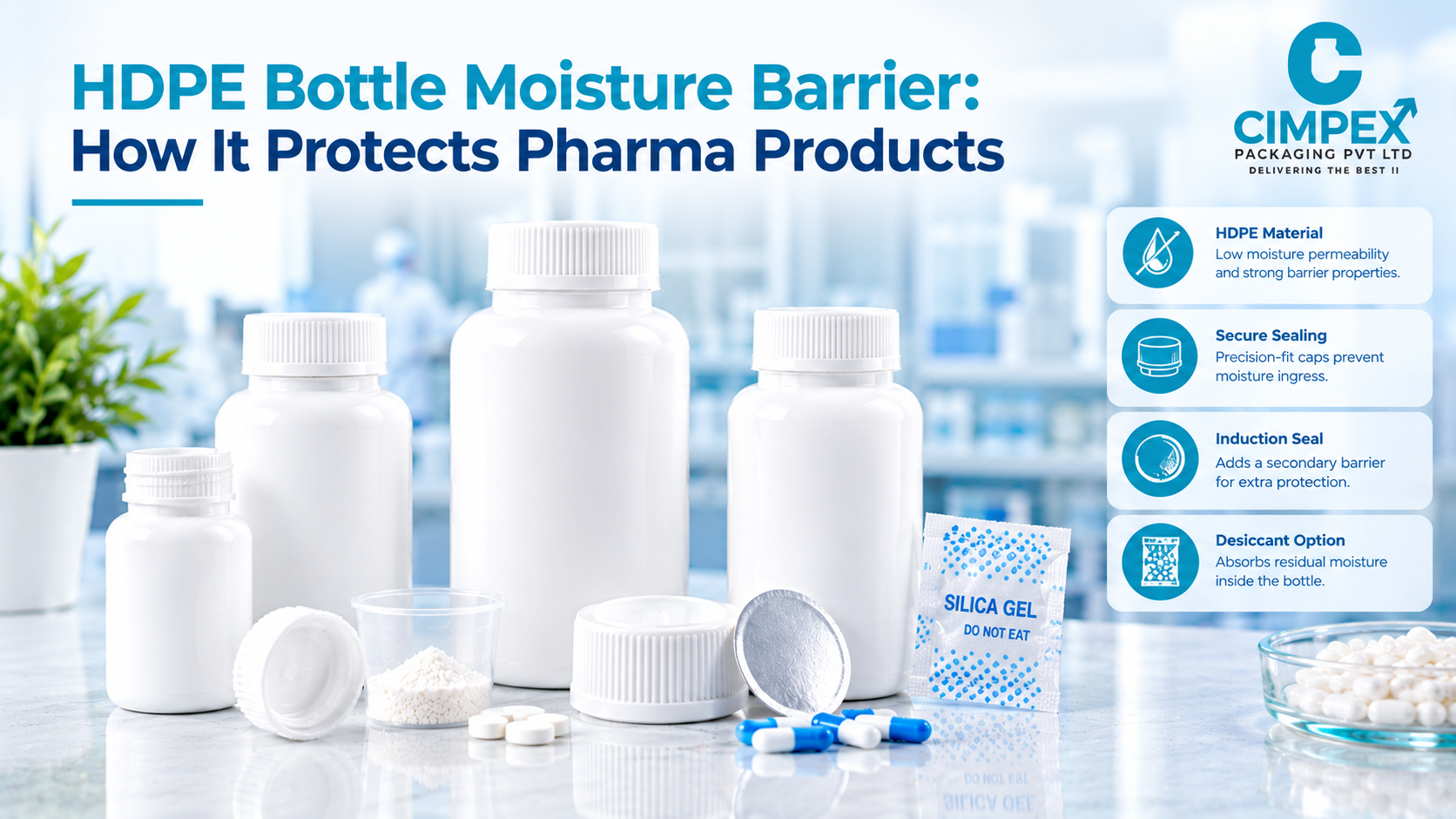
Why an HDPE Bottle Moisture Barrier Matters
Moisture is one of the most common causes of product failure for solid oral dosage forms, nutraceuticals, and hygroscopic powders. Even small amounts of humidity entering a container can trigger tablet softening, capsule sticking, powder caking, or chemical instability in active ingredients. This is why an effective hdpe bottle moisture barrier is not a nice-to-have feature but a core packaging requirement for any product where stability testing shows sensitivity to humidity. Because HDPE is semi-crystalline and naturally low in permeability compared with many other plastics, it is widely used across pharma and nutraceutical packaging specifically for its moisture-resistant behaviour. But the resin itself is only part of the picture; wall thickness, cap fit, and sealing method all influence how well the finished bottle actually performs as moisture sensitive packaging in real-world storage conditions.HDPE Barrier Properties Explained
The strength of an hdpe bottle moisture barrier comes down to hdpe barrier properties rooted in the material’s molecular structure. High-density polyethylene has tightly packed polymer chains with relatively low amorphous content, which limits the pathways through which water vapour molecules can pass. This gives HDPE meaningfully better moisture resistance than lower-density plastics, though it is still not a perfect barrier on its own, since some vapour transmission does occur over time through the plastic wall itself. Wall thickness has a direct relationship with how well an hdpe bottle moisture barrier performs: thicker walls generally reduce vapour transmission rates, which is why many pharma-grade bottles use heavier gauge HDPE than a comparable FMCG container might need. Bottle design also plays a role, since fewer seams, a well-fitted cap, and a smooth internal surface all reduce the number of potential points where moisture could enter.Understanding Moisture Sensitive Packaging Requirements
Moisture sensitive packaging is typically defined by the stability data generated during product development, which specifies acceptable limits for moisture vapour transmission rate over the product’s intended shelf life. Formulators use this data to decide whether a standard HDPE bottle is sufficient or whether additional protection, such as a desiccant or a foil induction seal, needs to be built into the packaging design. Getting moisture sensitive packaging right requires looking at the whole system rather than any single component in isolation. An hdpe bottle moisture barrier with excellent hdpe barrier properties can still underperform if the cap does not seal properly, or if the induction seal is applied inconsistently during filling. This is why experienced pharma packaging teams test complete assembled units rather than evaluating the bottle and closure separately.HDPE Moisture Protection: Desiccants and Induction Seals
The Role of a Desiccant Bottle
A desiccant bottle uses an integrated or inserted desiccant, commonly silica gel or molecular sieve, to actively absorb residual moisture inside the container after filling and during storage. Unlike the passive protection an hdpe bottle moisture barrier provides on its own, a desiccant actively manages humidity that is already present, which is particularly useful for hygroscopic tablets or capsules that are sensitive even to small amounts of trapped moisture. Desiccant bottles are commonly specified when stability testing shows that passive barrier properties alone are not sufficient to meet shelf-life requirements, especially in humid climates or for products with long distribution chains.The Role of an Induction Seal Bottle
An induction seal bottle adds a foil liner that is heat-sealed to the bottle mouth immediately after filling, creating a secondary barrier beneath the cap. This is one of the most effective and widely used methods of reinforcing an hdpe bottle moisture barrier because it closes off the gap between cap threads and bottle neck, a point where moisture can otherwise migrate in even when the cap itself is properly tightened. An induction seal bottle also provides tamper evidence, which is often a regulatory requirement alongside the moisture protection benefit, making it a practical default for most pharma moisture barrier specifications rather than an optional extra.Building a Complete Pharma Moisture Barrier System
Key Elements of an Effective Pharma Moisture Barrier
- A well-specified hdpe bottle moisture barrier with wall thickness matched to the product’s stability profile and shelf-life target.
- A properly fitted cap with consistent torque application during capping.
- An induction seal bottle configuration for products needing tamper evidence and secondary sealing.
- Desiccant inclusion where stability data shows passive barrier properties are insufficient alone.
Common Gaps That Undermine Moisture Sensitive Packaging
- Inconsistent induction sealing during high-speed filling, leaving some units under-sealed.
- Using a lighter wall thickness than the stability data actually supports.
- Storing filled bottles in high-humidity environments before the seal is fully applied.
- Overlooking desiccant capacity relative to the container’s actual headspace volume.
HDPE Bottle Moisture Barrier: Passive vs Active Protection
| Approach | How It Works | Best Suited For |
| HDPE wall barrier | Limits vapour transmission through the plastic itself | General moisture sensitive packaging with moderate sensitivity |
| Induction seal bottle | Foil liner blocks the cap-to-neck gap | Products needing tamper evidence plus sealing |
| Desiccant bottle | Actively absorbs residual and incoming moisture | Highly hygroscopic tablets, capsules, or powders |
| Combined system | Wall barrier, induction seal, and desiccant together | Long shelf-life or high-humidity distribution regions |
What Buyers Should Ask Their Packaging Supplier
Before finalising a specification, it is worth confirming wall thickness options for the hdpe bottle moisture barrier, whether induction sealing is applied in-house or by a third party, and whether the supplier can provide moisture vapour transmission rate data for the specific bottle and cap combination being proposed. Suppliers who can share this data upfront generally make stability testing and regulatory documentation considerably easier later in the product development process. According to the U.S. Food and Drug Administration’s guidance on container closure systems, packaging components must be evaluated as part of the complete drug product system, which reinforces why bottle, cap, and seal all need to be assessed together rather than in isolation. This principle applies equally whether the finished pack relies on the hdpe bottle moisture barrier alone or combines it with a desiccant bottle and induction seal bottle for additional protection.Conclusion
An effective hdpe bottle moisture barrier depends on more than the resin alone: wall thickness, cap fit, induction sealing, and desiccant use all combine to determine how well moisture sensitive packaging performs over a product’s real shelf life. Understanding hdpe barrier properties helps buyers set realistic specifications, while desiccant bottles and induction seal bottles fill the gaps that passive barriers cannot close on their own. Building a pharma moisture barrier around actual stability data, rather than assumptions, is what keeps sensitive products stable from filling line to end user. If your product has known humidity sensitivity, review your stability data alongside your bottle wall thickness, cap type, and sealing method before finalising packaging. Explore Cimpex Packaging’s HDPE bottle range or contact the team to discuss desiccant and induction seal options suited to your formulation.Frequently Asked Questions
HDPE’s tightly packed polymer structure limits how easily water vapour passes through the plastic wall, giving it a naturally low permeability. This makes the hdpe bottle moisture barrier effective for many pharma and nutraceutical products, though wall thickness and cap fit still matter.
Thicker HDPE walls generally reduce vapour transmission rates, improving overall barrier performance. This is why pharma-grade bottles often use a heavier gauge than standard FMCG containers, particularly for products with strict stability requirements.
A desiccant bottle is typically necessary when stability testing shows that passive hdpe moisture protection alone will not keep humidity within acceptable limits. This is common for highly hygroscopic tablets, capsules, or powders with long shelf-life targets.
An induction seal bottle adds a heat-sealed foil liner that blocks the gap between the cap threads and the bottle neck. This reinforces moisture protection and provides tamper evidence, which many pharma packaging specifications require.
Moisture sensitive packaging is usually tested by measuring moisture vapour transmission rate for the assembled bottle, cap, and seal combination under controlled humidity conditions, then comparing results against the product’s stability data.
Relying on the bottle alone is rarely sufficient for sensitive products. A complete pharma moisture barrier system typically combines wall thickness, a properly fitted cap, an induction seal, and sometimes a desiccant for full protection.
Yes, humid climates and long distribution chains increase the demand placed on hdpe moisture protection, often requiring additional measures such as desiccants or thicker walls compared with drier, shorter-distribution markets.