


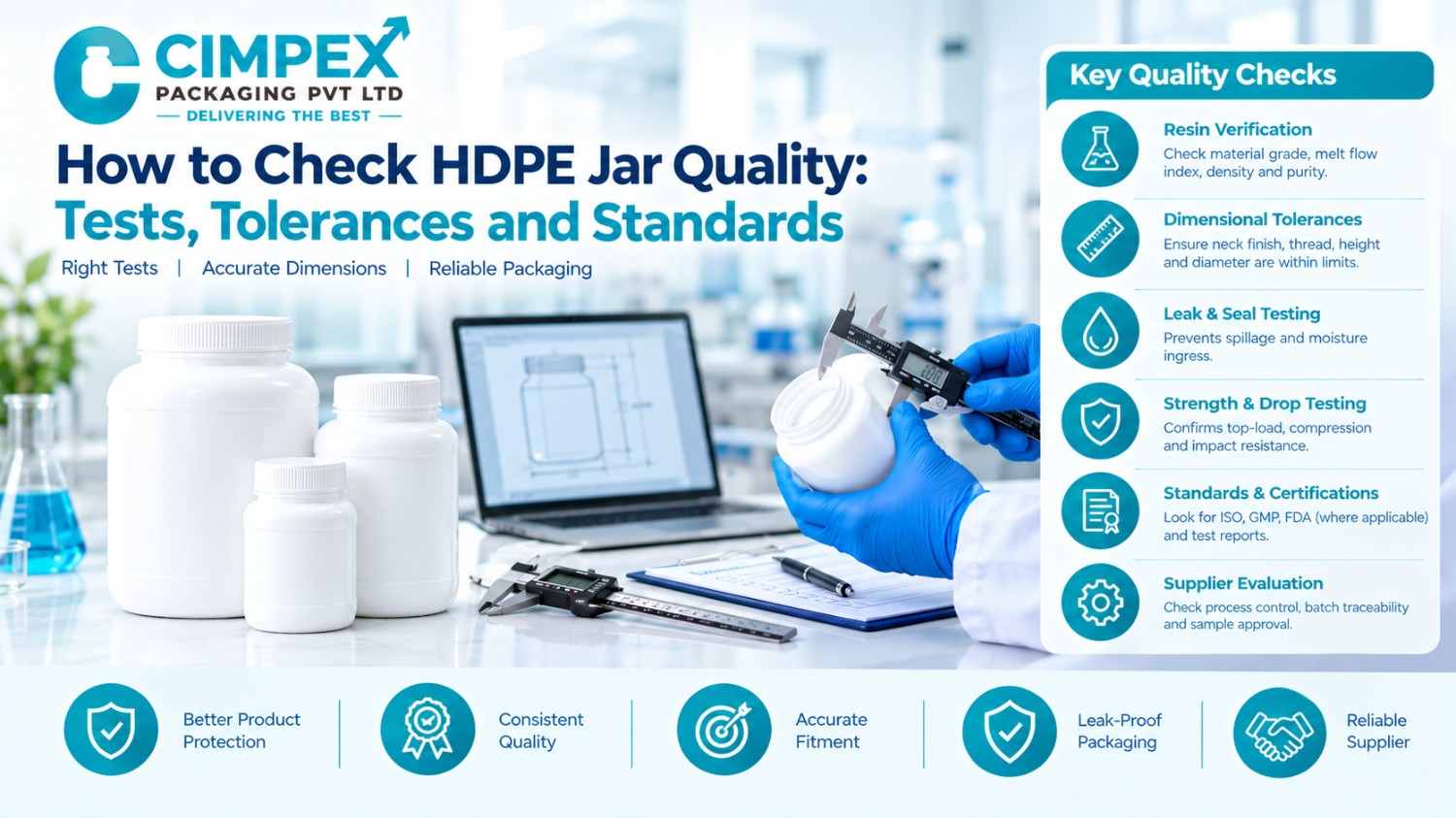
To check the quality of an HDPE jar, you need to verify four things: the resin, the dimensions, the seal and the strength of the finished container. A jar can look flawless and still fail in use if the neck is slightly out of tolerance, the wall is uneven or the closure does not seal. This guide explains what each test checks, which tolerances matter most, which standards and certifications to ask about and how to review samples before a bulk order.
Buyers in pharmaceutical, nutraceutical, food and cosmetic packaging often receive a sample, judge it by eye and approve it. A structured check takes little more time and prevents most of the problems that appear on the filling line or in the customer’s hands.
Why HDPE Jar Quality Matters
A jar protects the product, carries the brand and works with the filling line and closure. When quality drifts, the consequences are practical: leaking or loose closures, powder exposed to humidity, jars that jam on the line or labels that will not sit flat. For regulated products such as medicines and supplements, poor consistency can also trigger complaints and rework.
High-density polyethylene is a good base material. According to the general reference on high-density polyethylene, it combines a high strength-to-density ratio with resistance to many solvents, which is why it is so widely used for containers. But material alone does not guarantee a good jar. Moulding control, tooling condition and inspection discipline decide whether every jar in a batch matches the approved sample.
Start with the Resin and Documentation
Quality starts before moulding. Ask which resin grade is used and whether it is suitable for the intended contact, such as food, pharmaceutical or general use. Cimpex Packaging states that its jars use food-grade and pharma-grade resin from approved suppliers with material traceability, and that incoming raw material is inspected for melt flow index, density and purity.
Documents Worth Requesting
- Certificate of Analysis: Confirms the batch properties against the agreed specification.
- Material compliance statement: Shows the resin is suitable for the application and market.
- Batch coding and traceability records: Allow a problem batch to be identified and traced.
- Drawing or specification sheet: Defines capacity, neck finish, weight and critical dimensions.
A supplier that can supply these promptly is usually running a controlled process.
HDPE Jar Quality Testing: What Should Be Checked
Effective HDPE jar quality testing combines visual checks, measurements and performance tests. No single test is enough, because each reveals a different type of defect, and strong HDPE jar quality testing records the results for every batch.
Visual Inspection
Visual checks catch cosmetic and functional defects: black specks, colour variation, flash at the parting line, sink marks, scratches and distorted shapes. Compare samples under consistent lighting against an approved reference. Pay close attention to the neck and sealing surface, because small blemishes there can affect the seal.
Weight and Wall Thickness
Weighing jars shows whether material distribution is consistent. A jar that is much lighter than the approved sample may have thin walls, while a heavier one may signal wasted material or a process change. Wall thickness uniformity matters for strength, top-load performance and stress resistance, particularly in the base and shoulder.
Strength and Drop Performance
Top-load or compression tests show whether jars can carry stacked weight in storage. Drop tests simulate handling and transit. Cimpex Packaging reports checking top-load and compression strength alongside leak and drop resistance, though the page does not publish the test conditions, so request those if they matter to you.
HDPE Jar Testing Methods Explained
The most useful way to understand HDPE jar testing methods is to link each one to the failure it prevents.
- Dimensional measurement: Prevents closure and line-fit problems by checking neck, thread, height and diameter.
- Torque testing: Checks that closures apply and release at the intended force.
- Leak and seal testing: Prevents spillage and moisture ingress.
- Drop and top-load testing: Prevents breakage in distribution and warehouse stacking.
- Stress-crack testing: Identifies jars likely to crack under chemical and mechanical stress.
Where formal standards apply, test conditions are defined by organisations such as ASTM and ISO. For example, ASTM publishes methods for drop impact and stress-crack resistance of blow-moulded polyethylene containers. Ask a supplier which methods or internal procedures it follows and request results, not just a statement that testing is done.
HDPE Jar Dimensional Tolerances
HDPE jar dimensional tolerances define how far a measurement may vary from the nominal value while still being acceptable. They matter most at the neck and thread, where the closure must engage reliably, and at the overall height and diameter, which affect filling lines, cartons and labelling.
Plastic is a flexible, temperature-sensitive material, so tolerances are set with shrinkage and ovality in mind. A few principles help:
- Neck finish tolerances are tightest. A small deviation can cause a loose or cross-threaded closure.
- Height and diameter affect automation. Filling, capping and labelling machines need consistent dimensions.
- Measure after cooling. Plastic continues to settle after moulding, so measure jars at stable temperature.
- Use the same method each time. Gauges and sampling plans should be consistent between batches.
Do not accept a general promise of “tight tolerances”. Ask for the tolerance on critical dimensions and the sampling method used to verify them.
HDPE Jar Leak Testing
HDPE jar leak testing confirms that the jar and closure together stop product escaping and moisture entering. It is especially important for powders, tablets and cosmetic creams, where humidity or leakage damages the product or the customer’s trust. Typical approaches include inverting or pressurising the sealed pack and checking for loss, though the right method depends on the product and closure.
Because the closure is half the seal, test the assembled jar, not the jar alone. Liners, induction seals and caps all influence the result. Cimpex Packaging lists induction-seal compatible necks, tamper-evident caps and child-resistant closures for its jars, so confirm which combination you are testing and check it again after transit simulation. A seal that holds on the bench may loosen after vibration.
HDPE Jar Quality Standards and Certifications
HDPE jar quality standards fall into three groups: management systems, material and contact requirements, and product-specific rules.
What to Look For
- Quality management: ISO 9001 is a recognised quality management framework, and Cimpex Packaging lists ISO 9001:2015 among its certifications.
- Good manufacturing practice: GMP-compliant processes are expected for pharmaceutical and food-grade packaging.
- Material compliance: Food and pharma applications require suitable resins, and export markets often add chemical regulations such as REACH and RoHS.
- Customer specifications: Many brands add their own acceptance criteria for dimensions, appearance and performance.
Meeting HDPE jar quality standards on paper shows that a system exists. They do not replace sample testing, so use both. Review the supplier’s listed credentials and ask for current copies.
Reading a Supplier’s Test Report
A test report is only useful if you know how to read it. Check that it names the batch, the date, the sample size and the method used for each test. Look for actual measured values against the specification rather than a bare “pass” entry, and confirm that the critical dimensions on the report match the ones on your drawing. If a report omits the neck finish or the closure used for leak testing, ask for the missing detail. Reports that are consistent from batch to batch are a good sign, while results that look identical every time can suggest that data is being copied instead of measured.
How Requirements Differ by Application
Jar quality criteria shift with the product. Pharmaceutical and nutraceutical jars put most weight on moisture protection, closure sealing and documentation. Food jars add hygiene and food-contact suitability. Cosmetic jars lean towards appearance, surface finish and label adhesion, while industrial or household products care most about strength and chemical resistance. Cimpex Packaging lists jars for pharmaceuticals and nutraceuticals, food and beverage, cosmetics, lubricants, agrochemicals and household products, so define your own priorities first and rank the tests accordingly.
A Practical Sample Approval Checklist
When your samples arrive, follow a repeatable routine:
- Check the paperwork against the order specification.
- Inspect for visual defects against an approved reference.
- Weigh and measure a sample set, focusing on the neck and thread.
- Fit the actual closure and check torque and seal.
- Fill with your product and run a leak and transit test.
- Label and test on your line if automation is used.
Record the results, and repeat the key checks on the first production batch.
Common Mistakes to Avoid
- Approving by eye only: Defects at the neck are often invisible without measurement.
- Testing the jar without the closure: Seal performance depends on the pairing.
- Accepting vague tolerance statements: Ask for numbers on critical dimensions from the supplier’s own specification.
- Skipping the first-batch check: Production tooling can behave differently from sample tooling.
- Ignoring storage and transit conditions: Heat, vibration and stacking all expose weak points.
Conclusion
Knowing how to check an HDPE jar means looking beyond appearance. Verify the resin documentation, measure the critical dimensions, test the jar with its closure for leaks and strength, and confirm the supplier’s quality system and certifications. Keep a written checklist of HDPE jar testing methods for sample approval and repeat the key checks on the first production batch.
If you are specifying a new jar, record your product type, closure, capacity and acceptance criteria before you approach suppliers. Explore the Cimpex Packaging range of HDPE jars, or contact the team to discuss samples, documentation and testing for your application.
Frequently Asked Questions
Check the resin documents, inspect the jar visually, weigh and measure critical dimensions, fit the actual closure and run leak and drop tests. Repeat the key checks on the first production batch. A combination of paperwork, measurement and performance testing is far more reliable than visual inspection alone.
Common tests include visual inspection, weight and wall-thickness checks, dimensional measurement, torque testing, leak and seal testing, drop testing, top-load testing and stress-crack testing. The right set depends on the product, closure and market requirements.
They are the permitted variations from a jar’s nominal dimensions, such as neck diameter, thread, height and wall thickness. The neck finish is usually the most critical because the closure must fit and seal. Ask your supplier for the tolerances on critical dimensions.
Leak testing usually involves sealing the filled or empty jar with its closure and checking for product loss or air escape, for example by inversion, pressure or vacuum methods. The method depends on the product. Always test the assembled jar and closure together.
Relevant standards include ISO 9001 for quality management, GMP for pharmaceutical and food-grade packaging, resin compliance for food or pharma contact and any customer or market-specific requirements. Ask suppliers for current certificates and material documentation.
Yes. Test samples for fit, seal and strength with your own product and closure, then repeat key checks on the first production batch. This is the most reliable way to detect tolerance or sealing problems before they affect a whole order.
Leaks usually come from mismatched neck and closure dimensions, damaged sealing surfaces, wrong liners, incorrect closing torque or seals disturbed during transport. Checking tolerances and testing the assembled pack after transit simulation helps identify the cause early.