


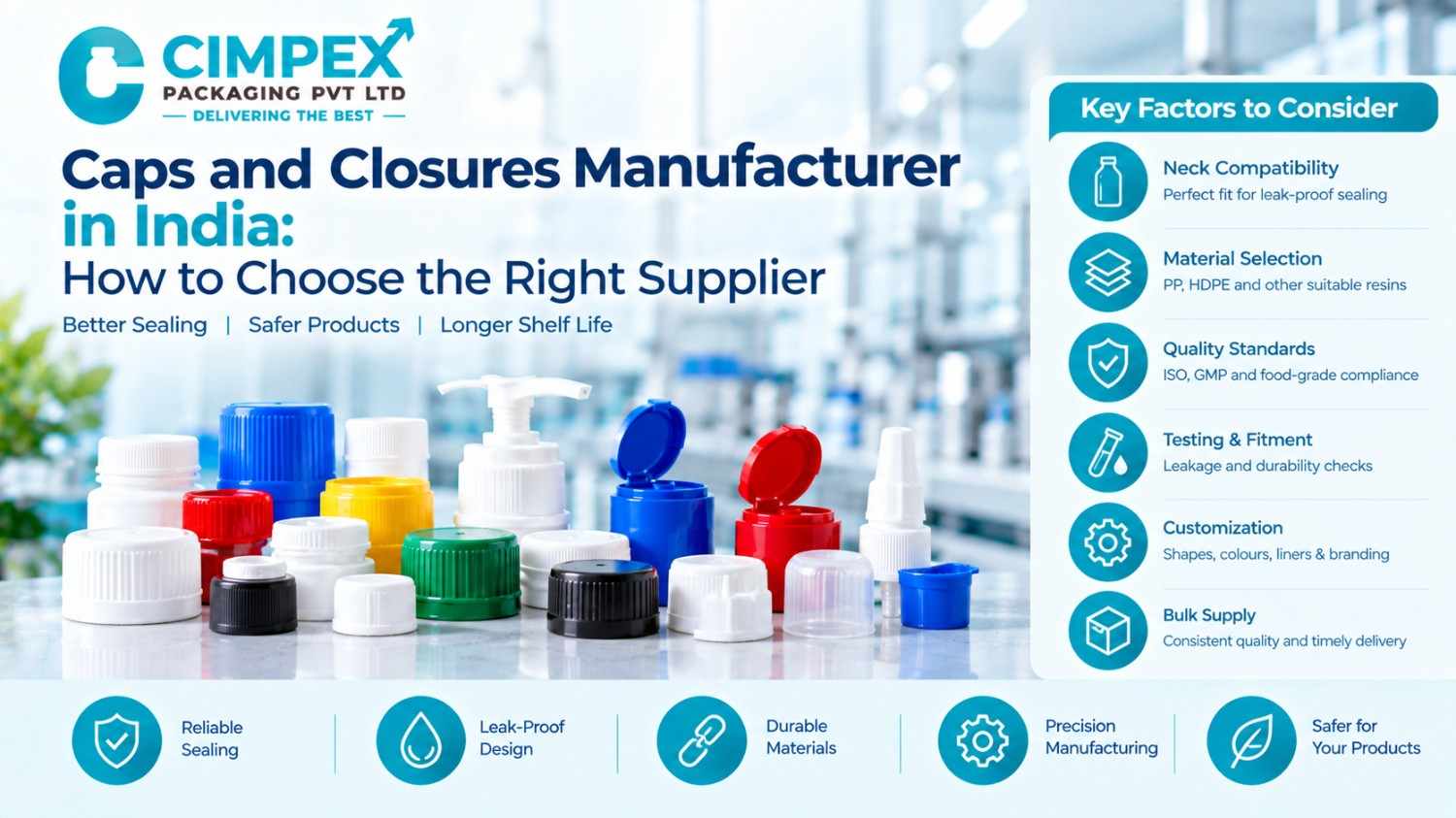
Why Closures Deserve as Much Attention as Bottles
Buyers often spend weeks selecting a bottle and minutes selecting its cap. In practice, the closure is the part that opens, reseals, shows tampering and protects the product every time the pack is used. A reliable caps and closures manufacturer in India therefore influences product safety, shelf life and customer experience as much as the bottle supplier does. The best results come when the bottle and cap are designed, moulded and tested as a pair. When they come from separate sources, small differences in thread form or neck dimensions can add up to leakage on the filling line or in transit.What to Expect From a Caps and Closures Manufacturer in India
A serious caps and closures manufacturer in India should be able to answer practical questions without hesitation. Which resin grades are used for which closure types? How are thread dimensions checked, and how often? What happens when a batch fails inspection? Clear, specific answers signal a disciplined process, while vague answers usually signal risk. It also helps to ask for production samples instead of hand-finished prototypes, because only production samples show how the cap will behave in bulk.Bottle Neck Compatibility: Where Most Problems Begin
Bottle neck compatibility means that the cap thread, inner seal surface and neck finish all match. Even a slight mismatch can cause cross-threading, loose seating or uneven liner compression. When you evaluate a caps and closures manufacturer in India, ask which neck finishes are available and how thread dimensions are controlled during production.Custom Neck Finish and Closure Customization
Some products need a custom neck finish, for example to fit a dispenser, a dropper, a measuring cap or an existing filling line. Closure customization can cover thread style, height, diameter, colour, tamper-evident bands and liner type. Closure customization usually requires tooling, so confirm timelines and minimum order quantities early. A custom neck finish should be validated with the actual bottle and filling method before bulk production begins.Closure Material Selection
Closure material selection affects sealing, chemical compatibility, feel and cost. Most plastic closures are made from polypropylene or high-density polyethylene, and each has strengths.| Factor | PP closures | HDPE closures |
| Rigidity | Stiffer, firm feel | Slightly more flexible |
| Chemical resistance | Good | Good |
| Heat tolerance | Higher | Moderate |
| Typical use | Pharma, personal care, products needing firm threads | General packaging, bottles and jars in HDPE |
| Best suited for | Applications needing stiffness or heat tolerance | Applications where flexibility and impact resistance help |
Liners and Seals
The liner is often the real sealing element. Induction seal liners, pressure-sensitive liners and foam liners behave differently, so match the liner to the product and the bottle material. Ask your supplier which liner options are compatible with your cap design.Cap Manufacturing Process
The cap manufacturing process usually begins with resin selection, followed by injection moulding in precision tooling. After moulding, caps are inspected, assembled with liners where needed and packed to prevent damage in transit. Good process control keeps threads consistent from shot to shot, which is what makes bulk cap supply reliable. Ask a caps and closures manufacturer in India to explain its cap manufacturing process in detail, including how it controls cycle conditions, tooling maintenance and inspection frequency, because these details determine consistency.Cap Quality Standards and Closure Quality Control
Strong cap quality standards usually address dimensions, thread engagement, torque, appearance and leakage performance. Cap quality standards can come from your own specification, from customer requirements or from recognised industry references, so ask which apply to your product. Closure quality control then turns those standards into daily practice.What Good Closure Quality Control Looks Like
- Incoming resin checks to confirm that the correct grade is in use.
- In-process dimensional checks on thread, height and seal surfaces.
- Visual inspection for flash, short shots, black specks and colour variation.
- Batch records so a problem can be traced to its source.
- Final inspection and protective packing before dispatch.
Closure Testing and Compatibility Checks
Closure testing confirms that a cap performs on your actual bottle and product, not just on paper. Good closure testing is planned before bulk orders are released, and three types of testing deserve special attention.Leakage Testing for Bottle Caps
Leakage testing for bottle caps checks whether the pack stays sealed under normal handling, pressure changes and inversion. It can include squeeze, vacuum or inversion tests, depending on the product. Because a leak is both a quality and a safety failure, leakage testing for bottle caps should be completed before approving bulk orders.Cap Fitment Testing
Cap fitment testing checks thread engagement, seating, application torque and removal torque on the filling line. A cap that is perfect in the lab but too tight or loose on your machine will still cause rejections. Cap fitment testing is best done with production samples and your actual capping equipment.Packaging Compatibility Testing
Packaging compatibility testing examines whether the product, bottle, cap and liner interact over time. It looks for effects such as swelling, odour transfer, discolouration or loss of seal. Packaging compatibility testing is especially important for pharma, agrochemical and personal care formulations.Pharma Closure Requirements
Pharma closure requirements are stricter than those for many general products. Closures may need tamper evidence, child resistance, specific liners and documentation for materials. Child resistance in particular is covered in this general reference on child-resistant packaging. Requirements vary by product category and market, so confirm them with your regulatory team before finalising a design. A supplier familiar with pharma closure requirements will ask the right questions about dosage form, storage conditions and intended users.Key Factors to Consider for Pharma Closures
- Tamper evidence: a visible band or seal that shows whether the pack was opened.
- Child resistance: where required, check that the intended adult users can still open the cap easily.
- Liner compatibility: confirm that the liner does not interact with the formulation.
- Documentation: ask for material and process records your quality team can review.
- Common mistake: finalising the cap after the bottle has already been approved and validated.
Bulk Cap Supply: Capacity, Consistency and Lead Time
Bulk cap supply means more than producing large quantities. It means delivering the same dimensions, colour and performance in the thousandth shipment as in the first. Ask how many production cavities are used, how tooling is maintained and how lead times are planned for repeat orders. A caps and closures manufacturer in India that supplies bulk cap supply to several industries should be able to describe its capacity planning clearly.Mistakes to Avoid
The most frequent error is treating the cap as an afterthought. Others include approving a cap on appearance alone, skipping fitment trials on the real capping machine and changing the neck finish after validation has started. When a caps and closures manufacturer in India is involved early, these problems are usually caught on paper rather than on the production floor.Advantages and Disadvantages of Sourcing Caps and Bottles Together
Advantages
- Better fit, because bottle neck and cap are developed as one system.
- Simpler testing, with one supplier responsible for the complete pack.
- Fewer vendors to audit when one caps and closures manufacturer in India also supplies the bottles.
Disadvantages
- Less flexibility if you want to switch to a different closure style later.
- Dependence on one supplier, so capacity and backup planning matter.
Conclusion
A closure protects the product every time a pack is opened, which is why the supplier decision deserves careful evaluation. Check bottle neck compatibility first, select the material and liner for the product, insist on leakage and fitment testing, and confirm that bulk supply can stay consistent. A capable caps and closures manufacturer in India will welcome these checks and answer them with clear process information. Before you shortlist suppliers, prepare your bottle details, closure type, volume and testing requirements, then contact the Cimpex Packaging team for guidance on matching caps to your bottles.Frequently Asked Questions
Choose a caps and closures manufacturer in India by checking neck finish compatibility, material options, quality testing, customization ability and bulk capacity. Request production samples, test them with your bottle and filling line, and ask for evidence of leakage testing and dimensional inspection.
Bottle neck compatibility means the cap thread, neck finish and sealing surface are designed to match. A compatible pair seals reliably, applies smoothly on the filling line and opens easily for the user. Mismatched pairs often cause leakage, loose caps or damaged threads.
Polypropylene and HDPE are the most common materials. PP is stiffer and tolerates more heat, while HDPE is slightly more flexible and impact-resistant. The right choice depends on your product, the bottle material, the liner and the filling process, so discuss closure material selection with your supplier early.
Leakage testing for bottle caps usually involves filling bottles, applying caps at a set torque and exposing them to inversion, squeezing or pressure and vacuum conditions. Any liquid escaping or loss of seal counts as a failure. The exact method depends on your product.
Cap fitment testing checks how a cap threads, seats and tightens on the actual bottle neck, and how easily it opens. It confirms application and removal torque and catches problems such as cross-threading before bulk production begins, which makes it a core part of closure testing.
Yes, a good caps and closures manufacturer in India can customise closures. Closure customization can include thread style, colour, height, tamper-evident bands, liners and a custom neck finish. Tooling is usually required, so share your bottle drawing, filling method and expected volumes early to confirm timelines and minimum orders.
Pharma closure requirements often include tamper evidence, child resistance where applicable, compatible liners, material documentation and consistent quality. Exact requirements depend on the product and market, so confirm them with your regulatory team before finalising a closure.