


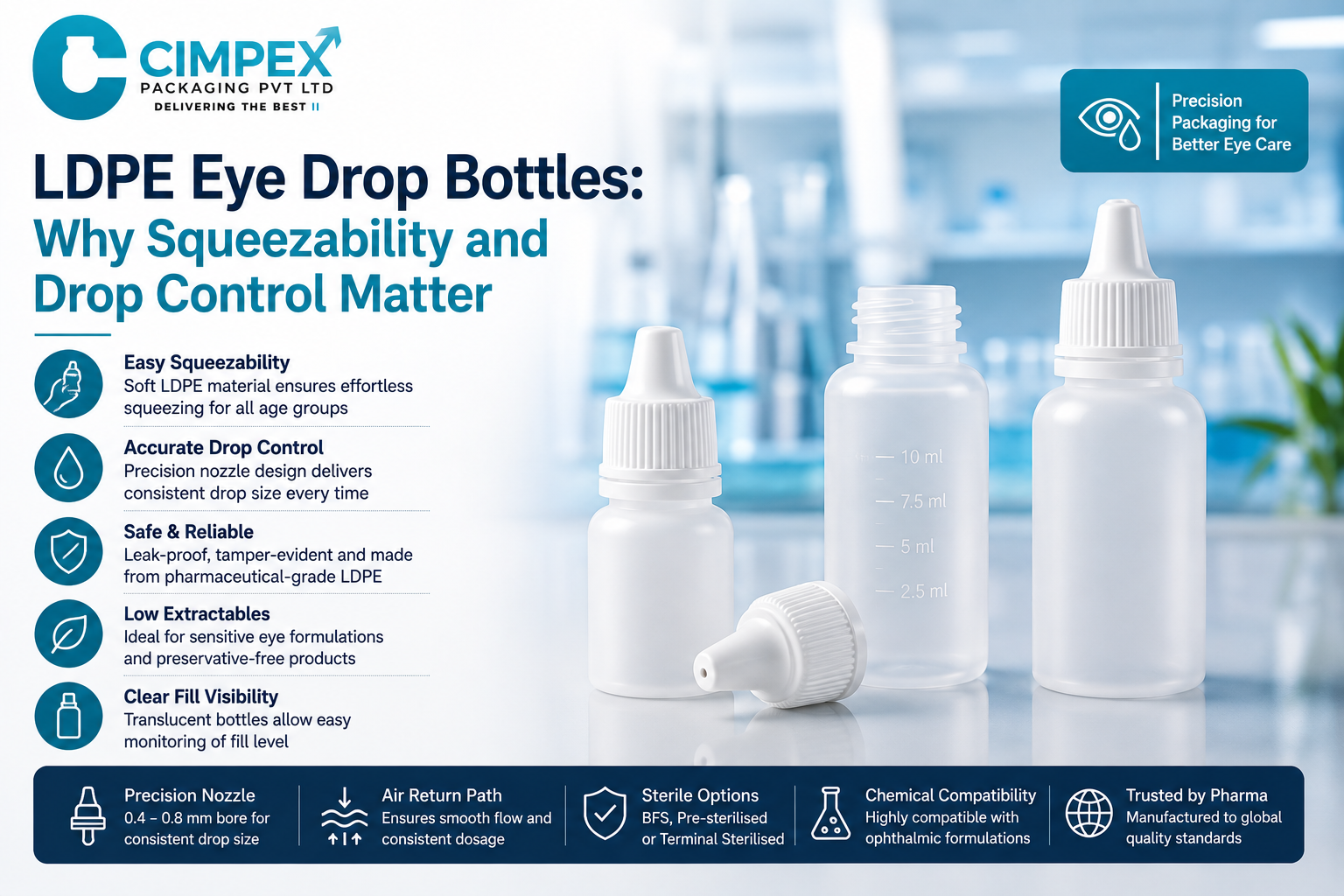
Ophthalmic products are formulated in microlitres but delivered by hand. The patient tilts their head, squeezes, and hopes one drop lands correctly. LDPE eye drop bottles dominate this application because low-density polyethylene flexes under light pressure and recovers cleanly, which is exactly what controlled dispensing needs. Our range of LDPE eye drop bottles covers the standard ophthalmic configurations.
Squeezability and drop control are not comfort features. In LDPE eye drop bottles they govern dosage accuracy, product waste, and whether an elderly patient can self-administer at all.
Why LDPE Is Commonly Used for Eye Drop Bottles
LDPE is neither the cheapest polyolefin nor the best barrier. It is chosen for how it behaves in the hand, and that is the whole case for LDPE eye drop bottles.
Flexibility and squeeze response
A low flexural modulus lets the wall deform under modest finger pressure and recover without permanent panelling. A bottle that stays dented traps air and disrupts the next dose. That recovery is why LDPE eye drop bottles outperform rigid alternatives.
Lightweight and practical
Small packs, commonly 5 ml and 10 ml, live in pockets and handbags. Light, unbreakable flexible plastic bottles suit that far better than glass.
Chemical compatibility
Polyolefins carry no plasticisers, which matters over a long shelf life. Ophthalmic LDPE is well established across pharmaceutical bottles, though compatibility must be confirmed per formulation.
Ease of manufacture
LDPE moulds cleanly, welds to itself and accepts press-fit nozzle inserts reliably, keeping assembly consistent.
Why Squeezability Matters in Eye Drop Packaging
Squeezability is the relationship between applied force and delivered volume. Too rigid, and patients with arthritis cannot generate enough force. Too soft, and a normal squeeze gives two or three drops. Both waste product; the first stops treatment.
Three factors control it:
- Wall thickness and its distribution
- Resin grade, particularly melt flow index
- Geometry, since oval sections concentrate deformation
When assessing squeeze bottles:
- Test with the real formulation, not water
- Test cold, as LDPE stiffens with age
- Include older users, not only your packaging team
- Check the bottle draws air back cleanly between doses
Well-designed LDPE eye drop bottles sit in a narrow window where a light, deliberate squeeze produces one drop, repeatably.
The Importance of Drop Control in Ophthalmic Packaging
The eye holds very little, so most of an oversized drop runs down the cheek. Two drops instead of one wastes roughly half the course.
In LDPE eye drop bottles, drop control is where bottle, nozzle and closure work as a system. The bottle supplies pressure, the nozzle forms the droplet, the closure protects the tip. Weakness anywhere shows as messy dispensing.
How Nozzle Design Influences Drop Size
The drop control nozzle is a moulded insert press-fitted into the neck. Four features do most of the work:
- Orifice diameter a smaller bore forms a smaller droplet
- Tip land a burr-free edge breaks cleanly, a flashed edge dribbles
- Air return path without a vent, the next squeeze is unpredictable
- Insertion depth a nozzle that shifts in transit alters volume
A drop control nozzle that performs perfectly with saline may behave differently with a gel or suspension.
Why Controlled Dispensing Improves User Experience
For patients, consistency removes guesswork: one squeeze gives one drop, so they stop over-applying and the course lasts as intended. For brands the gains are commercial fewer complaints, better dosage accuracy, less waste, and a pack that supports adherence.
Key Features to Look for in LDPE Eye Drop Bottles
When comparing suppliers of LDPE eye drop bottles, evaluate:
- Consistent squeezability across a batch, not a golden sample
- Reliable drop-to-drop volume with your product
- Nozzle matched to viscosity and dose
- Secure closure with dependable torque retention
- Leak resistance verified by a stated method
- Documented resin grade and traceability
- Dimensional consistency on neck finish and weight
- Compatibility of the ophthalmic LDPE grade with your formulation
- Clean manufacturing suited to pharmaceutical packaging
- Documentation supporting your regulatory route
LDPE vs Other Materials for Eye Drop Bottles
| Factor | LDPE | HDPE | PP |
| Flexibility | High | Moderate | Low |
| Squeezability | Excellent | Limited | Poor |
| Drop control | Excellent with matched nozzle | Workable | Difficult |
| Heat tolerance | Lower | Moderate | High |
| Typical use | Eye drops, dropper bottles | Tablets, powders | Hot-fill packs |
HDPE gives a better moisture barrier and more rigidity, which is why it dominates solid-dose formats; see our HDPE bottles range. Our HDPE vs PET vs PP guide works through the resin trade-offs. For dispensing, LDPE eye drop bottles remain the practical choice.
What Makes a Reliable Eye Drop Bottle Manufacturer in India?
Choosing an eye drop bottle manufacturer in India is a technical decision as much as a commercial one:
- Whether bottle, nozzle and closure come from one source
- Resin selection, and the ability to explain grade choices
- In-process quality control with documented inspection
- Dimensional consistency across long runs
- Clean areas suited to pharmaceutical work
- Customisation for capacity, nozzle and closure
- Realistic capacity and lead times
- Quality documentation and change control
Cimpex Packaging manufactures LDPE, HDPE and PP bottles, jars, caps and pumps from an ISO 9001:2015-certified facility in Baddi, supplying LDPE eye drop bottles with matched closures. Our guide on choosing an eye drop bottle manufacturer in India covers supplier evaluation further.
Sterility and Hygiene Considerations for Ophthalmic Packaging
Eye drops enter a sensitive, easily infected site. LDPE eye drop bottles are supplied clean, but clean is not sterile.
Where a sterile eye drop bottle is required, sterility comes from a validated process ethylene oxide, gamma irradiation or aseptic blow-fill-seal established for that specific product and container, never assumed from the material.
The packaging manufacturer’s contribution to a sterile eye drop bottle programme:
- Clean, controlled moulding and assembly
- Protected packing and handling
- Packaging integrity through transit
- Closure security and tip protection between doses
A sterile eye drop bottle programme is shared between supplier and filler.
Customization Options for LDPE Eye Drop Bottles
Most ophthalmic programmes adapt LDPE eye drop bottles in some way:
- Capacity, typically 5 ml to 30 ml
- Shape and grip profile, which affects squeeze feel
- Neck finish matched to your capping equipment
- Nozzle bore and geometry, set by the formulation
- Closure type, including tamper-evident options
- Colour, from natural to opaque white or amber
- Surface treatment for label adhesion
One family of LDPE eye drop bottles can then serve several products a viscous lubricant and a thin solution sharing a shell with different nozzles. Related formats such as our nasal and dropper vials use similar engineering.
Why Quality Testing Matters
Consistency, not capability, separates suppliers. Routine checks on LDPE eye drop bottles should include:
- Visual inspection for flash and nozzle defects
- Dimensional checks on neck finish, height and weight
- Leak testing with a stated acceptance level
- Closure torque, including residual torque after storage
- Drop dispensing evaluation for volume consistency
- Material verification against the declared grade
- Squeezability across the batch
- Batch-to-batch comparison over time
These checks convert supplier claims into evidence. Our manufacturing and quality process page outlines how bottles, nozzles and closures are made and inspected.
Why Pharmaceutical Companies Prefer Well-Designed LDPE Eye Drop Bottles
Well-engineered LDPE eye drop bottles reduce problems across a product’s life: easier handling, controlled dispensing, predictable squeeze response and light packaging. The pack becomes invisible in the best sense patients use it without thinking.
Looking for reliable LDPE eye drop bottles for your ophthalmic products? Connect with Cimpex Packaging to discuss specifications, dispensing requirements and packaging needs.
Final Thoughts
LDPE earns its place because it flexes predictably and recovers cleanly, giving patients real control over dosing. Squeezability decides whether a patient can dispense at all; drop control decides whether that dispense is accurate. Bottle and nozzle must be evaluated together, with the actual formulation.
The partner matters as much. A capable eye drop bottle manufacturer in India will engineer LDPE eye drop bottles around your product rather than supplying a standard tip and hoping it suits.
Frequently Asked Questions
Why are LDPE bottles used for eye drops?
LDPE flexes under light finger pressure and recovers its shape cleanly, giving consistent drop delivery. It is also lightweight, unbreakable and compatible with common ophthalmic formulations.
What makes LDPE eye drop bottles squeezable?
A low flexural modulus combined with controlled wall thickness. The panel is moulded thinner than shoulder and base, so the bottle deforms where fingers sit and recovers afterwards.
How does a drop control nozzle work?
The nozzle forms a droplet at its tip and releases it when surface tension breaks. Orifice diameter, tip geometry and the air return path together determine drop size and consistency.
Are LDPE eye drop bottles suitable for pharmaceutical products?
Yes, LDPE is widely used in ophthalmic packaging. Compatibility should still be confirmed for each formulation, with resin grade documentation requested from the manufacturer.
What should I check when selecting an eye drop bottle manufacturer in India?
Assess moulding capability, quality control, dimensional consistency, clean manufacturing, customisation options and documentation. Ask whether bottle, nozzle and closure come from one source.
How does bottle design affect drop size?
Wall thickness and geometry control how much pressure a squeeze generates, while the nozzle converts pressure into a droplet. Changing either alters delivered volume, so both need verifying.
Can LDPE eye drop bottles be customized?
Yes. Capacity, shape, neck finish, nozzle bore, closure type, colour and surface treatment can all be adapted to suit a specific ophthalmic product and its filling line.
What quality checks are important for ophthalmic bottles?
Visual inspection, dimensional verification, leak testing, closure torque, drop dispensing evaluation and material confirmation. Batch-to-batch consistency matters more than any single result.