


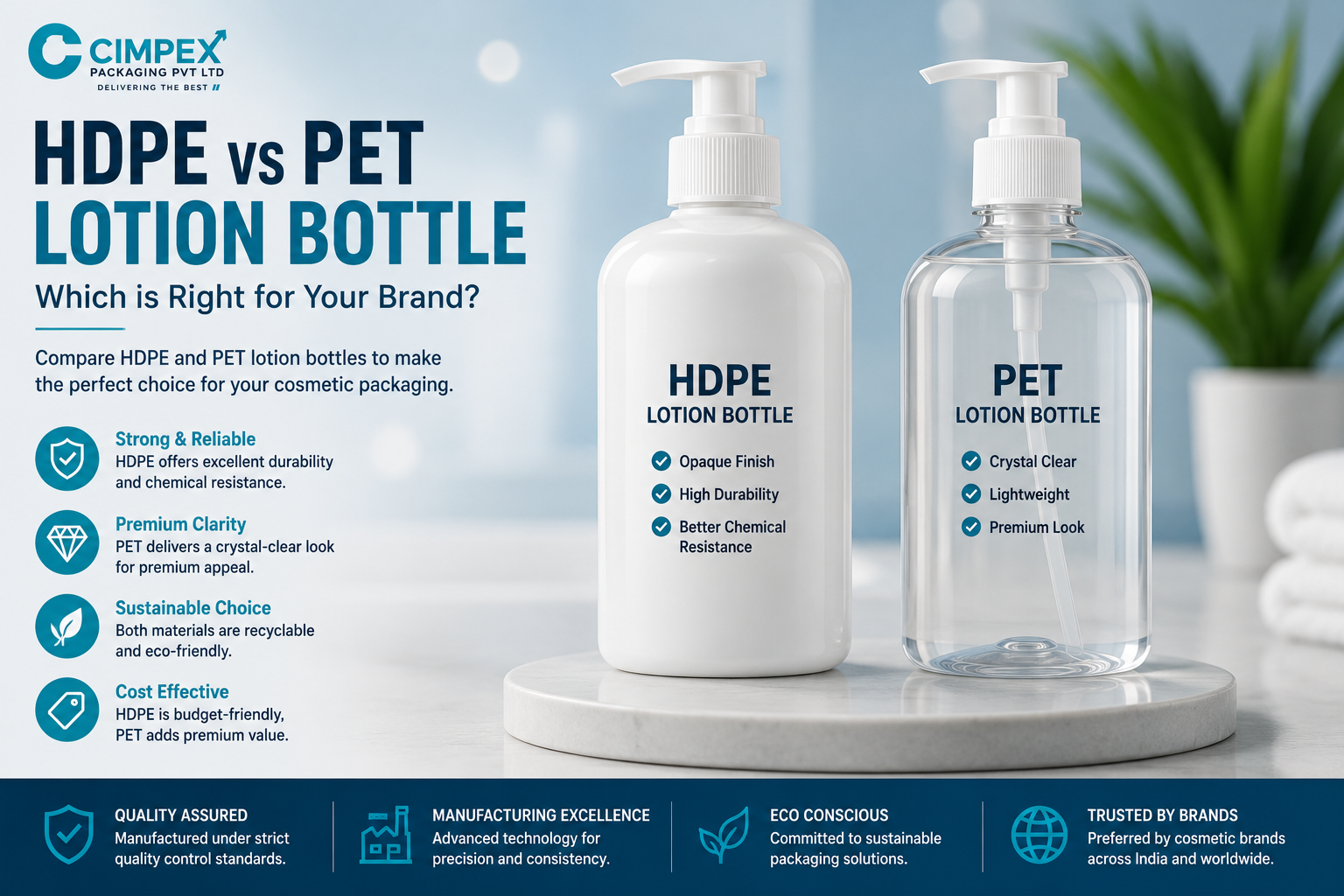
Packaging directly shapes how a cosmetic product performs, protects its formulation, and earns trust on the shelf. When a brand sources from a lotion bottle manufacturer in India, the first and most consequential material decision is whether to go with HDPE or PET. Both are widely used across body care, skincare, and personal care categories, yet they behave differently in ways that matter to filling lines, product stability, and consumer perception. Getting this choice wrong does not show up during sampling it surfaces weeks into distribution as a leakage issue, a formulation complaint, or a recall. Before comparing the two materials in detail, browse the full range of lotion bottles available from Cimpex Packaging to get a clear picture of what is available in both materials. This guide covers everything you need to make the right call for your specific product.
HDPE vs PET Lotion Bottles: A Detailed Comparison
The comparison between HDPE and PET covers several dimensions. Here is a clear breakdown of each.
Material Composition
HDPE (high-density polyethylene) is a semi-crystalline thermoplastic with tightly packed molecular chains, giving it stiffness, chemical resistance, and impact strength. PET (polyethylene terephthalate) is an amorphous thermoplastic with excellent optical clarity and dimensional stability. Both are approved for cosmetic contact applications.
Appearance
HDPE is naturally opaque and milky-white, accepting pigment uniformly across production runs. PET is naturally glass-clear the first choice when product visibility is part of the brand story. A lotion bottle manufacturer in India holds standard production tooling in both materials across popular sizes.
Strength and Durability
HDPE handles impact better across temperature ranges, making it the safer choice for export logistics involving rough handling or temperature variation. PET has strong tensile strength but requires careful wall thickness specification to avoid cracking under impact stress.
Chemical Resistance
HDPE resists essential oils, organic solvents, acids, and high-fragrance formulations reliably. PET is compatible with most cosmetic ingredients but can be affected by high-alcohol or oxidising formulations over extended shelf periods. Always run compatibility testing before committing either material to a new formula.
Moisture Protection
Both materials provide strong moisture barriers. HDPE’s denser molecular structure gives it a slight edge in humid warehouse environments, which matters for products with shelf lives of 24 months or longer. Brands targeting tropical markets or long distribution cycles should factor this in.
Sustainability
PET carries recycling code 1 and is the most widely collected plastic globally. HDPE carries recycling code 2 with equally strong collection infrastructure. Both support credible recyclability claims. Post-consumer recycled grades are available for both materials ask your cosmetic packaging supplier about recycled content options at your required production volume.
Cost Effectiveness
HDPE is generally more cost-efficient at scale lower raw material pricing and energy-efficient processing keep per-unit costs competitive for mass-market brands. PET carries a modest premium that is typically justified for prestige skincare where the aesthetic return on investment is visible at retail.
Best Product Applications
HDPE suits body lotions, hair care, baby care, and utility-grade skincare where chemical protection and durability take priority. PET suits facial serums, micellar waters, toning lotions, and transparent moisturisers where clarity and shelf presence drive consumer decisions.
Benefits of HDPE Lotion Bottles
The HDPE lotion bottle has earned its place in cosmetic packaging through consistent technical reliability. Experienced HDPE bottles manufacturers produce these in standard and custom configurations for a wide range of cosmetic applications.
- Excellent Chemical Resistance HDPE does not react with most cosmetic actives, fragrances, or botanical extracts, making it the safe default for complex formula chemistry.
- Flexible Walls for Squeeze Dispensing High-viscosity creams and thick body lotions dispense easily from HDPE bottles without requiring a pump closure, reducing packaging cost and simplifying filling.
- UV Protection Through Pigmentation Opaque pigmented HDPE naturally blocks UV light, protecting photosensitive ingredients without secondary packaging layers.
- Impact Resistance HDPE withstands drop testing and export transit without cracking or deforming, reducing damage rates across the supply chain.
- Long Shelf Life Performance The material’s dense moisture barrier makes it well-suited for products designed to remain stable over 24 months in open storage.
- Cost Efficiency at Scale Lower raw material and processing costs make HDPE the commercially rational choice for high-volume, mass-market cosmetic production.
Benefits of PET Lotion Bottles
The PET lotion bottle India cosmetic segment has grown steadily as prestige beauty and transparent skincare categories have expanded. The material’s glass-like clarity opens brand positioning possibilities that opaque HDPE cannot offer. Cimpex Packaging produces a full range of plastic bottles in PET formats for cosmetic and personal care applications.
- Crystal-Clear Appearance PET’s optical clarity lets the formulation itself become the visual hero, reinforcing purity perception and driving trial purchase.
- Premium Shelf Appeal Thin, uniform PET walls create a glass-like finish at a fraction of glass’s weight, supporting premium pricing in competitive retail environments.
- Lightweight PET reduces shipping weight without sacrificing structural performance, lowering freight cost and improving consumer portability.
- High Recyclability PET’s recycling code 1 status and global collection infrastructure make it the most credible choice for brands with formal recyclability commitments.
- Wide Decoration Options Screen printing, shrink-sleeve labelling, and hot stamping all adhere reliably to PET surfaces, supporting full-coverage brand decoration.
Choosing a Lotion Bottle Manufacturer in India
The manufacturer you partner with affects product quality as much as material selection does. A lotion bottle manufacturer in India with genuine cosmetic packaging experience will guide your brief productively asking about formulation chemistry, filling line specifications, and decoration before confirming a mould. Here is what to evaluate.
Manufacturing Experience and Capability
Look for a lotion bottle manufacturer in India with documented experience in cosmetic-grade packaging not just industrial or commodity containers. Ask for production samples, compatibility test data, and references in your product category. In-house tooling capability is a meaningful differentiator: it means design changes do not depend on third-party mould makers and lead times stay predictable.
Quality Assurance Standards
Multi-stage inspection covering incoming resin verification, in-process dimensional checks, and finished goods sampling is the baseline expectation. Ask for AQL standards applied to outgoing shipments. A lotion bottle manufacturer in India that exports to regulated markets in the US, EU, or Australia has already had these systems externally validated.
Mould Customisation and MOQ Flexibility
Brands at different growth stages need different things. Start-ups need manageable minimum order quantities and access to standard mould inventory to keep tooling costs down. Scaling brands need custom mould development with transparent lead times and ownership terms. Confirm both options are available before committing.
OEM and Private Label Support
Whether you need OEM production or white-label bottles decorated with your branding, confirm the lotion bottle manufacturer in India can handle colour matching, logo embossing, screen printing, and closure sourcing through a single manufacturing relationship.
Popular Lotion Bottle Sizes for Cosmetic Brands
Selecting the right fill volume is part of the packaging brief. Most standard sizes are available from a lotion bottle manufacturer in India without custom tooling, which reduces lead times and cost. Browse the available pump bottles to see matching closure options for each size.
- 100 ml Travel formats, trial packs, hotel amenities, and targeted facial treatments where dosing is small and daily. PET’s clarity works particularly well at this size for premium facial serums.
- 150 ml Mid-range facial moisturisers and conditioning products used sparingly. A compact size that fits bathroom shelves and travel bags comfortably.
- 200 ml lotion bottle The 200ml lotion bottle is the most versatile size in the cosmetic category. It suits everyday hand creams, body serums, and facial lotions used in daily routines, balancing fill volume with consumer convenience.
- 250 ml Body lotions and conditioning formulations applied to larger surface areas. Standard in mid-range personal care and spa collections.
- 300 ml Mass-market body care and professional salon formats where fill weight improves the value proposition without becoming unwieldy.
- 500 ml High-volume body wash, conditioning lotion, and professional formats. Also the standard for refill programmes in sustainable packaging models.
How to Select a Reliable Cosmetic Lotion Bottle Supplier
A reliable cosmetic lotion bottle supplier contributes to product success from the first development conversation through to repeat shipments. The right cosmetic lotion bottle supplier does more than fill purchase orders they prevent specification errors, reduce fill-line failures, and support compliance documentation for export markets. Key factors to evaluate include:
- Production Capacity Confirm the supplier can scale with your volume requirements without compromising batch consistency, particularly during seasonal peaks or new launch windows.
- Export Capability A cosmetic lotion bottle supplier already exporting to regulated markets has externally validated quality systems a meaningful proxy for production reliability.
- Technical Assistance The right supplier advises on neck finish selection, wall thickness, and closure compatibility before finalising a mould, not after a leakage complaint arrives.
- Timely Delivery Consistent lead times prevent launch delays. Confirm production lead times for standard repeat orders and how the supplier manages urgent requirements.
Conclusion
HDPE and PET each serve a distinct role in cosmetic packaging. HDPE delivers chemical resistance, impact durability, UV protection, and cost efficiency the right material for body care, hair care, and mass-market utility products. PET delivers optical clarity, premium aesthetics, and strong recyclability credentials the right material for prestige facial care, transparent formulas, and brand-forward beauty ranges.
The best packaging decision starts with formulation compatibility, consumer expectations, and distribution environment not material preference alone. A lotion bottle manufacturer in India with genuine cosmetic packaging expertise will help you work through all three before a mould is confirmed.
Sourcing from an experienced Indian manufacturer gives you access to modern production technology, competitive pricing, and quality systems validated across regulated export markets.
Frequently Asked Questions
1. What is the main difference between HDPE and PET lotion bottles?
HDPE is opaque, flexible, and chemically resistant best for body care. PET is crystal-clear and rigid ideal for premium facial serums and transparency-forward beauty brands.
2. Which material is better for thick cream formulations?
HDPE is preferred. Its flexible walls allow easy squeeze dispensing for high-viscosity creams, and its chemical resistance suits oil-heavy or fragrance-rich formulas well.
3. What is the most popular size for a cosmetic lotion bottle?
The 200ml lotion bottle is the most commonly sourced size, covering everyday facial lotions, hand creams, and body serums used in regular daily routines.
4. Is PET suitable for alcohol-based cosmetic formulations?
PET works for most cosmetics but can be affected by high-alcohol or oxidising formulas over time. Always run compatibility testing before committing PET to a new formulation.
5. How do I evaluate a lotion bottle manufacturer in India before ordering?
Request ISO certifications, product samples, compatibility test data, and AQL inspection standards. Confirm export track record and closure compatibility before placing a bulk order.
6. Can I get a custom bottle design from an Indian manufacturer?
Yes. Most established manufacturers offer in-house custom mould development. First-article lead times typically range from three to five weeks depending on design complexity.
7. Which lotion bottle material is more sustainable?
Both are recyclable. PET carries recycling code 1 with strong global collection infrastructure. HDPE carries code 2 with equally mature domestic collection. Both support recyclability claims.
8. What decoration options are available for cosmetic lotion bottles?
HDPE and PET bottles support screen printing, hot stamping, shrink-sleeve labelling, and pressure-sensitive labels. Custom colour matching and logo embossing are widely available.