


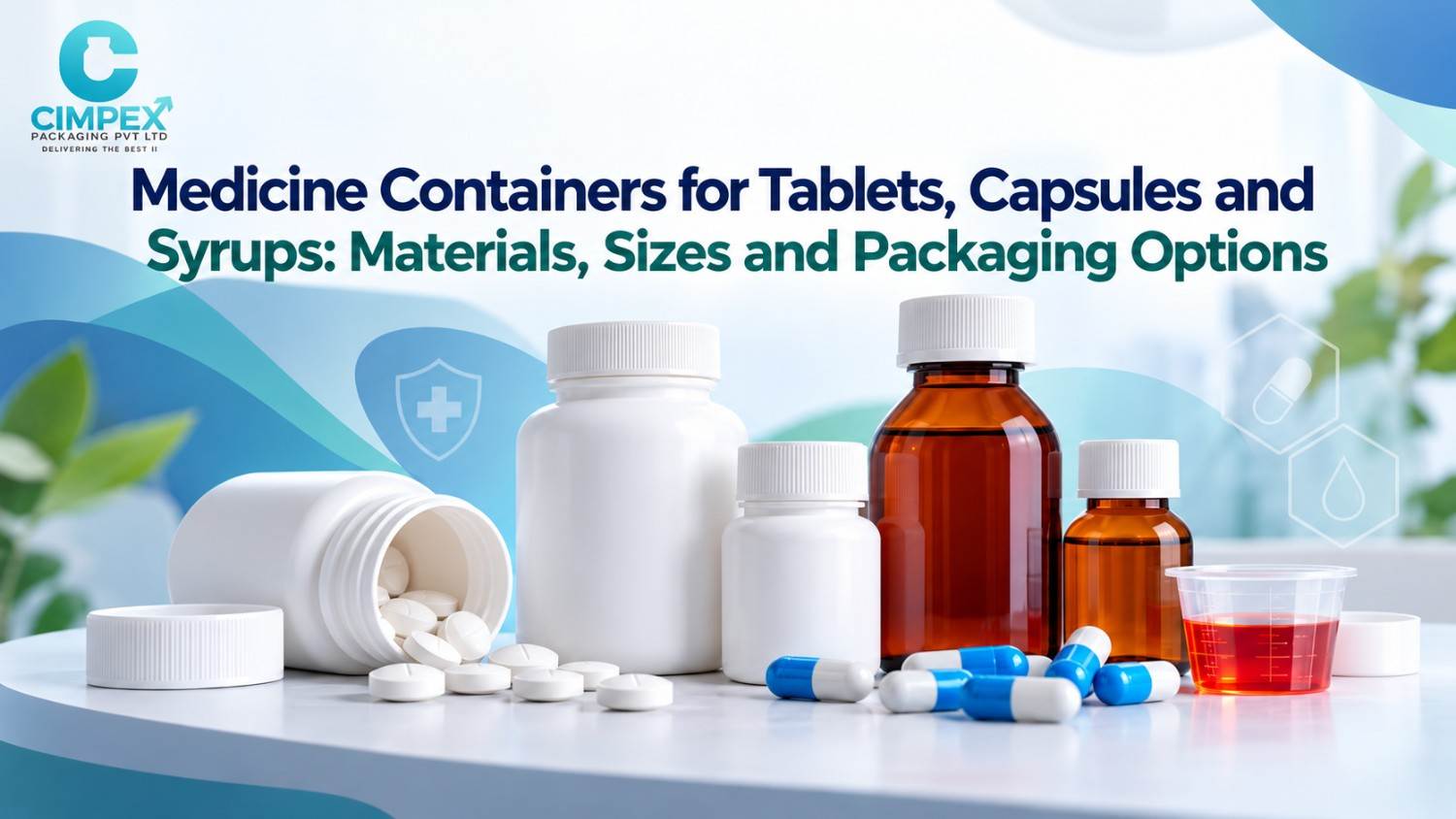
Why Medicine Containers Need More Attention Than General Packaging
Pharmaceutical products are sensitive to moisture, light, air and contamination. A container that works well for a household product may not suit a medicine, because the primary pack stays in direct contact with the formulation for its entire shelf life. For that reason, medicine containers are judged on three things: the resin they are made from, the accuracy of the neck and closure fit, and the consistency of production from one batch to the next. Packaging also supports patient safety. Clear label space, tamper-evident closures and child-resistant options, where the product or regulation calls for them, all depend on a well-designed bottle and cap system. Experienced buyers therefore treat the bottle and closure as one assembly rather than two separate purchases.Materials Used in Pharmaceutical Plastic Containers
Most pharmaceutical plastic containers are made from a small group of polymers, and each one suits a different type of product.High-Density Polyethylene (HDPE)
HDPE is widely used for solid and liquid dosage packaging because it combines moisture resistance, chemical resistance and impact strength. It is naturally translucent to opaque, which helps limit light exposure. The polymer’s properties are summarised in this overview of high-density polyethylene. In practice, HDPE medicine bottles are the standard choice for tablets, capsules and many oral liquids.Polypropylene (PP)
Polypropylene tolerates higher temperatures than HDPE and has a stiffer feel. It is common in closures, measuring caps and containers that must withstand heat during filling or sterilisation. Suitability depends on the exact grade, so confirm it with the manufacturer before committing to a design.Low-Density Polyethylene (LDPE)
LDPE is softer and more flexible. It is used where a squeezable body is useful, such as dropper-style and nasal formats, rather than for rigid tablet bottles.Key Material Selection Points
- Moisture sensitivity: hygroscopic tablets and capsules benefit from the barrier that HDPE provides.
- Light sensitivity: opaque or coloured walls reduce light exposure for photosensitive formulations.
- Chemical compatibility: liquid formulations should be tested against the resin before bulk ordering.
- Regulatory fit: confirm that the resin grade is suitable for pharmaceutical contact use before finalising a design.
Medicine Containers for Tablets and Capsules
Solid dosage forms look simple, but each has its own packaging risk.Tablet Packaging Bottles
Tablet packaging bottles are usually wide enough for easy filling and dispensing, with a neck finish that accepts a screw cap or a snap-on closure. Tablets are sensitive to humidity, so a tight cap fit and a neck suited to a liner matter as much as the bottle wall. Round, straight-sided shapes also run smoothly on counting and filling lines.Capsule Packaging Containers
Capsule packaging containers face a different risk. Capsule shells can soften or turn brittle when moisture levels shift, so a stable internal environment is essential. A wide mouth reduces breakage during filling, and smooth interior walls help prevent damage on automated lines.What to Check Before Ordering Solid-Dose Packaging
- Neck diameter and thread style, so the closure fits your capping machine.
- Wall thickness and rigidity, which affect handling during transport.
- Cap liner or seal compatibility with your product.
- Label area that is flat enough for your required text and regulatory information.
Medicine Syrup Bottles and Liquid Packaging
Medicine syrup bottles must hold liquids without leakage, resist the formulation chemically and work with a dosing aid. Typical features include a tamper-evident cap, a measuring cap or cup, and a neck shaped for a clean pour. Dosing accuracy depends heavily on the closure, which is why caps and bottles are best selected together. Light-sensitive syrups often need amber or opaque walls. When you evaluate medicine syrup bottles, ask whether the supplier can match the bottle to a specific measuring cap, because a mismatched cap can cause drips and unreliable dosing.Closures, Seals and Safety Features in Medicine Containers
A bottle is only as dependable as its closure. Medicine containers commonly use screw caps with liners, tamper-evident bands or induction-seal-ready necks, and child-resistant designs where the product or local rules require them. For tablet packaging bottles, the closure is the main defence against humidity entering after the first opening, so thread accuracy and liner choice deserve the same attention as the bottle body. Consider a simple example. A manufacturer packing moisture-sensitive tablets chooses a well-made bottle but pairs it with a loose-fitting generic cap. The product may pass early checks yet absorb moisture over months in warehouse conditions. Testing the complete bottle and closure together is what exposes this kind of weakness.How Pharmaceutical Plastic Containers Are Made and Checked
Most HDPE and PP bottles are produced by blow moulding or injection moulding, while caps and closures are injection moulded. Consistent output depends on stable resin supply, well-maintained moulds and regular in-process inspection. Responsible suppliers of pharmaceutical plastic containers verify dimensions, check for leaks and evaluate wall strength at defined intervals, then keep records so any batch can be traced. Capsule packaging containers in particular benefit from smooth interiors and clean neck finishes, because small moulding flaws can cause chipping or jammed caps during automated filling. Buyers of medicine containers should ask to see this inspection routine rather than accept a general quality statement.Understanding Plastic Medicine Bottle Sizes
Plastic medicine bottle sizes should follow the dose, the pack count and the patient’s use pattern, not just shelf appearance. A bottle that is too large wastes material and raises transport cost, while one that is too small can limit label space or complicate filling. Medicine containers are normally specified by nominal capacity, and the available range varies by manufacturer and by mould. Because of this, it is better to request the exact capacities, neck finishes and weights from the supplier than to rely on general charts. When comparing plastic medicine bottle sizes, also consider headspace, since tablets and capsules need some room for settling while liquids need space to prevent spillage on capping.Plastic Containers for Pharmaceutical Packaging: Format Comparison
Different dosage forms point to different container formats. The table below summarises the general decision logic using qualitative factors only.| Factor | Tablet and Capsule Bottles | Syrup and Liquid Bottles | Dropper and Nasal Formats |
| Typical material | HDPE or PP | HDPE, sometimes PET or PP closures | LDPE or HDPE |
| Mouth style | Wide mouth for easy filling | Narrower neck for controlled pouring | Small orifice with dispensing tip |
| Closure priority | Moisture-tight seal | Leak-proof, tamper-evident cap with dosing aid | Precise dispensing, clean seal |
| Main risk | Moisture, breakage | Leakage, dose inaccuracy | Contamination, drip control |
| Best suited for | Tablets, capsules, softgels | Syrups, suspensions, oral liquids | Drops, sprays, nasal products |
Choosing a Pharmaceutical Bottle Supplier in India
A dependable pharmaceutical bottle supplier in India does more than ship bottles. The supplier’s process control, raw material quality and communication determine whether every batch behaves the same on your filling line. As a pharmaceutical bottle supplier in India, Cimpex Packaging manufactures HDPE and PP bottles, jars and closures from its facility in Baddi, Himachal Pradesh, and works with customised sizes and bulk requirements for medicine containers of different formats.Supplier Evaluation Points
- Material traceability: ask about the resin grade used and how batches are tracked.
- Quality checks: leak testing, strength evaluation and dimensional checks should be routine, not occasional.
- Customisation: confirm whether custom bottle shapes, sizes and neck finishes are possible.
- Bulk capacity and lead time: check whether production capacity matches your forecast.
- Closure matching: a supplier that also makes caps reduces fit problems.
Common Packaging Mistakes to Avoid
- Selecting a bottle on appearance before checking closure compatibility.
- Skipping stability or compatibility testing with the actual formulation.
- Ordering the full volume before approving a sample.
- Ignoring label area and regulatory text requirements until late in the project.
- Choosing plastic containers for pharmaceutical packaging only on unit price, without comparing closure fit and testing records.
Conclusion
The best medicine containers protect the formulation, work smoothly on your filling line and make correct dosing easy for the patient. That outcome depends on a few decisions: choosing a suitable resin such as HDPE or PP, matching the neck and closure, selecting practical capacities and approving samples before bulk production. Treat the bottle and cap as one system when selecting medicine containers, test them with your actual product and choose a manufacturer that can document its quality checks. If you are sourcing medicine containers for tablet, capsule or syrup packaging, list your dosage form, required capacities and closure type before you request quotations. You can browse the range on the Cimpex Packaging website or contact the team for guidance based on your product and volume requirements.Frequently Asked Questions
Most medicine containers are made from HDPE, polypropylene or LDPE, with PET and glass used for certain products. HDPE is the most common for tablets, capsules and oral liquids because it resists moisture and impact. The right material depends on the formulation and its light and moisture sensitivity.
HDPE is usually the preferred plastic for tablet and capsule bottles because it offers a good moisture barrier, strong walls and chemical resistance. Polypropylene is also used where a stiffer body or higher heat tolerance is needed. Final selection should follow stability and compatibility testing.
Choose the size from the pack count, dose volume and available label area, then confirm headspace for filling and capping. Tablets and capsules need room to settle, while liquids need space to avoid spillage. Request exact capacities and neck finishes from the supplier before approval.
Yes, HDPE medicine bottles are widely used for oral liquids when the formulation is compatible with the resin. They resist impact and leakage when paired with a suitable cap. Always test your specific syrup against the bottle and closure before bulk production.
Check resin grade, quality testing practices, customisation options, production capacity and closure compatibility. Request samples and confirm lead times in writing. A supplier that documents its checks and answers technical questions clearly is generally the safer choice for regulated products.
Most syrup bottles benefit from a measuring cap or cup because it supports accurate dosing and reduces the need for separate dosing tools. Whether one is required depends on the product and applicable regulations. The cap should be matched to the bottle neck to prevent leakage.
Yes, many manufacturers offer custom shapes, sizes, colours and neck finishes for bulk orders. Customisation usually involves mould development, so confirm minimum quantities, sampling steps and timelines early. Share your filling line details so the design fits your equipment.