


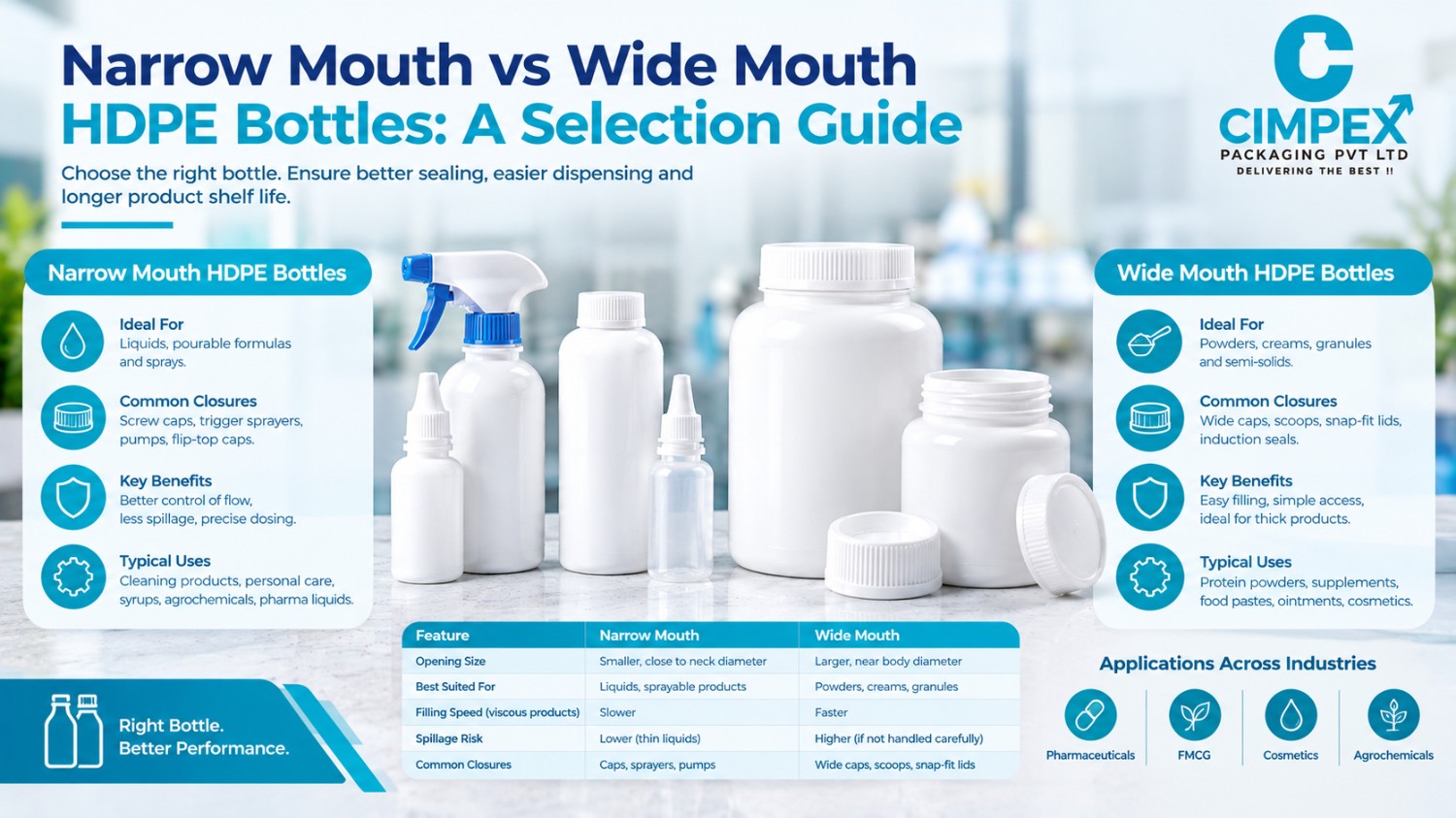
Deciding between narrow mouth vs wide mouth HDPE bottles is one of the earliest choices a brand makes when developing new packaging, and it’s a choice that’s genuinely hard to reverse once tooling and closures are finalised. The bottle’s opening size determines what closure options are available, how the product gets dispensed, and even how efficiently it fills on a production line. This guide walks through what separates the two bottle types, when each format makes sense, and the practical factors worth weighing before you commit to a neck size.
What Are HDPE Bottles?
HDPE, or high-density polyethylene, is one of the most widely used plastics in rigid packaging because it combines chemical resistance, durability, and a relatively low cost per unit. It’s approved for food contact in food-grade formulations and is commonly used across pharmaceuticals, agrochemicals, personal care, and household chemicals. Regardless of the product inside, every HDPE bottle’s mouth the opening at the top where the cap or pump attaches falls into one of two broad categories, which is exactly what the narrow mouth vs wide mouth comparison is about.
What Is a Narrow Mouth HDPE Bottle?
A narrow mouth bottle has an opening roughly the same diameter as the body of the bottle, typically fitted with a standard screw cap, a trigger sprayer, or a dispensing pump. This design is common for liquids that pour or spray easily, since a smaller opening naturally controls flow rate and reduces spillage during use. This format is the default choice for shampoos, liquid cleaners, syrups, and many pharmaceutical liquids, and it’s usually the first option considered whenever a formulation is a free-flowing liquid.
What Is a Wide Mouth HDPE Bottle?
A wide mouth hdpe bottle has a significantly larger opening relative to its body, often designed to accommodate a scoop, spatula, or simply a hand reaching in. This format suits powders, creams, granules, and thicker semi-solid products where pouring isn’t practical. Because the opening is wide, filling equipment can also work faster with viscous or particulate products, which is one reason manufacturers often prefer this format for bulk or industrial packaging. Once you understand this, the choice becomes less about preference and more about matching the container to the product’s physical state.
Narrow Mouth vs Wide Mouth HDPE Bottles: Key Differences
| Factor | Narrow Mouth Bottle | Wide Mouth HDPE Bottle |
| Typical opening size | Smaller, close to neck diameter | Larger, often near body diameter |
| Best suited for | Liquids, pourable formulas | Powders, creams, granules |
| Common closures | Screw caps, trigger sprayers, pumps | Wide caps, scoops, snap-fit lids |
| Filling speed for viscous products | Slower | Faster |
| Risk of spillage during use | Lower for thin liquids | Higher if not handled carefully |
The narrow mouth vs wide mouth decision comes down almost entirely to the physical state of the product and how the end user is expected to access it, rather than to aesthetics or brand preference alone.
How to Choose Between Narrow Mouth and Wide Mouth HDPE Bottles
Working through this decision should start with the product itself rather than the packaging aesthetic, since the wrong mouth size can genuinely frustrate the end user or slow down filling operations.
- Consider whether the product is a free-flowing liquid, a thick paste, or a dry powder this alone rules out one option in most cases.
- Think about how the customer will actually access the product: pouring, spraying, scooping, or dipping with fingers.
- Factor in your filling line’s equipment, since narrow openings often require slower, more precise dosing for viscous formulas.
- Check which closures and dispensers are compatible with each hdpe bottle neck finish before finalising bottle dimensions.
Brands that skip this step and choose a mouth size based purely on shelf appeal often end up reworking their packaging after customer complaints about spillage or difficulty dispensing a cost that’s easy to avoid by settling on the right neck size early in development.
Closure Options for HDPE Bottles
The hdpe bottle neck finish determines exactly which closures will fit, and mismatched specifications are one of the most common and most avoidable packaging errors.
Narrow Mouth Closures
Narrow mouth bottles commonly pair with continuous-thread screw caps, flip-top caps, trigger sprayers, and lotion or mist pumps. Because the neck finish is standardised across the industry (often referenced by size in millimetres, such as 20mm or 24mm), sourcing compatible closures from different suppliers is usually straightforward once you know which mouth size your product needs.
Wide Mouth Closures
Wide mouth bottles typically use press-fit lids, wide screw caps, or tamper-evident induction-sealed closures. Some formats also include a sifter or shaker insert when the product needs to be dispensed in controlled amounts despite the wide opening. As with narrow formats, the hdpe bottle neck finish on a wide mouth design must be confirmed against the chosen closure before bulk tooling is ordered.
Factors to Consider When Selecting HDPE Bottle Size and Design
- Product viscosity thin liquids favour narrow openings; thick or solid products favour wide ones, which is usually the first filter applied in any bottle-format evaluation.
- Dispensing bottle mouth requirements if the end user needs to squeeze, pump, or spray the product, the dispensing bottle mouth size has to match the pump or sprayer’s stem diameter exactly.
- Shelf presentation wide mouth bottles often photograph better for creams and cosmetics where the product itself is part of the visual appeal.
- Regulatory and labelling needs pharmaceutical and agrochemical products may require specific neck finishes for child-resistant or tamper-evident closures.
- Fill-line compatibility the dispensing bottle mouth size and shape should be checked against your existing filling and capping equipment before committing to a new mould.
Applications of Narrow and Wide Mouth HDPE Bottles
Narrow mouth bottles dominate categories like liquid detergents, personal care washes, syrups, and agrochemical concentrates, largely because these products are handled as pourable or sprayable liquids. Wide mouth formats, by contrast, are the standard answer whenever a powder vs liquid bottle decision favours powders, ointments, food pastes, or industrial greases anywhere the contents need to be scooped rather than poured. Many brands that sell both a liquid and a powdered version of the same product line end up using both formats side by side, which is a useful reminder that mouth-size choice should follow the product, not brand consistency alone. In nutraceuticals particularly, the powder vs liquid bottle question comes up constantly, since the same active ingredient is often sold in both a liquid tincture and a powdered blend.
Why HDPE Is Preferred for Many Packaging Applications
Beyond the narrow mouth vs wide mouth question, HDPE itself remains a preferred material because of its chemical resistance, impact strength, and compatibility with a wide range of neck finishes and closures. It resists cracking under stress, tolerates a broad temperature range, and is fully recyclable, which matters increasingly to brands managing sustainability commitments. Whether you need a wide mouth hdpe bottle for a thick cream or a narrow mouth bottle for a thin liquid, HDPE accommodates both formats without compromising on durability. According to the U.S. Environmental Protection Agency, HDPE is one of the plastic resins most commonly collected for recycling in municipal programs, which supports its continued use across consumer packaging regardless of which mouth size a product lands on.
Cimpex Packaging’s HDPE Bottle Range
Cimpex Packaging manufactures both narrow mouth HDPE bottles for liquids and sprays, and wide mouth HDPE jars for powders, creams, and semi-solids, with neck finishes engineered to match standard closures and dispensing pumps. Our lotion pump range is built to pair precisely with our narrow mouth bottle necks, while our measuring cups and caps support wide mouth formats that need a scoop or measuring accessory included. If you’re developing a new product and aren’t sure which format suits it, our team can review your formulation and recommend a neck size and closure combination suited to your application.
Frequently Asked Questions
What is the main difference in a narrow mouth vs wide mouth comparison?
A narrow mouth bottle has an opening close to the diameter of its body, suited to pourable or sprayable liquids, while a wide mouth hdpe bottle has a much larger opening designed for powders, creams, or scoopable products.
Can the same product be packaged in either bottle type?
Sometimes, but it depends on the product’s physical state. Thin liquids generally work poorly in wide mouth bottles because they’re harder to pour without spilling, while thick pastes or powders are difficult to dispense through a narrow opening.
How is HDPE bottle neck finish measured?
Neck finish is typically measured in millimetres across the outer diameter of the opening, alongside the thread specification, which together determine which caps, pumps, or sprayers will fit securely.
Are wide mouth HDPE bottles more expensive to produce?
Not necessarily. Cost depends more on bottle size, wall thickness, and mould complexity than on mouth width alone, though wide mouth designs sometimes require slightly more material around the opening for structural strength.
Which bottle type is better for a powder vs liquid bottle decision?
Powders are almost always packaged in wide mouth bottles for easy scooping, while liquids are packaged in narrow mouth bottles for controlled pouring or spraying. Matching mouth size to physical state avoids most dispensing complaints.
Do narrow mouth bottles work with trigger sprayers and pumps?
Yes. Narrow mouth bottles are the standard base for trigger sprayers, mist pumps, and lotion pumps, since these dispensers are designed around a narrower, more consistent dispensing bottle mouth diameter.
Can HDPE bottle designs be customised for a specific closure?
Yes. Manufacturers can develop custom neck finishes and bottle shapes to match a specific closure or branding requirement, though this typically requires a custom mould and a longer lead time than standard bottle formats, regardless of the mouth size involved.
Conclusion
The narrow mouth vs wide mouth decision isn’t a branding preference it’s a functional choice driven by the product’s physical state, how the customer will use it, and which closures need to fit. Narrow mouth bottles suit liquids that pour or spray, while wide mouth formats suit powders, creams, and anything that needs to be scooped. Getting that call right at the development stage avoids costly rework later, since neck finish and closure compatibility are difficult to change once production tooling is set.
If you’re planning packaging for a new liquid or powder product, review your formulation’s viscosity and intended dispensing method, then reach out to the Cimpex Packaging team to find the HDPE bottle format and neck finish that fits your requirements.