


Introduction
A nasal spray bottle has one job that sounds simple and isn’t: deliver the same dose, the same way, every time someone uses it. That reliability doesn’t come from the formulation alone. It comes from a bottle material that flexes predictably, resists the formula inside it, and holds up through manufacturing, shipping, and months of daily use. Finding the right nasal bottle manufacturer in India starts with getting that material choice right, and for nasal delivery, it almost always comes down to LDPE or HDPE.
Both are polyethylene, but they’re built differently at a molecular level, and that difference decides whether a bottle squeezes like it’s supposed to or sits there rigid and useless for spray dispensing. Get the material wrong and you’ll see it in dosing complaints, failed compatibility tests, or a formulation that degrades faster than expected.
Our nasal bottle lineup at Cimpex Packaging exists because of years spent testing exactly this trade-off against real pharmaceutical formulations.
This article breaks down how LDPE and HDPE actually perform in nasal delivery, walks through how these bottles get made, covers the different bottle types on the market, and gives you a practical framework for evaluating a nasal bottle manufacturer in India.
Why Nasal Bottle Selection Matters
- Patient safety
- Drug compatibility
- Accurate dosing
- Leak prevention
- Sterility
- Shelf life
- Regulatory compliance
Patient safety starts with a material that won’t shed particles or react with a formula delivered to nasal mucosa. Drug compatibility determines whether the active ingredient and preservatives stay stable in contact with the resin for the shelf life. Accurate dosing depends on the bottle behaving the same way on the thousandth squeeze as the first, a mechanical property, not a formulation one.
Leak prevention protects the product through transit and storage, especially across bulk export shipments. Sterility requirements mean both the resin and production environment need to support contamination-free manufacturing. Shelf life comes down to how well the material blocks moisture and oxygen. Regulatory compliance ties it together, since a nasal bottle manufacturer in India supplying pharma clients has to document compliance for every batch.
Nasal Bottle Manufacturer in India: LDPE vs HDPE for Nasal Delivery
Material selection sits near the top of every pharmaceutical packaging decision tree, and nasal delivery makes that especially clear. A dispensing mechanism only performs as well as the bottle wall behind it, so choosing between LDPE and HDPE is an engineering decision, not a cost exercise. A nasal bottle manufacturer in India has to weigh squeeze mechanics, barrier performance, and regulatory expectations before a single mould gets cut.
Understanding LDPE Nasal Bottles
What is LDPE?
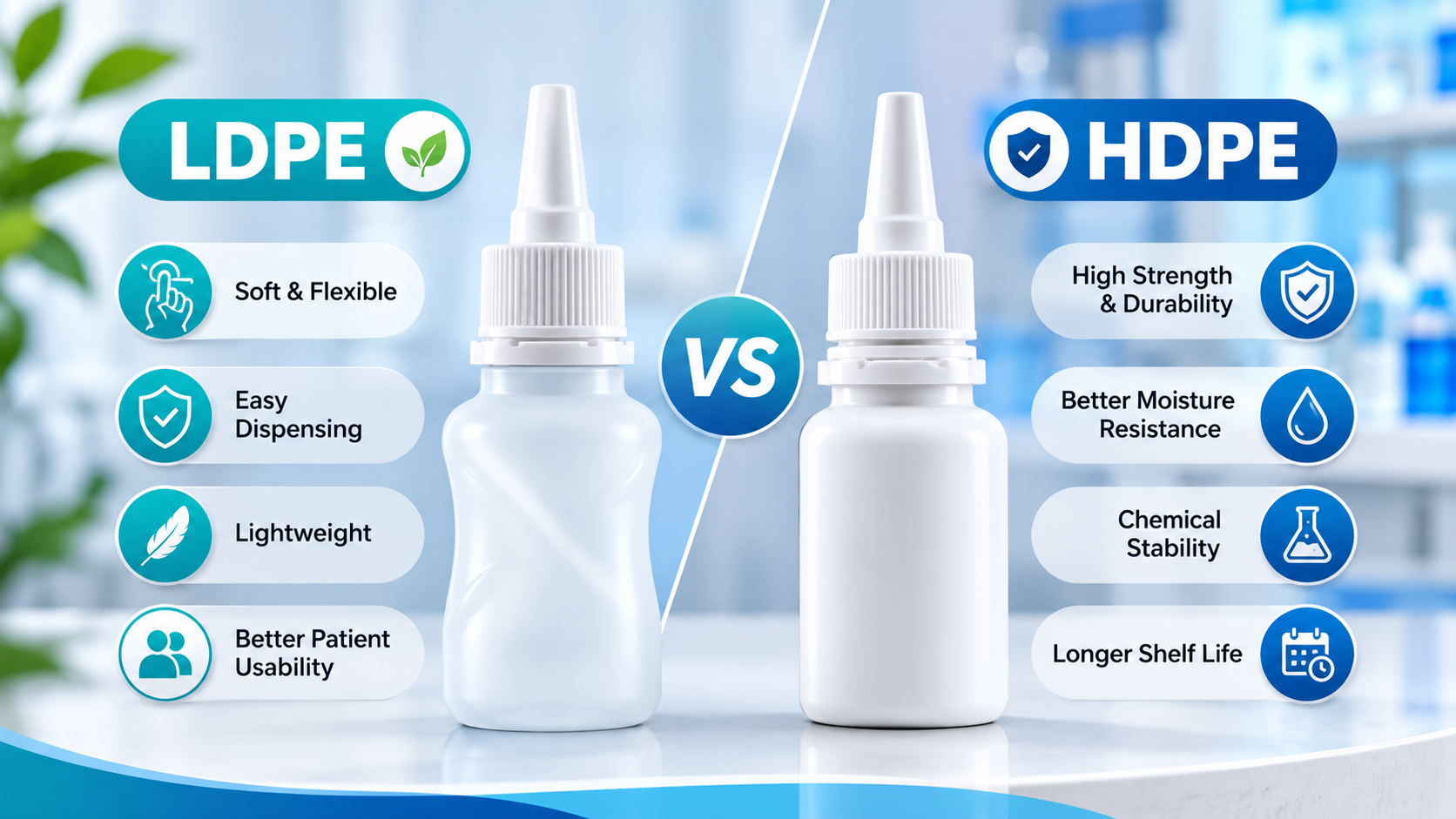
LDPE is a low-density polyethylene with a branched polymer structure that keeps the chains loosely arranged, which is why it behaves so differently from denser plastics. That loose structure gives LDPE its flexibility and squeezability, letting it compress under hand pressure and spring back afterward. Pharmaceutical-grade LDPE, produced without the additive packages used in industrial plastic, is what makes LDPE nasal pharma bottle production suitable for drug contact.
Advantages of LDPE Nasal Bottles
Easy dispensing is the headline benefit: squeeze pressure translates directly into spray or drop output without requiring unusual hand strength. Soft bottle design means the wall gives way smoothly rather than cracking, which matters across thousands of use cycles. Excellent patient usability follows from that same softness, since one-handed operation works even for someone who’s congested.
Lightweight construction keeps freight costs down on large orders, and cost effectiveness rounds it out: LDPE processes efficiently on standard blow moulding equipment without needing specialized tooling for typical shapes.
Limitations of LDPE
Lower rigidity means LDPE isn’t suited to larger bulk containers, where the bottle needs to hold its own shape rather than flex. Temperature limitations matter too, since LDPE has a lower melting point than HDPE and can deform under sterilization methods that rely on high heat. Oxygen permeability runs higher than HDPE, which can shorten shelf life for oxidation-sensitive formulations. Structural limitations show up mainly in larger formats, not the small bottles LDPE is built for.
Understanding HDPE Nasal Bottles
What is HDPE?
HDPE has a mostly linear, tightly packed molecular structure, which is where its strength and rigidity come from compared to LDPE. Moisture resistance and chemical resistance both improve as a result of that density. In nasal packaging, HDPE tends to show up in bulk saline containers and secondary packaging more than in primary spray bottles.
Advantages of HDPE Bottles
Higher durability means HDPE containers tolerate rough handling, warehouse stacking, and repeated use without deforming. Better impact resistance protects bulk containers during transit. Improved barrier properties keep moisture and oxygen out more effectively than LDPE, extending shelf life for sensitive formulations, and longer shelf life follows naturally from that barrier performance.
Limitations of HDPE
HDPE’s rigidity is precisely why it doesn’t work for squeeze-spray or squeeze-drop nasal bottles; the wall won’t compress and release the way the mechanism demands. It’s also more opaque than LDPE, limiting at-a-glance inspection unless a translucent grade is used.
LDPE vs HDPE: Complete Comparison for Nasal Delivery
Here’s how the two materials actually compare once you move past the basic properties.
Flexibility
LDPE flexes on demand and recovers its shape; HDPE resists deformation entirely, which is why the two serve completely different bottle formats.
Chemical Resistance
Both hold up well against typical nasal formulations, though HDPE has a slight edge with more aggressive, solvent-heavy actives.
Moisture Barrier
HDPE blocks moisture and oxygen more effectively, an advantage for formulations that need protection over a longer shelf life.
Patient Convenience
LDPE wins decisively for squeeze-dispensed products, since one-handed operation depends entirely on the material’s give.
Shelf Life
HDPE containers often support longer stability windows, while LDPE performs reliably within typical 12 to 24 month ranges.
Drug Compatibility
Both are broadly compatible with standard nasal formulations, though compatibility testing against your specific formula still matters regardless of material.
Manufacturing Cost
Costs are comparable for standard shapes, with HDPE holding a slight efficiency edge at very high production volumes.
Recyclability
HDPE carries resin code 2 and sees broader recycling acceptance than LDPE’s resin code 4, though both are technically recyclable.
Best Pharmaceutical Applications
LDPE suits sprays and drops that rely on squeeze dispensing; HDPE suits bulk rinses and secondary containers that need rigidity instead.
Types of Nasal Bottles Available
Nasal Spray Bottles
These pair an LDPE bottle body with a metering spray pump to deliver a fine mist, the most common nasal delivery format on the market. A nasal spray bottle manufacturer validates spray pattern against the formulation’s viscosity before finalizing a design.
Nasal Drop Bottles
Drop bottles use a narrower tip and gentler squeeze pressure to release individual drops, similar to our eye and nasal drop bottle formats. A dependable nasal drop bottle supplier tests drop volume consistency across a full batch, not just a handful of samples.
10ml Nasal Bottles
The 10ml nasal bottle is among the most frequently ordered sizes, holding enough product for several weeks of use while staying compact for a bag or cabinet.
Metered Dose Nasal Bottles
These use a calibrated valve that delivers a fixed volume regardless of squeeze force, which matters for prescription products where dosing precision is a regulatory requirement.
How Nasal Bottles Are Manufactured
Raw Material Selection
Manufacturing starts with pharmaceutical-grade LDPE or HDPE resin, checked for purity, since minor contamination can compromise a nasal formulation.
Blow Moulding
Heated resin is shaped inside a mould cavity under air pressure, part of our manufacturing process, forming the bottle to the wall thickness that determines its flex or rigidity.
Bottle Inspection
Newly formed bottles get checked for dimensional accuracy and surface defects before moving further down the line.
Sterilization
Bottles undergo sterilization appropriate to their intended use, whether gamma irradiation, ethylene oxide treatment, or validated cleanroom handling.
Leak Testing
Every batch undergoes pressure testing to catch seal or threading defects before bottles reach a pharmaceutical filling line.
Packaging
Finished bottles are counted, boxed, and palletized, with batch traceability documentation accompanying every shipment.
Industries That Use Nasal Bottles
- Pharmaceutical companies need validated, compliant packaging for prescription and OTC nasal products under regulatory approval.
- Hospitals rely on bulk and unit-dose nasal packaging, drawing from our product range, for consistent patient care across departments.
- Healthcare institutions beyond hospitals, including clinics, need similarly dependable dispensing formats.
- Contract manufacturing organizations require adaptable packaging specs across multiple client formulations.
- Medical distributors need consistent packaging quality across large-volume procurement.
How to Choose the Right Nasal Bottle Manufacturer
- Manufacturing experience specifically in pharmaceutical nasal packaging catches problems generic bottle suppliers typically miss.
- GMP compliance needs documentation, not just a claim made during a sales conversation.
- ISO certification, particularly for primary pharmaceutical packaging, signals an audited quality system.
- Material quality should be verified through certificates of analysis for every resin batch.
- Custom mould development lets a supplier match squeeze force and nozzle design to your formulation.
- Production capacity needs to genuinely match your launch volume without straining existing commitments.
- Quality testing should include leak and dose-accuracy validation, not just a visual check.
- Technical support during compatibility testing saves significant time during development.
- Export capability matters if you’re shipping internationally, since documentation shifts by market.
Common Mistakes Buyers Should Avoid
- Choosing only based on cost often means absorbing higher rejection rates later; weigh total cost against performance.
- Ignoring material compatibility risks discovering a stability problem after production has scaled up.
- Overlooking regulatory certifications can block market approval entirely; verify GMP and ISO documentation upfront.
- Selecting the wrong bottle size wastes product or creates an inconvenient dispensing experience.
- Ignoring dispensing accuracy means skipping squeeze-force validation against your formulation’s viscosity.
- Not evaluating supplier capabilities, like in-house tooling or cleanroom facilities, causes delays later.
Choosing the Right Packaging Partner for Better Pharmaceutical Performance
There’s no single correct answer between LDPE and HDPE, only the right answer for your specific delivery mechanism. LDPE earns its place in spray and drop bottles because it squeezes reliably; HDPE earns its place in bulk and rinse formats because it holds its shape and blocks moisture better.
Working with an experienced nasal bottle manufacturer in India means this decision gets made around your actual formulation, not a default resin choice. Get the material right before tooling begins, and the rest of manufacturing becomes far more predictable.
Ready to manufacture pharmaceutical nasal bottles built around your exact formulation? Contact Cimpex Packaging for LDPE and HDPE nasal packaging engineered to pharmaceutical standards, with customization and reliable bulk manufacturing built into every order.
Frequently Asked Questions
Which material is better for nasal bottles, LDPE or HDPE?
LDPE suits squeeze-spray and squeeze-drop nasal bottles best, while HDPE fits bulk or rinse formats that need rigidity and a stronger moisture barrier.
Why is LDPE commonly used for nasal spray bottles?
LDPE’s flexible structure compresses and recovers reliably, which is exactly the behavior a nasal spray bottle manufacturer needs for consistent dosing.
What are the benefits of HDPE nasal bottles?
HDPE offers superior durability, better impact resistance, and a stronger moisture barrier, making it well suited to bulk saline and rinse formats.
What sizes are available for nasal bottles?
Sizes typically range from 5ml to 30ml, with the 10ml nasal bottle among the most frequently ordered for standard multi-week use.
Are nasal bottles recyclable?
Yes, both LDPE and HDPE are recyclable, carrying resin codes 4 and 2 respectively, though HDPE sees broader recycling program acceptance.
How are nasal bottles manufactured?
Manufacturing involves medical-grade resin selection, blow moulding, inspection, sterilization, leak testing, and documented packaging before shipment.
What certifications should a nasal bottle manufacturer have?
Look for GMP compliance, ISO certification for pharmaceutical packaging, and documented batch traceability across every production run.
How do I choose a reliable nasal bottle manufacturer in India?
Evaluate pharmaceutical experience, certifications, cleanroom capability, and dispensing validation before selecting a nasal bottle manufacturer in India.