


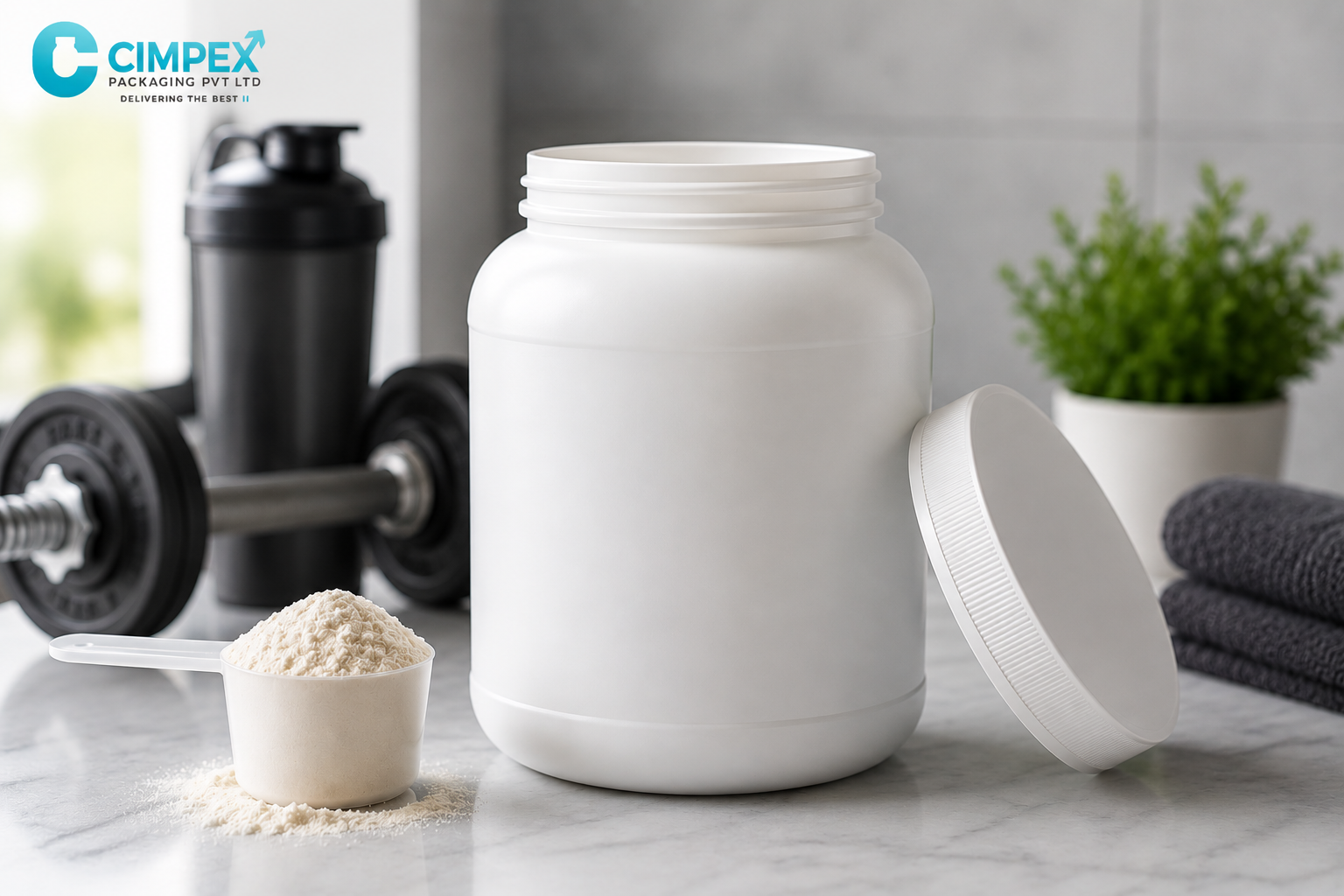
Supplement packaging is not a secondary decision — it is part of the product itself. A container that fails to protect its contents from moisture, light, or contamination undermines the formulation inside, regardless of how good that formulation is. For brands in the health and wellness space, choosing the right nutraceutical jar manufacturer is one of the most important sourcing decisions they make. Wide-mouth jars have become the dominant format across protein powders, capsules, gummies, and pre-workout blends because they solve a real practical problem: easy filling, easy scooping, and reliable sealing in a single package. Before diving into the material and size decision, take a look at the full range of nutraceutical jars available from Cimpex Packaging. This guide covers what to look for in a nutraceutical jar manufacturer and how to match jar specifications to your specific supplement product.
Why Packaging Matters in the Nutraceutical Industry
Every supplement product — whether it is a whey protein blend, a multivitamin capsule, or a creatine powder — depends on its container to arrive at the consumer in the same condition it left the manufacturing facility. An experienced nutraceutical jar manufacturer understands that the container is part of the product’s efficacy, not just its presentation.
Protecting Product Quality
Active ingredients in supplements are sensitive to oxygen, moisture, and UV exposure. A jar that does not hold an adequate seal allows environmental ingress that degrades protein structure, oxidises lipids, or reduces the potency of moisture-sensitive vitamins. Food-grade HDPE jars with induction-sealed liners address this problem at a material level.
Maintaining Freshness
Powdered supplements clump, cake, and degrade in quality when exposed to humidity. The right nutraceutical jar manufacturer builds moisture resistance into the container wall material and pairs it with a liner or desiccant-compatible closure that maintains a stable internal atmosphere throughout the product’s shelf life.
Building Consumer Trust
Tamper-evident banding, induction seals, and clean surface finishes communicate to the end consumer that a product has been handled responsibly. A jar that arrives damaged, discoloured, or improperly sealed creates a returns issue and a brand reputation problem that is difficult to recover from.
What Are Wide-Mouth Jars?
Wide-mouth jars are containers with a large-diameter neck opening — typically spanning the majority of the jar’s body diameter — that allows unobstructed access to the contents. They are the standard format chosen by any experienced nutraceutical jar manufacturer for powdered, granular, and solid supplement products. Browse the related range of HDPE jars for a practical sense of the available configurations.
Design Features
Wide-mouth jars are injection-moulded or blow-moulded in food-grade HDPE or PP, with a flat or slightly domed lid that threads onto a standardised neck finish. Wall thickness is specified to balance structural strength with material efficiency — heavier walls for large-format jars, lighter walls for smaller unit sizes. Most designs incorporate a stacking ledge for warehouse and retail shelving.
Ease of Filling and Scooping
Automated filling lines require a jar opening wide enough to accommodate filling nozzles without spillage. For consumer use, a wide-mouth opening allows easy scoop access to powders and granules without tipping or tunnelling through the product. Any nutraceutical jar manufacturer designing for high-volume supplement production must account for both filling-line and end-user access requirements.
Applications in Supplements
Wide-mouth jars are the standard format for protein powders, mass gainers, pre-workout blends, creatine, BCAAs, multivitamin tablets, capsules, and gummy supplements. The format works across product types because the wide opening accommodates both the filling nozzle and the consumer’s scoop, and the wide-base footprint provides stability on retail shelves.
Benefits of Wide-Mouth Nutraceutical Jars
Wide-mouth jars from an established nutraceutical jar manufacturer deliver a combination of practical and commercial advantages that make them the preferred format across the supplement industry.
- Easy Access A wide opening allows consumers to scoop the full product without struggling to reach the bottom of the container — a common complaint with narrow-neck designs. This matters particularly for 1 kg and 2 kg formats where the product level drops significantly during use.
- Excellent Sealing Wide-mouth closures paired with induction seals or foam liners create a reliable barrier against oxygen and moisture ingress. A nutraceutical jar manufacturer with in-house closure production can test the seal system against the specific formulation before bulk production begins.
- Moisture Resistance Food-grade HDPE has a strong moisture vapour transmission rate (MVTR), keeping hygroscopic powders like creatine and pre-workout blends from absorbing ambient humidity during storage and distribution.
- Food-Grade Materials All supplement jars must be made from food-grade or food-contact approved resins. A credible nutraceutical jar manufacturer will supply material certificates confirming resin grade and compliance with applicable contact material regulations.
- High Durability HDPE withstands physical stress during warehousing and transit without deforming or cracking, which is particularly relevant for export shipments covering long distances or multiple handling points.
- Stackability A flat-lid design with a recessed base allows stable stacking in warehouse racking and on retail shelves, reducing storage space requirements and improving pallet density for freight efficiency.
Popular Applications of Nutraceutical Jars
Wide-mouth nutraceutical jars serve a broad product range across sports nutrition, general wellness, and clinical supplement categories.
- Protein Powder Protein blends — including whey, casein, plant-based, and egg-white protein — are the highest-volume application for wide-mouth supplement jars. Fill weights typically range from 500 g to 2 kg.
- Whey Protein Container The whey protein container is the single most common application for large-format nutraceutical jars. A 1 kg or 2 kg wide-mouth jar with a tamper-evident closure and induction seal is the accepted standard across most sports nutrition brands.
- Mass Gainers High-carbohydrate mass gainers have bulky, low-density powder profiles that require large-diameter jars to accommodate the serving scoop and keep the fill level manageable for the consumer.
- Pre-Workout and BCAA Finely milled, often coloured pre-workout and BCAA powders benefit from wide-mouth formats that prevent static cling and allow even scooping without leaving powder residue on narrow-neck closures.
- Creatine Creatine monohydrate and creatine blends are highly hygroscopic and require strong moisture-barrier jars. A wide-mouth format with an induction-sealed liner is the standard choice for protecting product quality.
- Multivitamins and Capsules Tablet and capsule products use wide-mouth jars for easy counting access and compatibility with automatic counting and filling equipment. Child-resistant closures are commonly paired with supplement jars in this category.
How to Choose the Right Supplement Jar
Selecting the right jar for your supplement product involves more variables than jar size alone. The following factors should be confirmed with your nutraceutical jar manufacturer before tooling or bulk orders are finalised. The measuring scoops available from Cimpex Packaging are also worth reviewing alongside jar selection to ensure scoop-to-opening compatibility.
- Product Type Powders, capsules, tablets, and gummies each have different filling requirements and different closure needs. Confirm that the jar design is compatible with your filling equipment and your product’s physical form before finalising a specification.
- Jar Capacity Capacity selection depends on standard serving sizes and the number of servings per unit. A 30-serving protein tub at 30 g per serving requires a minimum 900 ml volume; specify accordingly with your nutraceutical jar manufacturer.
- Closure Type Wide-mouth jars can be paired with standard screw caps, child-resistant caps, or snap-top lids depending on the product category and target market. Confirm regulatory requirements for your market before specifying a closure type.
- Food-Grade Materials Only food-contact approved HDPE or PP should be used for supplement packaging. Request material certificates and compliance documentation from your nutraceutical jar manufacturer before approving a sample.
- Moisture Barrier Check the material’s MVTR specification against your product’s moisture sensitivity and intended shelf life. For hygroscopic products, specify a thicker wall or add a desiccant sachet compatible with the closure.
- Tamper-Evident Sealing Induction seals and shrink bands both provide tamper evidence. Induction sealing requires an induction-compatible liner and sealing equipment at the filling stage — confirm this capability before selecting it.
- Labelling Area Specify the label panel dimensions and surface finish (natural, white, or custom colour) early in the design process. Curved surfaces require label adhesives that maintain adhesion across temperature cycles.
- Shipping Durability For export shipments, specify drop-test and compression-test data for the jar design at full fill weight. A nutraceutical jar manufacturer with export experience will typically have this data available for standard designs.
Popular Nutraceutical Jar Sizes
Jar capacity selection is closely linked to serving size, serving count, and retail price point. Most nutraceutical jar manufacturers offer standard tooling across these volumes.
- 250 g Trial and sample sizes for new product launches, gym sampling programmes, and premium small-batch supplements where a lower entry price point supports first-purchase conversion.
- 500 g Mid-range format for 15–25 serving products. Common for BCAAs, creatine, and pre-workout blends where serving sizes are 5–20 g per dose.
- 750 g Bridge format between 500 g and 1 kg, used when serving count or scoop size creates an awkward fill for a standard 1 kg container.
- 1 kg nutraceutical jar The 1kg nutraceutical jar is the most widely recognised format in the sports nutrition category. It suits 25–33 serving protein powders at standard serving sizes and is the benchmark size for most whey protein container ranges.
- 2 kg Value-size format for committed users. Common in mass gainer categories where serving sizes are 75–100 g and consumer frequency is high.
- 5 kg Institutional and professional format for gyms, sports academies, and bulk buyers. Requires reinforced walls and a strong handle or grip feature for safe consumer handling.
How a Nutraceutical Jar Manufacturer Supports Private Label Brands
Private label supplement brands occupy one of the fastest-growing segments in the health and wellness market, and the right nutraceutical jar manufacturer plays a direct role in how quickly those brands can launch, scale, and compete at retail. Beyond producing a container, an experienced nutraceutical jar manufacturer provides the technical and commercial infrastructure that private label companies rely on throughout the product lifecycle.
Custom Mould Development for Brand-Specific Designs
A nutraceutical jar manufacturer with in-house tooling capability can develop custom jar shapes, embossed logos, and brand-specific neck finishes that standard catalogue jars cannot deliver. In-house mould development means design iterations happen faster and tooling ownership stays with the brand, reducing cost and timeline risk compared to outsourcing mould work to a third party. Most established nutraceutical jar manufacturers can take a brief from sketch to first article in three to five weeks for standard design complexity.
Custom colours, silkscreen printing, and label-surface finishing are typically available from the same nutraceutical jar manufacturer as part of a single OEM relationship. Consolidating bottle and decoration through one supplier reduces coordination overhead and makes it easier to maintain consistency across multiple SKUs in a supplement range.
OEM Production and Compliance Documentation
For private label brands entering regulated domestic or export markets, the compliance documentation package from a nutraceutical jar manufacturer is as important as the jar itself. Material certificates confirming food-contact resin grade, batch quality records, and AQL inspection reports are all documentation that distributors, retail buyers, and third-party auditors routinely request before approving a new supplement packaging supplier.
A nutraceutical jar manufacturer with established export capability to markets in the US, EU, or Southeast Asia will already have these systems in place. Brands sourcing for the first time benefit from this infrastructure immediately rather than having to build it from scratch with a manufacturer who has never supplied outside the domestic market.
Conclusion
Wide-mouth nutraceutical jars deliver the combination of product protection, consumer convenience, and brand presentation that supplement products require. HDPE food-grade construction, paired with the right closure and liner system, keeps moisture-sensitive powders stable throughout their shelf life and distribution journey.
Choosing the right jar size — from trial-size 250 g formats to value-size 2 kg containers — is a function of your serving size, serving count, and target consumer. A nutraceutical jar manufacturer with genuine food-grade packaging expertise will help you match all three to a production specification that performs reliably at scale.
Sourcing from an experienced manufacturer gives your brand access to modern production technology, documented quality systems, and the material compliance records that domestic and export markets increasingly require.
Frequently Asked Questions
1. What material is used for nutraceutical jars?
Food-grade HDPE and PP are the standard materials for nutraceutical jars. Both provide strong moisture barriers and are approved for food-contact supplement packaging.
2. What is the most popular size for a whey protein container?
The 1kg nutraceutical jar is the most widely used size for whey protein. It accommodates 25–33 standard servings and is the benchmark format in sports nutrition.
3. How do I verify that a supplement jar India supplier meets food-grade standards?
Request ISO 9001 certification, food-contact material certificates, and batch COAs. Export-capable manufacturers will have these documents readily available.
4. Can a protein powder jar manufacturer supply custom colours and logos?
Yes. Most established protein powder jar manufacturers offer custom colour matching, logo embossing, and silkscreen printing for OEM and private-label supplement brands.
5. What closure type is recommended for protein powder jars?
Wide-mouth screw caps paired with induction-sealed liners are the standard. They provide tamper evidence and a moisture-tight seal compatible with powder filling lines.
6. How is a nutraceutical jar manufactured?
Wide-mouth nutraceutical jars are typically produced by injection moulding or blow moulding food-grade HDPE. The lid is separately injection-moulded and paired to a matching neck finish.
7. What sizes does Cimpex Packaging offer for nutraceutical jars?
Cimpex Packaging produces wide-mouth nutraceutical jars from 250 g to 5 kg in food-grade HDPE, with custom mould development available for unique capacity requirements.
8. Is induction sealing required for all supplement jars?
Induction sealing is strongly recommended for moisture-sensitive products like protein powders and creatine. It provides a tamper-evident, airtight seal that foam liners alone do not match.