


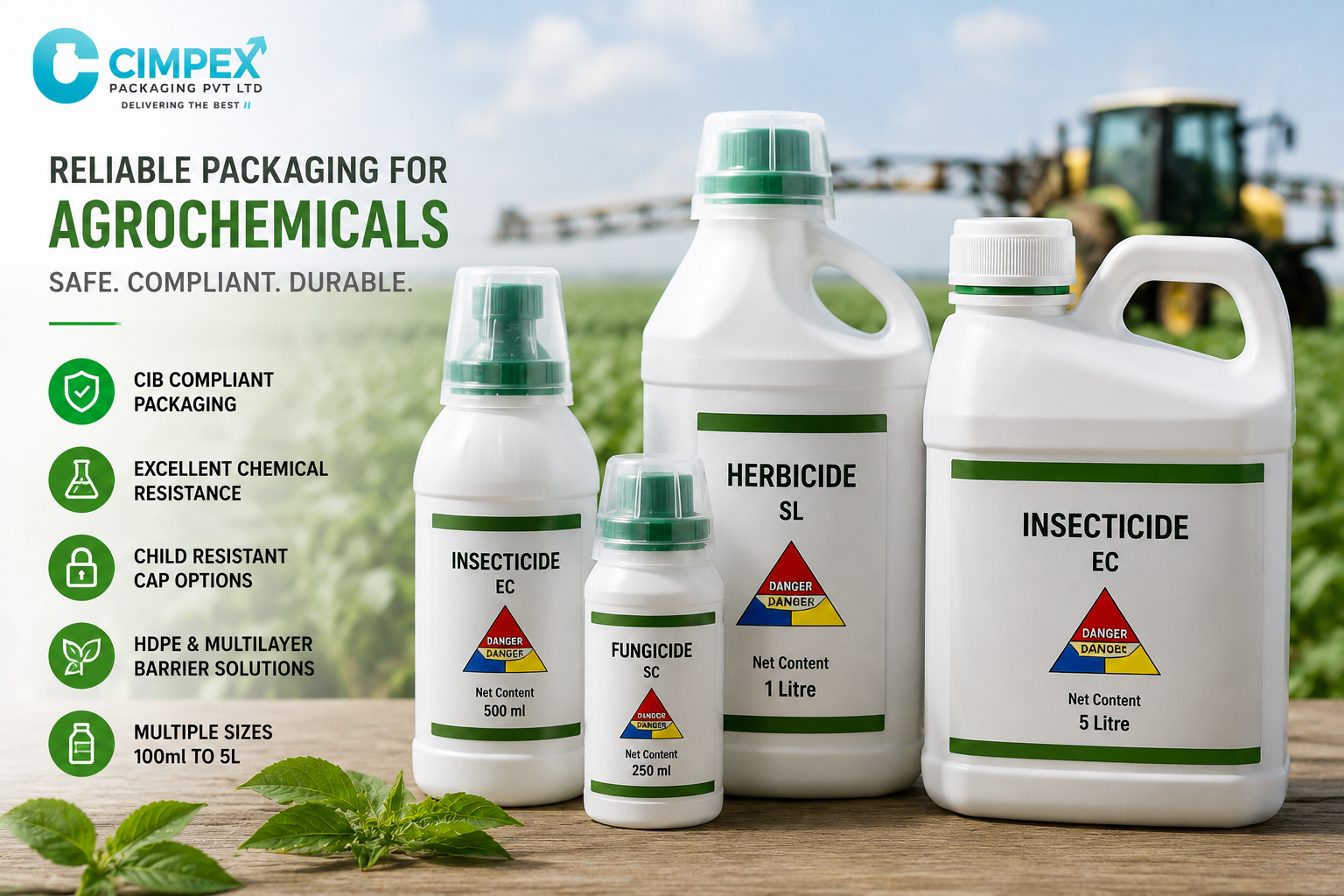
Selecting the right pesticide bottle manufacturer in India is not simply a procurement exercise it is a regulatory and safety obligation. Pesticide and agrochemical formulations are classified as hazardous materials under the Insecticides Act, 1968, and the containers that hold them must meet specific chemical resistance, structural integrity, and labelling standards before they can legally enter the Indian market. For procurement teams at crop protection companies, getting the packaging specification wrong creates compliance risk, product liability exposure, and potential supply disruption. Browse the complete range of pesticide bottles from Cimpex Packaging to understand what CIB-aligned production looks like in practice. This guide explains exactly what to look for in a pesticide bottle manufacturer in India, from material grade and chemical resistance to CIB compliance requirements and the most commonly sourced bottle sizes.
Why Quality Pesticide Packaging Matters
Pesticide formulations whether emulsifiable concentrates, suspension concentrates, wettable powders, or water-soluble liquids place significant chemical stress on their containers. A pesticide bottle manufacturer in India who understands formulation chemistry will specify the right resin grade, wall thickness, and closure system from the outset, rather than discovering compatibility issues after a product is already in the field.
Protecting Agrochemical Formulations
Active ingredients in crop protection products can degrade when they interact with reactive plastics. Solvent-based formulations, in particular, can cause plasticiser migration or stress cracking in under-specified containers. Food-grade or industrial-grade HDPE with the correct melt flow index resists these interactions reliably across the intended shelf life.
Ensuring Safe Storage and Transportation
Agrochemical containers are subject to stacking loads in warehouses, temperature variation in transit, and repeated handling at distribution points. A container that develops a stress crack under compression or a cap that leaks under pressure creates a spillage hazard that carries significant liability for both the agrochemical company and the pesticide bottle manufacturer in India responsible for the packaging.
Regulatory Compliance for Agrochemical Packaging
The Central Insecticides Board and Registration Committee (CIB & RC) governs pesticide packaging standards in India. Pesticide containers must meet specific requirements for construction, capacity marking, closure design, tamper evidence, and labelling before registration is granted. A pesticide bottle manufacturer in India operating outside these requirements puts its customers’ product registrations at direct risk.
Understanding CIB Compliance for Pesticide Bottles
CIB compliance is the baseline requirement for any pesticide bottle manufacturer in India supplying to the regulated agrochemical market. Non-compliant packaging can result in registration rejection, market withdrawal, or regulatory action against the brand. View HDPE & PP bottles from Cimpex Packaging to see production-grade examples aligned with Indian agrochemical packaging requirements.
What is CIB Compliance?
The Central Insecticides Board sets material, construction, and marking requirements for pesticide packaging under the Insecticides Act. A CIB compliant bottle must be manufactured from approved materials, hold the formulation without degradation or leakage, carry the correct capacity markings, and be fitted with tamper-evident closures. Compliance is demonstrated through documentation and physical testing, not self-declaration.
Why Manufacturers Must Use CIB Compliant Bottles
The CIB registration process for a new pesticide product requires submission of packaging specifications alongside the formulation data. A CIB compliant bottle is a prerequisite for product registration without it, a crop protection brand cannot legally sell its product in India. This means a pesticide bottle manufacturer in India who cannot supply the required documentation directly delays a brand’s route to market.
Testing and Quality Requirements
CIB-aligned testing for pesticide packaging includes chemical compatibility testing with the intended formulation, drop testing at full fill weight, compression testing under warehouse stacking loads, and closure torque testing. A pesticide bottle manufacturer in India with in-house testing capability can provide these results as part of the qualification documentation package.
Why HDPE is the Preferred Material for Chemical Bottles
HDPE is the dominant material for agrochemical packaging globally, and every credible pesticide bottle manufacturer in India produces in this resin. The material’s performance profile across chemical resistance, structural strength, and processing efficiency makes it the rational default for crop protection packaging. The full range of HDPE bottles covers the configurations most relevant to agrochemical applications.
- Chemical Resistance HDPE resists a broad spectrum of agrochemical formulations including organic solvents, aromatic compounds, acids, and alkalis. This makes chemical bottle HDPE the standard specification for emulsifiable concentrates and solvent-based insecticides that would stress-crack lesser plastics.
- Impact Resistance HDPE handles drop testing from standard heights at full fill weight without fracturing. This is non-negotiable for pesticide containers that travel through agricultural supply chains with multiple handling points before reaching the end user.
- UV Protection Agrochemical formulations often degrade under UV exposure. Chemical bottle HDPE can be compounded with UV stabilisers during resin processing, or the container colour can be specified in opaque pigments that block UV light from reaching the formulation.
- Moisture Barrier HDPE’s dense molecular structure provides a strong moisture vapour barrier, which matters for water-soluble powder and granule formulations that absorb ambient humidity and lose efficacy in compromised containers.
- Leak-Proof Performance Properly moulded HDPE with compatible neck finishes and closure systems holds a reliable seal through temperature cycling and pressure variation. A pesticide bottle manufacturer in India should run torque testing and leak testing on every closure combination before it is approved for bulk production.
- Long Shelf Life Agrochemical products are typically registered with shelf lives of two to three years. Chemical bottle HDPE maintains its structural and barrier properties across this period without embrittlement or stress relaxation under normal storage conditions.
- Recyclability HDPE carries recycling code 2 and has established collection infrastructure in most markets. For brands operating under Extended Producer Responsibility (EPR) obligations, specifying recyclable HDPE simplifies end-of-life compliance documentation.
- Cost Efficiency HDPE’s relatively low raw material cost and energy-efficient processing make it the most commercially rational choice for high-volume agrochemical packaging a relevant factor for a 1L pesticide bottle supplier working at scale.
Popular Pesticide Bottle Sizes
Agrochemical brands source across a range of fill volumes depending on formulation concentration, application rate, and target market. An established pesticide bottle manufacturer in India holds standard tooling across the most commonly requested sizes.
- 100 ml Highly concentrated formulations with low application rates including systemic insecticides and specialty fungicides are often packaged in 100 ml to reduce the entry price for growers and manage inventory risk for distributors.
- 250 ml Mid-concentration insecticides, herbicides, and fungicides for small-holder and horticulture applications. A common size for branded crop protection products at retail agricultural outlets.
- 500 ml Standard size for most broad-acre crop protection products. Balances fill volume with the handling requirements for field-level application by individual farmers.
- 1L pesticide bottle The 1L pesticide bottle is the most widely sourced format in the Indian agrochemical market. It suits products used at moderate application rates across medium-to-large farm operations, and it is the benchmark size for most crop protection portfolios. Any 1L pesticide bottle supplier worth qualifying should hold this size in standard production with full CIB documentation.
- 5L High-volume applications and institutional buyers. 5L containers require reinforced wall specifications, a handle moulded into the body or neck, and closure systems that hold under heavier fill weights.
How to Select a Reliable Agrochemical Bottle Manufacturer
An experienced agrochemical bottle manufacturer will bring formulation compatibility knowledge, regulatory documentation, and production consistency to the relationship not just a price list. The distinction between a generic plastic bottle supplier and a genuine agrochemical bottle manufacturer is the depth of technical support available before and after the first order. Review multilayer bottles for high-barrier applications alongside standard HDPE options when evaluating your supplier.
- Manufacturing Expertise Look for an agrochemical bottle manufacturer with documented experience in crop protection packaging specifically. Ask for case studies or references from agrochemical brands they currently supply.
- Modern Production Facility In-house blow moulding and injection moulding capability means dimensional consistency and faster response to design changes. Third-party moulding introduces variability that is difficult to audit.
- Compliance Testing A credible agrochemical bottle manufacturer runs leak testing, drop testing, and compatibility testing in-house and can supply the documentation as part of the quality package.
- OEM Manufacturing For brands that need private-label production or custom closure assemblies, confirm that the agrochemical bottle manufacturer can manage the full scope from moulding through to packed and labelled supply.
- Export Capability An agrochemical bottle manufacturer already exporting to regulated markets particularly in the EU, Africa, or Southeast Asia has already had its quality systems externally validated. This is a meaningful proxy for production reliability.
Pesticide Bottle Manufacturer in India
Cimpex Packaging is a trusted pesticide bottle manufacturer in India, producing CIB-compliant HDPE and PP containers built for the demands of the agrochemical industry. With in-house blow moulding, rigorous chemical compatibility testing, and standard tooling across sizes from 100 ml to 5L, Cimpex Packaging helps crop protection brands secure production-ready packaging along with the documentation needed for domestic registration and export markets.
Conclusion
CIB compliance is not a box to tick after a pesticide container has been sourced it is a specification that must be built into the container from the design stage. A pesticide bottle manufacturer in India who understands this will arrive at a compliant, production-ready specification faster and with fewer revisions than one who retrofits compliance documentation after the fact.
HDPE remains the material of choice for agrochemical packaging because its chemical resistance, structural performance, and processing economics are well-matched to the requirements of crop protection formulations. Confirming resin grade, wall thickness, and closure compatibility before committing to a supplier is the most important quality decision a procurement team can make.
Working with an experienced pesticide bottle manufacturer in India gives agrochemical brands access to modern production infrastructure, CIB-compatible documentation, and the export capability that international crop protection markets increasingly demand.
Frequently Asked Questions
1. What is CIB compliance for pesticide bottles?
CIB compliance means the bottle meets the Central Insecticides Board’s material, construction, and closure requirements under the Insecticides Act, 1968 essential for pesticide registration in India.
2. Why is HDPE preferred for chemical bottle packaging?
Chemical bottle HDPE resists solvents, acids, and agrochemical actives that would stress-crack other plastics. It also provides UV protection, impact resistance, and long shelf life.
3. What sizes does a pesticide bottle manufacturer in India typically supply?
Standard sizes range from 100 ml to 5L. The 1L pesticide bottle is the most widely sourced format across the Indian agrochemical market, suited to most broad-acre crop protection products.
4. How do I verify that an agrochemical bottle manufacturer is CIB compliant?
Request packaging specifications, material certificates, compatibility test data, and evidence of prior CIB registration submissions using the container design you are evaluating.
5. What testing is required for pesticide bottle qualification?
Chemical compatibility, drop testing at full fill weight, compression testing, closure torque testing, and leak testing are all required for CIB-aligned pesticide bottle qualification.
6. Can a pesticide bottle manufacturer in India supply for export markets?
Yes. Established Indian manufacturers export to agrochemical markets in Africa, Southeast Asia, the Middle East, and Latin America with the documentation that regulated buyers require.
7. What HDPE resin grade is suitable for pesticide containers?
High-density PE resins with appropriate melt flow index for the container wall thickness are standard. Confirm the resin grade is suitable for your specific formulation class EC, SC, WP, or SL.
8. What closure types are compatible with HDPE pesticide bottles?
Induction-sealed, shrink-banded, and snap-ring closures all meet tamper-evidence requirements. The choice depends on filling line capability and the regulatory requirement for your target market.