


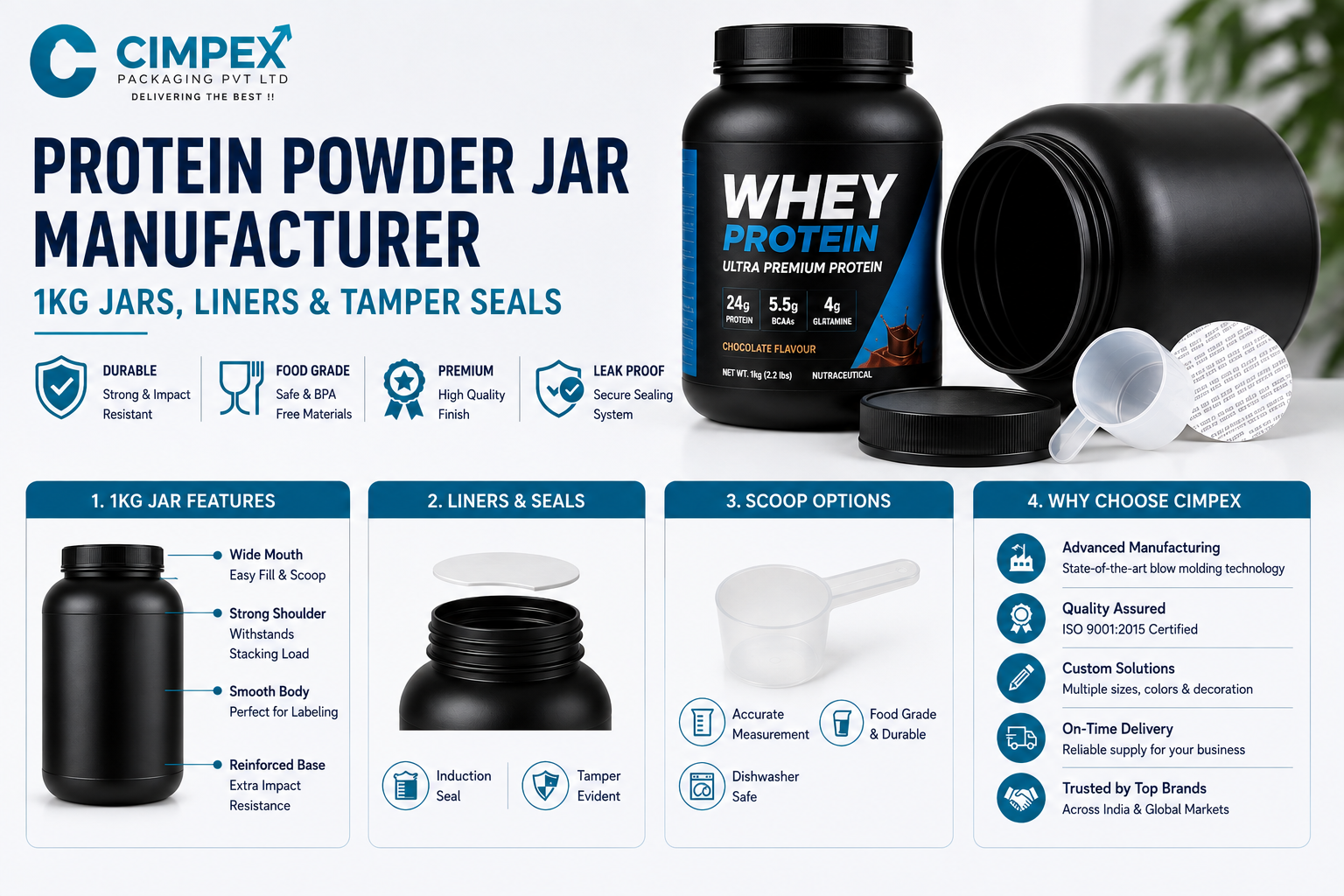
Choosing a protein powder jar manufacturer looks straightforward until the first pallet arrives with dented shoulders, the induction seal peels in shreds, or the scoop works its way to the bottom of the powder in transit. A 1kg whey protein container is among the most demanding formats in nutraceutical packaging: light in weight, huge in volume, shipped long distances, judged in two seconds on a crowded shelf. At Cimpex Packaging in Baddi, we mould HDPE and PP nutraceutical & protein jars for brands that need the jar, liner, seal and scoop to behave as one system rather than four parts from four vendors which is precisely why serious brands consolidate with a single protein powder jar manufacturer.
Why the 1kg Format Is Deceptively Difficult
A 1kg jar is not a scaled-up 500g jar. Whey concentrate sits at a bulk density of 0.35–0.45 g/cc, so a kilogram needs roughly 2,200–2,800 ml of internal volume depending on blend, aeration and settling. That volume must fit a container tall enough to look premium, wide enough for a 60cc scoop to move freely, and stable enough to survive a six-high pallet stack in an un-airconditioned warehouse in May.
Three forces act on the jar at once:
- Top load from stacking during storage and line-haul.
- Internal pressure swings as jars move between altitudes, chilled stores and ambient trucks.
- Impact at the base rim, where drop failures almost always begin.
Any protein powder jar manufacturer that quotes purely on grammage “we’ll do 62 grams instead of 68” is solving a costing problem, not an engineering one. Weight matters; where it sits matters more.
What Should You Expect From a Protein Powder Jar Manufacturer?
Procurement compares price per piece. Packaging development should compare four things underneath it.
1. Wall distribution, not just wall thickness
In extrusion blow moulding, material naturally thins at the shoulder and the parting line. A well-programmed parison controller redistributes it so the load path rim, shoulder, sidewall, base carries stacked weight without buckling. On a typical 1kg jar we target 0.8–1.1 mm in the sidewall with deliberately heavier sections at the shoulder radius and base standing ring. Ask your protein powder jar manufacturer for a section-weight map of the moulding, not a single average figure.
2. Wide mouth and neck finish
Powder jars live or die on the neck. Too narrow and consumers scrape knuckles; too wide and closure torque turns inconsistent. Common finishes:
- 83mm, 89mm or 100mm wide-mouth finishes for 1kg and 2kg jars, usually with a threaded PP cap.
- 120mm for high-volume, low-density blends such as mass gainers.
- 24/410 or 28/410 only for sample or sachet-adjacent SKUs never the main pack.
A serious protein powder jar manufacturer holds neck dimensions to a published drawing and checks them with go/no-go gauges every shift, because that neck has to seal against a foil liner with no tolerance for waviness.
3. Label panel and decoration
Design teams routinely supply artwork assuming a flat panel where the jar carries a 3° draft. Brief your protein powder jar manufacturer on the label window early: recessed panel height, a texture break top and bottom, and a flat zone for the batch code. Our HDPE jars are tooled with dedicated label panels so wrap-around and pressure-sensitive labels sit without the “smile” distortion that kills premium shelf presence.
4. Resin and compliance
For protein, HDPE is the workhorse good moisture barrier, good impact strength at low temperature, economical. PP suits clarity, higher heat resistance or a stiffer feel; LDPE appears mainly in liners and gaskets. Whichever you pick, your protein powder jar manufacturer should produce food-grade resin documentation, migration data and evidence of a controlled manufacturing environment. Cimpex operates an ISO 9001:2015-certified quality system and supplies brands whose own audits reference GMP and USP Class VI expectations for material selection.
Liners, Induction Seals and Tamper Evidence
This is where most complaints originate, and where a protein powder jar manufacturer earns or loses the account.
Induction seal construction
A standard induction wad is a laminate: pulpboard or foam backing, wax layer, aluminium foil, and a heat-seal facing matched to the jar resin. HDPE jars need an HDPE-compatible sealant layer specifying a PET-grade liner on an HDPE neck is the single most common cause of seals that lift at the edge.
Specify:
- Land width on the neck: 2.5–3.5 mm gives a consistent, peelable bond.
- Seal integrity: no leakage under vacuum or dye-penetration check.
- Peel behaviour: clean one-piece removal, no foil fragments left behind.
- Tab or no tab: tabbed liners improve user experience but add cost and need correct orientation on the line.
Tamper evidence beyond the foil
Foil alone is not tamper evidence in every market’s regulatory sense. We tool tamper-evident bands with frangible bridges, shrink sleeves over the closure, and two-piece caps with an inner disc. For export SKUs, confirm destination expectations before tooling retrofitting a TE band into an existing cap mould is expensive and rarely clean.
Torque and application
Under-torqued caps leak; over-torqued caps crack the skirt or crush the liner. For an 89mm PP cap on an HDPE jar, application torque generally lands around 22–30 in-lb, with removal torque expected to drop no more than about 40% after 24 hours. Have your protein powder jar manufacturer validate this on your actual capping head, not in a lab vice.
Scoops: The Component Everyone Forgets
A scoop is a small moulding with outsized influence on brand perception. If it floats, the consumer sees it; if it sinks, they dig. If the graduation is unreadable after a wash, your dosing claim is undermined.
Specify four things:
- Volume in cc, tied to your serving size 25cc, 30cc, 45cc and 60cc are the common steps.
- Material food-grade PP for stiffness and heat tolerance, no regrind.
- Handle geometry long enough to reach the base of a 1kg jar without a hand entering the powder.
- Packing method loose in-jar, bagged, or seated on top under the liner.
We mould protein scoops in-house, so diameter is checked against the actual jar mouth rather than assumed. Our guide as a measuring scoop manufacturer covers sizing, tolerances and dosing accuracy in the detail procurement teams need before an RFQ.
How to Qualify a Supplement Jar India Supply Base
Run this filter before shortlisting a protein powder jar manufacturer or committing money to tooling.
- Does the vendor mould jars, caps and scoops, or only one of the three?
- Can they show section-weight or mould-flow data for a comparable 1kg nutraceutical jar?
- What is their in-house testing scope top load, drop, leak, torque retention, dimensional?
- Are batch records, resin COAs and lot traceability available on request?
- Who owns the tooling, and who pays for modifications?
- Will they support your capping line during first commercial runs?
A protein powder jar manufacturer with an in-house tool room usually resolves a fitment issue in days; a trader routes it through a third party and takes weeks.
Costing, MOQs and Lead Times
Three variables dominate landed cost: resin grade, jar weight and decoration method. Realities worth planning around:
- Tooling is a one-time investment amortise across realistic 12-month volume, not launch quantity.
- Mono-material families (HDPE jar, PP cap, PP scoop) simplify recycling messaging and SKU complexity.
- Freight is volumetric. A jar 8mm shorter at the same fill volume changes cartons per truck.
- Colour changeovers carry purge cost; consolidate shades where the brand allows.
For brands scaling from 5,000 to 50,000 pieces a month, the right protein powder jar manufacturer is the one whose MOQ, tool capacity and quality system absorb that curve without a re-tool halfway through.
Final Thoughts
The jar, the liner, the seal and the scoop are one engineering problem wearing four purchase order numbers. Treat them that way in your RFQ and the classic failures lifted foil, cracked skirts, buried scoops, dented shoulders never reach your line. As a protein powder jar manufacturer working from Baddi, Cimpex Packaging supplies HDPE, PP and LDPE bottles, jars, caps, pumps and scoops to pharma, nutraceutical, cosmetic, FMCG, agrochemical and chemical brands across India and export markets. Scoping a new SKU or repairing an inherited one? Discuss protein packs with our team and bring fill weight, bulk density and capping line details to the first call.
Frequently Asked Questions
What jar size do I need for 1kg of whey protein?
Most whey concentrates need 2,200–2,800 ml of internal volume for 1kg, depending on bulk density and settling. Confirm with your own powder rather than a generic conversion, and add headspace for the scoop.
Is HDPE or PET better for a whey protein container?
HDPE offers better impact strength, a stronger moisture barrier and lower cost. PET is chosen when brands want transparency. For 1kg supplement jars in India, HDPE remains the default for durability and shelf life.
Do induction seals work on HDPE jars?
Yes, provided the liner’s heat-seal layer is specified for HDPE. A PET-grade liner on an HDPE neck causes edge lift and peel failure. Match the liner to the resin and validate on your own sealing tunnel.
What neck finish is standard for a 1kg nutraceutical jar?
Wide-mouth finishes of 83mm, 89mm or 100mm are typical for 1kg jars. Mass gainers and low-density blends often move to 120mm so a larger scoop can be used comfortably.
Can I get jars, caps and scoops from one supplier?
Yes. Sourcing jar, closure, liner and scoop from one protein powder jar manufacturer removes fitment risk, shortens approvals and gives you one accountable party when something fails on the capping line.
What is a realistic MOQ for supplement jars in India?
MOQs depend on tooling status and colour. Existing tooling with natural or white shades allows smaller runs; custom moulds and bespoke masterbatch need higher volumes to make commercial sense.
How long does new jar tooling take?
Plan several weeks from frozen drawing to first-article samples, plus trials, drop and top-load testing, and artwork fitment. Build that into the launch calendar to avoid late compromises.