


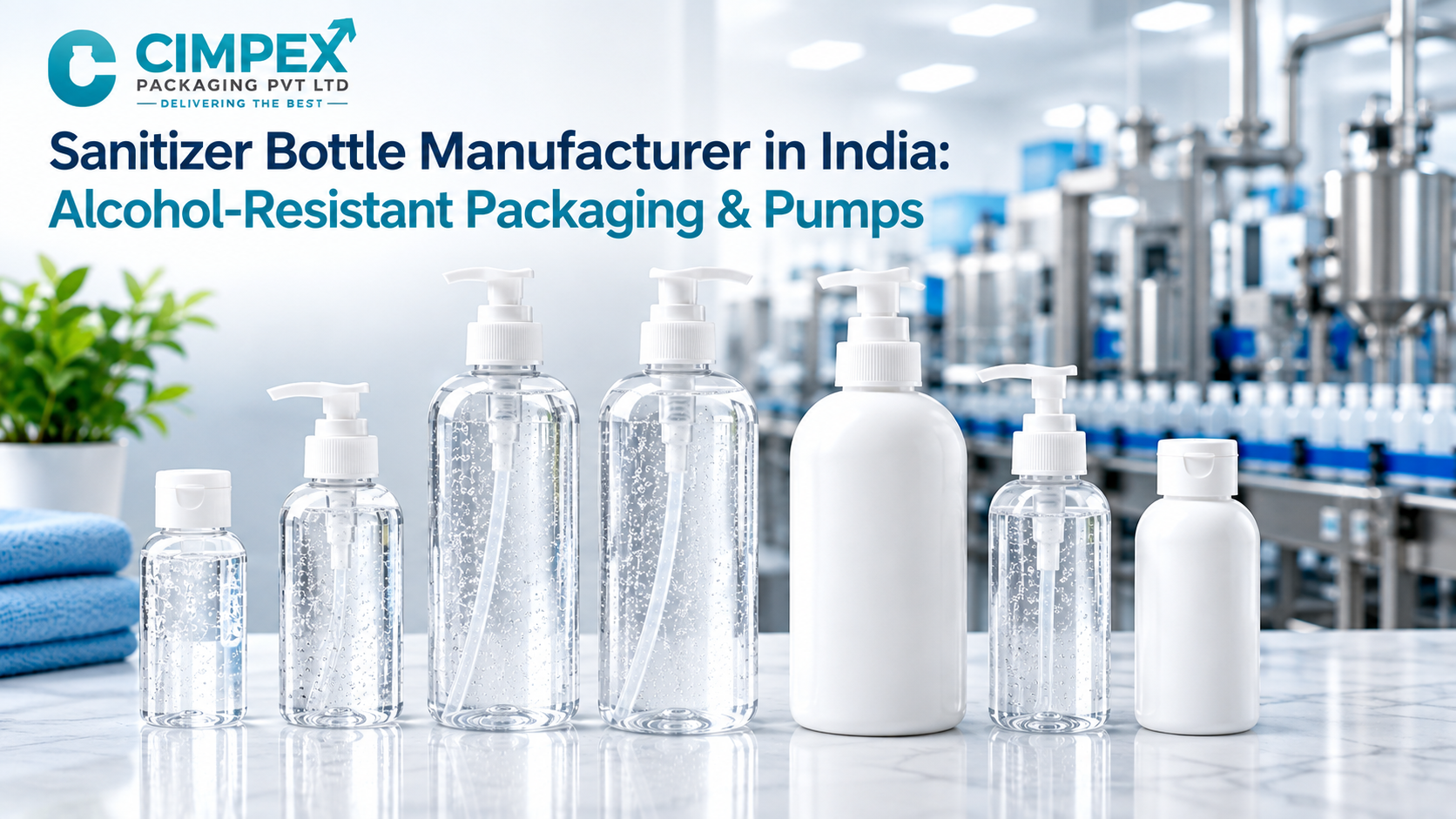
Sanitizer packaging looks simple from the outside a bottle, a cap, a pump. Anyone who has actually filled an alcohol-based formulation knows it is not. Ethanol and isopropanol behave very differently from shampoo or floor cleaner: they evaporate fast, they attack weak resins, they swell certain gaskets, and they find every micro-gap in a closure. That is why the choice of a Sanitizer Bottle Manufacturer in India decides far more than unit price. It decides whether your bottles arrive at the depot without weight loss, whether your pumps still prime after six months on a shelf, and whether your label stays flat instead of lifting at the edges. Material selection, wall thickness, neck finish, closure liner, pump compatibility, leak resistance and shelf presentation are all connected. Buyers who treat them as one system the way an experienced plastic bottle manufacturing (INTERNAL-LINK-1) partner does end up with far fewer complaints from the market.
Why the Choice of Manufacturer Matters More for Sanitizer
Sanitizer is an unforgiving product for packaging. A bottle that performs perfectly with a water-based lotion may lose 3–5% of its fill over a few months when it holds 70% alcohol. The loss is not always visible; it shows up as a slightly soft bottle, a paneled sidewall, or a customer complaint about “less quantity.”
A capable Sanitizer Bottle Manufacturer in India anticipates this. The resin, the wall distribution, the neck finish and the liner are chosen together, not independently. This is the difference between a supplier who sells containers and a partner who supplies packaging that works with your formulation.
What Usually Goes Wrong
- Thin shoulders that collapse during transport in summer heat A Sanitizer Bottle Manufacturer in India should validate material and closure compatibility before production.
- Closures with liners that soften and lose seal against alcohol
- Pumps whose internal springs or gaskets are not alcohol-rated
- Neck finishes that vary batch to batch and jam automatic capping heads Choosing a Sanitizer Bottle Manufacturer in India with controlled production processes can improve batch consistency.
Most of these are avoidable at the specification stage, which is exactly why the manufacturer conversation should start before the artwork is finalised, not after.
Alcohol Resistance and Material Selection
The first question in every sanitizer project is which resin to use. Both HDPE and PET are widely used across the category, and each suits a different commercial purpose.
Why HDPE Works Well for Sanitizer
HDPE is chemically tolerant, tough and forgiving. It handles alcohol content comfortably, takes impact without cracking, and performs well in institutional and bulk formats. It is opaque by nature, which helps protect the product visually and hides any settling or colour drift. For refill packs, dispensers and large-format supply, HDPE bottles (INTERNAL-LINK-2) remain the practical default. A reliable Sanitizer Bottle Manufacturer in India evaluates the bottle and dispensing system as one package.
Why PET Is Chosen for Retail
PET gives clarity, gloss and a premium shelf look that consumers respond to. For retail sanitizer, that visual quality matters buyers want to see the gel or liquid. PET does require more attention to wall design and closure sealing with high-alcohol formulations, so bottle geometry is engineered accordingly. When brands want transparency without compromising strength, well-designed PET bottles (INTERNAL-LINK-3) are the usual answer.
Choosing the Right Bottle Size
Size is a commercial decision as much as a technical one. Small 50ml and 100ml formats travel in bags and pockets. Mid-range 200ml and 250ml sit on desks and counters. Larger packs serve refill and shared-use situations.
Where the 500ml Sanitizer Bottle Fits
The 500ml sanitizer bottle has become the workhorse of the category. It is large enough to last in a busy environment, still light enough to handle with one hand, and it fits standard shelf and carton dimensions without wasting space. Clinics, schools, offices, hotels and factory floors buy it repeatedly. A 500ml sanitizer bottle also carries a pump comfortably, which is why it dominates counter-top and reception-desk placement. For brands running both retail and institutional lines, the 500ml sanitizer bottle is often the single SKU that serves both. A Sanitizer Bottle Manufacturer in India can help brands select packaging according to formulation and usage.
Sanitizer Bottles With Pumps and Dispensing Systems
Dispensing is where most field complaints originate. A sanitizer bottle with pump has to deliver a consistent shot, prime quickly, and stay sealed during transit. If the pump drips, the label stains. If it under-doses, users press repeatedly and the product runs out faster than expected. Sanitizer pump India requirements should include compatibility, locking and component consistency.
Pump Selection and Dosage
Lotion pumps for sanitizer are typically specified by neck size and output per stroke. Gels need a slightly higher output and a stronger spring action than thin liquids. Foam pumps are chosen where users want a controlled, low-splash application. Trigger sprays suit surface sanitizers rather than hand products. A sanitizer bottle with pump should be tested with the actual formulation before bulk production.
Matching the pump to the formulation viscosity is essential a sanitizer bottle with pump that works beautifully with a thin liquid may struggle with a thickened gel. Discussing this with your dispenser pump solutions (INTERNAL-LINK-4) supplier early avoids costly retooling later. Working with a Sanitizer Bottle Manufacturer in India makes specification and quality discussions more straightforward.
Sanitizer pump India buyers also need to think about transit locking. A down-lock or clip-lock pump prevents accidental discharge inside cartons. Reliable sanitizer pump India supply means consistent neck threads, consistent dip-tube lengths cut to the bottle height, and consistent spring quality across batches.
Wholesale and Bulk Supply Considerations
Hand sanitizer bottle wholesale buying is driven by predictability. Institutional tenders, distributor stocking and contract filling all depend on repeat consignments that behave identically.
Practical points to settle before the first order: An experienced Sanitizer Bottle Manufacturer in India can support repeat orders with consistent dimensions.
- Dimensional consistency neck finish and height tolerances must suit your filling and capping line
- Carton and pallet planning bottles per carton, cartons per pallet, and how that maps to your transport lanes
- Lead time and call-off whether you need staggered dispatches against a blanket order A Sanitizer Bottle Manufacturer in India should consider transport, storage and dispensing requirements together.
- Component matching caps, pumps and bottles supplied together rather than sourced separately
Hand sanitizer bottle wholesale programmes work best when the bottle, closure and pump come from a coordinated supply chain. Sourcing three components from three vendors is where thread mismatches and torque problems begin.
Quality and Manufacturing Consistency
Consistency is the real product. A bottle that is correct once is not useful; a bottle that is correct across every batch is. The right Sanitizer Bottle Manufacturer in India can reduce avoidable packaging problems before launch.
That comes from stable process control resin handling, mould maintenance, weight checks, and in-line inspection for neck defects and pinholes. An established Sanitizer Bottle Manufacturer in India builds this into routine production rather than treating it as an occasional audit exercise.
Wall Thickness and Strength
Wall thickness is a balancing act. Too thin and the bottle panels or cracks on drop. Too thick and you pay for resin you do not need, and the bottle becomes hard to squeeze where squeezability matters. Good design puts material where stress occurs shoulder, base and neck rather than spreading it evenly.
Leak Prevention and Closure Compatibility
Leakage is almost always a closure issue rather than a bottle issue. The liner material, the applied torque and the neck finish work as one sealing system. Alcohol-compatible liners and correctly specified caps and closures (INTERNAL-LINK-5) prevent both leakage and slow evaporation loss. A capable Sanitizer Bottle Manufacturer in India can align bottle design with the intended market format.
Customisation, Shapes and Brand Presentation
Sanitizer is a crowded shelf. Bottle shape, colour and finish do a lot of the differentiation work. Cylindrical rounds are efficient and economical. Oval and flat formats read as more premium and hold labels well. Colour masterbatch, frosted effects and matte finishes are all achievable within standard production.
Decoration choices screen printing, labels, sleeves should be decided alongside bottle geometry, because a curved panel and a flat panel demand different label solutions. This is standard practice in pharmaceutical and FMCG packaging (INTERNAL-LINK-6), where presentation and function are specified together.
Applications Across Retail, Institutional and Commercial Use
Retail packs prioritise appearance and one-hand use. Institutional supply for hospitals, schools and offices prioritises capacity, refillability and durability. Commercial and industrial buyers want robust bottles that survive rough handling and frequent movement. Personal-care extensions sanitizing sprays, gels, wipes solutions usually reuse the same bottle families with different closures, which keeps tooling and inventory efficient. Selecting a Sanitizer Bottle Manufacturer in India is ultimately a packaging performance decision.
Sustainability and Lightweighting
Lightweighting is the most immediate sustainability lever in plastic packaging: less resin per bottle, lower freight weight, lower cost. It has to be done through design, not by simply reducing gram weight until failures appear. Mono-material construction also helps recyclability matching an HDPE bottle with an HDPE closure keeps the pack in a single recycling stream.
Talk to Cimpex Packaging About Your Sanitizer Requirement
If you are planning a new sanitizer line or reviewing an existing one, share the basics bottle size, preferred material, pump or cap type, expected quantity, and any customisation you need in shape, colour or decoration. Our team can help you match the right sanitizer bottle solutions (INTERNAL-LINK-7) to your formulation, filling line and distribution plan. Manufacturers, brand owners, procurement teams and distributors are all welcome to get in touch and discuss specifics rather than generalities.
Conclusion
Sanitizer packaging rewards attention to detail. The resin has to tolerate alcohol, the wall has to survive transport, the closure has to seal, and the pump has to deliver the same dose on the first press and the five-hundredth. Choosing an experienced Sanitizer Bottle Manufacturer in India means those decisions are made together, with the formulation and the supply chain in view. Whether the requirement is a retail pack, a 500ml sanitizer bottle for institutional use, or a large hand sanitizer bottle wholesale programme, working with a Sanitizer Bottle Manufacturer in India that understands both moulding and dispensing gives you packaging that performs quietly which is exactly what good packaging should do.
Frequently Asked Questions
1. What type of bottle is best for alcohol-based sanitizer?
HDPE and PET are both suitable. HDPE offers chemical tolerance and toughness for bulk use, while PET gives clarity for retail packs. Choice depends on format and shelf presentation.
2. Is a 500ml sanitizer bottle suitable for institutional use?
Yes. The 500ml sanitizer bottle is the most common institutional format enough capacity for busy areas, easy one-hand use, and it takes a counter-top pump comfortably.
3. How do I stop my sanitizer bottles from leaking?
Leakage is usually a sealing issue. Use an alcohol-compatible liner, a correctly matched neck finish, and the right capping torque. Bottle and closure should be specified together. An established Sanitizer Bottle Manufacturer in India can help maintain consistency across recurring production batches.
4. Which pump works best for sanitizer gel?
Gels need a pump with higher output per stroke and stronger spring action than thin liquids. A sanitizer bottle with pump should always be trialled against your actual viscosity. A Sanitizer Bottle Manufacturer in India should also consider the final distribution environment when approving a package.
5. Can bottles be customised in shape and colour?
Yes. Shape, colour, finish and decoration can be developed to suit your brand. Discuss geometry and labelling together, since curved panels and flat panels suit different labels.
6. What should I check before placing a wholesale order?
Confirm neck finish, dimensional tolerances, carton and pallet configuration, and lead times. Hand sanitizer bottle wholesale supply depends on batch-to-batch consistency above all.
7. Are pumps and bottles supplied together?
Sourcing bottles, caps and pumps from a coordinated supply chain avoids thread mismatch and torque issues. Sanitizer pump India buyers should confirm dip-tube length per bottle height.
8. Why does sanitizer lose volume during storage?
Alcohol evaporates through weak seals and unsuitable liners. Correct material selection and closure sealing prevent the slow weight loss that customers notice as short fill.