


Choosing the right packaging is no longer a back-office decision — it protects your product, your brand, and your patients. This guide walks pharmaceutical, FMCG, cosmetic, nutraceutical, and industrial buyers through everything that matters when selecting containers and a manufacturing partner.
Finding a dependable tablet container manufacturer in India has become a priority for pharmaceutical companies, nutraceutical brands, and healthcare exporters that need packaging which performs as reliably as the products inside it. A tablet or capsule may pass every quality test on the production line, yet its shelf life, potency, and consumer trust still depend heavily on the container that holds it. As Indian manufacturing scales up to serve domestic demand and large export markets, buyers are paying closer attention to the suppliers behind their bottles, caps, and closures.
India has steadily grown into one of the most important hubs for plastic packaging, supported by strong polymer processing capacity, skilled labour, and a deep base of regulated pharmaceutical companies. This growth has created a wide field of suppliers — but not all of them deliver consistent quality. The difference between a good packaging partner and an average one usually shows up in the details: wall thickness, sealing performance, moisture control, and the ability to scale production without slipping on standards.
Durable plastic packaging continues to dominate the pharma and FMCG sectors for clear reasons. It is lightweight, shatter-resistant, easy to label, and far more cost-effective to ship than glass. When it is manufactured correctly, it also offers excellent protection against moisture, light, and contamination. Throughout this guide, we’ll also look at how Cimpex Packaging approaches these requirements as a quality-focused manufacturer.
Overview of the Product Category
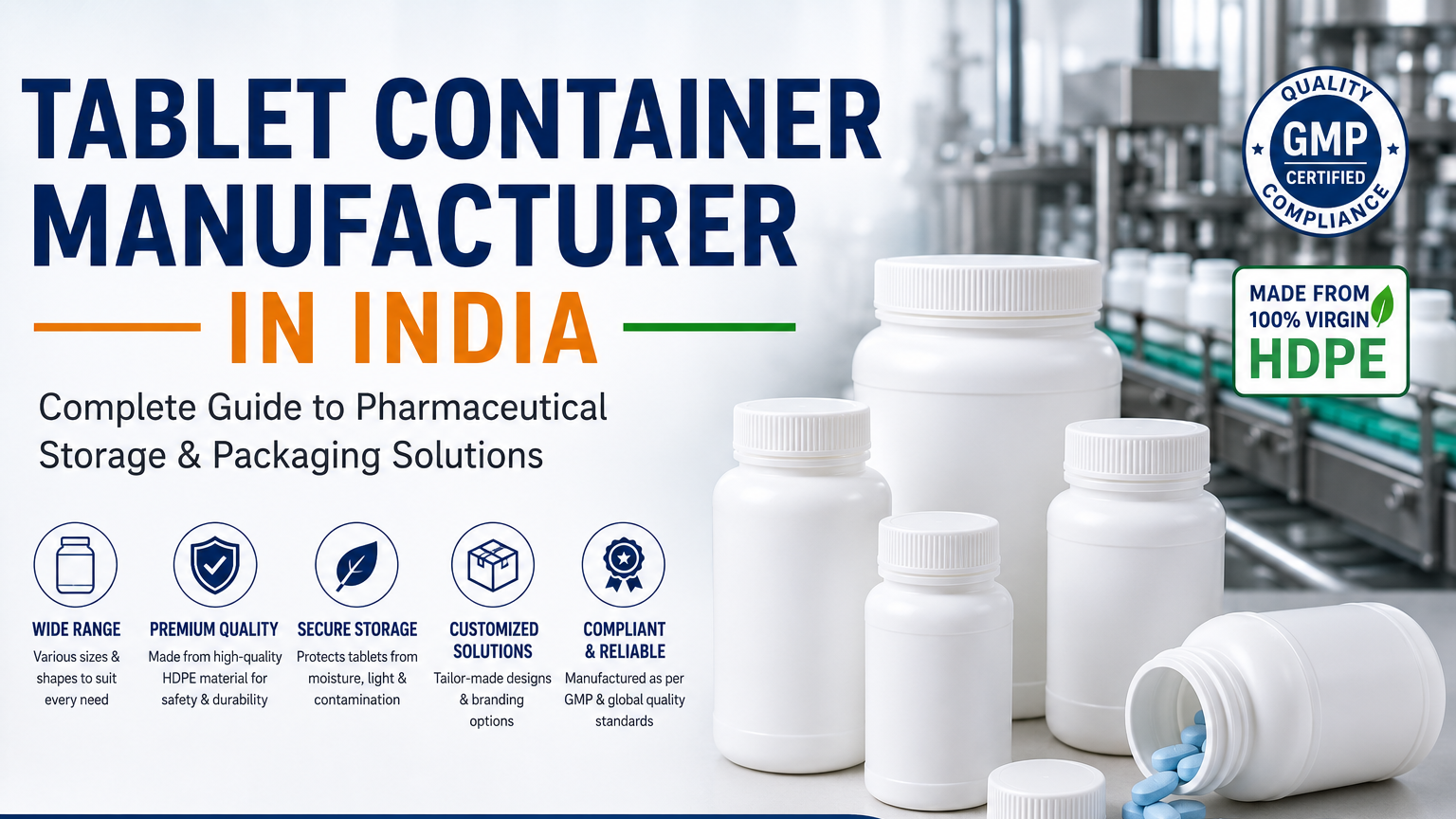
Tablet containers are rigid plastic bottles designed specifically to store solid-dose medicines, supplements, and health products. Unlike generic bottles, a well-built pharma tablet container is engineered around the product it protects — controlling moisture ingress, resisting impact during transit, and accepting tamper-evident or child-resistant closures without distortion.
The category covers a broad range of sizes and shapes. Smaller containers suit sample packs and short courses, while larger formats serve hospital supply and high-count retail packs. A common request from buyers is the 100cc tablet container, a versatile mid-size format widely used for tablets, capsules, and nutraceutical pellets because it balances count capacity with shelf footprint.
Within this product family you’ll typically find:
- Round and square tablet containers for standard solid-dose packaging.
- Capsule containers with wider necks for easy filling and dispensing.
- Wide-mouth jars for powders, gummies, and bulk supplements.
- Light-resistant (amber or opaque) bottles for sensitive formulations.
- Containers paired with CR (child-resistant) and tamper-evident caps.
A specialised tablet container manufacturer will offer this full range rather than a single off-the-shelf size, allowing brands to standardise packaging across an entire product portfolio.
Importance of Quality Packaging
In regulated industries, packaging is part of the product. A container that warps in summer heat, cracks during shipping, or lets in humidity can compromise an entire batch — and the financial and reputational cost of a recall far outweighs any saving on cheaper packaging.
Why does quality packaging matter so much in pharma? Because it directly affects stability, safety, and compliance. Good packaging keeps medicines effective until their expiry date, prevents contamination, blocks tampering, and reassures regulators and consumers that the product has been handled responsibly from factory to shelf.
Quality packaging delivers several measurable benefits for B2B buyers:
- Product protection — guards against moisture, oxygen, light, and physical damage.
- Regulatory confidence — meets the documentation and material standards auditors expect.
- Brand consistency — uniform colour, finish, and fit across every production run.
- Reduced wastage — fewer rejected units and lower transit breakage.
- Consumer trust — clean, secure, professional packaging signals a reliable product.
Industries Using These Packaging Products
While tablet and capsule containers are most associated with medicine, the same manufacturing know-how serves a surprisingly wide set of industries. A capable supplier of plastic packaging solutions usually works across several of these sectors at once.
Pharmaceutical packaging
The core market — bottles and containers for tablets, capsules, syrups, and dry powders, where compliance, sealing, and moisture control are non-negotiable.
Nutraceutical packaging
Vitamins, protein blends, gummies, and herbal supplements rely on wide-mouth jars and tamper-evident containers that keep products fresh and shelf-ready.
FMCG packaging
Fast-moving consumer goods need durable, attractive, cost-efficient containers that survive high-volume distribution and stand out on crowded shelves.
Food packaging
Food-grade jars and bottles for spices, condiments, confectionery, and dry goods, manufactured from materials certified safe for direct contact.
Cosmetic packaging
Creams, scrubs, and powders call for refined finishes and reliable closures. Many brands source these alongside their pharma lines from one cosmetic packaging containers partner to simplify procurement.
Healthcare packaging
Clinics, diagnostics labs, and medical-device companies use containers for sample collection, dispensing, and bulk storage where hygiene is critical.
Industrial packaging
Chemicals, lubricants, and specialty additives require chemically resistant bottles and drums built to handle aggressive contents safely.
Packaging Materials Used
The performance of any container starts with the polymer it’s moulded from. The three workhorses of rigid plastic packaging are HDPE, PET, and PP — each chosen for a specific balance of strength, clarity, and resistance.
HDPE (High-Density Polyethylene)
The most common material for pharma tablet containers. HDPE offers excellent moisture resistance, good impact strength, and a stable, opaque body that helps shield light-sensitive contents. It is the default choice for tablets and capsules. Brands often source these from a dedicated HDPE bottle manufacturer to ensure consistent grade and wall thickness.
PET (Polyethylene Terephthalate)
Valued for its glass-like transparency and strength, PET is ideal when product visibility matters — supplements, FMCG goods, and many consumer products. It is lightweight and fully recyclable, which appeals to brands focused on sustainability.
PP (Polypropylene)
PP stands out for heat resistance and chemical stability, making it well suited to hot-fill processes, food containers, and closures. It also accepts living-hinge designs used in flip-top caps.
Here’s how the three materials compare at a glance:
| Material | Key Advantages | Resistance Profile | Common Applications |
|---|---|---|---|
| HDPE | Durable, opaque, strong moisture barrier | High moisture & impact resistance | Pharma tablet & capsule containers |
| PET | Transparent, lightweight, recyclable | Good clarity, moderate chemical resistance | FMCG bottles, supplements, beverages |
| PP | Heat resistant, rigid, food-safe | High heat & chemical resistance | Food containers, caps, hot-fill packs |
The right material depends on the formulation, the climate it ships through, and shelf-life expectations. A knowledgeable manufacturer helps buyers match polymer to product rather than forcing a one-size-fits-all option.
The Manufacturing Process
Behind every reliable container is a tightly controlled production process. Understanding the basics helps buyers ask the right questions when auditing a supplier.
- Injection molding — used for caps, closures, and rigid components where dimensional precision is essential. Molten polymer is injected into a steel mould under high pressure for tight, repeatable tolerances.
- Blow molding — the primary method for bottles and tablet containers. A heated polymer parison is inflated against the mould wall to form a hollow, seamless body with consistent wall thickness.
- Quality control — in-process and final inspections check dimensions, weight, neck finish, and cosmetic defects before packing.
- Material testing — incoming resin is verified for grade and purity, and finished parts are checked against specification.
- Leak testing — sealed samples are pressure- or vacuum-tested to confirm the container-and-closure system holds an airtight, moisture-tight seal.
A manufacturer that documents each of these stages gives pharmaceutical buyers the traceability they need for their own audits. This disciplined approach is central to how Cimpex Packaging keeps quality consistent across high-volume orders.
Packaging Safety Standards
For medicines, supplements, and food products, safety standards aren’t optional — they determine whether a product can legally reach the shelf, especially across borders. Reputable suppliers of pharmaceutical packaging products build compliance into the product from the start.
- Food-grade standards — materials certified safe for direct contact with food and ingestible products.
- Pharma compliance — adherence to applicable drug-master-file and good-manufacturing-practice expectations for primary packaging.
- Export requirements — documentation and material certifications that satisfy regulators in target markets.
- Tamper-evident packaging — induction seals and breakaway bands that visibly reveal any interference.
- Child-resistant closures — CR caps engineered to slow access by young children while staying usable for adults.
What is a CR cap container? It is a container fitted with a child-resistant closure that requires a specific push-and-turn or squeeze-and-turn action to open. Sourcing from an experienced CR cap container supplier ensures the cap and bottle are tested together as a matched system, not just assembled from mismatched parts.
Customization Options
Standard catalogues are a starting point, not a limit. Most B2B buyers need packaging that reflects their brand and fits their filling line, which is why customisation matters.
- Size customization — from compact sample bottles to large bulk jars, including popular mid-size formats like the 100cc tablet container.
- Color customization — natural, white, amber, or brand-matched colours, plus opacity tuned for light-sensitive contents.
- Branding — embossing, screen printing, and consistent finishes that carry brand identity onto the container itself.
- Label compatibility — smooth, uniform surfaces engineered for clean application of pressure-sensitive and wrap labels.
- Cap options — flip-top, CR, tamper-evident, and induction-seal-ready closures matched to the neck finish.
Buyers who also need bottles for liquids often consolidate orders with a single pharma bottle manufacturer, keeping branding and quality consistent across both solid-dose and liquid product lines.
Benefits of Buying from an Indian Manufacturer
Sourcing packaging from India has become a strategic advantage for global and domestic brands alike. The combination of capacity, cost, and capability is hard to match.
- Cost efficiency — competitive pricing without compromising on material grade, driven by scale and local resin supply.
- Bulk supply — high-volume capacity for steady, repeatable orders that keep production lines running.
- Export support — familiarity with international documentation and packaging norms for overseas shipments.
- Faster production — shorter lead times and responsive scheduling for both standard and custom runs.
For brands comparing options, the value of working with a single, accountable partner — rather than juggling several small vendors — usually outweighs marginal price differences. Manufacturers that also produce specialised formats, such as a multilayer bottle manufacturer for high-barrier needs, let buyers grow their range without changing suppliers.
Sustainable Packaging Trends
Sustainability has moved from a marketing line to a procurement requirement. Brands now expect their packaging partners to help reduce environmental impact while maintaining performance.
- Recyclable plastics — HDPE, PET, and PP are all widely recyclable, supporting circular-economy goals when collected properly.
- Reduced material usage — light-weighting designs that use less polymer per unit without losing strength.
- Eco-conscious packaging — interest in recycled-content resins and designs that are easier to sort and recycle.
Forward-looking manufacturers are responding by optimising mould designs and exploring greener material options, helping buyers meet both regulatory pressure and customer expectations.
Conclusion: Partner With a Packaging Manufacturer You Can Trust
Choosing the right tablet container manufacturer in India shapes the quality, safety, and shelf appeal of everything you sell. Whether you need a robust pharma tablet container, a reliable capsule container manufacturer, a versatile 100cc tablet container, or a dependable CR cap container supplier, the goal is the same — packaging that protects your product and your reputation.
Cimpex Packaging brings together quality-focused manufacturing, flexible customisation, and bulk supply capacity to serve pharmaceutical, nutraceutical, FMCG, cosmetic, and industrial buyers. If you’re planning a new product launch or reviewing your current suppliers, now is the right time to explore better packaging.
Reach out for samples, specifications, and bulk pricing — and let’s build packaging that works as hard as your products do.
Frequently Asked Questions
How do I choose a reliable tablet container manufacturer in India?
Look for documented quality control, material testing, and leak testing, plus the ability to supply both standard and custom sizes. A reliable manufacturer should offer compliant materials, tamper-evident and CR cap options, and the capacity to deliver bulk orders on consistent lead times.
What is a 100cc tablet container used for?
A 100cc tablet container is a popular mid-size format used to pack tablets, capsules, and nutraceutical pellets. It balances a useful product count with a compact shelf footprint, which makes it a common choice for retail packs, supplement brands, and pharmacy dispensing.
Why is HDPE preferred for pharmaceutical packaging?
HDPE offers a strong moisture barrier, good impact resistance, and an opaque body that shields light-sensitive medicines. It is durable, lightweight, and recyclable, which is why it is the default material for most pharma tablet and capsule containers.
What is a CR cap container and when is it required?
A CR (child-resistant) cap container uses a closure that needs a specific push-and-turn or squeeze-and-turn action to open. It is required for many medicines and potentially hazardous products to reduce accidental access by children, and should be tested as a matched cap-and-bottle system.
Can packaging be customised for my brand?
Yes. Containers can be customised by size, colour, and opacity, and finished with embossing or printing for branding. Surfaces are engineered for clean label application, and closures can be matched to your filling line — including flip-top, tamper-evident, and CR caps.
What standards should food-grade packaging meet?
Food-grade packaging must use materials certified safe for direct contact with ingestible products and free from harmful migration. For export, it should also carry the documentation and certifications required by the destination market’s regulators.
Do Indian manufacturers support export packaging requirements?
Established Indian manufacturers are familiar with international packaging norms and can provide the material certifications and documentation needed for overseas shipments. This makes India a practical sourcing base for pharma and FMCG exporters.
What is the difference between a tablet container and a capsule container?
Both store solid-dose products, but capsule containers often feature a wider neck for easier filling and dispensing of capsules. A specialised capsule container manufacturer offers formats and closures suited to capsule shape, count, and moisture sensitivity.
What is the minimum order quantity for bulk packaging?
Minimum order quantities vary by product type, size, and customisation level. Bulk and custom runs usually have higher minimums than standard catalogue items. It is best to share your size, material, and volume needs with the supplier to get an accurate quote.
How does Cimpex Packaging ensure consistent quality?
Cimpex Packaging applies controlled manufacturing with material testing, in-process inspection, and leak testing across production runs. Combined with flexible customisation and bulk capacity, this helps deliver packaging that stays consistent from the first unit to the last.