


A tablet is only as stable as the container holding it. Moisture creeps in through a poor closure, a cap loosens in transit, and a batch that passed every stability trial reaches the pharmacy already compromised. None of that shows up on a purchase order.
That is why the container carries m capsule container manufacturer ore weight than its unit price suggests. Child-resistant caps protect households where medicines and children share a cupboard. Desiccants hold humidity away from hygroscopic actives across slow distribution chains.
Capacity matters just as much. An oversized bottle leaves headspace that lets tablets abrade, while an undersized one forces a pack change late. Every experienced tablet container manufacturer in India has watched both mistakes reach validation.
Choosing a tablet container manufacturer in India therefore means assessing moulding discipline, closure systems and documentation together, not comparing rates. To review specifications first, see our tablet containers range.
This guide covers container types, CR caps, desiccant options and a full size chart. It is written from the production floor of a working tablet container manufacturer in India rather than from a catalogue, so the figures reflect what actually runs on the line.
What Is a Pharmaceutical Tablet Container?
Purpose of Tablet Containers
A pharma tablet container does four jobs at once: holds a counted fill, blocks moisture and light, resists transit damage and carries the labelling a regulator expects. A tablet container manufacturer in India designs around all four together.
It is also a dosing interface. Patients open it twice daily for years, so cap torque and mouth diameter affect adherence as much as any clinical factor.
Materials Used
- HDPE: the default for solid oral dose packs, strong and moisture-resistant
- PP: chosen when higher clarity or heat resistance is needed
- Liners and caps: specified by the tablet container manufacturer in India alongside the bottle
- PET: used where visibility supports retail nutraceutical sales
- Glass: retained for specialised or highly reactive formulations
Why HDPE Is Preferred
HDPE balances water vapour barrier, impact strength and cost. It moulds consistently, accepts induction sealing and stays inert against most solid dose formulations, which is why a pharma tablet container is rarely anything else.
Any established tablet container manufacturer in India defaults to virgin HDPE, keeping regrind away from product-contact surfaces entirely.
Understanding Child-Resistant (CR) Caps
What Are CR Caps?
Child-resistant caps require a coordinated opening action a young child cannot easily perform, while remaining manageable for an adult.
Push-and-turn and squeeze-and-turn are the common designs. Both are tested against protocols such as ISO 8317 before a CR cap container supplier can make the claim, and a tablet container manufacturer in India should hold that evidence on file.
How CR Caps Work
A push-and-turn cap uses two shells. The outer spins freely until downward pressure engages lugs on the inner shell, which then unscrews from the neck.
Closure geometry, liner thickness and torque all influence performance, so ask your CR cap container supplier to validate cap and container as a matched system.
Benefits of Child-Resistant Closures
- Patient safety: reduces accidental ingestion by young children at home
- Regulatory compliance: required in many export markets and drug categories
- Tamper resistance: pairs with induction sealing to evidence first opening
- User convenience: senior-friendly designs let elderly patients open the pack without tools
- Single accountability: one tablet container manufacturer in India owning both parts avoids fitment disputes
A capable tablet container manufacturer in India supplies container and closure together, with fitment and torque data on record.
Role of Desiccants in Tablet Packaging
What Are Desiccants?
Desiccants are adsorbents placed inside the pack to capture residual moisture and humidity entering through the closure. A tablet container manufacturer in India sizes them against headspace, not tablet count.
They arrive as canisters, sachets or integrated desiccant closures moulded into the cap. Each format changes the usable volume of a pharma tablet container.
Types of Desiccants
- Silica gel: the general-purpose choice across normal humidity ranges
- Molecular sieve: adsorbs strongly at low humidity, suited to hygroscopic actives
- Activated clay: an economical option for less sensitive formulations
- Desiccant closure: cap-integrated systems that remove loose components from the fill
Why Moisture Protection Matters
- Shelf-life improvement: controlled headspace humidity supports the registered shelf life
- Product stability: assay, dissolution and hardness stay closer to release specification
- Moisture absorption: effervescent and hygroscopic tablets clump without protection
- Pharmaceutical quality: fewer stability deviations and fewer market complaints
Plan desiccant volume into capacity. A pharma tablet container sized to tablet count alone leaves no room for the canister, so a tablet container manufacturer in India asks for the desiccant specification early.
Tablet Container Size Guide
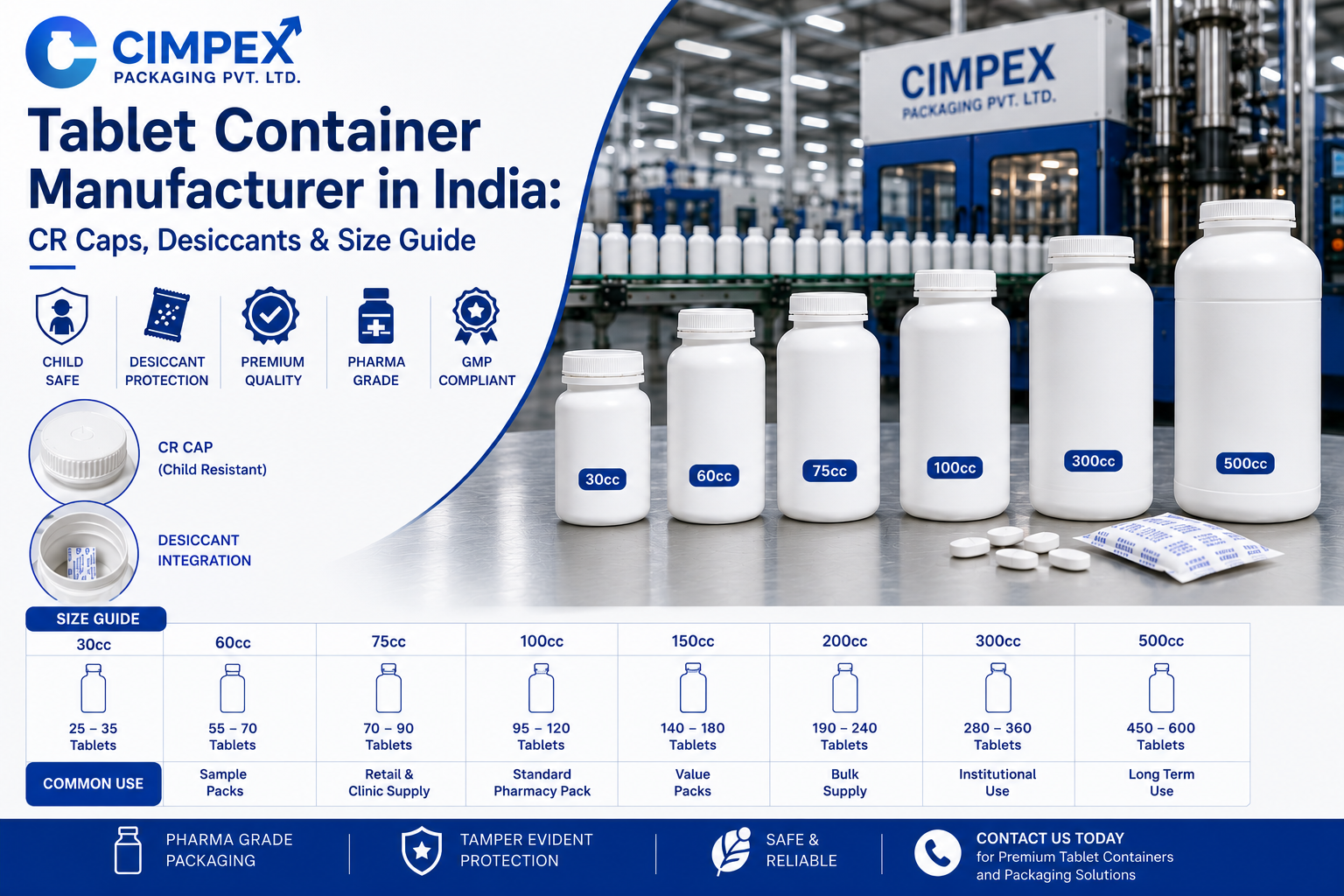
Capacity is quoted in cubic centimetres, not tablet count. The chart below covers the sizes a tablet container manufacturer in India runs most often, from sample packs to bulk tablet packaging.
| Container Size | Approx. Tablet Capacity | Common Applications | Suitable Products |
| 30cc | 25 to 35 tablets | Sample packs, short courses | Antibiotics, trial packs |
| 60cc | 55 to 70 tablets | One-month retail packs | Analgesics, antacids |
| 75cc | 70 to 90 tablets | Retail and clinic supply | Multivitamins, antihistamines |
| 100cc | 95 to 120 tablets | Standard pharmacy pack | Chronic therapy, supplements |
| 150cc | 140 to 180 tablets | Value packs, nutraceuticals | Calcium, iron, protein tablets |
| 200cc | 190 to 240 tablets | Bulk retail, institutional | Herbal and ayurvedic tablets |
| 300cc | 290 to 360 tablets | Hospital and dispensary | Veterinary, bulk generics |
| 500cc | 480 to 600 tablets | Bulk tablet packaging | Contract manufacturing, exports |
Treat these counts as indicative. Actual fill depends on tablet diameter, thickness, coating and desiccant volume, so ask your tablet container manufacturer in India for a trial fill before artwork sign-off.
Neck finishes generally run 33mm, 38mm, 45mm and 53mm, which keeps CR caps interchangeable across capacities. The 100cc tablet container remains the most requested size in Indian pharmaceutical packaging.
How to Choose the Right Tablet Container
Work through these nine checkpoints with your tablet container manufacturer in India before tooling is committed. They settle most specification disputes in one meeting.
- Tablet size: diameter and thickness set mouth diameter and pour behaviour
- Fill volume: count tablets, add desiccant volume, then allow modest headspace, since a 100cc tablet container will not hold 100 large coated tablets
- Moisture sensitivity: hygroscopic actives need tighter liners and stronger desiccants
- CR cap compatibility: confirm with your CR cap container supplier that the neck matches certified closures before mould cutting
- Desiccant requirements: choose early between canister, sachet and desiccant closure
- Storage conditions: zone IV climatic data drives the moisture barrier specification
- Regulatory compliance: CDSCO, pharmacopoeial and export market requirements
- Branding: label area, embossing and shelf presence for retail lines
- Export packaging: shipper counts, stacking strength and labelling decide which tablet container manufacturer in India can serve the market
Our manufacturing process page shows how these decisions translate into tooling and validation.
Applications of Tablet Containers
Five categories account for most of the volume a tablet container manufacturer in India handles.
Pharmaceutical Tablets
Generic and branded solid dose products form the largest volume. Antibiotics and antidiabetics move through HDPE tablet containers with CR closures, most often in the 60cc to 100cc tablet container range.
Capsules
Capsules occupy more volume per dose than tablets, so a capsule container manufacturer specifies wider mouths and larger capacities for the same count. Confirm this before assuming parity.
Nutraceutical Supplements
Vitamins and protein tablets sell on shelf appeal as well as protection, so a tablet container manufacturer in India supplies larger printed packs here, as our nutraceutical jars show.
Herbal Medicines
Ayurvedic and herbal tablets are often hygroscopic and aromatic, so a tablet container manufacturer in India specifies desiccant closures and tighter liners for these lines.
Veterinary Medicines
Veterinary packs favour larger capacities and robust closures, since dosing happens on farms. A tablet container manufacturer in India usually runs these alongside human formats.
Customization Options Available
Standard containers cover most needs, but branded lines need adjustment. A full-service tablet container manufacturer in India offers:
- Bottle colours: white, amber and opaque for light-sensitive formulations
- Custom capacities: intermediate sizes developed where standard cc values do not fit the fill
- Embossing: moulded logos, batch panels and grip features
- Silk screen printing: durable direct printing that survives handling
- Labelling: wrap-around, front-and-back and shrink sleeve formats
- Induction seal compatibility: flat sealing land for reliable foil adhesion
- Custom mould development: bespoke shapes and neck finishes cut in-house
- Child-resistant closures: certified CR systems matched to the neck
- Tamper-evident features: break rings and sealed closures
Matching caps and closures and HDPE jars can be developed alongside the container, so one tablet container manufacturer in India owns the whole pack.
Conclusion
Tablet packaging succeeds when three decisions align: the right capacity, a closure certified for the market, and a moisture strategy matched to the formulation. A good tablet container manufacturer in India insists on all three.
Settle those three with your tablet container manufacturer in India before tooling, and the pack will hold its shelf life without late-stage rework or repeat stability studies.
Ready to specify your pack? Contact Cimpex Packaging today for premium tablet container manufacturing, CR closures and desiccant-ready designs. Send your tablet dimensions, count and market, and we will recommend a capacity, ship samples and quote in writing.
Frequently Asked Questions
1. What makes a reliable tablet container manufacturer in India?
A dependable tablet container manufacturer in India offers GMP-aligned moulding, virgin HDPE, certified CR fitment, desiccant-ready necks and documented leak testing.
2. How many tablets does a 100cc tablet container hold?
A 100cc tablet container holds roughly 95 to 120 standard round tablets. Final count varies with tablet diameter, coating and whether a desiccant canister sits inside.
3. Are child-resistant caps mandatory in India?
Not for every product domestically, though many export markets require them. A CR cap container supplier should provide ISO 8317 test evidence before you register the pack.
4. Which desiccant suits tablet packaging best?
Silica gel suits most tablets, while molecular sieve performs better at low humidity. Size the pharma tablet container so the canister fits without loosening the fill.
5. Can tablet containers be induction sealed?
Yes. The neck needs a flat sealing land and the cap a foil liner, giving tamper evident packaging that works alongside certified child-resistant closures.
6. How do capsule containers differ from tablet containers?
Structurally very little. A capsule container manufacturer specifies wider mouths and larger capacities, since capsules occupy more volume per dose than compressed tablets of the same strength.
7. What is the usual MOQ for bulk tablet packaging?
Most quotes from a tablet container manufacturer in India start near 10,000 pieces on stock moulds. Custom shapes need more, since tooling and validation must be recovered.
8. Can Cimpex develop custom moulds and closures?
Yes. As a tablet container manufacturer in India, we develop custom capacities, colours, embossing and CR closures, then sample for approval before bulk production.