


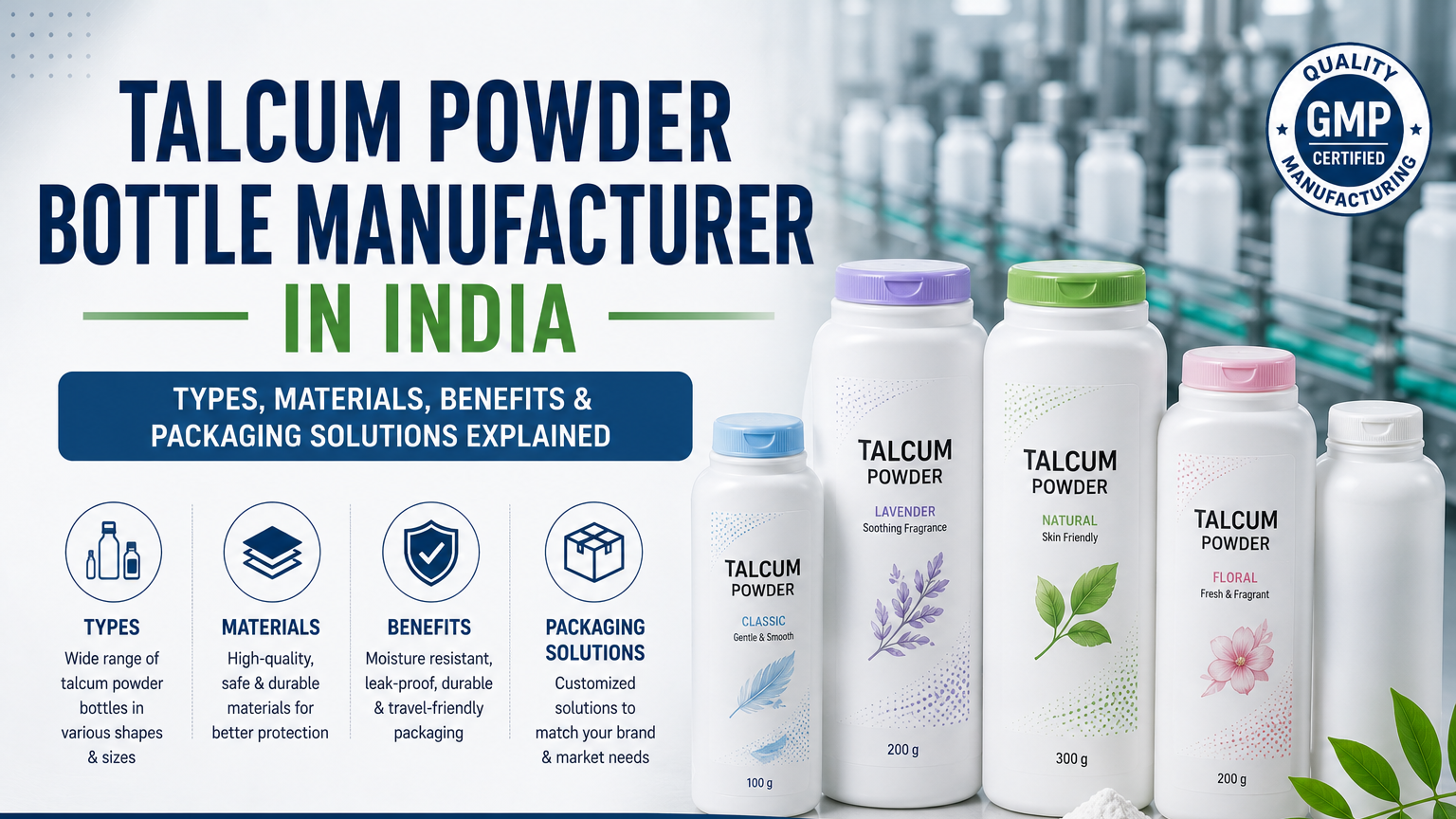
Choosing the right talcum powder bottle manufacturer is one of the most practical decisions a brand can make, because the bottle does far more than simply hold powder. It controls dispensing, protects the contents from moisture, carries the label, and shapes the first impression a customer forms on the shelf. As India’s packaging sector continues to expand on the back of growing pharmaceutical, FMCG, and cosmetic production, businesses are looking for suppliers who can deliver consistent quality at scale rather than one-off batches with uneven results.
The packaging industry in India has grown into one of the largest in the world, supported by rising domestic demand and steady export orders. For powder products in particular, durable plastic bottles have become the standard choice. They are lightweight, shatter-resistant, easy to transport in bulk, and far more forgiving during handling than glass. A well-made bottle keeps powder dry, dispenses cleanly through a sifter cap, and holds its shape through filling lines, shipping, and shelf life. This guide explains the product category, the materials involved, the manufacturing process, and what to look for when you partner with a supplier such as Cimpex Packaging.
Overview of the Product Category
A talcum or dusting powder bottle is a rigid container designed to store fine powder and release it in controlled amounts. Unlike a standard liquid bottle, it relies on a perforated sifter cap that lets powder pass through small holes while keeping the rest sealed inside. This combination of body and closure is what makes the product suitable for body powders, prickly heat powders, foot powders, baby care ranges, and a wide range of cosmetic and healthcare formulations.
The category covers several common formats, and most brands settle on a mix of sizes depending on their product range:
- Round talcum bottles in 50g, 100g, 150g, 200g, and 400g fills for retail and family packs.
- Oval and flat bottles that sit comfortably in the hand and stand out on a crowded shelf.
- Travel and sachet-style packs for sampling, hotel amenities, and on-the-go use.
- Sifter cap bottles with flip-top or twist-open dispensing for clean, mess-free application.
Quick answer: A talcum powder bottle is a rigid plastic container fitted with a sifter cap that dispenses fine powder in controlled amounts. Common materials are HDPE and PP, and the most popular retail size is the 100g talcum bottle.
Importance of Quality Packaging
Powder is unforgiving when packaging is poor. If a bottle wall is too thin, it dents on the shelf. If the sifter cap fits loosely, powder leaks during transit and arrives at the retailer in a cloud of dust. If the plastic is not the right grade, the bottle can crack in cold storage or warp during summer shipping. Each of these problems leads to returns, complaints, and lost trust, which is why quality control at the manufacturing stage matters more than the unit price alone.
Good packaging delivers value in several ways at once:
- It keeps fine powder dry by sealing out moisture and humidity.
- It protects the product through long supply chains and rough handling.
- It supports clean branding with smooth, label-friendly surfaces.
- It reassures buyers through secure, tamper-evident closures.
- It reduces wastage with accurate, repeatable dispensing.
For brands that sell across multiple states or export overseas, consistency from batch to batch is just as important as the design itself. A reliable plastic packaging solutions partner gives you the same bottle, week after week, so your filling lines and labels never have to be readjusted.
Industries Using These Packaging Products
Although dusting powder bottles are most closely associated with personal care, the same bottle formats and closures serve a much wider set of industries. The requirements differ, but the underlying need for clean, safe, durable packaging is shared across the board.
Pharmaceutical Packaging
Medicated powders, antifungal dusting powders, and wound-care products need packaging that meets strict hygiene and compliance standards. Pharma buyers often look for the same supplier who can also handle their solid-dose ranges, which is why many turn to a single pharma bottle manufacturer for both powder and tablet packaging.
FMCG Packaging
Fast-moving consumer goods rely on eye-catching, low-cost packaging produced in very high volumes. Talcum and dusting powders in this segment compete on shelf appeal and price, so bottle weight, finish, and reliable supply all play a part.
Nutraceutical Packaging
Protein blends, dietary supplements, and health powders are often packed in wide-mouth bottles or jars that share manufacturing methods with talcum bottles. Moisture protection here is critical to preserving shelf life.
Food Packaging
Spice powders, drink mixes, and seasoning blends use food-grade containers with sifter or shaker caps. The same dispensing technology used for body powder works well for kitchen products that need controlled pouring.
Cosmetic Packaging
Loose powders, talc-based beauty products, and grooming ranges depend on premium finishes and custom shapes. Brands in this space frequently order cosmetic packaging containers in matching colours and styles to build a coherent product family.
Healthcare Packaging
Clinics, hospitals, and home-care brands need packaging that is easy to handle, clearly labelled, and safe for repeated use. Durability and clean dispensing reduce contamination risk.
Industrial Packaging
Beyond consumer markets, powdered chemicals, additives, and technical compounds are packed in rugged bottles built for strength and chemical resistance rather than appearance.
Packaging Materials Used
The material a bottle is moulded from decides almost everything about how it performs. For powder packaging, three plastics dominate, and each is chosen for a specific balance of strength, clarity, and resistance. Understanding these helps buyers specify the right grade rather than leaving it to chance.
- HDPE (High-Density Polyethylene): Tough, opaque, and an excellent moisture barrier. HDPE is the workhorse of powder and pharma packaging because it resists impact and protects contents from humidity. Many buyers source these directly from an HDPE bottle manufacturer who can guarantee consistent wall thickness.
- PET (Polyethylene Terephthalate): Clear, glossy, and lightweight, PET is favoured when brands want to show the product inside. It gives a premium look for FMCG and cosmetic ranges while remaining recyclable.
- PP (Polypropylene): Heat-resistant and rigid, PP suits caps, closures, and food contact applications where the container may face higher temperatures during filling or storage.
When these materials are evaluated against the demands of powder packaging, the differences become clear:
- Strength: HDPE and PP offer high impact resistance; PET is strong but more rigid and brittle under sharp impact.
- Durability: All three hold up well in transit, with HDPE leading for repeated handling.
- Chemical resistance: HDPE and PP resist a broad range of chemicals, which matters for medicated and industrial powders.
- Moisture resistance: HDPE provides the best moisture barrier, keeping fine powder free-flowing.
- Food safety: Food-grade PP and PET are widely used for edible powders and seasoning products.
Material Comparison Table
| Material | Key Advantages | Moisture Barrier | Common Applications |
|---|---|---|---|
| HDPE | Durable, impact-resistant, opaque | Excellent | Pharma bottles, talcum & dusting powders |
| PET | Transparent, glossy, lightweight | Good | FMCG and cosmetic packaging |
| PP | Heat-resistant, rigid, food-safe | Good | Food containers, caps & closures |
Manufacturing Process
A dependable bottle is the result of a controlled process, not luck. The journey from raw granules to a finished, capped bottle passes through several stages, each with its own checks. Knowing how this works helps buyers ask the right questions before placing a bulk order.
- Injection molding: Used mainly for caps, sifter discs, and rigid components, where precise dimensions ensure a snug, leak-free fit.
- Blow molding: The core method for forming hollow bottle bodies, producing even walls and consistent capacity from one unit to the next.
- Quality control: Bottles are checked for weight, height, neck finish, and visual defects at regular intervals across the run.
- Material testing: Incoming resin is verified for grade and food or pharma compliance before it ever reaches the machine.
- Leak testing: Finished bottles and caps are tested together so that no powder escapes during transport or storage.
Manufacturers who invest in multilayer bottle manufacturer capabilities can also produce bottles with enhanced barrier properties for products that are especially sensitive to moisture or oxygen.
Packaging Safety Standards
For regulated products, packaging is part of the product itself. Buyers in pharma, food, and export markets cannot simply choose a bottle on looks; it has to meet documented standards. A capable supplier understands these requirements and builds them into the specification from the start.
- Food-grade standards: Materials certified safe for direct contact with edible powders and seasonings.
- Pharma compliance: Bottles produced under controlled conditions suitable for medicated powders, often alongside other pharmaceutical packaging products.
- Export requirements: Documentation and material grades that satisfy overseas import regulations.
- Tamper-evident packaging: Seals and bands that show clearly if a bottle has been opened.
- Child-resistant closures: Specialised caps for products that must be kept safely away from children.
Customization Options
Few brands want a generic bottle. The ability to tailor a container to a product line is what turns a supplier into a long-term partner. Customisation usually covers a few key areas, and a flexible manufacturer can combine them in a single order.
- Size customization: From compact 50g travel packs to the popular 100g talcum bottle and larger family sizes.
- Color customization: Matched to brand palettes, with opaque, frosted, or tinted finishes.
- Branding: Embossing, screen printing, and surface treatments that lift shelf presence.
- Label compatibility: Smooth, evenly curved surfaces designed for clean label application without bubbles.
- Cap options: Flip-top sifters, twist-open discs, and screw caps to suit different dispensing needs.
Brands that also need related formats often consolidate orders by working with a single tablet container manufacturer for both their powder and solid-dose ranges, which simplifies sourcing and keeps quality consistent.
Benefits of Buying from an Indian Manufacturer
India has become a preferred sourcing destination for plastic packaging, and for good reason. Local manufacturing brings together competitive pricing, strong production capacity, and a maturing export ecosystem. For both domestic brands and overseas buyers, the advantages are practical and measurable.
- Cost efficiency: Lower production costs translate into better margins without compromising on grade.
- Bulk supply: High-volume capacity means large, repeatable orders are handled smoothly.
- Export support: Familiarity with international standards and shipping documentation eases cross-border trade.
- Faster production: Established machinery and skilled teams shorten lead times from order to delivery.
These strengths are exactly why a focused supplier like Cimpex Packaging is able to serve growing brands and large manufacturers alike without forcing them to choose between price and reliability.
Sustainable Packaging Trends
Sustainability has moved from a talking point to a buying criterion. Retailers and consumers increasingly favour packaging that uses less material and can be recycled, and powder bottles are well placed to meet this expectation because the plastics involved are widely recyclable.
- Recyclable plastics: HDPE, PET, and PP are all accepted in common recycling streams.
- Reduced material usage: Lightweighting trims plastic content while keeping bottles strong.
- Eco-conscious packaging trends: Mono-material designs and refill-friendly formats that simplify recycling.
Forward-looking manufacturers are already adapting tooling and material choices so that brands can make greener claims with confidence, rather than being caught out by changing regulations later.
Looking for a Reliable Talcum Powder Bottle Partner?
Cimpex Packaging supplies durable, custom dusting powder bottles in bulk for pharma, FMCG, cosmetic, and export brands. Share your specifications and get a tailored quote.
Conclusion
Selecting the right talcum powder bottle manufacturer protects your product, your brand, and your supply chain at the same time. From the choice between HDPE, PET, and PP, to the fit of a precise sifter cap bottle manufacturer closure, every detail influences how your powder performs once it leaves the factory. Whether you need a compact dusting powder bottle for sampling, a reliable 100g talcum bottle for retail, or a dependable round talcum bottle supplier for bulk export, the quality of your packaging partner shows up in every shipment.
Cimpex Packaging brings together durable materials, careful quality control, and flexible customisation to help brands package powder products with confidence. If you are planning a new launch or scaling up production, reach out to discuss your requirements and request a quote for bulk packaging solutions tailored to your industry.
Frequently Asked Questions
What does a talcum powder bottle manufacturer actually produce?
A talcum powder bottle manufacturer produces rigid plastic containers fitted with sifter or flip-top caps for dispensing fine powder. This includes round, oval, and travel formats in materials such as HDPE and PP. Many also offer custom sizes, colours, and branding for pharma, FMCG, and cosmetic brands.
Which is the best size for a retail dusting powder bottle?
The 100g talcum bottle is the most popular retail size because it balances shelf appeal with everyday usability. Smaller 50g packs work well for travel and sampling, while 200g and 400g sizes suit family packs. The right choice depends on your price point and target shelf.
What is a sifter cap and why does it matter?
A sifter cap is a perforated closure that lets powder pass through small holes while keeping the rest sealed inside. A precise sifter cap bottle manufacturer ensures the cap fits tightly so powder dispenses cleanly without leaking during transport. A poor fit leads to spillage and customer complaints.
Why is HDPE preferred for powder packaging?
HDPE is preferred because it offers an excellent moisture barrier, strong impact resistance, and good chemical resistance. These properties keep fine powder dry and free-flowing throughout its shelf life. It is also durable enough to survive bulk handling and long supply chains without cracking.
Are these bottles suitable for food-grade and pharma products?
Yes. When produced from certified food-grade or pharma-compliant resin under controlled conditions, these bottles are suitable for edible powders and medicated dusting products. The key is sourcing from a manufacturer who verifies material grades and maintains documented quality control.
Can I order custom colours, sizes, and branding?
Most established manufacturers offer full customisation. This covers size from travel packs to large family bottles, colour matching, embossing, screen printing, and label-friendly surfaces. You can also choose between flip-top, twist-open, and screw cap closures to suit your product.
What should I check before placing a bulk order?
Check the material grade, wall thickness consistency, cap fit, and the supplier’s quality control and leak-testing process. Confirm lead times, minimum order quantities, and any export documentation you may need. A sample run before full production helps avoid surprises later.
Do you support export packaging requirements?
Reliable Indian manufacturers are familiar with international standards and shipping documentation, which makes cross-border supply smoother. Export-ready packaging uses certified materials and compliant closures. Discuss your destination market early so the specification meets local import regulations.
Are talcum powder bottles recyclable?
Yes. Bottles made from HDPE, PET, and PP are accepted in common recycling streams. Many brands now choose lightweighted, mono-material designs to reduce plastic use and simplify recycling. Ask your supplier about eco-conscious options when planning a new launch.
Why choose Cimpex Packaging as a round talcum bottle supplier?
Cimpex Packaging focuses on durable materials, consistent quality control, and flexible customisation for bulk buyers. As a round talcum bottle supplier serving pharma, FMCG, cosmetic, and export brands, it combines competitive pricing with dependable supply. Share your specifications to receive a tailored quote.