


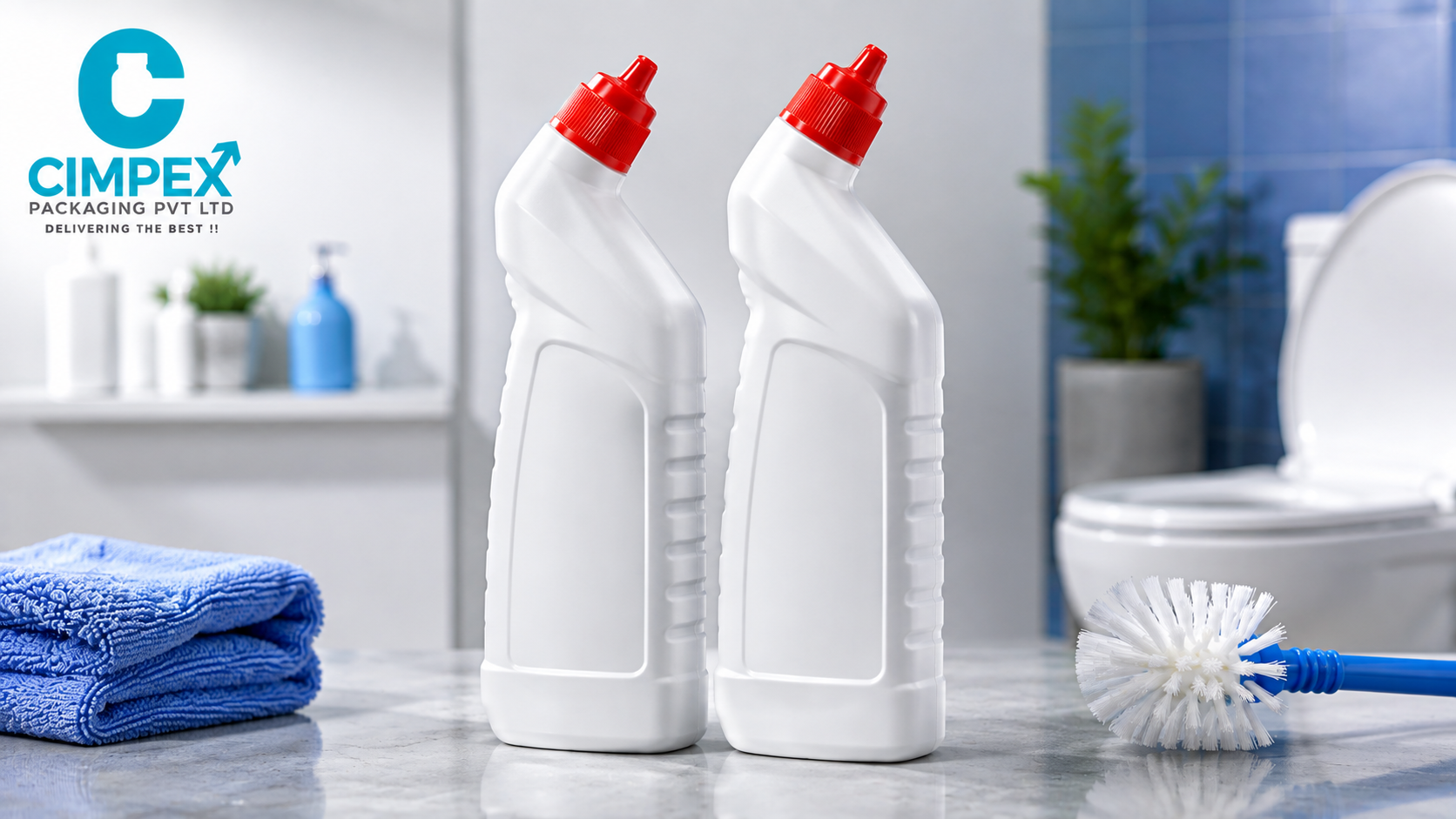
Toilet cleaner is one of the harshest fills a plastic bottle ever has to hold concentrated hydrochloric or phosphoric acid formulations will find any weakness in resin quality or wall thickness within weeks, not years. A toilet cleaner bottle manufacturer that treats this as a standard HDPE bottle project, rather than an acid-resistant engineering problem, is setting a brand up for leaks, cap failures, or worse, a product recall. This guide covers what actually goes into a reliable acid-resistant, bent-neck toilet cleaner bottle, and what to check before committing to a production run.
Cimpex Packaging manufactures toilet cleaner bottles in acid-resistant HDPE, moulded in-house in Baddi with the bent-neck geometry this category depends on for under-rim application.
Why Acid Resistance Is Non-Negotiable for This Category
Most toilet cleaner formulations sold in India are acid-based, commonly built around hydrochloric acid concentrations designed to cut through limescale and hard-water stains. A toilet cleaner bottle manufacturer has to account for:
- Stress-crack resistance acidic fills combined with mechanical stress from the bent neck can cause environmental stress cracking in poorly formulated HDPE.
- Chemical-grade resin, not commercial-grade standard HDPE grades used for water or FMCG bottles are not automatically suitable for concentrated acid contact.
- Cap and seal compatibility acid vapour can degrade certain gasket materials over time, so cap liner selection matters as much as the bottle resin.
- UV and long-shelf-life stability many toilet cleaner bottles sit on retail shelves under fluorescent or window light for months; resin additives need to hold up without embrittlement.
What Is a Bent-Neck Bottle, and Why Does This Category Use It?
The bent-neck (or angled-neck) design is close to a category standard for toilet cleaners, and it’s a functional choice, not a stylistic one. A toilet cleaner bottle manufacturer builds the angle into the mould so the product stream reaches under the toilet rim without the user having to tilt the bottle at an awkward angle themselves.
Design Considerations for a Bent Neck
- Angle degree typically 15–30 degrees from vertical, calibrated to reach under-rim surfaces comfortably from a standing pour position.
- Wall thickness at the bend the bent section is a stress point; thinner walls here are the most common failure location in poorly engineered moulds.
- Cap orifice size controls flow rate; too wide and the product runs off target, too narrow and the user squeezes harder, increasing splash risk.
How Does a Toilet Cleaner Bottle Manufacturer Test for Acid Resistance?
This is worth asking directly before placing an order, because visual inspection alone won’t catch a resin or wall-thickness problem that only shows up after weeks of acid contact.
- Extended fill trials bottles filled with the actual target formulation and stored at room and elevated temperature for several weeks, checked for embrittlement or discolouration.
- Stress-crack testing filled bottles placed under mechanical load (stacking pressure, drop testing) to confirm the resin doesn’t crack under combined chemical and physical stress.
- Cap-seal degradation checks liners and gaskets inspected after extended acid vapour exposure, not just a fresh-fill leak test.
- Wall-thickness verification at the bend the angled neck section specifically checked against drawing tolerance, since this is where thinning is most likely during moulding.
Standard Capacity: Why 500 ml Dominates This Category
Most retail toilet cleaner bottles in India sit around the 500 ml mark, balancing a few practical factors a toilet cleaner bottle manufacturer has to weigh:
- Shelf presence large enough to look substantial next to competing brands without excessive material cost.
- Handling ergonomics filled weight stays manageable for one-handed pouring at an angle.
- Retail price positioning 500 ml sits in a familiar price bracket for the category across mass-market and premium tiers.
Smaller 250 ml formats exist for travel or trial sizes, and bulk institutional formats above 1 L are available where volume justifies custom tooling.
Wall Thickness and Resin Grade Specifications
- Wall thickness: Typically 0.8 mm–1.1 mm depending on bottle height and bend severity thicker than a comparable water bottle to handle acid stress.
- Resin grade: Chemical-grade HDPE with stress-crack-resistant additives, distinct from food-grade or commercial-grade resin used elsewhere in the HDPE & PP bottles
- Cap material: PP is common for the cap itself, chosen for better chemical compatibility with acidic vapour than some alternative resins.
- Colour and opacity: Most brands use pigmented, opaque HDPE both for shelf branding and to protect light-sensitive formulation components.
Comparing Toilet Cleaner Bottles to Other Chemical Packaging
Toilet cleaner bottles share some engineering DNA with other harsh-chemical formats, but they’re not identical. A sanitizer bottle manufacturer in India deals primarily with alcohol-based formulations, which stress plastic differently than acid does alcohol tends to attack certain plasticisers and can cause swelling in some resins, while acid attacks through stress-cracking and surface etching. A toilet cleaner bottle manufacturer needs resin and additive packages specifically validated against acid, not simply “chemical-resistant” in a general sense.
How Bent-Neck Bottles Are Moulded
Producing a bent-neck bottle is mechanically more demanding than a straight-neck format, which is part of why not every toilet cleaner bottle manufacturer handles it well. The angled section requires a mould design that manages resin flow around the bend without creating thin spots or weld lines where two flow fronts meet unevenly. During blow moulding, the parison has to be positioned and inflated so wall thickness stays consistent through the curve rather than thinning disproportionately at the outer radius of the bend the point under the most stress once the bottle is filled and squeezed repeatedly. A toilet cleaner bottle manufacturer with in-house tooling can adjust parison programming and cooling time specifically for the bend, rather than working around a generic straight-neck mould retrofitted with an angle.
Branding and Label Considerations for This Category
Toilet cleaner bottles compete on a crowded retail shelf where colour and cap design do a lot of the brand-recognition work. A toilet cleaner bottle manufacturer typically supports:
- Pigmented resin in-mould consistent colour that won’t scratch off or fade the way a painted finish might under repeated handling.
- Panel geometry for label adhesion flat or gently curved panels sized to standard label press formats, avoiding excessive curvature that causes labels to wrinkle.
- Embossed branding logo or texture moulded directly into the bottle surface, useful for tactile shelf differentiation without adding a label cost.
- Cap colour matching many brands use a contrasting cap colour against the bottle body for shelf visibility from a distance.
Regulatory and Safety Labelling Considerations
Because toilet cleaners are classified as hazardous household chemicals in most markets, a toilet cleaner bottle manufacturer should also be able to accommodate:
- Child-resistant closure options, where required by your target market’s regulations
- Sufficient panel space for mandatory hazard symbols, ingredient disclosure, and usage warnings
- Tamper-evident features, typically a break-away band on the cap that shows visibly if the bottle has been opened
These aren’t universally mandatory across every market, but a toilet cleaner bottle manufacturer that hasn’t handled hazardous-goods labelling requirements before is worth double-checking on this point specifically.
Quality Checklist Before You Commit to Production
- Confirm resin grade is validated specifically against your formulation’s acid concentration, not a generic chemical-resistant claim
- Request extended fill-trial data, not just a fresh-sample leak test
- Verify wall thickness at the bend point against engineering drawing, not just overall average thickness
- Check cap liner material compatibility with acid vapour exposure
- Confirm our moulding process includes in-house QC at each production stage, not just final inspection
- Test cap orifice flow rate against your target dispensing pattern
Engineered for the Job
A toilet cleaner bottle manufacturer that treats acid resistance as a formulation-specific engineering requirement not a generic HDPE claim is the one that keeps you out of a stress-crack recall six months post-launch. The bent-neck geometry, wall thickness at the bend, and resin additive package all have to be validated against your actual product, not assumed from a data sheet. If you’re specifying a new toilet cleaner format, request cleaner-bottle samples filled with your formulation before committing to full production tooling.
Frequently Asked Questions
Why do toilet cleaner bottles need acid-resistant HDPE?
Most toilet cleaners are acid-based formulations that can cause stress-cracking or embrittlement in standard commercial-grade resin over time.
What angle is standard for a bent-neck toilet cleaner bottle?
Typically 15–30 degrees from vertical, calibrated to direct the product stream under the toilet rim from a standing pour position.
What’s the standard capacity for toilet cleaner bottles in India?
500 ml is the most common retail size, balancing shelf presence, handling ergonomics, and category price positioning.
How thick should the walls be on an acid-resistant bottle?
Typically 0.8 mm–1.1 mm, with extra attention to the bent-neck section where thinning during moulding is most likely to occur.
Can a toilet cleaner bottle manufacturer test resistance against my specific formulation?
Yes reputable manufacturers run extended fill trials with your actual product rather than relying on generic chemical-resistance claims.
What cap material works best with acid-based toilet cleaners?
PP is commonly used for caps due to better chemical compatibility with acidic vapour compared to some alternative resins.
Is a toilet cleaner bottle manufacturer different from a sanitizer bottle manufacturer?
Yes acid and alcohol stress plastic differently, so resin and additive packages need to be validated against the specific chemical class, not treated as interchangeable.