


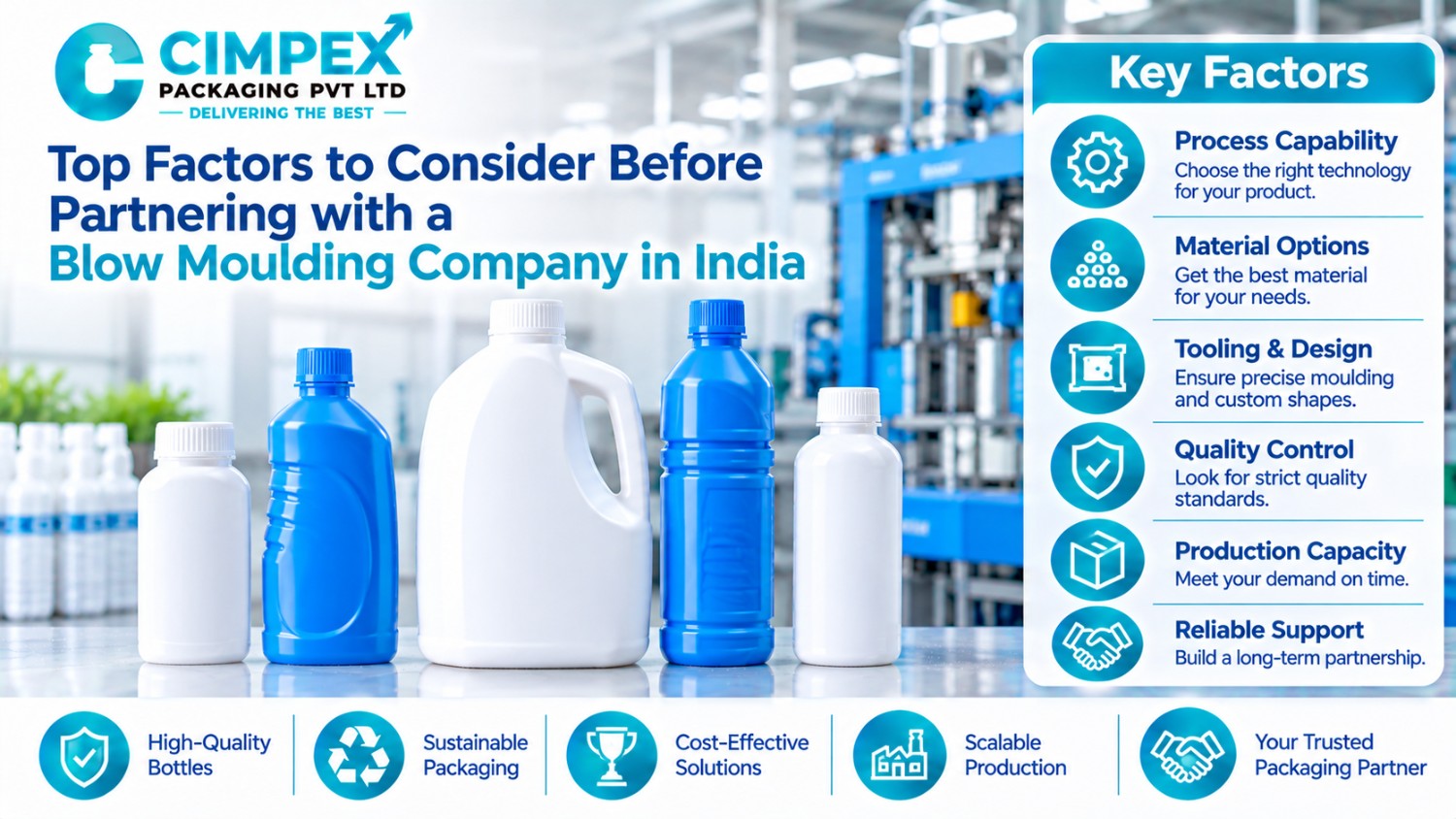
Start with Your Own Requirements Before Approaching a Blow Moulding Company in India
Before approaching any supplier, document what you need. Define the product that will go into the bottle, the volume range, the neck finish, the closure type, the material preferences and the regulatory environment. A pharmaceutical liquid, an agrochemical concentrate and a personal care product place very different demands on a container. A clear brief saves time on both sides. It also makes quotations comparable, since every blow moulding company in India you contact will be working from the same information. Vague enquiries tend to produce vague answers and unrealistic quotes.What Process Capability Should a Blow Moulding Company in India Offer?
Blow moulding is the process of forming hollow plastic parts by inflating a heated plastic tube or preform inside a mould. If you want a general technical background, this overview of blow moulding covers the main variants. The three processes most relevant to bottle buyers behave differently, and a good blow moulding company in India should explain which one suits your product.| Process | How it works | Typical strengths | Points to consider |
| Extrusion blow moulding | A hot tube of plastic is extruded and inflated inside a mould | Flexible shapes, handles, a wide range of sizes, commonly used with HDPE | Excess material (flash) must be trimmed, neck precision varies by setup |
| Injection blow moulding | A preform is injection moulded on a core and then blown | Precise neck finishes, no flash, suited to smaller bottles | Higher tooling cost, less suited to handles or large volumes |
| Injection stretch blow moulding | A preform is stretched and blown, giving biaxial orientation | Clarity and strength, widely used with PET | Preform and mould must be matched carefully |
Materials and Product Compatibility
The material determines how the bottle performs with your product. HDPE is widely used for its chemical resistance, toughness and moisture barrier. PP offers higher heat tolerance and is common in products that need hot filling or sterilisation. PET provides clarity and is common in beverages and some pharmaceutical liquids. Multilayer constructions can add barrier properties where oxygen, light or aggressive chemicals are a concern. When assessing a blow moulding plastic bottle manufacturer, ask how they select resin grades, whether they can document the source of each lot and what compatibility information they can share for your product category. Your own testing remains essential, since claims made by a supplier cannot replace stability and compatibility studies. Any blow moulding company in India you shortlist should be able to discuss these trade-offs openly.Questions to Ask About Materials
- Which resins can the plant process reliably, and can they use virgin resin only where required?
- Is the resin grade suitable for the product contact conditions of your industry?
- Does the supplier offer coloured, opaque or multilayer options if your product needs light or barrier protection?
- How are resin lots traced from receipt to finished bottle?
Tooling and Mould Design Capability
Moulds define the shape, weight distribution, neck finish and consistency of every bottle. A capable blow moulding company in India will review your design, advise on wall thickness, base design and parting lines, and suggest changes that improve strength or reduce weight without compromising performance. Ask who owns the moulds, where they are stored and how they are maintained, because these points are often overlooked until a dispute arises. If you are working with an HDPE bottle manufacturer in India, check whether tooling is made in-house or sourced from outside. In-house capability can shorten modification cycles, while outsourced tooling may add lead time and make troubleshooting slower. Neither approach is wrong, but you should know which one applies.Quality Systems and Process Control
Consistency is what separates a good blow moulding company in India from an average one. A single sample proves little. What matters is the ability to produce the same bottle in the thousandth lot as in the first. Look at the following signs of a disciplined blow moulding plastic bottle manufacturer.- Incoming material checks: Verification of resin and colour masterbatch before use
- In-process inspection: Regular checks of weight, dimensions, neck finish and visual defects during production
- Leak and fit testing: Confirmation that bottles and closures work together as intended
- Documented procedures: Clear records for batch identification, corrective action and change control
- Cleanliness controls: Controlled handling and packing, especially for pharmaceutical and food-related use
Customisation and Design Support
Many brands need more than a catalogue bottle. They need a particular shape, capacity, colour or neck finish that sets the product apart or fits an existing filling line. A custom plastic bottle manufacturer should be able to move from concept to sample in a clear, documented sequence: design review, mould development, sample approval and pilot run. Every blow moulding company in India handles custom projects differently, so ask to see examples of similar work. Be realistic about timelines. Custom tooling requires design, fabrication, trials and adjustments. Ask for a development schedule, and agree on what constitutes an approved sample before mould fabrication begins. Changes after approval cost both money and time.Pharmaceutical and Regulated Applications
If your bottles will hold medicines, the quality approach of your blow moulding company in India becomes even more important. A pharmaceutical bottle manufacturer should be comfortable with documentation requirements, traceability and change control, and should understand that pharmaceutical customers conduct audits and qualification exercises. Ask about material certificates, cleanliness controls during moulding and packing, and the way deviations are reported. Confirm what testing you are expected to carry out yourself and what information the supplier can provide to support your regulatory submissions. Requirements differ by country and product type, so involve your regulatory team early.Capacity, Lead Time and Supply Reliability
A blow moulding company in India may produce excellent samples but struggle to keep up with demand. Discuss realistic capacity, how production is scheduled and what happens if your volumes increase. It is reasonable to ask a plastic blow moulding manufacturer in India how many machines can run your bottle, whether mould capacity can be expanded and how the supplier handles peak seasons. Pay attention to the following practical points:- Lead time for first orders and for repeat orders
- Safety stock arrangements for critical items
- Packing methods that protect bottles in transit
- Transport options and delivery reliability to your fill-finish site
- Communication practices, including who to contact when something goes wrong
Sourcing Packaging in a Single Place
Many companies prefer to deal with a plastic packaging manufacturer in India that can supply bottles, caps, closures and related components together. Matching components from one source reduces the risk of neck finish mismatches and simplifies accountability. Ask whether your HDPE bottle manufacturer in India offers matching closures, tamper-evident options, pumps or measuring devices, and whether they can support printing or labelling needs. For bespoke packs, confirm with the custom plastic bottle manufacturer who owns the moulds and where they are stored. If the bottles will hold medicines, check whether the pharmaceutical bottle manufacturer can also supply matching tamper-evident caps and documentation. Single-source supply has a downside as well: it creates dependence. Consider qualifying a second source for critical items, or at least understand what would happen if your main supplier could not deliver for a period.Commercial Terms and Transparency
Price matters when comparing any plastic packaging manufacturer in India, but a low quotation can hide important gaps. Compare quotations on the same basis: material grade, weight, neck finish, packing method, tooling cost, mould ownership, minimum order quantities and payment terms. Clarify how price changes will be handled when raw material costs shift, and agree on how quality complaints and returns are managed. Look for a blow moulding company in India that answers questions directly, shares realistic timelines and flags risks early. Transparent communication during the sampling stage usually reflects how the relationship will work once production begins.Conclusion
The most reliable way to choose a blow moulding company in India is to judge it on process capability, material control, tooling expertise, quality systems and supply reliability, not on price alone. Define your requirements clearly, test samples under real conditions, visit the plant where possible and insist on documentation that supports traceability and change control. Taking these steps before you commit protects your product, your brand and your production schedule. A blow moulding plastic bottle manufacturer worth partnering with will welcome these questions. If you are planning a new bottle project or reviewing an existing supply arrangement, prepare a clear brief covering product, volume, neck finish, closure and material preferences, then compare each blow moulding company in India on the same basis. You can explore the bottle and closure range at Cimpex Packaging or contact the team for guidance based on your packaging requirements.Frequently Asked Questions
A blow moulding company in India manufactures hollow plastic products such as bottles, jars and containers by heating plastic and inflating it inside a mould. It typically offers design support, mould development, production, quality inspection and supply. Some also provide matching caps and closures for the bottles they make.
It depends on the product. Extrusion blow moulding suits many HDPE bottles and handled containers, injection blow moulding suits small bottles needing precise necks, and injection stretch blow moulding suits clear PET bottles. A good plastic blow moulding manufacturer in India recommends the process after reviewing your design and volume.
Check process capability, material traceability, tooling capability, quality control, capacity and communication. Request samples, visit the plant if possible, and ask about change control and documentation. Compare quotations on the same specification, including tooling ownership, minimum order quantities and lead times.
HDPE is tough, resistant to many chemicals and offers a good moisture barrier, which makes it suitable for pharmaceutical, chemical, personal care and food-related products. It is also well suited to extrusion blow moulding. You should still test compatibility with your own product before committing. An HDPE bottle manufacturer in India can usually advise on suitable grades and wall design.
Yes. A custom plastic bottle manufacturer can usually adapt shape, capacity, colour and neck finish. Custom work normally involves design review, mould fabrication, sample approval and a pilot run. Share your capacity, neck finish, closure type and filling line details early, and agree on a development schedule, because custom tooling takes time to build and validate.
Ask for material certificates, certificates of analysis, dimensional drawings, quality management details, change-control procedures and batch traceability records. For pharmaceutical use, also ask any pharmaceutical bottle manufacturer about cleanliness controls and how deviations are handled. Requirements vary by industry and market.
It can be. A single plastic packaging manufacturer in India makes neck finish matching and accountability simpler. The trade-off is dependence on one source, so many buyers qualify a backup supplier for critical items. The right approach depends on your risk tolerance and volume.