


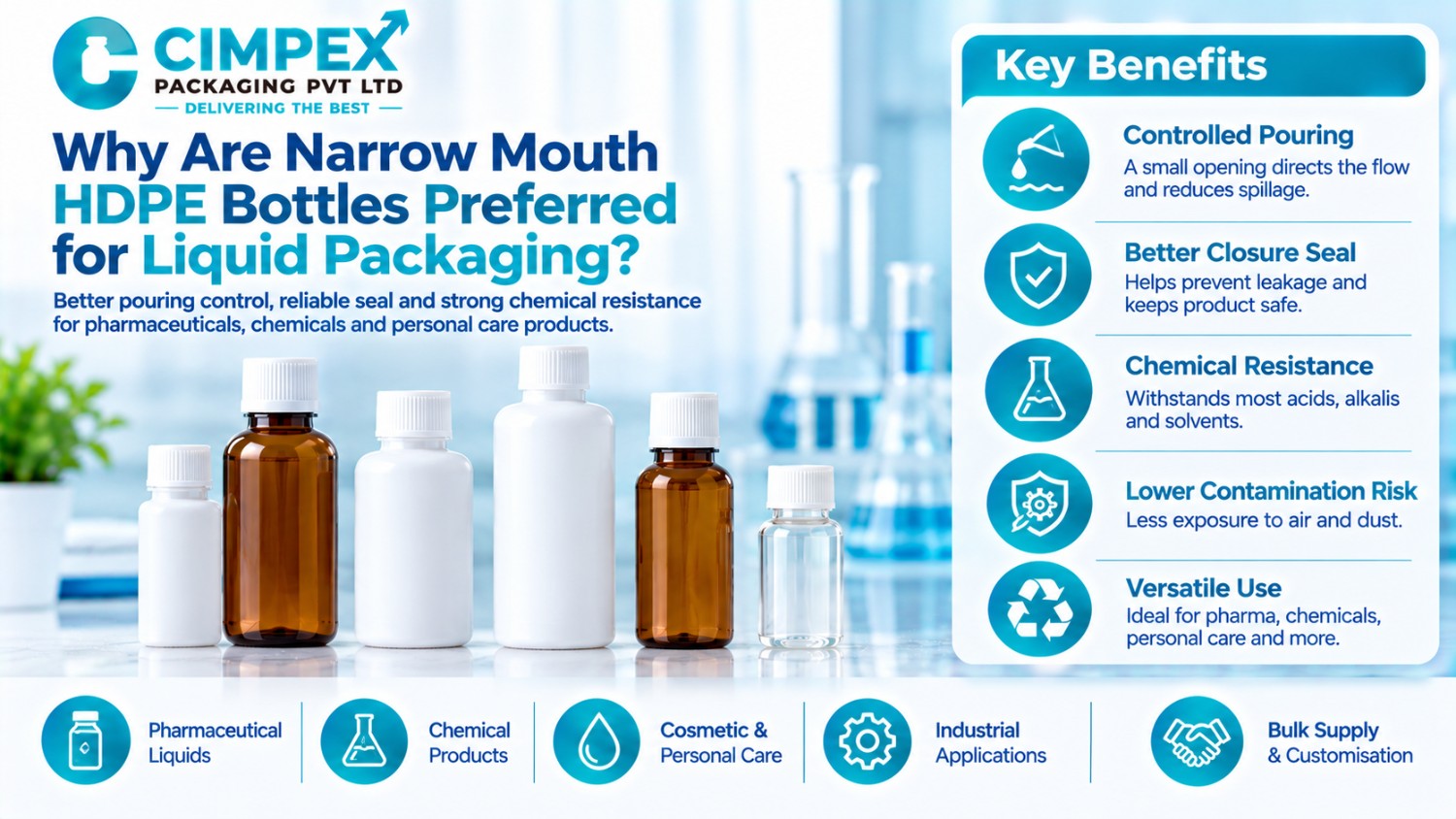
What Are Narrow Mouth HDPE Bottles?
A narrow mouth bottle has a neck opening that is small relative to the width of the body. The neck carries a thread, which accepts screw caps, dropper fittings, sprayers or pumps. High-density polyethylene, or HDPE, is a tough, lightweight plastic that is widely used for bottles because it resists moisture and many chemicals and is recyclable. HDPE typically has a density of 0.941 to 0.965 g/cm³, resists acids, alkalis, alcohols and most solvents, and is a recyclable material marked with resin identification code 2. Those properties explain why narrow mouth HDPE bottles appear across pharmaceuticals, chemicals, lubricants and personal care.Why Narrow Mouth HDPE Bottles Are Preferred for Liquids
Several practical advantages explain the preference, and they matter most when the product is thin and poured or dispensed repeatedly.Key Advantages
- Controlled pouring: a small opening directs the flow, which reduces splashing and waste, especially with syrups and concentrated liquids.
- Better closure seal: a smaller diameter is easier to seal and helps limit leakage during transport.
- Lower contamination risk: less open area means less dust, air and moisture entering the bottle.
- Reduced evaporation: volatile liquids such as alcohol-based products lose less to the air.
- Dispenser compatibility: the neck suits droppers, orifice reducers, pumps and sprayers.
Narrow Mouth HDPE Bottles for Liquid Packaging: Where They Work Best
Liquids differ in viscosity, volatility and chemistry, so no single bottle suits all of them. Narrow mouth HDPE bottles for liquid packaging perform best with free-flowing and moderately thick liquids such as syrups, solvents, cleaners, oils, shampoo and concentrates. Very thick pastes and powders are better served by wide mouth bottles or jars. Common applications include pharmaceuticals, agrochemicals, lubricants and automotive fluids, food and beverage, personal care and cosmetics, household and industrial chemicals, and veterinary products. HDPE bottles are commonly available from roughly 30 ml to 5 litres, and the wider plastic bottle range runs from 5 ml to 5 L.HDPE Bottles for Pharmaceutical Liquids
HDPE bottles for pharmaceutical liquids must satisfy stricter requirements than general-purpose bottles. The resin should be food-grade or pharma-grade, free from contaminants, and traceable. Cleanliness during moulding and packing matters, and the neck should match the closure so that tamper-evident or child-resistant caps seat correctly. Pharma bottles should be made under hygienic conditions and be compatible with child-resistant and tamper-evident closures. Eye drop bottles typically come in 5 ml, 10 ml, 15 ml and 20 ml sizes, alongside nasal spray and drop bottles. For regulated products, FDA’s draft guidance on container closure systems is a useful reference because it describes a risk-based approach to evaluating packaging. It is a draft and non-binding, so check current status with your regulatory adviser.Where Narrow Mouth Fits Pharma Packaging
HDPE bottles for pharmaceutical liquids in a narrow mouth format suit the following cases.- Oral liquids and syrups that are measured or poured
- Dropper bottles for oral, ear or eye products
- Nasal sprays and drop products with pump or dropper fittings
- Veterinary liquids and supplements
HDPE Bottles for Syrup and Medicine Packaging
HDPE bottles for syrup and medicine packaging are usually narrow necked, because the dose is poured into a cap or measuring cup. The smaller opening reduces drips down the side of the bottle, and the screw cap provides a firm seal between doses. HDPE also protects against moisture and is unlikely to shatter if dropped, which suits households and clinics. Light protection is a separate question. Natural or white HDPE offers some opacity, but sensitive formulations may need coloured or multilayer bottles. Discuss the product’s stability needs with the supplier before choosing colour.Plastic Bottles for Chemical Packaging
Plastic bottles for chemical packaging need to resist the liquids they hold, remain leak-free under handling, and withstand stress cracking. HDPE is widely used for agrochemicals, cleaning concentrates and industrial liquids. HDPE offers excellent resistance to acids, alkalis and alcohols, but for unusual chemicals the supplier should confirm compatibility before an order. Narrow necks help here too, because pouring concentrated chemicals from a small opening lowers spill risk. Compatibility still has to be tested. Surfactants, solvents, fragrances and dyes in a specific formulation can interact with plastic in ways a general chart will not predict.Narrow Neck Plastic Bottles for Liquid Products
Narrow neck plastic bottles for liquid products share the same logic as narrow mouth HDPE bottles but may use other materials, such as PP, PET or PETG, when clarity or different chemical behaviour is needed. HDPE remains the default for opaque, impact-resistant packs, while PET is common where transparency matters. Neck finish is the key specification. Industry-standard neck finishes allow you to choose caps and dispensers from different suppliers, which gives flexibility in sourcing. Ask for bottles that use industry-standard neck finishes so you are not locked into one cap supplier.Narrow Mouth vs Wide Mouth HDPE Bottles
Choosing between formats comes down to what is inside the bottle and how it is used. Narrow mouth HDPE bottles also run well on automated filling lines.| Factor | Narrow mouth bottle | Wide mouth bottle |
| Best suited for | Free-flowing liquids | Thick liquids, creams, powders |
| Pouring control | High | Lower |
| Closure and dispenser options | Droppers, pumps, sprayers, screw caps | Large screw caps, scoops |
| Filling and cleaning | Slower by hand, fine on filling lines | Easier by hand |
| Exposure to air | Lower | Higher |
Industrial Liquid Packaging Bottle Supplier: What to Look For
An industrial liquid packaging bottle supplier should be judged on consistency as much as on price. Uneven walls cause weak spots and weight variation, so ask about wall thickness checks. Bottles should also be tested for drop resistance, leak resistance, top-load strength and stress cracking.Supplier Questions Worth Asking
When shortlisting suppliers of narrow mouth HDPE bottles, put these questions in writing.- Which resin grade is used, and can material data sheets be shared?
- How are drop, leak and top-load tests performed?
- Is each batch documented so reorders match earlier supply?
- Do neck finishes follow industry standards?
- What are the MOQ, lead time and sampling terms?
Custom Narrow Mouth HDPE Bottle Manufacturer: Customisation and MOQ
A custom narrow mouth HDPE bottle manufacturer should be able to develop shape, colour and neck finish around your product. Standard MOQ often starts at around 5,000 units, custom moulds require higher quantities, and a custom mould typically takes three to four weeks from approved design to first sample. Also ask about quotation turnaround and sample availability before bulk orders.Customisation Options
- Custom mould development for unique shapes
- Pantone-matched colours
- Label-ready surfaces for screen printing, labels or shrink sleeves
- Neck finish matched to your closure
Common Mistakes to Avoid
Buyers new to narrow mouth HDPE bottles tend to repeat the same errors.- Skipping compatibility tests: a bottle that suits one chemical may fail with another.
- Choosing the wrong neck: confirm the thread against the cap or dispenser first.
- Ignoring light protection: some medicines and agrochemicals need coloured or multilayer bottles.
- Ordering a custom mould without samples: approve a sample before committing to volume.
Conclusion
Narrow mouth HDPE bottles earn their place in liquid packaging through controlled pouring, secure sealing, chemical resistance and compatibility with droppers, pumps and caps. The right choice depends on the liquid’s chemistry, the dispensing method and the regulatory context, so test samples, confirm neck finishes and review documentation before bulk ordering. If you are planning a liquid product launch, list your formulation, fill volume, closure type and order quantity before approaching suppliers. Plastic bottles for chemical packaging deserve the same scrutiny, and an industrial liquid packaging bottle supplier should welcome it. Then contact the Cimpex team for guidance on sizes, customisation and bulk supply.Frequently Asked Questions
Narrow mouth HDPE bottles give better pouring control, a more secure closure seal and less exposure to air and contamination. Combined with HDPE’s resistance to moisture and many chemicals, this makes them a practical choice for syrups, cleaners, lubricants, agrochemicals and pharmaceutical liquids.
Yes, when made from pharma-grade or food-grade HDPE and produced under hygienic conditions. HDPE bottles for syrup and medicine packaging should always be approved against your formulation. Look for FDA-compliant virgin resin for food and pharmaceutical applications. Always confirm the grade, documentation and compatibility with your specific formulation before approving a supplier.
HDPE resists most acids, alkalis, alcohols and common industrial solvents, so it suits many chemical products. For aggressive or unusual chemicals, share the formulation with the supplier and test samples to confirm compatibility, because surfactants and fragrances can affect plastic over time.
Narrow neck plastic bottles for liquid products range from small pharmaceutical bottles of a few millilitres to industrial bottles of several litres. HDPE bottles commonly cover roughly 30 ml to 5 litres, and the wider plastic bottle range runs from 5 ml to 5 L, with custom sizes available.
A standard MOQ often starts at around 5,000 units, with higher quantities for custom moulds. MOQs depend on bottle size, colour and whether the design is standard or custom, so request a written quotation for your exact specification.
A custom narrow mouth HDPE bottle manufacturer should state this clearly. A custom mould typically takes three to four weeks from approved design to first sample. Timelines vary with design complexity, so confirm the schedule in writing and plan sample approval before committing to production volume.
Yes. HDPE is recyclable and carries resin identification code 2. Using an HDPE closure with an HDPE bottle keeps the pack in a single material stream, though local collection and recycling systems determine what is actually recycled in practice.