


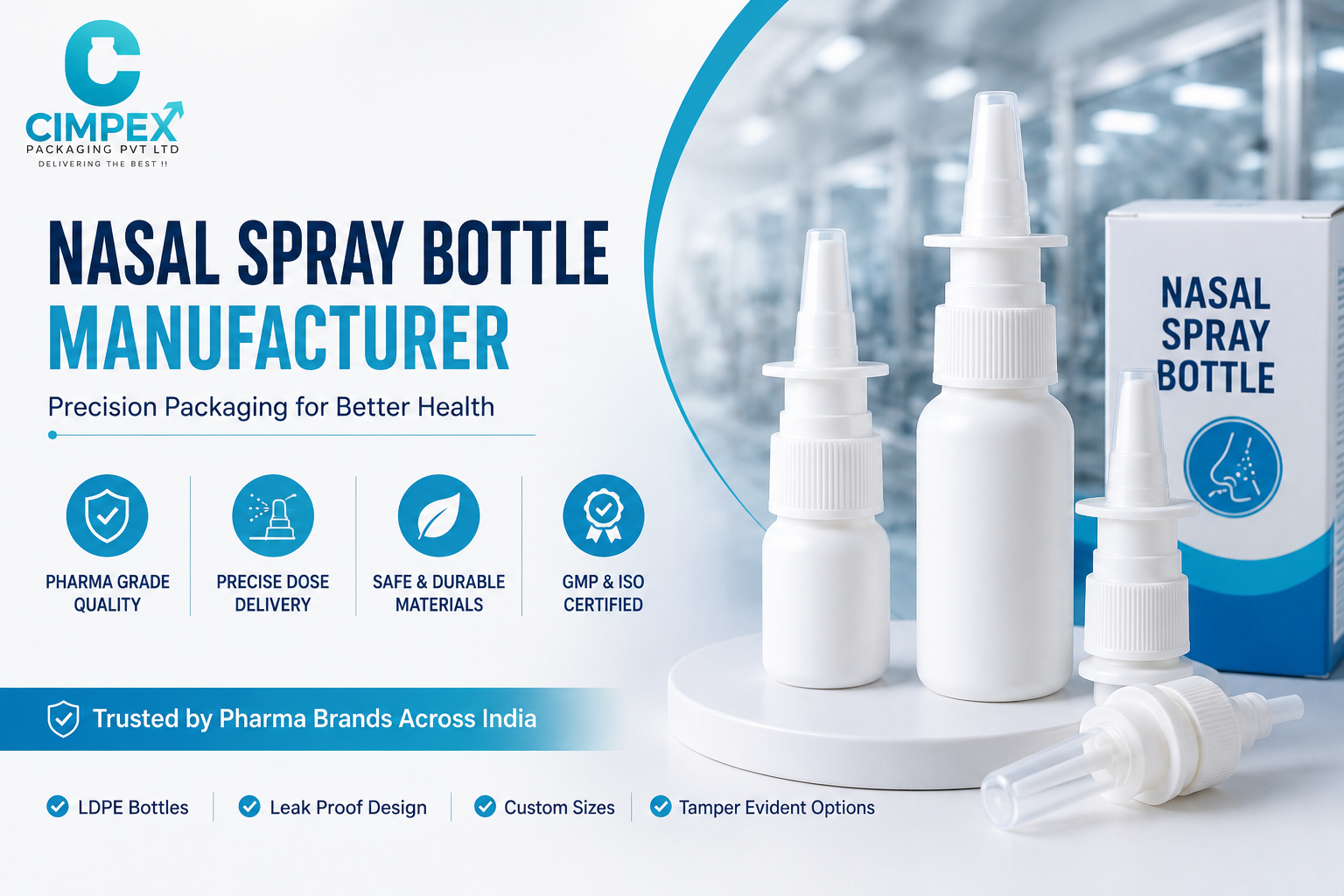
If you’re bringing a new nasal formulation to market, the nasal spray bottle manufacturer you choose will shape everything from dose accuracy to shelf life. Nasal packaging looks simple from the outside — a small bottle, a pump, an actuator — but the engineering underneath decides whether every spray delivers the same dose, whether the resin resists your formulation, and whether your product clears regulatory review without delay. This guide walks through the bottle types, pump mechanics, resins, and compliance checkpoints that separate a dependable nasal spray bottle manufacturer from one that will cost you a batch recall. Before we get into specs, it’s worth understanding what sits inside a typical nasal vials assembly and why each part matters on its own.
What Is a Nasal Spray Bottle System, Exactly?
A nasal spray bottle system is really three components working together: the bottle (reservoir), the pump (metering mechanism), and the actuator (the nozzle you press). Each part is manufactured and tested separately, then assembled and torque-tested as a unit. A capable nasal spray bottle manufacturer controls tolerances across all three, because a bottle neck that’s a fraction of a millimetre out of spec will cause a pump to seat loosely, leak, or under-dose.
Reservoir capacities for pharma nasal packaging typically run from 5 ml to 30 ml, with 10 ml, 15 ml, and 20 ml being the most common commercial sizes. Neck finishes are standardised — 18/415, 20/410, and 24/410 are the sizes you’ll see quoted most often, and they need to match your chosen pump’s collar exactly.
Common Types of Nasal Spray Bottles
Not every nasal application needs the same bottle. Here’s how the common nasal bottles formats break down:
- Standard metered-dose bottles: fixed-volume pump delivers a consistent spray per actuation, used for saline, decongestant, and steroid nasal sprays.
- Preservative-free / airless bottles: use a piston or bag-in-bottle mechanism so no air re-enters after each dose, extending shelf life without preservatives.
- Bidirectional / nasal-to-nasal delivery bottles: used for powder or specialised liquid formulations that need to reach further into the nasal cavity.
- Multi-dose vs. single-dose (unit-dose) bottles: multi-dose bottles serve 50–200 actuations; unit-dose vials are used for one-time or emergency-use products like naloxone sprays.
- Child-resistant nasal bottles: fitted with tamper-evident overcaps for OTC products sold without a prescription.
A pharma-focused nasal spray bottle manufacturer will usually stock several of these formats as standard tooling rather than building custom molds for every order, which keeps lead times and minimum order quantities manageable for mid-size brands. When you’re comparing quotes, ask each nasal spray bottle manufacturer which of these formats they run on existing tooling versus which would require a new mold — that single question often explains a big chunk of the price and lead-time difference between two otherwise similar bids.
It’s also worth asking how a manufacturer handles small-batch trial runs. A brand launching its first nasal product rarely wants to commit to a six-figure order before clinical or consumer feedback is in, so a nasal spray bottle manufacturer willing to run a pilot batch on existing tooling is often the more practical partner for a first launch, even if their large-volume pricing isn’t the very lowest on the table.
How Do Nasal Spray Pumps and Actuators Work?
The pump is the part that turns a squeeze or a press into a precisely metered spray, and it’s the component most likely to make or break your product’s performance. A typical pump draws liquid up a dip tube, compresses it through a spring-loaded piston, and forces it out through the actuator’s orifice at a set spray pattern and particle size.
Two variables matter most for formulation teams:
- Dose volume: usually 50–140 microlitres per actuation for nasal sprays, tightly controlled so every patient receives the labelled amount.
- Priming requirement: most pumps need 3–7 primes before first use and after periods of non-use, which should be reflected in your patient labelling.
Actuator design also determines spray pattern and plume geometry — a poorly designed actuator can produce a stream instead of a fine mist, which affects how well the drug deposits in the nasal cavity. Reputable pump and actuator suppliers will provide spray-pattern test data (plume geometry and droplet-size distribution) as part of their technical dossier, and you should ask for this before finalising your device.
Actuation force is another detail formulation teams overlook. Pediatric and geriatric products often need a lower actuation force than a standard adult decongestant spray, and a good nasal spray bottle manufacturer will offer spring options that adjust this without changing the dose volume. It’s a small mechanical change, but it can meaningfully affect patient compliance, particularly for chronic-use products like daily steroid nasal sprays.
Materials: Why LDPE, HDPE, and PP Matter
Resin selection isn’t cosmetic — it determines chemical compatibility, clarity, and barrier performance.
- LDPE (Low-Density Polyethylene): flexible, translucent, and the most common choice for squeezable nasal bottles because it tolerates repeated compression without cracking. Most LDPE nasal bottle supplier catalogues centre on this resin for exactly that reason.
- HDPE (High-Density Polyethylene): more rigid and offers a slightly better moisture barrier, often used where the bottle isn’t hand-squeezed but relies purely on the pump mechanism.
- PP (Polypropylene): chosen when higher heat resistance or a glossier finish is required, though it’s less common for the bottle body itself and more often used for caps and actuators.
All resins used for pharma contact should be certified to USP Class VI and tested for extractables and leachables, particularly if your formulation contains preservatives, alcohols, or essential oils that can interact with plastic over time. A dependable nasal spray bottle manufacturer India teams can rely on will share full material certificates and batch traceability documentation without being asked twice.
Colour and clarity also feed into resin choice. Clear or natural LDPE lets patients see remaining fill level, which matters for OTC products where consumers self-monitor usage, while an amber or opaque HDPE bottle is often specified when the active ingredient is light-sensitive. A nasal spray bottle manufacturer that stocks both natural and pigmented resin in-house can usually turn around colour changes faster than one that outsources compounding.
Dose Accuracy, GMP, and Regulatory Compliance
For any pharma nasal bottle manufacturer, compliance isn’t optional — it’s the baseline. At minimum, expect:
- GMP-compliant manufacturing environment with documented cleanroom classifications for filling-adjacent processes.
- ISO 9001:2015 certification covering the manufacturer’s quality management system.
- Batch-level dose-accuracy testing, typically reporting delivered-dose uniformity across a sample set of actuations.
- Material safety data and extractables/leachables reports available on request.
- CIB (Central Insecticides Board) or relevant regulatory clearances if the formulation crosses into agrochemical or biocide categories.
Ask any shortlisted nasal vial supplier India teams are considering for a certificate of analysis on a recent batch, not just a generic quality brochure. The difference between “we’re ISO certified” and “here’s the COA from last month’s run” tells you how mature their quality system really is.
Compliance also extends to how packaging is stored and handled before it reaches your filling line. A nasal spray bottle manufacturer should be able to describe their warehousing conditions, packaging-in-packaging protocols to prevent contamination in transit, and how they handle non-conforming units flagged during incoming inspection at your facility. These operational details rarely appear on a spec sheet but matter enormously once you’re running production at scale.
How to Choose the Right Nasal Spray Bottle Manufacturer
Selecting a nasal spray bottle manufacturer comes down to six practical checks rather than a long checklist of promises:
- Tooling ownership: do they own the molds for your bottle and neck size, or are they subcontracting? Owned tooling means faster changes and shorter lead times.
- Minimum order quantities: mid-size brands should look for MOQs that match a real launch batch, not a quantity designed for large pharma only.
- Pump compatibility: confirm the pump collar and bottle neck are tested together as an assembly, not sourced from two unrelated vendors and hoped to fit.
- Documentation depth: material certificates, dose-accuracy data, and stability-study support for your specific formulation.
- Location and logistics: a manufacturer based centrally in India, for instance, can often ship faster to both domestic pharma companies and export markets than one working through multiple intermediaries.
- Export experience: if you sell beyond India, ask whether the manufacturer has shipped nasal packaging internationally before and what documentation they prepare for customs and regulatory filings in destination markets.
We’ve also written a deeper breakdown of what separates the best nasal spray bottle manufacturer in India from the rest, including vendor red flags worth watching for during your evaluation.
Weighing these six points against price alone is where most sourcing teams go wrong. The cheapest quoted unit price from a nasal spray bottle manufacturer can quietly cost more once you factor in rework from ill-fitting pumps, delayed launches from undocumented tooling, or a failed stability study caused by an uncertified resin.
If you want a broader view of how nasal packaging fits into pharmaceutical bottle sourcing generally, our pharma bottle manufacturer guide covers material selection, compliance standards, and vendor evaluation across the wider bottle category, not just nasal formats.
Lead Times, MOQs, and Working With an Indian Manufacturer
Most brands sourcing from a nasal spray bottle manufacturer in India can expect lead times of four to eight weeks for standard tooling, extending to twelve or more weeks if a new mold is required. Domestic pharma companies typically see faster turnaround than export orders, simply because export shipments add customs documentation, freight booking, and destination-market labelling requirements on top of production time.
MOQs also vary widely by format. Standard multi-dose bottles on shared tooling can sometimes ship in quantities as low as 10,000–15,000 units, while unit-dose vials and custom colours tend to carry higher minimums because of the additional changeover time on the line. Building a realistic timeline with your chosen nasal spray bottle manufacturer well before your target launch date avoids the common trap of discovering a mold lead time only after your formulation is finalised.
Choosing Your Nasal Packaging Partner
Nasal packaging sits at the intersection of engineering and regulatory precision — a bottle that looks fine on a shelf can still under-dose a patient if the pump, neck finish, and resin weren’t engineered as one system. Cimpex Packaging manufactures nasal bottles, pumps, and actuators in-house at our Baddi, Himachal Pradesh facility, with owned tooling across standard neck sizes and batch-level documentation for pharma, nutraceutical, and FMCG brands. If you’re evaluating a nasal spray bottle manufacturer for an upcoming launch, we’d suggest starting with a technical conversation rather than a price list — the right conversation usually surfaces requirements a spec sheet alone won’t. You can request nasal-spray samples directly from our team to test fit, resin compatibility, and spray pattern before committing to a production run.
Frequently Asked Questions
What is the typical MOQ for a nasal spray bottle manufacturer in India?
MOQs vary by neck size and tooling ownership, but mid-size manufacturers commonly start around 25,000–50,000 units for standard formats, lower for stock designs.
Which neck size is most common for pharma nasal bottles?
18/415 and 20/410 are the most widely used neck finishes for 10 ml and 15 ml nasal spray bottles across pharma applications.
Can nasal spray bottles be made preservative-free?
Yes, airless or bag-in-bottle pump systems prevent air re-entry after each dose, which allows preservative-free formulations with extended shelf life.
How many primes does a nasal spray pump need before first use?
Most pumps require 3–7 priming actuations before first use and again after two or more weeks of non-use, per standard patient labelling.
What certifications should a pharma nasal bottle manufacturer hold?
Look for ISO 9001:2015, USP Class VI resin certification, GMP-aligned manufacturing, and documented extractables/leachables testing on request.
Is LDPE or HDPE better for nasal spray bottles?
LDPE suits squeezable, hand-compressed bottles; HDPE offers more rigidity and a marginally better moisture barrier for pump-only designs.
Do nasal spray bottle manufacturers provide dose-accuracy testing data?
Reputable manufacturers provide delivered-dose uniformity reports and spray-pattern data as part of standard technical documentation, not as a paid add-on.