


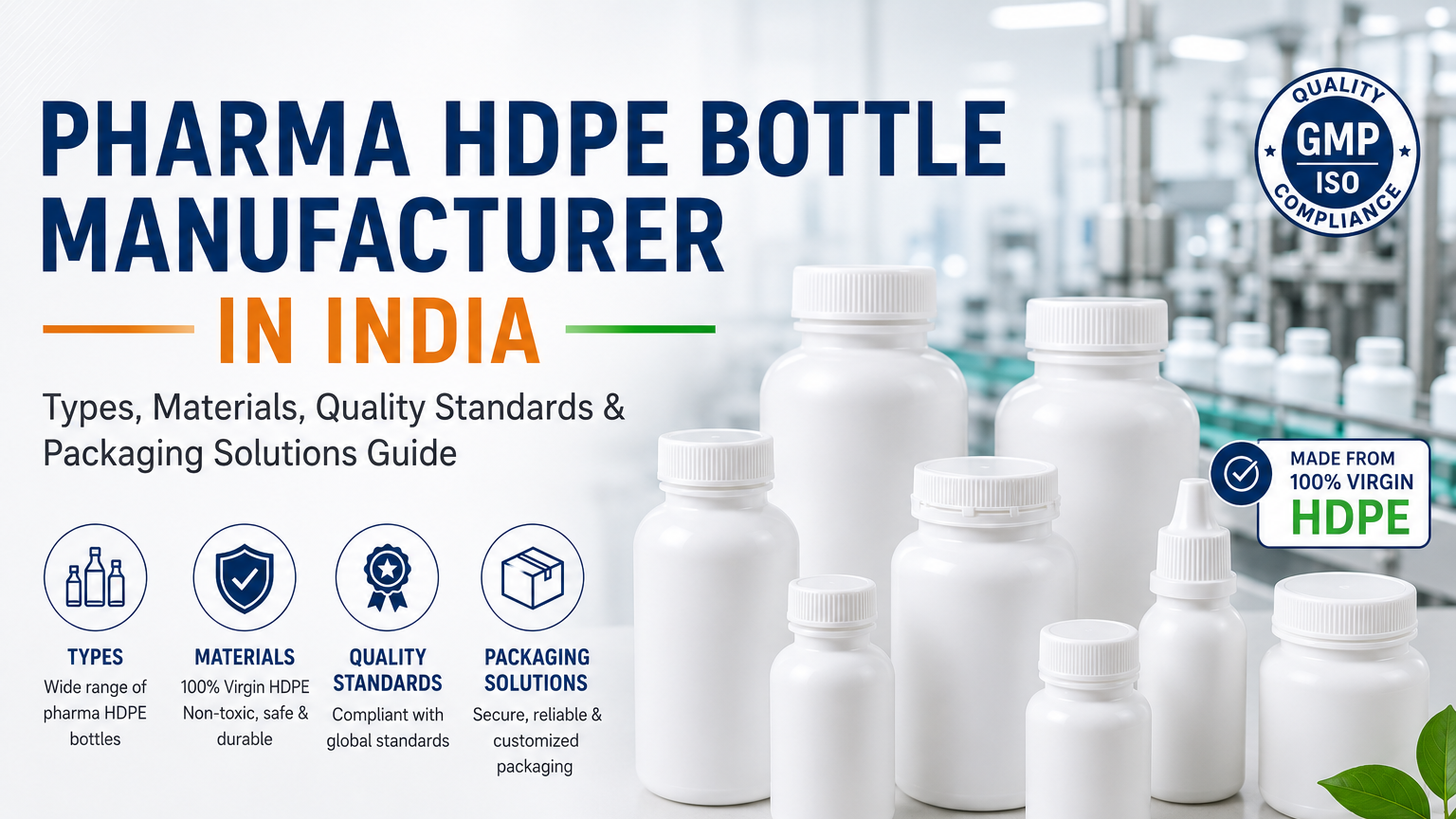
Choosing the right pharma bottle manufacturer in India is one of the most underrated decisions a healthcare or consumer brand makes. The bottle protects the product, carries the label, and quietly signals quality to every buyer who picks it up.
Packaging is no longer treated as an afterthought in the pharmaceutical and consumer goods world. A bottle has to survive transport, resist moisture and chemicals, keep its contents stable through a long shelf life, and meet regulatory expectations in every market it ships to. India has become a serious base for this work, supported by a large pharmaceutical sector, growing export demand, and a packaging industry that has invested heavily in modern molding and quality systems. For pharma companies, FMCG brands, nutraceutical players, and exporters, a dependable manufacturing partner is now a core part of getting a product to shelf safely and on time.
This guide walks through the bottle types, materials, manufacturing methods, and quality standards that matter when sourcing primary packaging, and what to look for before placing a bulk order. Wherever it helps, it points to the kind of capabilities a specialist supplier such as HDPE bottle manufacturer Cimpex Packaging brings to the table.
Overview: What Is a Pharma Bottle?
A pharma bottle is a primary packaging container designed to hold medicines, supplements, and health products in direct contact with the formulation. Because it touches the product, it must be made from approved, inert materials and built to tight tolerances so that closures seal reliably and contents stay protected.
Unlike ordinary containers, pharmaceutical bottles are engineered around the needs of the formulation inside them. A bottle for solid tablets has different requirements from one holding a light-sensitive syrup or a moisture-sensitive powder. The category covers a wide range of formats, and a capable manufacturer typically produces most of them in-house.
- Tablet and capsule containers with wide mouths and secure caps for solid dosage forms.
- Liquid and syrup bottles designed for accurate pouring and tight sealing.
- Dropper and eye-drop bottles for precise, sterile dispensing.
- Nasal spray and nasal vial bottles built for fine-mist or drop delivery.
- Nutraceutical jars for powders, gummies, and bulk supplements.
- Industrial and chemical bottles engineered for aggressive contents.
For solid dosage packaging in particular, a dedicated tablet container manufacturer can match the neck finish, wall thickness, and closure type to the exact product and filling line.
Why Quality Pharmaceutical Packaging Matters
The cost of poor packaging is rarely just the bottle. A weak seal, an off-spec neck, or a material that interacts with the formulation can compromise product stability, trigger recalls, or fail a regulatory audit. In regulated industries, packaging failures carry real financial and reputational weight.
Quality pharmaceutical packaging protects a product in four ways: it acts as a barrier against moisture, light, and air; it preserves the chemical stability and shelf life of the formulation; it prevents contamination and tampering; and it ensures accurate, safe dispensing for the end user.
Reliable packaging also smooths everything downstream. Consistent bottle dimensions keep high-speed filling lines running without jams. Compatible necks and caps reduce leak complaints. And documented compliance makes export clearance far less painful. This is why experienced buyers treat pharmaceutical packaging in India as a quality decision first and a price decision second.
Industries That Rely on These Bottles
While the word “pharma” sits in the name, the same containers serve a broad set of sectors, each with its own priorities.
- Pharmaceutical: tablets, capsules, syrups, eye drops, and nasal formulations that demand inert, compliant materials.
- FMCG: fast-moving household and personal-care products where appearance, cost, and supply speed matter.
- Nutraceutical: vitamins, protein powders, and gummies that need moisture protection and shelf appeal.
- Food and beverage: sauces, flavorings, and edible liquids requiring food-grade, leak-proof packaging, often using a multilayer bottle manufacturer for barrier performance.
- Cosmetics and personal care: lotions, serums, and creams that rely on attractive, functional cosmetic packaging containers with pumps and dispensers.
- Healthcare and hygiene: sanitizers, antiseptics, and medical liquids needing chemical resistance.
- Industrial and agrochemical: pesticides and chemicals where durability and safe handling are non-negotiable.
Because requirements vary so widely, the most useful suppliers offer a full catalogue of plastic packaging solutions rather than a narrow set of standard sizes.
Pharma Bottle Materials: HDPE, PET & PP
Most plastic pharma bottles are made from one of three polymers. Each behaves differently, and matching the material to the product is where good engineering starts.
HDPE (High-Density Polyethylene)
HDPE is the workhorse of pharmaceutical packaging. It is tough, lightweight, and offers an excellent moisture barrier, which makes it ideal for tablets, capsules, and moisture-sensitive products. Its strong chemical resistance also suits many liquids and industrial contents. Naturally translucent to opaque, it shields contents from some light and pairs well with desiccants. This is why a specialist pharma HDPE bottle supplier is often the first call for solid dosage packaging.
PET (Polyethylene Terephthalate)
PET is prized for clarity. Its glass-like transparency lets brands showcase syrups, oral liquids, and nutraceutical products, and it offers a good barrier to gases. Amber-tinted PET adds light protection for sensitive formulations. It is strong and shatter-resistant, though it tolerates less heat than PP, so it is not suited to hot-fill or autoclaving.
PP (Polypropylene)
PP stands out for heat resistance and rigidity. It can withstand higher temperatures, which makes it the material of choice for closures, caps, and containers that may face steam or hot filling. It also resists a wide range of chemicals and is common in jars and food containers.
| Material | Key Strengths | Moisture / Chemical Barrier | Common Applications |
|---|---|---|---|
| HDPE | Durable, excellent moisture barrier, light, opaque | Very high moisture barrier; strong chemical resistance | Tablet & capsule bottles, pharma liquids, chemical bottles |
| PET | Crystal-clear, shatter-resistant, good gas barrier | Good barrier; available in amber for light protection | Syrups, oral liquids, FMCG & nutraceutical packaging |
| PP | Heat-resistant, rigid, autoclavable | Strong chemical resistance; moderate moisture barrier | Caps & closures, jars, food & hot-fill containers |
Food safety is a shared requirement across all three: pharmaceutical and food-grade bottles should be produced from approved resins and run on lines that prevent cross-contamination, so the finished container is safe for direct product contact.
The Manufacturing Process
Bottle quality is decided on the shop floor long before the product reaches a filling line. Two molding methods dominate, each suited to different formats.
- Blow molding shapes hollow containers by inflating molten plastic inside a mold. It is the standard route for bottles and is valued for consistent wall thickness and high output.
- Injection molding forces molten plastic into precise molds and is used for caps, closures, and rigid components that need tight dimensional accuracy.
Modern facilities pair these processes with disciplined quality control at every stage. A robust pharmaceutical packaging products workflow typically includes:
- Raw material testing to confirm resin grade, purity, and suitability for pharma contact before production begins.
- In-process checks on weight, wall thickness, neck finish, and dimensions to keep bottles within tolerance.
- Leak testing to verify that bottles and closures seal correctly and protect contents in transit.
- Visual and functional inspection for clarity, color consistency, and defect-free surfaces.
This layered approach is what separates a consistent supplier from one that ships variable batches, and it directly affects how smoothly your filling and capping lines run.
Packaging Safety & Quality Standards
Regulated buyers do not just want a bottle that looks right; they want documented proof that it meets recognized standards. The most relevant benchmarks fall into a few groups.
- Food-grade compliance: resins and finished bottles that satisfy food-contact safety requirements for edible and ingestible products.
- Pharmaceutical compliance: production under Good Manufacturing Practice (GMP) conditions and the use of pharma-approved plastics. A GMP compliant bottle manufacturer documents process controls, hygiene, and traceability throughout.
- Material biocompatibility: plastics that meet stringent biological-reactivity classifications such as USP Class VI, the reference many buyers cite when they look for a USP-VI bottle manufacturer for sensitive applications.
- Export requirements: packaging and documentation aligned with destination-market rules so shipments clear customs without delay.
Tamper-Evident & Child-Resistant Features
Two safety features deserve special attention. Tamper-evident packaging, such as induction seals and shrink bands, gives consumers visible assurance that a product has not been opened. Child-resistant closures, like push-and-turn caps, protect children from accidental ingestion and are mandatory for many medicines and hazardous products. A capable supplier offers a range of caps and closures that build these protections in without slowing the filling line.
Customization Options
Off-the-shelf bottles rarely fit a brand perfectly. The value of a strong manufacturing partner shows in how far they can tailor a container to a specific product, line, and brand identity.
- Size and volume: custom capacities matched to dose, fill volume, and shelf space.
- Color: tints for brand consistency or functional light protection, including amber and opaque white.
- Branding: embossing, logos, and finishes that lift shelf presence and recognition.
- Label compatibility: smooth, correctly contoured surfaces designed for clean label application.
- Cap and closure options: CRC caps, flip-tops, droppers, pumps, and induction-seal-ready necks.
When these elements are engineered together rather than bolted on afterward, the result is packaging that performs on the line, protects in the field, and looks the part on the shelf.
Benefits of Choosing an Indian Manufacturer
Sourcing primary packaging from India has become a strategic advantage for both domestic brands and international buyers.
- Cost efficiency: competitive pricing driven by lower production costs without compromising on approved materials.
- Bulk supply capacity: high-volume facilities that handle large orders while holding quality steady.
- Export support: familiarity with international standards and documentation for smoother global shipments.
- Faster production: mature molding capacity and local supply chains that shorten lead times.
- Proximity to pharma clusters: manufacturing hubs that sit close to major drug-making regions, reducing logistics friction.
For brands that need both scale and reliability, partnering with an established pharma bottle manufacturer turns packaging from a bottleneck into a dependable part of the supply chain.
Sustainable Packaging Trends
Sustainability has moved from a talking point to a purchasing criterion. Buyers increasingly ask suppliers how their packaging reduces environmental impact, and the industry has responded on several fronts.
- Recyclable plastics: HDPE and PET are both widely recyclable, supporting circular-economy goals when collected properly.
- Reduced material usage: lightweighting designs that use less resin per bottle while keeping strength intact.
- Eco-conscious design: simplified, mono-material constructions that are easier to recycle and process.
For a deeper comparison of two of the most common pharma materials, the breakdown of HDPE versus PET bottles is a useful reference when balancing performance against sustainability goals.
Need reliable bulk packaging for your brand?
From tablet containers to dropper bottles and custom closures, Cimpex Packaging supports pharma, FMCG, nutraceutical, and cosmetic brands with quality-focused, made-to-order solutions.
Conclusion
Primary packaging is too important to leave to chance. The right bottle protects your formulation, keeps your filling line moving, and carries your brand into the buyer’s hands intact. Getting that right starts with selecting a capable pharma bottle manufacturer in India whose materials, molding, and quality systems match the demands of your product and your target markets.
As a trusted name in pharmaceutical packaging in India, Cimpex Packaging combines disciplined production with deep customization, serving as a GMP compliant bottle manufacturer, a dependable pharma HDPE bottle supplier, and a quality-focused USP-VI bottle manufacturer for sensitive applications. The result is durable, compliant packaging built around your formulation rather than forced to fit it.
If you are planning a new product, switching suppliers, or scaling up volumes, now is the time to talk specifications. Reach out to Cimpex Packaging to discuss custom sizes, closures, and bulk packaging solutions for your brand.
Frequently Asked Questions
What is the best material for pharmaceutical bottles?
It depends on the product. HDPE is preferred for tablets, capsules, and moisture-sensitive items thanks to its strong moisture barrier. PET suits syrups and liquids where clarity matters, while PP is ideal for caps and heat-resistant containers. A good manufacturer recommends the right material per formulation.
What does a GMP compliant bottle manufacturer mean?
A GMP compliant bottle manufacturer produces packaging under Good Manufacturing Practice conditions, with documented hygiene, process control, and traceability. This ensures bottles are made consistently, from approved materials, in a controlled environment, which is essential for pharmaceutical and healthcare products.
Why is HDPE used for pharma bottles?
HDPE offers an excellent moisture barrier, strong chemical resistance, and high durability while remaining lightweight. Its opaque-to-translucent nature also shields contents from some light. These properties make it the most common choice for tablet, capsule, and many liquid pharma applications.
What is a USP-VI bottle manufacturer?
USP Class VI is one of the most stringent biological-reactivity classifications for plastics used in medical and pharmaceutical contact. A USP-VI bottle manufacturer uses materials that meet this standard, providing added assurance of low toxicity and biocompatibility for sensitive formulations.
What is the difference between blow molding and injection molding?
Blow molding shapes hollow containers like bottles by inflating molten plastic inside a mold, giving consistent walls and high output. Injection molding forces plastic into precise molds and is used for caps, closures, and rigid parts that need tight dimensional accuracy.
How do manufacturers ensure pharma bottles are leak-proof?
Leak resistance is verified through dedicated leak testing, plus in-process checks on neck finish, wall thickness, and closure fit. Matching the bottle to a compatible cap and seal is critical, which is why quality suppliers test bottle-and-closure systems together rather than in isolation.
Are these bottles suitable for food-grade and nutraceutical products?
Yes. When produced from approved, food-grade resins on contamination-controlled lines, HDPE, PET, and PP bottles are safe for direct contact with edible and ingestible products. This makes them suitable for nutraceuticals, supplements, food liquids, and beverages.
Can I get custom sizes, colors, and closures for bulk orders?
Absolutely. A capable manufacturer offers custom volumes, colors such as amber or opaque white, branding options, and a full range of caps including child-resistant and tamper-evident closures. Bulk orders are produced to your exact specifications with consistent quality.
Why source pharma packaging from a manufacturer in India?
India offers cost-efficient production, high-volume capacity, faster lead times, and growing export expertise, supported by proximity to major pharma clusters. This combination lets brands secure compliant, quality packaging at competitive prices for both domestic and international markets.